
How to Become a Textile Engineer in the US

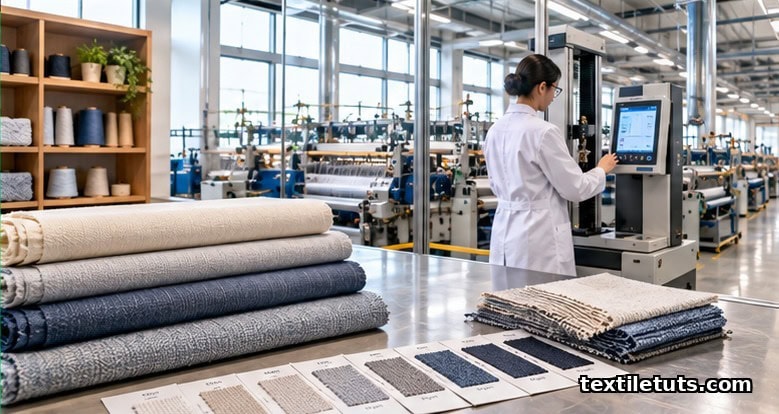
A textile engineer in the United States designs the fiber, yarn, and fabric production systems that supply a $70 billion domestic apparel and textile market, holds a bachelor’s degree in textile engineering or materials engineering from an ABET-accredited program, and earns a median annual wage of $100,780 according to the U.S. Bureau of Labor Statistics May 2024 data.
The single most important credential is the ABET-accredited bachelor’s degree, because U.S. engineering employers treat ABET accreditation as the baseline for entry-level textile and materials engineering positions, and the broader category the BLS tracks, materials engineers, is projected to grow 5 percent from 2023 to 2033.
This guide walks through the academic path, the technical knowledge that matters on the job, the standards employers test against, and the realistic salary and career outcomes for textile engineers working in the United States in 2026.
What Textile Engineers Actually Do Day to Day
Textile engineers translate fiber science into repeatable manufacturing processes. The job spans fiber selection (cotton, polyester, aramid, carbon, specialty cellulosics), yarn formation (ring, rotor, air-jet, friction spinning), fabric construction (weaving, knitting, nonwoven bonding), and wet processing (pretreatment, dyeing, printing, finishing).
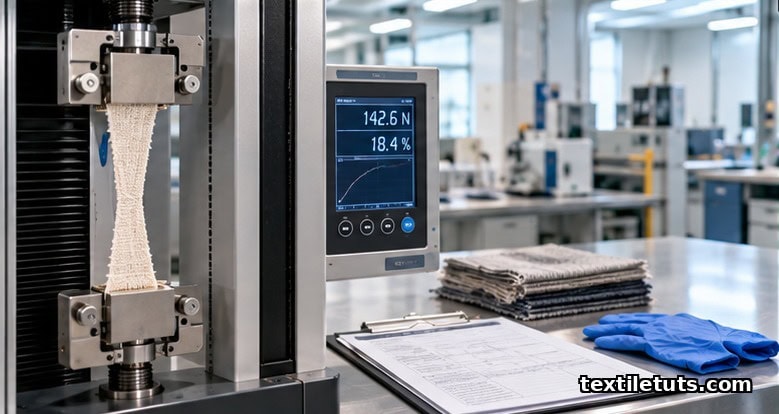
Day-to-day responsibilities include running tensile strength tests on new fabric lots (ASTM D5034 measures breaking strength and elongation), monitoring air permeability on finished goods (ASTM D737), troubleshooting dye-lot shade variation against AATCC gray scales, and writing process specifications that downstream garment factories follow. Engineers also pilot new machinery, validate supplier claims, and lead root-cause investigations when production runs go out of tolerance.
U.S.-based textile engineers work in three main settings: mills and dye-houses (textile manufacturing, NAICS 313), brand-owned product development labs (apparel, NAICS 315), and contract testing labs that certify fabric performance to retailer standards.
Education Pathways in the United States
The standard path is a four-year Bachelor of Science in Textile Engineering, Textile Chemistry, or Materials Science and Engineering. A handful of programs hold ABET accreditation specifically in textile engineering, and many more hold ABET accreditation in materials engineering with textile-relevant concentrations.
North Carolina State University operates the largest dedicated textile program in North America through the Wilson College of Textiles, offering BS, MS, and PhD degrees across Textile Engineering, Textile Technology, and Polymer and Color Chemistry. Thomas Jefferson University (formerly Philadelphia University) holds ABET accreditation for its Engineering program with textile and fashion concentrations. Georgia Institute of Technology’s Materials Science and Engineering program accepts textile-focused research and supplies graduates to technical-textile employers. Other institutions with textile or fiber science programs include Clemson University, University of Massachusetts Dartmouth, Kansas State University, Cornell University’s Department of Fiber Science and Apparel Design, and the Fashion Institute of Technology’s textile development and marketing track.
For applicants without a textile-specific bachelor’s degree, a related engineering degree plus textile-focused graduate study is a recognized alternative. A master’s degree (typically two years beyond the bachelor’s) is common for engineers moving into technical textile roles (ballistic, filtration, medical, geotextile). Doctoral study is required for corporate R&D leadership and academic research positions.
Co-op and internship experience matters. NCSU’s Textiles (TECS) and Engineering (E) co-op sequences place undergraduates in paid, full-time rotations with manufacturers such as Milliken & Company, VF Corporation, Elevate Textiles, and Patagonia, and the same employers recruit most U.S. textile engineering graduates.
Key Skills and Technical Knowledge
Strong textile engineers combine materials science, chemistry, mechanical engineering, and statistical process control. The technical baseline includes polymer and fiber chemistry (crystallinity, degree of polymerization, moisture regain), yarn formation mechanics (twist, hairiness, count systems Ne/Tex/Denier), fabric geometry (cover factor, GSM, stitch density), and wet processing fundamentals (dye-fiber affinity, fixation mechanisms, colorfastness requirements).
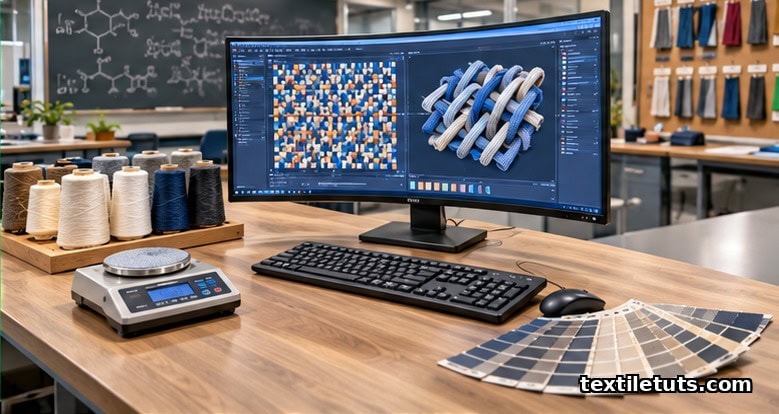
Beyond the core science, employers in 2026 expect working proficiency in: ASTM and AATCC test method selection and execution, ISO 17025 laboratory quality systems, statistical process control (SPC), root-cause analysis methods (8D, fishbone, 5-why), Lean and Six Sigma process improvement, and CAD for textile structures. Knowledge of textile-specific software (such as TexGen for yarn structure modeling, or Arahne for weave/knit simulation) is increasingly valued.
Communication matters as much as technical depth. Textile engineers write process specifications, present test results to non-technical brand managers, and coordinate with offshore manufacturing partners, so written and spoken English fluency is a hiring prerequisite in U.S. roles.
Accreditation and Standards That Matter
Three credential and standards bodies shape the work. ABET (formerly the Accreditation Board for Engineering and Technology) accredits engineering degree programs, and most U.S. engineering employers require an ABET-accredited degree for engineer-in-training and professional engineer progression.
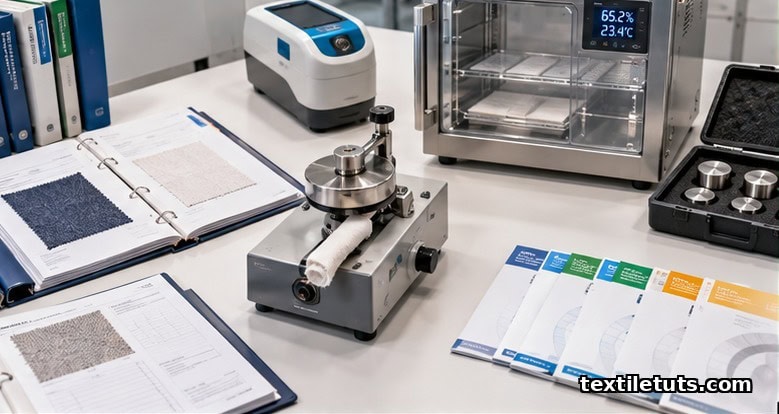
AATCC (American Association of Textile Chemists and Colorists) publishes the test methods U.S. textile labs use daily: TM 8 for colorfastness to crocking, TM 15 for colorfastness to perspiration, TM 61 for colorfastness to laundering, and TM 135 for dimensional changes after home laundering. ASTM International (formerly the American Society for Testing and Materials) supplies the broader textile standards library, including D5034 (breaking strength), D3776 (mass per unit area), D1424 (tearing strength by Elmendorf), D737 (air permeability), and D3512 (pilling resistance).
ISO standards apply to products sold internationally and to U.S. defense contracts: ISO 139 (standard atmospheres for conditioning), ISO 20645 (antibacterial activity), and ISO 6330 (domestic washing and drying procedures). The Textile Institute (textileinstitute.org) awards the professional credential CText (Certified Textile Technologist) and CText ATI (Associate of the Textile Institute), which carry weight in technical textile and defense procurement roles.
For state-regulated engineering work (civil consulting, some industrial facilities), engineers progress through Engineer-in-Training (EIT) and Professional Engineer (PE) licensure, administered state by state under the National Council of Examiners for Engineering and Surveying (NCEES). Textile manufacturing itself is not a licensed profession, so PE licensure is optional for most textile engineers.
Career Outlook and Salary
The BLS Occupational Employment and Wage Statistics survey does not publish a separate textile engineer category, but the closely related materials engineers category (SOC 17-2131) provides the clearest published benchmark. BLS reports a median annual wage of $100,780 in May 2024, with the lowest 10 percent earning $65,470 and the top 10 percent earning more than $167,560. The mean annual wage was $113,470. These figures reflect wages across materials engineering roles, including the textile, plastics, and composites subsectors.
Employment of materials engineers is projected to grow 5 percent from 2023 to 2033, faster than the average for all occupations, driven by demand for advanced materials in aerospace, defense, medical devices, and lightweight automotive components. The American textile industry’s traditional strengths (technical textiles, nonwovens, protective fabrics, filtration) align directly with these growth areas.
Entry-level textile engineers in U.S. manufacturing typically start between $65,000 and $75,000 per year, with senior process or quality engineers reaching $95,000 to $130,000 within eight to ten years. Technical textile specialists (ballistic, filtration, medical) and those in defense procurement often command the upper range. Compensation at branded apparel companies (Nike, Patagonia, VF Corporation, Hanesbrands) tends to sit at the higher end for similar roles because of location and corporate benefits packages.
The Textile Institute’s annual Career and Salary Survey, last published for 2024 data, similarly places U.S. textile technical staff with five to ten years of experience in the $80,000 to $110,000 band, consistent with BLS data.
Frequently Asked Questions
How long does it take to become a textile engineer in the US?
Four years for a Bachelor of Science in Textile Engineering or a related engineering field. Engineers who pursue the ABET-accredited master’s path add two more years. Most entry-level U.S. textile engineering hires enter the workforce four years after starting college, and textile engineering programs typically embed one or two required co-op semesters that delay graduation by six to twelve months but strengthen job placement.
Do you need a license to work as a textile engineer in the US?
No. Textile engineering is not a state-licensed profession in the United States. Engineers working in regulated industries (civil infrastructure, public utilities, some defense facilities) progress through the Engineer-in-Training (EIT) and Professional Engineer (PE) track administered by NCEES, but textile manufacturing itself does not require PE licensure.
Is textile engineering a good career in 2026?
Yes, particularly for engineers willing to specialize in technical textiles (filtration, medical, defense, geotextile, smart textiles). BLS projects 5 percent employment growth for materials engineers from 2023 to 2033, faster than the 4 percent average across all occupations, and demand for engineering talent in U.S.-based technical textile manufacturing remains steady even as commodity apparel production has moved overseas.
Can you become a textile engineer without an engineering degree?
Yes, in adjacent roles. Graduates with degrees in textile technology, textile chemistry, or fashion merchandising often move into textile engineering roles at the technician or specialist level, and a master’s degree in textile engineering can substitute for an undergraduate engineering background. However, engineer-in-training progression and most R&D positions require an ABET-accredited engineering bachelor’s degree as the entry credential.
What is the difference between textile engineering and textile technology?
Textile engineering programs, ABET-accredited, emphasize the math and physical sciences (calculus, differential equations, thermodynamics, polymer physics) and qualify graduates for engineer-in-training roles. Textile technology programs emphasize hands-on manufacturing processes, quality systems, and management, and qualify graduates for production, quality, and merchandising roles. Both paths lead to textile careers, but engineering degrees unlock the design, R&D, and licensure-track positions.
References
- U.S. Bureau of Labor Statistics. Occupational Employment and Wages, May 2024: 17-2131 Materials Engineers. https://www.bls.gov/oes/current/oes172131.htm — primary salary and wage distribution data for materials engineers in the United States.
- U.S. Bureau of Labor Statistics. Materials Engineers: Occupational Outlook Handbook. https://www.bls.gov/ooh/architecture-and-engineering/materials-engineers.htm — job outlook, education requirements, and 2023-2033 employment projection.
- ABET. Accredited Program Search. https://amspub.abet.org/ — searchable directory of ABET-accredited engineering programs in textile, materials, and related fields.
- North Carolina State University. Wilson College of Textiles — Textile Engineering Program. https://textiles.ncsu.edu/ — undergraduate and graduate program descriptions and co-op information.
- AATCC. Test Methods and Standards. https://www.aatcc.org/ — colorfastness, dimensional stability, and appearance test methods used by U.S. textile labs.
- ASTM International. Textile Standards. https://www.astm.org/products-services/standards-and-publications/standards/textile-standards.html — tensile, tear, air permeability, and mass per area test standards.
- The Textile Institute. Professional Qualifications. https://www.textileinstitute.org/ — CText and CText ATI professional credentials recognized internationally.
- ISO. ISO 139:2005 Textiles — Standard atmospheres for conditioning and testing. https://www.iso.org/standard/35179.html — international conditioning standard cited in defense and export testing protocols.
This article is the working reference for prospective textile engineering students and early-career engineers in the United States. Editorial by Iftay Khairul Alam, TextileTuts. Sources: U.S. Bureau of Labor Statistics (May 2024), ABET, AATCC, ASTM International, ISO, the Textile Institute, and the North Carolina State University Wilson College of Textiles, as cited.


