
Houndstooth Weaving

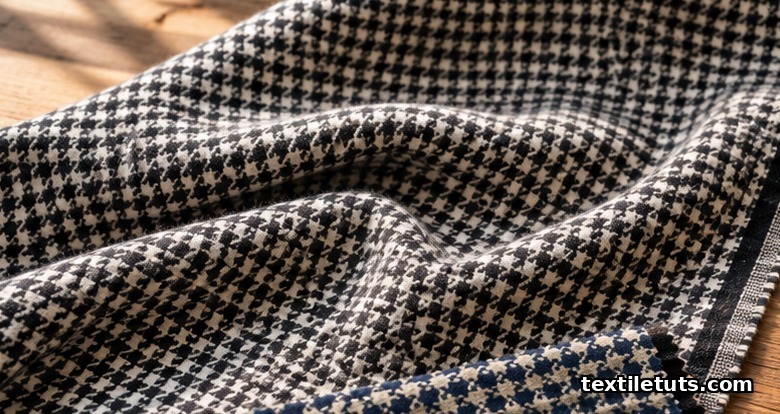
Houndstooth fabric is woven on a 2/2 twill base with two contrasting warp colors and two contrasting weft colors arranged in a 4 × 4 block repeat, producing the pattern’s characteristic four-pointed tooth motif that measures roughly 0.5 to 1.5 cm across in suiting-weight wool.
The pattern belongs to the color-and-weave family, meaning the motif emerges from how solid-colored yarns are sequenced in the loom draft rather than from any printed or embroidered surface decoration. The result is a structurally integral pattern that survives laundering, dry cleaning, and years of wear without fading in patches the way a print would.
This guide covers how houndstooth is constructed on the loom, the thread and color sequencing behind the tooth motif, the yarn and sett choices most mills use for suiting and outerwear, the colorfastness standards the woven fabric is tested against, and the practical questions weavers and buyers ask most often.
What Houndstooth Is (and What It Is Not)
Houndstooth is one member of a wider group called color-and-weave effects, where the weave plan interlocks two or more colors to create an optical pattern the eye reads as a third structure. The same loom and reed setup can produce houndstooth, glen plaid, Prince of Wales check, or shepherd’s check by changing only the color sequencing in the draft. Britannica classifies houndstooth as a “broken check” pattern, a duotone derivative of the twill weave that produces an abstract four-pointed shape rather than a clean square grid.
The motif is often confused with the smaller-scale dogtooth (also called puppytooth), which is technically the same color-and-weave arrangement scaled down to roughly half the tooth size. A 1 cm tooth versus a 0.5 cm tooth moves a fabric from houndstooth into dogtooth territory. Likewise, shepherd’s check uses the same 2/2 twill construction but reads as a softer, more check-like pattern because the dark and light blocks are arranged in plain stripes rather than staggered tooth blocks.
The Loom Construction of Houndstooth
Every houndstooth fabric is built on three coordinated decisions: the weave, the threading draft, and the color sequencing of warp and weft. Changing any one of those three variables changes the resulting motif.
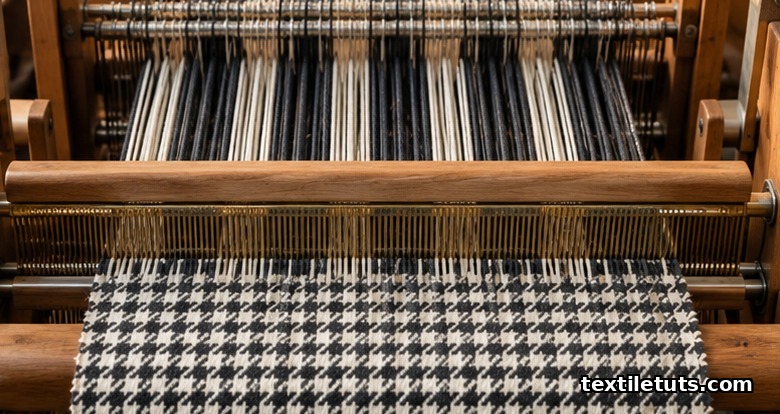
1. Weave structure. The base weave is a 2/2 twill. Each end floats over two picks and under two picks, and each pick floats over two ends and under two ends. Twill is chosen over plain weave because the diagonal float hides the seam where dark and light blocks meet, which sharpens the tooth outline.
2. Threading draft. The warp repeats a 2-dark, 2-light sequence across the full warp width. In a 4-end repeat, ends 1 and 2 carry color A (typically black or navy) and ends 3 and 4 carry color B (typically white or ecru). The repeat continues straight-draw on 4 shafts; a 4-shaft floor loom is the minimum hardware required.
3. Weft pick sequence. The weft mirrors the warp. Picks 1 and 2 carry color A, picks 3 and 4 carry color B, repeating across the full fabric length. Combined with the 2/2 twill lift plan, the dark warp floats across the light weft picks and vice versa, producing the four-pointed tooth at every 4 × 4 intersection.
The repeat unit (one complete tooth) therefore occupies 4 ends by 4 picks of the woven grid. Tooth size in the finished cloth equals 4 × warp spacing (warp crimp allowance included) in one direction, and 4 × pick spacing in the other. At a typical suiting sett of 16 ends per cm and 14 picks per cm, one tooth spans roughly 2.5 cm in warp and 2.8 cm in weft before finishing shrinkage.
Yarn, Sett, and Cover Factor for Houndstooth
Yarn choice controls both the hand (drape and softness) and the visual scale of the tooth. Worsted wool yarns from 2/48 Nm to 2/60 Nm are the standard for suiting because worsted spinning aligns fibers parallel, which sharpens the contrast edge between dark and light blocks. Woolen-spun yarns produce a softer, fuzzier tooth outline because the protruding fibers blur the boundary, a finish often preferred for heavier outerwear.
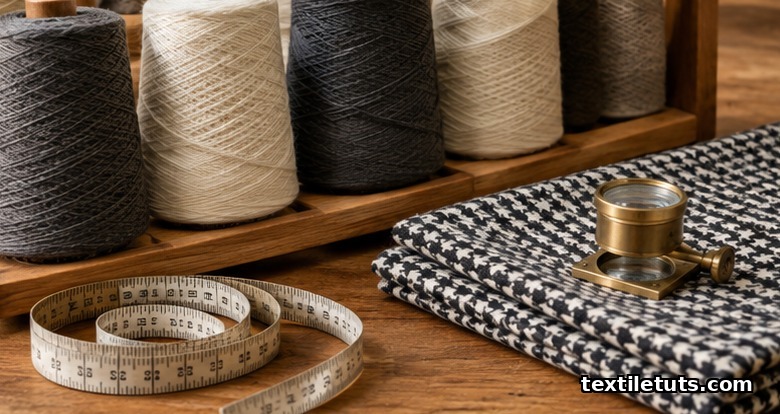
Typical sett numbers for wool houndstooth, taken from standard worsted weaving practice:
- Suiting (220 to 280 g/m²): 14 to 18 ends per cm, 12 to 16 picks per cm, 2/48 to 2/60 Nm worsted.
- Jacketing (280 to 380 g/m²): 10 to 14 ends per cm, 9 to 12 picks per cm, 2/30 to 2/40 Nm worsted or woolen.
- Coat weight (380 to 520 g/m²): 7 to 10 ends per cm, 6 to 9 picks per cm, single-ply Nm 8 to Nm 14 woolen.
Mass per unit area for woven textiles is reported under ASTM D3776 / D3776M-20, the standard test method used by most mills to quote fabric weight. Cover factor for houndstooth usually sits between 0.70 and 0.85, slightly lower than a comparable solid twill because the color boundary introduces an optical perception of openness even when the weave is tight.
Colorfastness Standards That Apply to Houndstooth
Because houndstooth is a duotone weave, color migration between adjacent dark and light yarns is the most common in-service failure. Mills test against the ISO 105 series for colorfastness and the AATCC test methods where North American buyers are involved.
| Standard | What it measures | Typical pass for houndstooth |
|---|---|---|
| ISO 105-C06:2010 | Color fastness to domestic and commercial laundering | Grade 4 to 5 at 40 °C |
| ISO 105-B02:2014 | Color fastness to artificial light (xenon arc) | Grade 5 or higher for wool suiting |
| ISO 105-X12:2016 | Color fastness to rubbing (crocking) | Dry grade 4 to 5, wet grade 3 to 4 |
| AATCC TM 8 | Colorfastness to crocking (US equivalent) | Dry 4.0, wet 3.0 minimum |
| ISO 139:2005 | Standard atmosphere for conditioning and testing | 20 °C and 65% RH |
| ASTM D3776/D3776M-20 | Mass per unit area (fabric weight) | Per buyer spec |
Wet rubbing is where poorly dyed dark yarns fail first because excess dyestuff sits on the fiber surface and transfers to the adjacent light yarns. Reactive dyes on cotton or wool, properly soaped after dyeing, are the standard fix; acid dyes on protein fibers perform similarly when post-dyeing washing is thorough.
Common Weaving Defects in Houndstooth
Three defects show up disproportionately in houndstooth production because the eye reads the pattern so readily. A single misplaced pick will break a tooth outline across the full fabric width.
- Broken tooth: One pick of the wrong color (a light pick where a dark pick belongs) produces a vertical white slash through the dark block. Caused by a weft color change error at the loom.
- Staggered tooth: The 4 × 4 grid appears to shift by one end or one pick, breaking the rhythm of the check. Caused by a draft setup error on a new warp.
- Floating yarn: A missed end lift leaves a long warp float that catches and snags. Caused by a harness or tie-up error.
Most mills run houndstooth at 5 to 10% lower loom speed than a plain solid twill because the pick-and-pick weft insertion (alternating two colors every two picks) leaves more time for color changes than a single-color weft.
Finishing Operations Specific to Houndstooth
Wool houndstooth for suiting goes through a standard worsted finishing sequence: scouring, crabbing (hot water setting), decating (controlled steam pressing), and pressing. Crabbing is the step most responsible for the clean tooth outline because it stabilizes the yarn twist and prevents the woven-in distortion from relaxing later in the garment. For cotton or viscose houndstooth, the sequence is desizing, scouring, bleaching if needed, mercerizing for cotton (which adds luster and sharpens the tooth edge), and sanforizing for dimensional stability.
Dimensional stability after five home launderings is reported under AATCC TM 135 or ISO 5077, both of which are commonly listed on houndstooth spec sheets for shirting and casualwear.
Modern Variants and Scale Choices
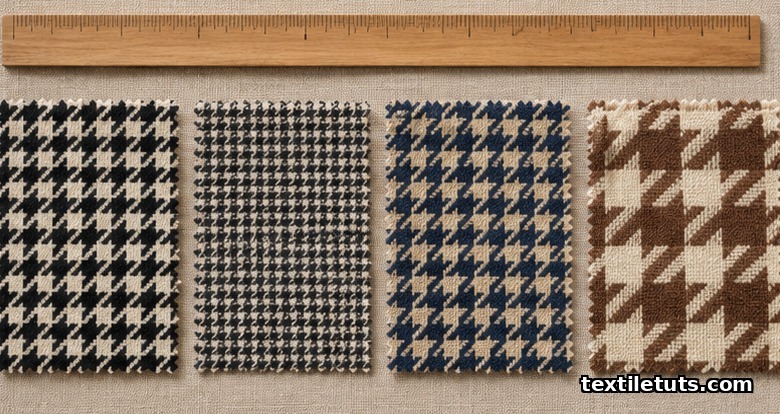
The classic houndstooth is black-and-white, but the same draft works in any two contrasting colors. Navy-and-ecru, charcoal-and-stone, and brown-and-cream are the common autumn/winter variants. Micro-houndstooth (also called jumbo dogtooth when the tooth is enlarged to 2 cm or more) is popular in outerwear because the larger scale reads from a distance and photographs well on camera. The same 4 × 4 draft produces all of these; only the yarn color and the picks-per-cm change.
Frequently Asked Questions
What is the difference between houndstooth and shepherd’s check?
Both patterns use a 2/2 twill base with two warp and two weft colors, but shepherd’s check arranges the colors in straight stripes of 4 or 8 ends rather than the 2-and-2 alternating block that produces the tooth. The result reads as a check rather than a broken check. Historically, shepherd’s check is also called “shepherd’s plaid” and predates the more sharply toothed houndstooth we know today.
Is houndstooth printed or woven?
The original and most durable houndstooth is woven on a loom using the color-and-weave technique described above. Printed houndstooth exists and is cheaper to produce, but the print sits on the yarn surface and fades with washing, while a woven houndstooth’s pattern is structurally integral and survives decades of wear. For suiting, outerwear, and heirloom garments, woven is the standard.
What yarn count is best for weaving houndstooth fabric?
For worsted wool suiting, 2/48 to 2/60 Nm yarns are the most common, woven at 14 to 18 ends per cm. For lighter weight shirting or summer suiting in cotton or linen, 2/80 to 2/100 Ne cotton or Nm 60/1 linen is typical at 20 to 24 ends per cm. The yarn count and the sett together determine the tooth size in the finished cloth.
How many shafts does a houndstooth loom need?
Four shafts is the minimum, because the threading draft repeats over four ends. Eight-shaft or twelve-shaft looms can also weave houndstooth, often with a more sophisticated lift plan that adds surface interest, but a basic four-shaft floor loom is the textbook starting point for learning the pattern.
Why does dark dye sometimes bleed onto the light blocks in houndstooth?
Bleeding happens when excess dyestuff remains on the fiber surface after dyeing. The light block sits right next to the dark block, so any loose dye migrates during washing or perspiration. Post-dyeing soaping at 90 °C or higher, followed by multiple rinses, removes the surface dye. ISO 105-C06 and ISO 105-X12 are the two test methods mills use to confirm bleeding is under control before shipment.
References
- British Standards Institution. ISO 105-B02:2014, Textiles — Tests for colour fastness — Part B02: Colour fastness to artificial light: Xenon arc fading lamp test. ISO. https://www.iso.org/standard/65216.html — Defines the xenon-arc lightfastness test used to rate houndstooth color stability.
- British Standards Institution. ISO 105-C06:2010, Textiles — Tests for colour fastness — Part C06: Colour fastness to domestic and commercial laundering. ISO. https://www.iso.org/standard/51276.html — The standard wash-fastness test applied to duotone weaves.
- American Association of Textile Chemists and Colorists. AATCC Test Method 8: Colorfastness to Crocking. AATCC. https://www.aatcc.org — North American equivalent to ISO 105-X12 for rub-fastness testing.
- ASTM International. ASTM D3776/D3776M-20, Standard Test Methods for Mass Per Unit Area (Weight) of Fabric. ASTM. https://www.astm.org/d3776_d3776m-20.html — The method used to quote houndstooth fabric weight in g/m².
- Encyclopædia Britannica. Houndstooth (textile pattern). Britannica. https://www.britannica.com — Historical and structural overview of houndstooth as a broken-check derivative of twill.
- British Standards Institution. ISO 7211-3:1984, Textiles — Woven fabrics — Construction — Methods of analysis — Part 3: Determination of number of threads per unit length. ISO. https://www.iso.org/standard/4971.html — Method for verifying the 4 × 4 thread repeat in houndstooth and similar color-and-weave cloths.
- Adanur, S. (2001). Handbook of Weaving. CRC Press. https://www.routledge.com/Handbook-of-Weaving/Adanur/p/book/9781587160134 — Reference text covering color-and-weave theory and the 2/2 twill base used in houndstooth.
This article is the working reference for houndstooth weaving construction, yarn choice, color sequencing, and applicable colorfastness standards. Editorial by Mohammad Yousuf (Anik), TextileTuts. Sources: ISO 105-B02, ISO 105-C06, AATCC TM 8, ASTM D3776/D3776M-20, ISO 7211-3, Britannica, and Adanur (2001) as cited.


