
Heat of Wetting (An Exceptional Property of Wool)

When wool gets wet, it actually generates heat—a phenomenon called the heat of wetting. Unlike synthetic fabrics that feel cold and clammy when damp, wool produces a distinctive warming sensation because its polar chemical structure releases thermal energy as water molecules bond to the fiber. Wool generates approximately 113 J/g of heat upon wetting—more than double the heat produced by cotton (46 J/g)—which is why wool garments provide immediate warmth even in damp conditions.
Heat of Wetting
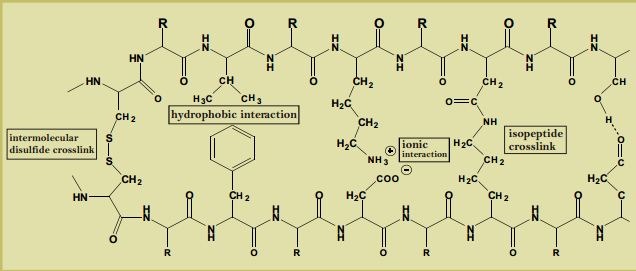
Wool fiber absorbs up to 30% of its dry weight in moisture without feeling wet or clammy. This phenomenon is called the heat of wetting. When wool makes contact with water, the polar groups along the polypeptide chain (primarily hydroxyl groups and amino acids) form hydrogen bonds with water molecules, releasing thermal energy in an exothermic reaction. The heat generated ranges from approximately 46 J/g for cotton to 113 J/g for wool, making wool one of the most exothermic fibers upon wetting.
Wool Fiber Structure
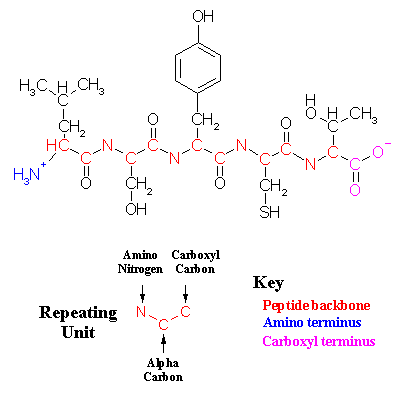
Wool is a natural protein fiber composed primarily of keratin, a structural polymer built from amino acids including cystine (16–18% by weight in typical Merino wool). The outermost layer of the wool fiber is the epicuticle, a hydrophobic membrane 3–6 nm thick that coats the fiber surface and provides chemical resistance. This epicuticle layer contains long-chain fatty acids (primarily 18-methyleicosanoic acid) that create a waxy, water-repellent surface, preventing complete penetration of liquid water while still allowing water vapor transmission.
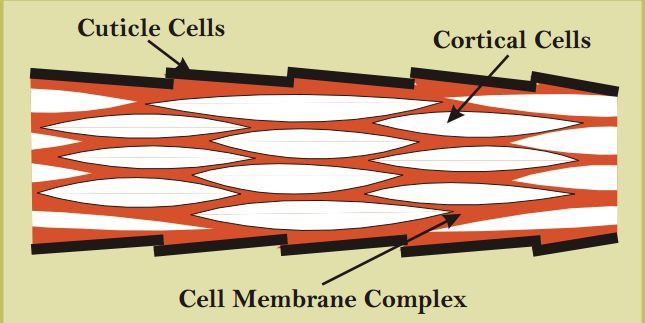
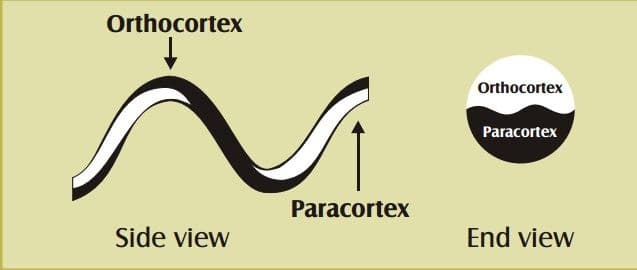
Beneath the epicuticle lies the cuticle layer, consisting of overlapping scale-like cells 0.3–0.5 µm thick that point toward the fiber tip. The cuticle is followed by the cortex, the bulk of the fiber interior, which comprises two distinct cell types: the orthocortex and the paracortex. The orthocortex is located on the outer side of the fiber’s natural crimp curve and contains more helical keratin structures, making it more elastic and flexible. The paracortex occupies the inner side of the crimp curve and has a higher concentration of cystine cross-links (disulfide bonds), providing greater stability and resistance to deformation.
The differential distribution and relative proportions of orthocortex and paracortex along the fiber’s cross-section produces the characteristic crimp wavelength of 18–36 µm in Merino wool. Crimp keeps fibers separated, preventing them from lying flat and maintaining millions of trapped air pockets within the fleece or yarn structure. These air pockets are critical insulators, reducing heat transfer and contributing to wool’s renowned thermal regulation properties.
Here are some images to illustrate the concept clearly—
Mechanism of Heat of Wetting in Wool
- When wool fiber contacts liquid water, water molecules penetrate the fiber’s porous epicuticle layer and reach the polar groups of the keratin polypeptide chain. Hydrogen bonds form between water molecules and hydrophilic sites on the protein matrix. This bond formation releases thermal energy at a rate of approximately 113 J/g for wool, significantly higher than cotton (46 J/g) or flax (55 J/g).
- The released heat becomes trapped within the microscopic air pockets maintained by fiber crimp. Air circulation within these pockets is severely restricted, preventing convective heat loss. This trapped thermal energy raises the temperature of the fiber-air system, creating the characteristic warm, dry feel of wool textiles against skin.
- The epicuticle membrane allows water vapor (but not liquid water) to pass through at a rate of approximately 15–25 g/m²/hr at 20°C and 65% relative humidity. Moisture vapor released from the fiber surface evaporates gradually into the surrounding air, producing a sustained cooling effect that prevents heat accumulation during active use.
- Under dry atmospheric conditions (below 65% relative humidity), the polar groups of the keratin chain release bound water molecules in an endothermic reaction, absorbing heat from the environment. Wool’s hygroscopic nature enables this reversible moisture exchange, maintaining a dynamic equilibrium that regulates temperature and humidity within the textile microclimate.
Heat of Wetting Values for Textile Fibers
The heat of wetting varies considerably across fiber types, reflecting differences in chemical composition, internal structure, and and the number of hydrophilic sites available for hydrogen bonding. The following values are expressed in Joules per gram (J/g) of dry fiber:
| Fiber | Heat of Wetting (J/g) | Moisture Regain at 20°C/65% RH (%) |
| Wool | 113 | 15–17 |
| Viscose (Rayon) | 106 | 11–13 |
| Silk | 69 | 9–11 |
| Flax | 55 | 8–10 |
| Cotton | 46 | 7–8.5 |
Wool’s superior heat of wetting (113 J/g) is a direct result of its highly polar side chains, extensive amorphous protein matrix, and the presence of hydrophilic groups in the keratin structure. Wool absorbs roughly double the moisture by weight compared to cotton before feeling damp, and it generates approximately 2.5× more thermal energy upon initial wetting.
Key Specifications: Wool Heat of Wetting at a Glance
| Property | Value |
| Heat of Wetting (Wool) | 113 J/g |
| Heat of Wetting (Cotton) | 46 J/g |
| Moisture Absorption Capacity | Up to 30% of dry weight |
| Moisture Vapor Transmission | 15–25 g/m²/hr |
| Crimp Wavelength (Merino) | 18–36 µm |
| Epicuticle Thickness | 3–6 nm |
| Cystine Content (Merino) | 16–18% by weight |
Wool absorbs moisture both from the body and the surrounding environment, creating a dry, warm microclimate next to the skin that remains thermally stable across a wide range of humidity levels.
Applications and Practical Significance
The heat of wetting property makes wool exceptionally suitable for cold-weather apparel, outdoor performance textiles, and next-to-skin garments. When a wool garment first contacts sweat or precipitation, the exothermic reaction provides an immediate warming sensation. During prolonged wear, wool’s high moisture vapor transmission rate (15–25 g/m²/hr) allows excess heat and moisture to escape before liquid water forms, preventing the clammy feeling associated with synthetic fibers.
Wool’s thermal regulation also plays a role in firefighting protective apparel, where the combination of low flammability (limiting oxygen access through char formation), moisture absorption, and heat of wetting provides critical thermal buffering. Wool chars at approximately 300°C rather than melting or dripping, and the heat absorbed during moisture desorption delays flame spread.
REFERENCES
- Cook, J. Gordon. Handbook of Textile Fibres: Volume I: Natural Fibres. Merrow Publishing, 1984.
- Nazirul Islam, M. E. Apparel Fibres.Bangladesh University of Engineering and Technology, 2014.
Images:
http://www.spletnik.ru/blogs/moda/46138_tkani_naturalnyenaturalnye


