
GSM Verification Process

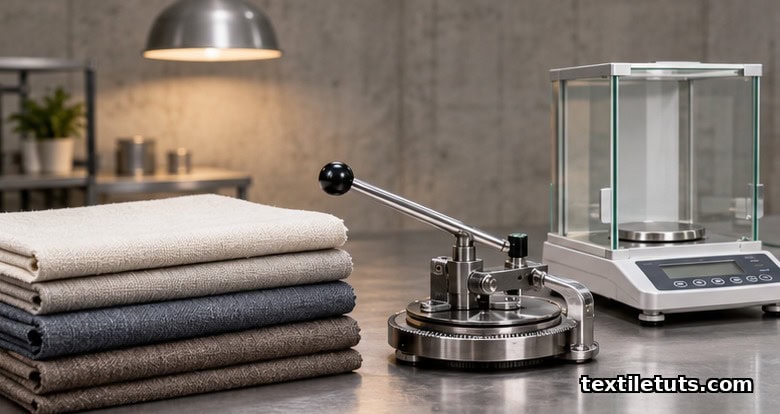
GSM verification measures fabric mass per unit area in grams per square meter using a calibrated circular cutter or GSM balance, with ISO 3801:1977 specifying a 100 cm² specimen and acceptance tolerances typically within ±2.5% for woven fabrics and ±5% for knitted fabrics.
Verification confirms that bulk production matches the approved lab dip or development sample, catching GSM drift before fabric is cut into garments.
This guide covers the equipment, conditioning, calculation, and tolerance rules that textile mills, buying houses, and QA labs use to verify GSM on the production floor.
What GSM Means in Textile Production
GSM (grams per square meter, also written g/m²) is the universal unit for fabric areal density. It tells a buyer, merchandiser, or technician how much a square meter of fabric weighs under standard conditions. The same metric is sometimes called “fabric weight” in casual conversation, but in any QA report or technical sheet, GSM is the agreed numerical expression.
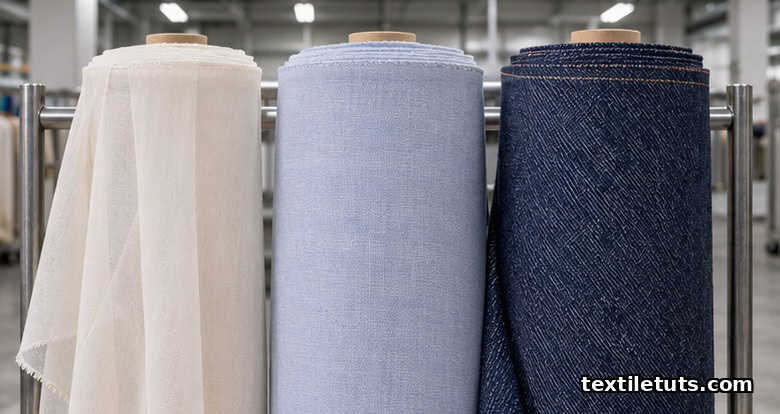
Knowing the GSM is essential because it drives downstream decisions:
- Marker planning and fabric consumption estimates.
- Knit panel stiffness and drape performance.
- Print and dye penetration behavior.
- Costing sheets and yarn consumption forecasts.
When the GSM of bulk rolls drifts away from the original approved sample, the same marker plan can consume 8–12% more fabric on a 5% GSM increase. For a 100,000-piece T-shirt order, that drift is the difference between profit and loss.
ISO 3801: The Reference Standard for Woven GSM
ISO 3801:1977, “Textiles, Woven fabrics, Determination of mass per unit length and mass per unit area,” is the original method most QA labs still follow for woven constructions. The standard defines four specimen sizes (the 100 cm² disc is the most common in commercial labs) and requires the sample to be conditioned in a standard atmosphere before weighing.
For knitted fabrics, ISO 3801 also applies, but most knit mills cross-reference ASTM D3776/D3776M-20, “Standard Test Methods for Mass Per Unit Area (Weight) of Fabric,” which covers knit, woven, and nonwoven fabrics in one method.
The companion conditioning standard is ISO 139:2005, “Textiles, Standard atmospheres for conditioning and testing,” which fixes the lab at 20 ± 2 °C and 65 ± 4% relative humidity. Reading the GSM off a sample that has not been conditioned is the single most common source of false rejections in third-party inspections.
Equipment Required for Verification
Two pieces of equipment dominate GSM verification in production labs.
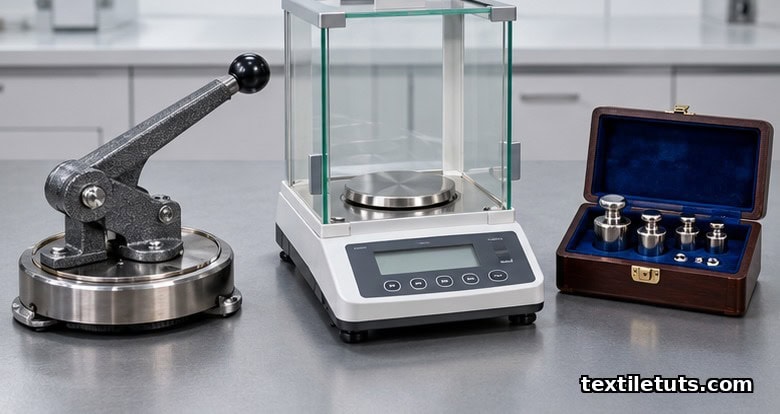
The circular cutter (sometimes called a GSM cutter or fabric sample cutter) is a sharpened circular die mounted on a lever. It cuts a sample of fixed area, traditionally 100 cm², from the fabric. The disc is then weighed on an analytical balance readable to 0.001 g. ISO 3801 acknowledges the cutter area as the practical default.
The GSM balance combines the cutter and the balance in one instrument. The operator places fabric under the cutter, presses the lever, and reads the GSM directly. Quality balances often use 100 cm² cutters and divide the measured mass by 0.01 m² to convert grams per 100 cm² to grams per square meter. Modern electronic balances handle the conversion internally.
Other items in a complete GSM verification setup:
- Analytical balance, readable to 0.001 g, calibrated against a Class 1 reference weight.
- Conditioning rack or standard atmosphere chamber per ISO 139.
- Sealed sample bags for transport from the line to the lab.
- Cutting mat and straight edge for non-cutter workflows (square-cut method).
Step-by-Step GSM Verification Procedure
The verification workflow is the same whether the test is run on a woven roll, a knit panel, or a finished garment.
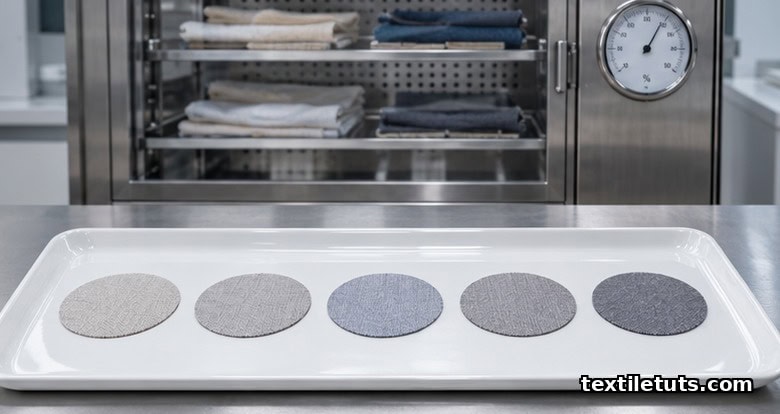
- Condition the sample. Lay the fabric loose on a conditioning rack for at least 24 hours in a 20 ± 2 °C, 65 ± 4% RH atmosphere (ISO 139).
- Select the test area. Avoid selvedges, holes, and obvious defects. ISO 3801 recommends five specimens per lot for woven fabrics, taken across the width to capture variability.
- Cut the specimen. Use the calibrated 100 cm² circular cutter or a square template of measured dimensions. For accuracy, verify the cutter’s cutting area annually against a reference steel rule; cutters wear and the actual area can creep above 100 cm².
- Weigh the specimen. Record the mass in grams to three decimal places on the analytical balance.
- Calculate GSM. For a 100 cm² cutter, GSM = mass (g) × 100. For a different area, GSM = mass (g) / area (m²).
- Average the readings. Report the mean of the five specimens and the coefficient of variation (CV%). For woven fabrics, CV should be below 3%; for knits, expect 4–6% on a uniform lot.
- Compare to the standard. Subtract the result from the buyer-approved target. A deviation within ±2.5% (woven) or ±5% (knit) is typical pass-band. Anything outside calls for a second test and a discussion with the mercerizer or knitting supervisor.
Common GSM Tolerances by Fabric Type
Different constructions tolerate different levels of variation. The numbers below are typical pass-bands in woven and knit buying contracts. Always defer to the buyer’s specification sheet, as some buyers tighten tolerance to ±2% on premium shirtings.
| Fabric Type | Typical Target GSM Range | Common Pass-Band |
|---|---|---|
| Combed cotton shirting (woven) | 110–140 | ±2.5% |
| Denim (3/1 twill, woven) | 280–420 | ±5% |
| Polyester chiffon (woven) | 60–90 | ±3% |
| Single jersey knit (cotton) | 140–180 | ±5% |
| 1×1 rib knit | 180–240 | ±5% |
| Fleece (3-thread, knit) | 280–360 | ±6% |
| Interlock knit | 200–260 | ±5% |
| Nonwoven (spunbond polypropylene) | 15–60 | ±8% |
The wider tolerance on knits reflects their elastic recovery. A single jersey can stretch during cutting, momentarily lowering its apparent mass until it relaxes on the conditioning rack.
Sources of Error in GSM Measurement
Five recurring mistakes account for most failed GSM checks that later turn out to be lab errors rather than production defects.
- Unconditioned sample. Fabric straight off the knitting machine can carry 8–12% moisture regain. Reading it immediately inflates GSM.
- Worn cutter. A circular cutter that has cut more than 5,000 samples may drift above its nominal 100 cm² area. Replace or re-calibrate annually.
- Balance drift. Analytical balances need daily verification with a Class 1 calibration weight. A 0.005 g drift is invisible on a 2 g sample, but it converts to 0.5 GSM error.
- Wrong sample zone. GSM varies across the width of a woven loom. Selvedge readings are not representative of the body.
- Residual finish chemicals. Some softeners are hygroscopic. Reading GSM immediately after finishing inflates the value. A re-scoured specimen is the corrective action.
Frequently Asked Questions
What GSM cutter size should I use for knit fabric?
The 100 cm² cutter is the standard for both knit and woven GSM verification under ISO 3801. Some knit mills prefer a larger 200 cm² or 500 cm² specimen to average out stitch-level variability, but the conversion math remains the same: divide the specimen mass in grams by its area in square meters.
How long should fabric be conditioned for GSM testing?
ISO 139 specifies a minimum of 24 hours in a 20 ± 2 °C, 65 ± 4% RH atmosphere until constant mass is reached. For most cotton and cotton-blend fabrics, 24 hours is enough. For high-synthetic-content knits with low moisture regain, 4 hours is sufficient because moisture exchange is faster.
Can I use a kitchen scale for GSM verification?
No. A kitchen scale readable to 1 g introduces ±1 GSM error on a 100 cm² sample, which alone exceeds the pass-band on a 40 GSM chiffon. GSM verification requires an analytical balance readable to 0.001 g, calibrated against a traceable reference weight.
Does GSM verification need an accredited lab?
For internal first-party checks, an in-house lab following ISO 3801 is sufficient. For buyer claims or third-party inspections, the lab should hold ISO/IEC 17025 accreditation, which proves traceability of the balance, the cutter, and the conditioning environment. Most buying contracts allow either, but require that the method be referenced in the inspection report.
What is the difference between GSM and ounces per square yard?
GSM (g/m²) and ounces per square yard (oz/yd²) are two units for the same property. One oz/yd² equals 33.906 g/m². To convert: GSM = oz/yd² × 33.906. Denim and bottom-weight fabric are often specified in oz/yd² in North America, while shirting and knit fabrics are specified in GSM globally.
References
- International Organization for Standardization. ISO 3801:1977, Textiles, Woven fabrics, Determination of mass per unit length and mass per unit area. iso.org, Method for woven GSM with 100 cm² specimen.
- ASTM International. ASTM D3776/D3776M-20, Standard Test Methods for Mass Per Unit Area (Weight) of Fabric. astm.org, Method covering woven, knit, and nonwoven fabrics.
- International Organization for Standardization. ISO 139:2005, Textiles, Standard atmospheres for conditioning and testing. iso.org, Defines 20 °C / 65% RH laboratory atmosphere.
- AATCC. AATCC Test Method 135, Dimensional Changes of Fabrics after Home Laundering. aatcc.org, Companion method that references GSM before and after wash cycles.
- ResearchGate / MDPI. Measurement uncertainty evaluation for fabric mass per unit area. researchgate.net, Peer-reviewed treatment of cutter wear and balance calibration effects.
- Textile Institute. Physical Testing of Textiles. textileinstitute.org, Reference textbook covering GSM verification procedures and tolerance setting.
This article is the working reference for GSM verification procedures in woven and knit fabric production. Editorial by Iftay Khairul Alam, TextileTuts. Sources: ISO 3801:1977, ASTM D3776/D3776M-20, ISO 139:2005, AATCC TM 135, peer-reviewed measurement uncertainty literature, and the Textile Institute as cited.


