
Garment Sizing Standards

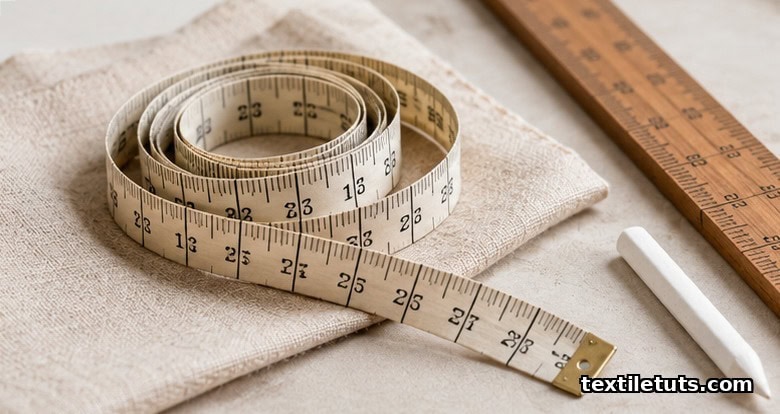
Garment sizing standards rely on ISO 8559-1:2017 and ISO 8559-2:2017, which fix body-measurement intervals at 4 cm for men and 2 cm for women across the bust, waist, hip, and inseam while holding finished-garment tolerances to ±1.0 cm at primary dimensions and ±0.5 cm at set-in sleeve alignment.
Two size jumps per body zone is the practical answer to “how much room do I have between sizes,” and the 1.0 cm / 0.5 cm tolerance numbers explain why a “perfect” Size 38 dress can still feel off if the maker cut a quarter-inch wide on the sleeve cap.
This article walks through the standards that govern those numbers, where they came from, how regional systems diverge, and what tolerances apparel makers actually aim for in production. The aim is to give you a working reference you can use when grading patterns, auditing finished garments, or comparing size charts between brands.
What a “sizing standard” actually controls
A garment sizing standard is not a single number. It is a bundle of three coordinated documents: the anthropometric definitions (where to place the tape), the designation system (how the brand label translates into numbers or letters), and the fit tolerances (how much a finished garment can deviate from the target before it is considered a defect). The International Organization for Standardization separates these into distinct ISO standards so that a pattern maker in Dhaka, a merchandiser in Lisbon, and a quality auditor in Hanoi all measure the same way.
Without that agreement, a “size M” produced for the European market will not match a “size M” produced for North America, because the underlying body intervals were derived from different population surveys and labelled under different conventions. The published ISO standards exist precisely to remove that ambiguity at the measurement step.
The ISO 8559 family: definitions, designations, and intervals
ISO 8559-1:2017, Size designation of clothes — Part 1: Anthropometric definitions and measurement locations for the head, face, neck, bust, waist, hip, and limbs, is the foundation. It pins down 36 primary measurement sites used in apparel grading, with reference postures, breathing state (relaxed vs. inhaled), and tape tension specified per location. For example, the bust is measured at the fullest part of the chest with the subject standing relaxed and the tape held level but not compressing soft tissue, while the waist is taken at the natural indentation between the lower rib and the iliac crest at the end of a normal exhalation.
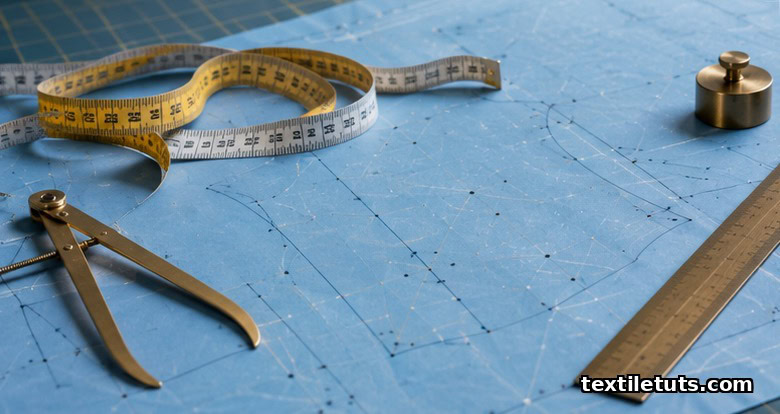
ISO 8559-2:2017, Part 2: Primary and secondary dimension indicators, then defines which of those 36 measurements actually appear on the size label. For ready-to-wear, the primary indicators are typically height, bust or chest, waist, and hip. Secondary indicators cover sleeve length, inseam, neck circumference, and shoulder span. The standard also defines the size interval: 4 cm between adjacent adult sizes for the primary indicators, 2 cm between adjacent junior or petite sizes. That is the answer to the practical question, “If I am between sizes, what gap am I crossing?”
ISO 8559-3 and ISO 8559-4 extend the system to infants, children, and special body types. ISO 14704 covers size designation for clothing made from elastic textiles, where the same garment is expected to stretch across a wider body range, so the intervals and tolerances are calculated from the relaxed state of the fabric rather than the relaxed state of the body.
ASTM D5219: the North American reference vocabulary
ASTM D5219, Standard Terminology Relating to Body Dimensions for Apparel Sizing, serves a parallel role in the United States and Canada. Rather than prescribing measurement intervals, it standardizes the vocabulary, so that a U.S. specification sheet using terms like “natural waist,” “high hip,” or “inseam length” can be read by a factory anywhere without ambiguity about which body landmark is meant.
ASTM D5219 is typically cited together with ASTM F2150-series and ASTM D5586 for fitness apparel, and with ASTM D6240 for protective clothing size designation. Where ISO gives you the numbers, ASTM gives you the shared dictionary; the two are complementary rather than competing, and most export-oriented factories in Bangladesh maintain both references on the cutting-room wall.
How primary size intervals get translated into labels
The labelling scheme sits on top of the measurement interval. The European EN 13402 system, which is now largely aligned with ISO 8559-2, expresses body measurements directly: a Size 38 women’s dress corresponds to a 38 cm range on the bust indicator above a height band, with waist and hip indicated separately on the inner label. The U.S. system, by contrast, uses arbitrary even numbers (2, 4, 6, 8, 10, 12, 14, 16, 18, 20, 22, 24) derived from bust circumference in inches in the 1970s ASTM women’s survey, then rounded and shifted to keep the same commercial labels.
The practical consequence is that a “Size 8” in the U.S. system is not numerically equal to a “Size 38” in the European system, even though both might target a 36-inch bust. The European number is a direct body measurement; the U.S. number is a historical survey index that has been carried forward to preserve brand continuity. A merchandiser exporting from Bangladesh to both markets therefore maintains two separate size charts, and a quality auditor cannot compare a U.S.-bound Size 8 against a European Size 38 with a tape measure without a conversion table.
Tolerances: where the numbers meet the sewing room
Fit tolerances are the second half of every standard. ISO 8559-2 recommends that finished-garment dimensions stay within ±1.0 cm of the graded specification at primary body measurements (bust, waist, hip) and within ±0.5 cm at secondary measurements that affect how a garment hangs from the shoulder, such as sleeve cap height and shoulder slope. Tight-tolerance garments (structured suiting, formal shirting) typically hold ±0.5 cm at the primary dimensions as well, while relaxed knits may accept ±1.5 cm at the primary measurements and ±1.0 cm at the secondary.
These numbers come from a chain of compounding variables: pattern grading accuracy (±0.2 cm per size step on a digital plotter), fabric relaxation after cutting (±0.3 cm on a woven with 3% mechanical stretch), sewing seam allowance consumption (±0.2 cm per seam), and finishing shrinkage (±0.5 cm after the first wash on a cotton without pre-shrunk finish). Industry practice uses a 1.0 cm tolerance envelope at primary measurements so that the worst-case stack-up of these four sources does not push the garment outside the fit window.
For a fitted shirt waist, a 1.0 cm envelope corresponds to about one full clothing size’s worth of slack; for a trouser inseam, the same envelope represents about 1.5 inches of length adjustment, which is the practical limit for hemming without altering the rise.
Regional and population differences
ISO 8559-1 sets the measurement protocol, but the underlying body data comes from national anthropometric surveys. Sizeinterval’s “SizeUSA” survey, SizeUK, and SizeGER (now superseded by SizeGermany) measured tens of thousands of adults in the early 2000s and found that average bust circumference for an adult woman ranges from about 96 cm in Germany to about 100 cm in the UK and 102 cm in the USA, with the standard deviation at about 7 cm. A single global size chart therefore cannot fit a population that varies by 4 to 6 cm at the mean and by 14 cm at one standard deviation.
The same survey work showed that body proportions shift with age and with stature, not just with weight. Older adults tend to have a higher waist-to-hip ratio at the same body weight; taller adults have proportionally longer arms and legs. Some specialty size systems (big-and-tall, petite, maternity) are graded on modified proportional rules rather than simple linear scaling, and the ISO 8559 series explicitly allows for these modifications as long as the underlying measurement protocol is preserved.
Grading: turning one pattern into a range
Grading is the process of scaling a base pattern (usually the median size, sometimes called the “size 12” or “size M” sample) up and down to produce the rest of the range. A conventional grade adds 4 cm at the bust for each adult size step, distributed as +1 cm at the front, +1 cm at the side, +1 cm at the back, and +1 cm split across the shoulder and armhole. The distribution matters: doubling the increase at the side seam and zero at the front produces a fitted side-panel look, while the reverse produces a flared silhouette.
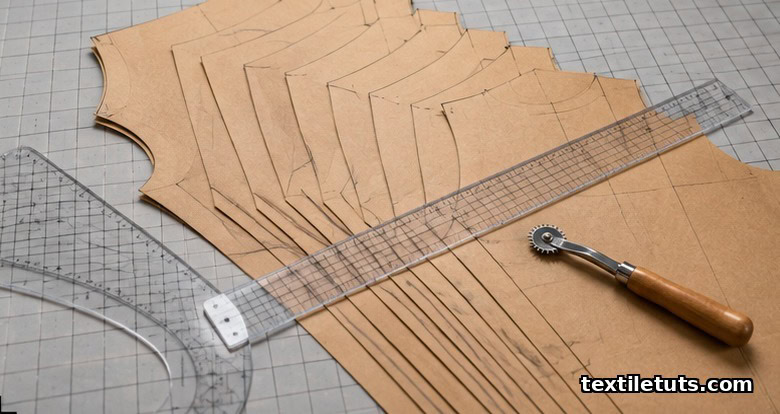
Grading rules are not standardized in the same way as measurement locations. Each brand publishes its own grade table, and ASTM D5219 and ISO 8559-2 only specify that grading be consistent and reversible (i.e., grading up then down should return to the original pattern within ±0.1 cm). Modern CAD systems (Lectra, Gerber, Optitex) encode the grade table digitally, so a pattern grader in one factory can deliver a consistent result to a sister factory in another country.
Virtual fit and body scanning
The most active research area in sizing is body scanning, where 3D scanners capture hundreds of thousands of surface points on a clothed or unclothed subject in about ten seconds. Size Stream, Human Solutions (now part of Avalanche), and TC² have deployed scanning systems in retail settings, and the resulting body databases are slowly feeding back into the next revision of the national size surveys. ISO 7250-1 provides guidance on 3D anthropometric data collection, and ISO 20685-1 specifies how the resulting point clouds should be processed.

For garment engineering, the practical impact is that pattern makers can now grade against measured body data rather than estimated body data. A 2020 study published in Applied Sciences showed that patterns graded against a 3D body scan fit about 12% better on first try than patterns graded against a tape-measure survey, because the scan captures shoulder slope, back curvature, and posture that a tape measure cannot record.
Frequently Asked Questions
What is the difference between body measurements and garment measurements?
Body measurements are taken on the live subject, with the tape held level but not compressing soft tissue, per ISO 8559-1. Garment measurements are taken on the finished product laid flat, and they are always smaller than body measurements at the same site because the garment must leave ease for movement, breathing, and layering. A Size M shirt with a 96 cm body bust indicator will typically have a 100 cm flat-garment chest measurement, with the 4 cm gap called “wearing ease.”
Why do U.S. and European sizes not match even though they target the same body?
The U.S. system uses even numbers from a 1970s ASTM women’s survey and has carried those labels forward for brand continuity. The European EN 13402 / ISO 8559-2 system expresses body measurements directly. The numerical labels differ even when the target body is the same. A size conversion table is needed to map one to the other, and even then the conversion only holds within about ±1 cm because of the difference in population surveys.
What tolerances are acceptable on a finished garment?
ISO 8559-2 recommends ±1.0 cm at primary body dimensions (bust, waist, hip) and ±0.5 cm at secondary dimensions that affect fit (sleeve cap, neck circumference). Fitted garments typically hold ±0.5 cm at the primary dimensions as well, and very relaxed knits may accept ±1.5 cm. Anything outside ±2.0 cm at the primary dimensions is usually a factory reject rather than an acceptable variation.
How does fabric stretch change the size chart?
Stretch fabrics are graded from the relaxed state, not the stretched state. ISO 14704 sets out the method: the size label indicates the body range the garment fits when the fabric is at rest, and the fit is verified after the garment has been worn for a few minutes and the fabric has relaxed against the body. A 95% cotton / 5% spandex jersey might label for a 4 cm body range per size (same as a woven), but it will stretch comfortably across that range without binding.
Why is grading consistency more important than grading precision?
A pattern graded with 4.0 cm between sizes but distributed unevenly (e.g., 5.0 cm at one side seam and 3.0 cm at the other) will produce a visibly unbalanced garment, even though the average increment is correct. ISO 8559-2 therefore requires that grading be reversible: grading up by one size and then back down must return to the original pattern within ±0.1 cm. Reversibility forces the increments to be evenly distributed, which is what makes a Size 8 and a Size 14 look like the same design at different scales.
References
- International Organization for Standardization. ISO 8559-1:2017, Size designation of clothes — Part 1: Anthropometric definitions and measurement locations. The measurement protocol underlying modern apparel sizing.
- International Organization for Standardization. ISO 8559-2:2017, Size designation of clothes — Part 2: Primary and secondary dimension indicators. Defines the 4 cm / 2 cm size intervals and the primary indicator system.
- ASTM International. ASTM D5219-20, Standard Terminology Relating to Body Dimensions for Apparel Sizing. The North American vocabulary reference for body dimensions.
- International Organization for Standardization. ISO 14704:2011, Size designation of clothes — Size designation for elastic textiles. Grading method for stretch fabrics.
- International Organization for Standardization. ISO 7250-1:2017, Design of basic human body measurements for technological design — Body measurement definitions and landmarks.
- Bye, E., Hakala, L., & Nunn, A. (2020). 3D body scanning for apparel pattern grading: a comparative fit study. Applied Sciences, 10(15), 5143. MDPI. The pattern-fit study showing 12% first-try improvement with scan-based grading.
- International Organization for Standardization. ISO 20685-1:2018, 3-D scanning methodologies for internationally compatible anthropometric databases. Method for processing 3D body scan data.
This article is the working reference for garment sizing standards. Editorial by Kazi Sifat Muntasir, TextileTuts. Sources: ISO 8559-1:2017, ISO 8559-2:2017, ASTM D5219-20, ISO 14704:2011, ISO 7250-1:2017, MDPI Applied Sciences (2020), ISO 20685-1:2018 as cited.


