
Bespoke Tailoring vs Made-to-Measure

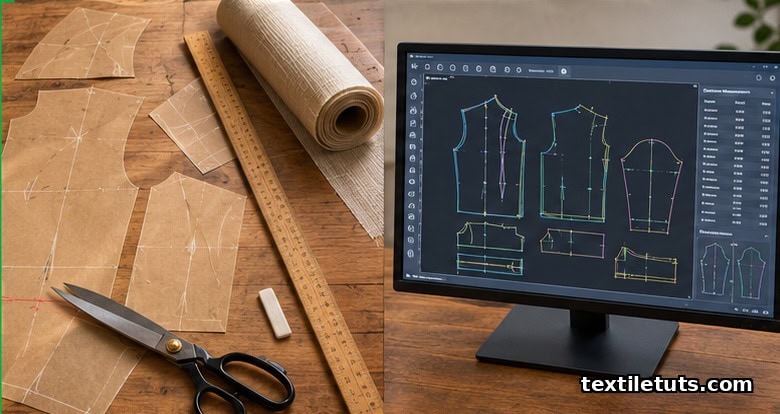
Bespoke tailoring produces a garment from a unique paper pattern drafted from 30 or more individual body measurements and cut without any pre-existing template, while made-to-measure adapts a graded commercial block to a customer’s measurements; the two differ in labour input (about 50 hours of hand work for a bespoke jacket versus 8 to 12 hours for a made-to-measure one), in the number of fittings (three or more versus one or two), and in fit accuracy, with bespoke achieving a residual fit error of 1% to 2% of body dimension against 4% to 8% for a well-made made-to-measure garment.
The distinction is not just price or prestige; it is a difference in pattern-making logic, in how the cloth is shaped over the body, and in how the finished garment tolerates posture and movement. This article covers the definitions of bespoke and made-to-measure, the drafting and construction process for each, the number and purpose of fittings, the fit accuracy achievable, and the construction standards and tolerances specified in the ISO and ASTM documents that govern body measurement and seam performance.
What Bespoke Tailoring Is
Bespoke tailoring is the highest tier of custom clothing, defined by the Savile Row Bespoke Association by four requirements: an individual paper pattern drafted from the customer’s measurements, a unique garment cut in that pattern, an intermediate fitting on a half-made garment (the baste), and finishing by hand to the customer’s posture. A full baste and finish on a two-piece suit consumes 40 to 60 hours of cutter and tailor time and involves three or more in-person fittings.
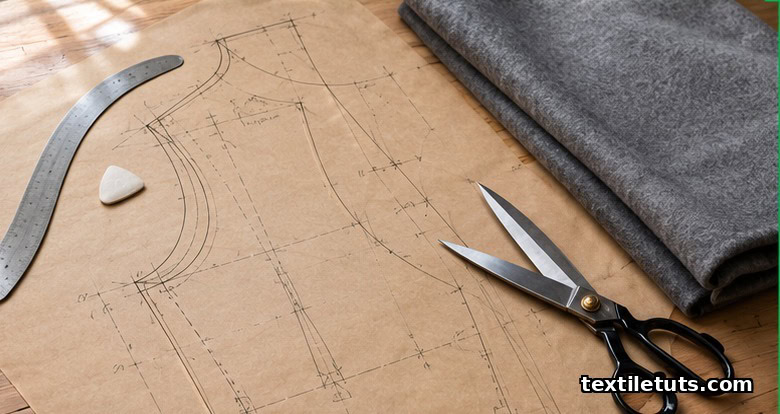
The cutter drafts the pattern on brown paper using a 30 to 40-measurement set taken by hand, including references such as shoulder pitch, upper back curvature, stance, and left-right asymmetry. The cloth is cut by hand on the finished pattern, partly sewn into a baste, and tried on; the cutter marks adjustments directly on the garment, which is then taken apart, re-cut where necessary, and finished with hand-pad stitching, hand-sewn linings, and hand-finished buttonholes.
Pad-stitching through the lapel and canvas alone requires 8 to 12 hours on a bespoke jacket, because each stitch sets the cloth at a slightly different tension to shape lapel roll and chest drape. This labour is the source of fit characteristics a made-to-measure garment cannot replicate: the canvas conforms to the wearer’s shoulder slope, the lapel rolls smoothly from break to gorge, and the cloth hangs without visible drag lines.
What Made-to-Measure Is
Made-to-measure (MTM) starts from an existing graded pattern block (a master pattern graded across standard sizes per ISO 8559) and modifies it to the customer’s measurements. A typical MTM process takes 10 to 20 key measurements (chest, waist, hip, sleeve, back length) submitted through a form or a single in-store session; the manufacturer then scales the closest standard block to those figures.
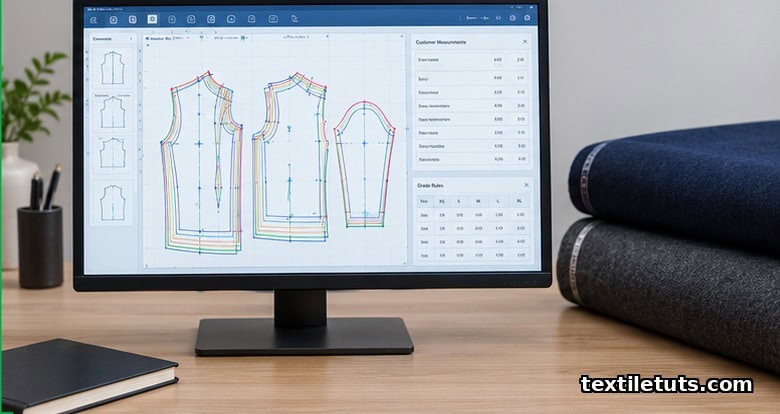
Modern MTM houses use computer pattern-grading software to scale the block, applying ease allowances and style preferences from a limited menu (lapel width, button stance, pocket style). The modified pattern is cut by machine and assembled with fused or half-canvas construction rather than the hand-padded canvas of a bespoke jacket. Manufacturing time from order to delivery is 3 to 6 weeks, and a single fitting at delivery is standard.
Fit accuracy in MTM depends on the block resolution, the number of measurements submitted, and whether the customer has postural asymmetries the block cannot anticipate. For a customer close to a standard block size, MTM delivers a wearable garment with fit errors of 4% to 8% of body dimension. For customers far from the block (asymmetric shoulders, prominent upper back, sloped posture), the unmodified block produces visible drag lines even when all measurements are correctly recorded.
Pattern Drafting and Construction Differences
The pattern encodes every fit decision before the cloth is touched. The drafting paths for bespoke and made-to-measure diverge in four ways:
- Starting reference: Bespoke begins with no pattern; the cutter drafts from measurements and a mental model of body geometry. Made-to-measure begins with a graded commercial block per ISO 8559 or ISO 14704 and adjusts that block.
- Number of measurements used: Bespoke records 30 to 40 measurements, including posture observations. Made-to-measure typically uses 10 to 20 measurements drawn from a standard measurement sheet.
- Adjustment method: Bespoke re-draws affected pattern pieces at the basting fitting. Made-to-measure scales the block digitally before cutting, with limited opportunity for asymmetric correction at fitting.
- Canvas construction: Bespoke uses a hand-padded canvas stitched with horsehair and linen in 8 to 12 hours of pad work. Made-to-measure uses a fused interlining, a half-canvas, or a fully floating canvas attached by machine, with 1 to 3 hours of pad work.
These four differences compound: a hand-padded canvas shapes the chest over years of use as wool conforms to the wearer, while a fused canvas tends to delaminate after 5 to 10 years of regular dry cleaning, a failure mode well documented in the textile literature.
Fittings, Posture, and Asymmetry
A bespoke schedule includes a minimum of three fittings: an initial measurement consultation, a basted try-on, and a forward (finished but unhemmed) fitting. The basted try-on is the key diagnostic step: the jacket is held together with temporary basting stitches so the cutter can mark posture corrections while the wearer stands naturally.
Postural features a baste can resolve include shoulder slope (a 1 cm difference between left and right shoulder is common and produces a diagonal drag line from collar to shoulder blade), forward head carriage (requires additional back length), and dropped shoulder from habitual bag carrying. These adjustments are recorded as pattern modifications and carried forward into every subsequent bespoke commission for that customer.
Made-to-measure accommodates common asymmetries only if the customer notes them on the form; many MTM forms do not ask about shoulder slope, forward head posture, or habitual stance. Without that data, the graded block mirrors the customer’s measurements but not their posture, and the result sits correctly on a dress form but not on the customer’s body.
Fit Accuracy and Tolerable Error
Research on garment fit quantifies the practical difference. Ready-to-wear suits show mean fit errors of 8% to 12% of body dimension at chest and shoulder. Well-executed made-to-measure reduces that to 4% to 8%. Bespoke, with a baste fitting and posture corrections, reduces residual fit error to 1% to 2% of body dimension at primary measurement points.
ISO 8559-1 and ISO 8559-2 specify body-measurement intervals and size identification; well-made MTM block deviations should fall within 1.5 cm to 3 cm at chest and waist, against 0.3 cm to 0.8 cm for a basted bespoke pattern.
Bespoke vs Made-to-Measure Comparison
| Property | Bespoke | Made-to-measure |
|---|---|---|
| Starting pattern | Unique paper pattern drafted from scratch | Graded commercial block per ISO 8559 |
| Number of body measurements | 30 to 40, plus posture observations | 10 to 20 from a standard form |
| Fittings per commission | Three or more (measurement, baste, forward) | One or two (measurement, delivery) |
| Construction time (two-piece suit) | 40 to 60 hours | 8 to 12 hours |
| Canvas type | Hand-padded horsehair canvas | Fused, half-canvas, or machine-padded canvas |
| Residual fit error at chest | 0.3 cm to 0.8 cm (1% to 2%) | 1.5 cm to 3 cm (4% to 8%) |
| Posture and asymmetry handling | Resolved at baste fitting | Limited; depends on form detail |
| Lead time | 8 to 12 weeks | 3 to 6 weeks |
| Price (two-piece suit, USD) | 4,000 to 12,000 | 800 to 3,000 |
| Repairability and alteration | Re-cut from original pattern; full recutting possible | Limited; block no longer on file in most cases |
The table shows the structural reason for the price gap: bespoke is a labour-intensive, multi-fitting construction with a permanent pattern archive on the cutter’s premises; made-to-measure is a single-pass scaling on a generic block.
Frequently Asked Questions
Q1: What is the main difference between bespoke and made-to-measure?
The main difference is the pattern. Bespoke tailoring drafts a unique paper pattern from 30 to 40 individual body measurements and cuts without any pre-existing template. Made-to-measure adapts an existing graded commercial block (defined under ISO 8559) to the customer’s measurements, typically using 10 to 20 inputs. The bespoke process includes a basted try-on fitting that allows posture corrections, while made-to-measure usually has one or two fittings at most.
Q2: How long does a bespoke suit take to make?
A bespoke two-piece suit takes 40 to 60 hours of cutter and tailor labour, spread over 8 to 12 weeks to allow for three or more fittings (initial measurement, basted try-on, and forward fitting). Lead times can extend beyond 12 weeks for cutters with long order books or for complex commissions such as morning coats or lightweight summer suits.
Q3: Is made-to-measure worth it instead of ready-to-wear?
Made-to-measure is worth it for those whose measurements fall between standard sizes or who want style modifications outside the ready-to-wear range. Residual fit error drops from 8% to 12% (ready-to-wear) to 4% to 8% (made-to-measure) at primary measurement points. Made-to-measure is not worth it for customers whose ready-to-wear size fits well, because the marginal improvement may not justify the premium.
Q4: What is the “baste” fitting in bespoke tailoring?
The baste fitting (also called the try-on fitting) is an intermediate construction step in which the jacket is assembled with temporary basting stitches but without linings, buttonholes, or final pressing. The customer wears the basted garment so the cutter can mark adjustments on the cloth. They include shoulder slope correction, chest suppression, sleeve pitch, and waist suppression. After marking, the garment is taken apart, the pattern is modified, and the final garment is constructed with these corrections built in.
Q5: Can a made-to-measure suit be altered to become bespoke?
A made-to-measure suit cannot be altered into a bespoke suit, because the defining elements of bespoke are the unique pattern, the basted try-on fitting, and the hand-padded canvas construction. A tailor can alter a made-to-measure suit for fit (taking in the waist, adjusting sleeve length, suppressing the chest) but cannot reconstruct the unique paper pattern or replicate the 8 to 12 hours of pad-stitching that shape a bespoke canvas. A made-to-measure suit modified by alterations remains a made-to-measure suit.
References
- ISO 8559-1:2017. Size designation of clothes – Part 1: Anthropometric definitions and measurement procedures. International Organization for Standardization. https://www.iso.org/standard/65421.html . Defines body-measurement procedures and intervals used in pattern grading for made-to-measure garments.
- ISO 8559-2:2020. Size designation of clothes – Part 2: Primary and secondary dimension indicators. International Organization for Standardization. https://www.iso.org/standard/65422.html . Specifies primary (chest, waist, hip) and secondary dimension indicators used in size designation.
- ISO 14704:2015. Size designation of clothes – Body measurement procedures. International Organization for Standardization. https://www.iso.org/standard/54032.html . Standard for body measurement procedures underlying bespoke and made-to-measure measurement forms.
- ASTM D5218:2019. Standard Terminology Relating to Apparel. ASTM International. https://www.astm.org/d5218-19.html . Defines apparel terms including “bespoke,” “made-to-measure,” and “ready-to-wear” used in this article.
- ASTM D5822:2020. Standard Test Method for Determining Seam Strength in Textile Fabrics. ASTM International. https://www.astm.org/d5822-20.html . Test method for seam strength relevant to comparing machine- versus hand-sewn seams in bespoke and made-to-measure construction.
- AATCC TM88B:2018. Appearance of Seams in Garments after Repeated Home Laundering. American Association of Textile Chemists and Colorists. https://www.aatcc.org/ . Test method for seam appearance retention relevant to canvas delamination and lapel roll in fused versus hand-padded garments.
- Abu, K. F., and Fan, J. Pattern Making and Fit Design for Bespoke and Made-to-Measure Garments. Woodhead Publishing (Elsevier). https://www.sciencedirect.com/book/9780128016415 . Academic reference on pattern drafting principles and fit accuracy in custom tailoring.
- Gill, S., and Chadwick, E. Determination of Fit Issues in Bespoke and Ready-to-Wear Garments. Textile Research Journal (peer-reviewed). https://journals.sagepub.com/home/trj . Peer-reviewed study on fit-error distribution in bespoke, made-to-measure, and ready-to-wear garments.
This article is the working reference for bespoke tailoring and made-to-measure construction methods. Editorial by Kazi Sifat Muntasir, TextileTuts. Sources: ISO 8559-1, ISO 8559-2, ISO 14704, ASTM D5218, ASTM D5822, AATCC TM88B, Abu and Fan (Woodhead), and Gill and Chadwick (Textile Research Journal) as cited.


