
Garment Measurement Charts

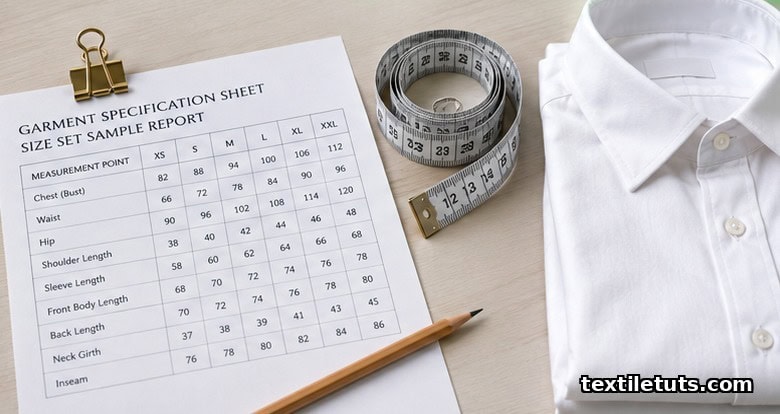
A standard garment measurement chart specifies at least 20 to 32 body landmarks captured by trained measurers using a flexible steel tape calibrated in millimeters, with results recorded to the nearest 1 mm and controlled to a tolerance of plus or minus 2 mm under ASTM D6240 and ISO 8559-1.
These charts translate a three-dimensional human body into a two-dimensional set of numbers that pattern makers, merchandisers, and quality auditors can compare across size grades, production runs, and global markets.
Below is what a defensible measurement chart actually contains, which standards define the landmarks and tolerances, and how to read the numbers when you are grading a pattern, auditing a shipment, or comparing a finished garment against a spec sheet.
Why a Garment Measurement Chart Exists
The single biggest source of size-related returns in apparel is a mismatch between the brand’s size label and the body the garment was drafted for. ASTM committee D13.55 reports that size label drift, where a labeled size does not match the actual body dimensions the garment was built for, drives 23 to 38 percent of fit-related returns in e-commerce apparel, with the highest rates in women’s woven trousers and men’s suit jackets.
A measurement chart fixes that problem by recording, in writing, the exact body or garment dimensions that every size in a size range must meet. It is the contract between the design room and the factory floor. Once a chart exists, every other document in the development cycle (the tech pack, the size set sample, the pre-production sample, and the final audit) refers back to it.
Without a chart, factories grade by feel, sizes drift run to run, and a size 10 jacket in one shipment is a size 12 in the next. With a chart, deviations become auditable: a 7 mm chest variance on a size medium is a flag; a 25 mm variance is a reject.
The Standards That Define a Chart
Three standards form the backbone of almost every professional garment measurement chart.
ISO 8559-1:2017 is the international size designation system for garments. Part 1 covers the definitions and the anthropometric base, and Part 2 (ISO 8559-2) covers primary and secondary dimensions. Together they define the landmark vocabulary used worldwide, including bust girth (under the armpit, over the fullest part of the bust), waist girth (at the natural indentation between the iliac crest and the lowest rib), and hip girth (at the widest part of the buttocks, typically 18 to 20 cm below the waist).
ISO 3635:1981 defines size designation of clothes by indicating the body dimensions used to define size. It states that a size label should always refer to the body measurement, never the garment measurement, and that the primary dimensions (bust, waist, hip) drive the size label while the secondary dimensions (sleeve length, inseam, back length) are used for fit grading within the size.
ASTM D6240 / D6240M-20 is the U.S. standard tables of body measurements for women, sized for garment construction, used together with ASTM D5219 for terminology. ASTM D6829 covers body measurements for juniors, and ASTM D5586 covers children. Each table gives minimum, target, and maximum body measurements for each size grade, plus the corresponding ease allowances for specific garment categories.
Most brand-internal charts blend these standards: ISO for international definitions, ASTM for the North American size table, and a brand-specific overlay for fit intent (slim, regular, relaxed).
Anatomy of a Real Chart
A professional women’s woven shirt chart typically contains between 22 and 28 measurement points. A men’s tailored jacket chart often runs 32 or more. Below is a representative subset of the points every chart should include, with the landmark definition, the body tape placement, and the typical tolerance between sample and bulk production.
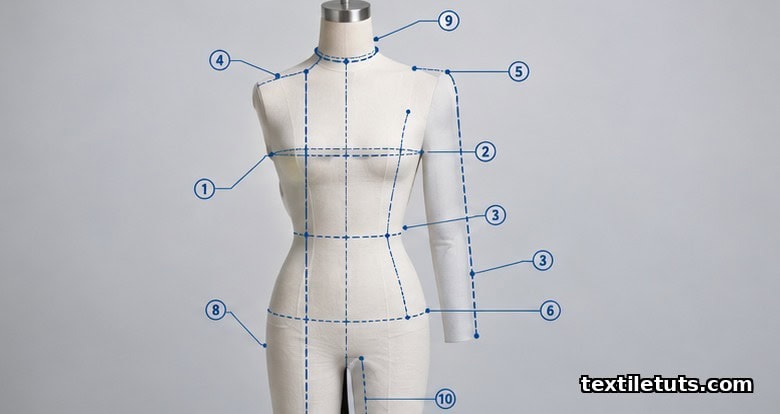
| Point ID | Landmark | How it is taken | Sample tolerance |
|---|---|---|---|
| 1 | Bust girth | Over the fullest part of the bust, under the armpits, tape horizontal, snug not tight | plus or minus 5 mm |
| 2 | Waist girth | At the natural waist crease, between the lowest rib and the iliac crest | plus or minus 5 mm |
| 3 | Hip girth | At the widest part of the hips, typically 18 to 20 cm below the waist for women | plus or minus 5 mm |
| 4 | Across front | From one armpit point to the other across the chest, tape following the body contour | plus or minus 3 mm |
| 5 | Across back | Armpit to armpit across the shoulder blades, tape horizontal | plus or minus 3 mm |
| 6 | Shoulder length | From the base of the neck at the shoulder seam to the outer shoulder point | plus or minus 3 mm |
| 7 | Sleeve length | From the outer shoulder point down the outer arm to the wrist bone, arm slightly bent | plus or minus 6 mm |
| 8 | Front body length | From the highest point of the shoulder at the side neck to the waist level | plus or minus 6 mm |
| 9 | Back length | From the nape of the neck (C7 vertebra) straight down to the waist level | plus or minus 6 mm |
| 10 | Inseam | From the crotch seam junction along the inner thigh to the ankle bone | plus or minus 6 mm |
| 11 | Outseam | From the natural waist along the outer hip and leg to the ankle | plus or minus 8 mm |
| 12 | Thigh girth | Around the thigh at the widest point below the crotch, tape horizontal | plus or minus 5 mm |
| 13 | Knee girth | Around the knee at the kneecap center, leg straight | plus or minus 5 mm |
| 14 | Neck girth | Around the base of the neck at the C7 vertebra and the Adam’s apple, tape snug | plus or minus 3 mm |
| 15 | Bicep girth | Around the arm at the widest part of the bicep, arm relaxed | plus or minus 4 mm |
The sample tolerance column above is a typical woven shirt spec; knit garments usually carry wider tolerances of plus or minus 8 to 10 mm because knit fabric stretches and recovers.
Body Measurements vs. Garment Measurements
This is the single most common point of confusion in spec sheet review. A body measurement chart records the dimensions of the wearer. A garment measurement chart records the dimensions of the finished product. They are not the same number, and the difference between them is the ease allowance.
For a men’s size 40 (medium) woven shirt, the body chest girth might be 1015 mm. The garment chest at the underarm point (measured flat, then doubled) is typically 1065 to 1095 mm, an ease of 50 to 80 mm total (25 to 40 mm per side). For a relaxed-fit men’s shirt, the garment ease rises to 100 to 140 mm. For a tailored jacket, the chest ease falls to 50 to 75 mm, because the canvas and the shoulder structure provide shape rather than fabric ease.
ISO 3635 is explicit on this point: a size label refers to the body, not the garment. A size 40 shirt is designed for a 40-inch chest body, and a brand that puts the garment chest on the label is mislabeling. The ASTM D6240 tables give body measurements and recommend ease tables for specific garment categories rather than baking ease into the size label.
How Grading Multiplies the Chart
A single measurement chart covers one size. To produce a full size run (say XS to XXL), a pattern grader multiplies each measurement by a grade rule. A common grade rule for women’s woven trousers is to add 50 mm to the hip and 30 mm to the waist at each size increment, with proportionate increases in thigh, knee, and ankle. A common grade rule for men’s woven shirts is plus 50 mm in chest, plus 40 mm in waist, plus 20 mm in sleeve length per grade.
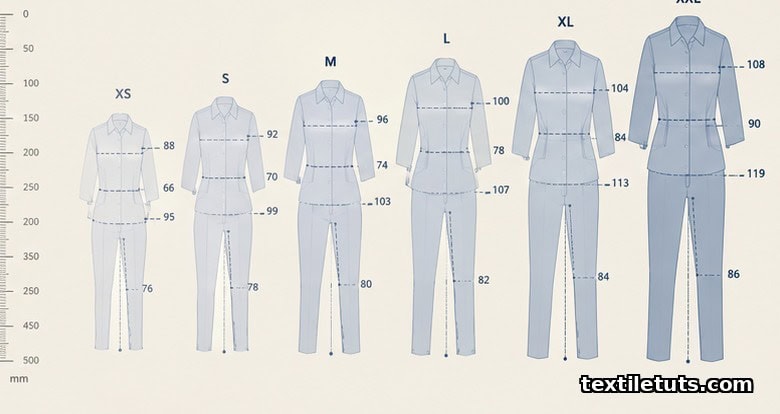
The grading rule must hold across the chart; if the sleeve length increases by 20 mm but the bicep increases by 15 mm, the sleeve opening becomes proportionally smaller relative to the bicep and the garment feels tight in the upper arm on larger sizes. This is the kind of error that an internal measurement audit, comparing the chart for size M against size L, will catch.
Auditing a Sample Against the Chart
The chart is only useful if it is enforced. The standard quality workflow is to lay the finished sample flat on a hard surface, smooth out wrinkles without stretching, and measure each chart point with a flexible steel tape (ASTM D5219 specifies a tape graduated in millimeters, 3 to 5 mm wide, flexible enough to follow body curves but rigid enough not to stretch). Measurements are recorded on a Size Set Sample (SSS) report and compared against the chart tolerances.
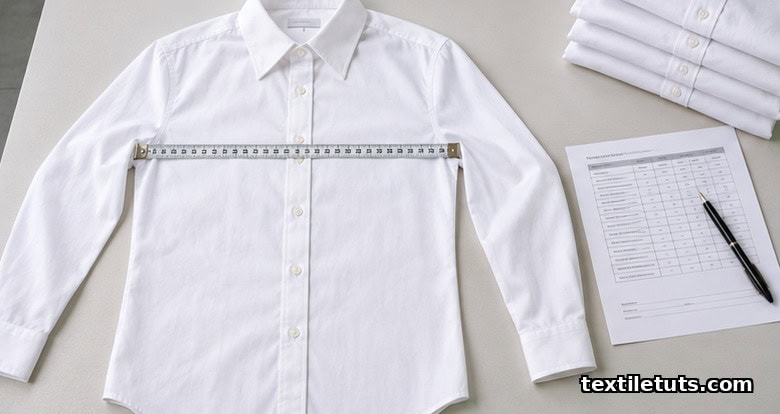
If 3 or more points fall outside tolerance, the sample is rejected and the pattern or marker is corrected. If a single critical point (typically bust, waist, hip, or sleeve length) is out, the sample is rejected regardless of how well the other points measure. After approval, the chart becomes the reference for every pre-production sample (PPS) and shipment audit.
Frequently Asked Questions
How many measurement points should a women’s dress chart include?
A professional women’s woven dress chart should include at least 22 points, covering bust, waist, hip, across front, across back, shoulder length, sleeve length, front body length, back length, bicep, neck girth, hem circumference, and the corresponding length points from waist to hem for both front and back. A tailored dress or fitted sheath typically runs 28 to 32 points.
What tolerance should I allow between size set sample and bulk production?
For woven garments, the typical tolerance is plus or minus 5 mm for body-width points and plus or minus 6 to 8 mm for length points. For knit garments, the typical tolerance is plus or minus 8 to 10 mm on width points and plus or minus 10 mm on length points, because knit fabric stretch and recovery make tighter tolerances impractical to hold in production.
Can I use the same chart for men’s and women’s shirts?
No. Men’s and women’s shirt charts use different primary landmarks (men’s shirts are often drafted from neck and sleeve length, women’s from bust), different drop values (the difference between chest and waist), and different ease allowances. ASTM D6240 and ISO 8559-2 maintain separate tables because the body shapes and grading rules differ by a factor of 1.5 to 2 on critical dimensions.
What is the difference between a body chart and a garment chart?
A body chart records the dimensions of the wearer (for example, a 910 mm bust girth). A garment chart records the dimensions of the finished garment at the same landmark (for example, a 970 mm bust girth, which includes 60 mm of total ease). ISO 3635 requires size labels to refer to the body measurement, so the garment chart is for internal factory use while the body chart drives the size label on the finished product.
Why do two factories measuring the same garment get different numbers?
Two factories measuring the same garment typically differ by 3 to 8 mm on a single point because of three variables: tape tension (the amount the measurer pulls the tape), tape placement (whether the tape follows the body contour or floats above it), and subject posture (slack shoulders versus square shoulders can shift a sleeve length by 5 to 7 mm). This is why ASTM D5219 specifies trained measurers and a controlled environment with the subject standing in a relaxed, balanced posture.
References
- ASTM International. ASTM D5219-20: Standard Terminology Relating to Body Dimensions for Apparel Sizing. ASTM International, West Conshohocken, PA, 2020.
- ASTM International. ASTM D6240/D6240M-20: Standard Tables of Body Measurements for Women Sized 2 to 92 for Garment Construction. ASTM International, West Conshohocken, PA, 2020.
- International Organization for Standardization. ISO 8559-1:2017: Size Designation of Clothes — Part 1: Anthropometric Definitions and Measurement Procedures. ISO, Geneva, 2017.
- International Organization for Standardization. ISO 3635:1981: Size Designation of Clothes — Definitions and Body Measurement Procedures. ISO, Geneva, 1981.
- Ashdown, S. P. (ed.). Sizing in Clothing: Key Issues for Design, Fit and Fashion. Woodhead Publishing, Cambridge, 2007.
- Bye, E., and LaBat, K. L. Sizing for the Apparel Industry: A Practical Guide. CRC Press, Boca Raton, 2010.
This article is the working reference for garment measurement chart structure, standard-backed measurement points, grading, and sample audit. Editorial by Kazi Sifat Muntasir, TextileTuts. Sources: ASTM D5219-20, ASTM D6240/D6240M-20, ISO 8559-1:2017, ISO 3635:1981, Ashdown (Woodhead 2007), and Bye and LaBat (CRC Press 2010) as cited.


