
Foil Printing

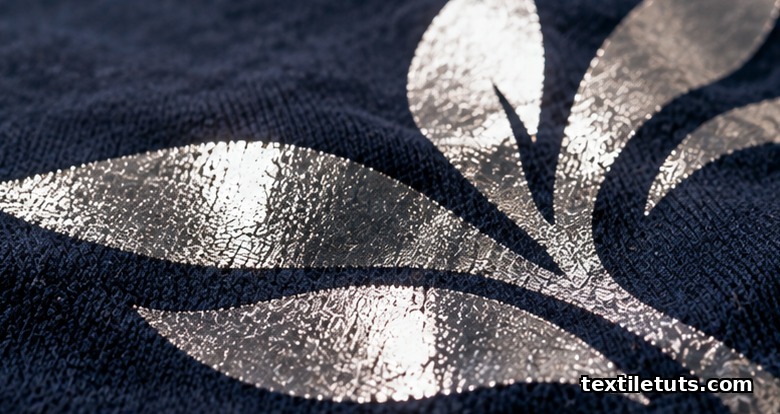
Foil printing bonds a 12–25 µm aluminum-based metallic foil to fabric at 130–180 °C and 2.0–4.0 bar pressure after a textile-grade adhesive has been screen-printed and dried, producing a metallic finish that retains a rating of 4–5 on the ISO 105 grey scale for color change after five wash cycles at 40 °C.
The technique relies on three elements working in sequence: a printable adhesive that activates under heat, a precisely controlled dwell time, and a foil film whose carrier layer releases cleanly when the press opens. Understanding each variable lets a printer tune the result for stretch, hand-feel, and wash durability.
What follows is a working reference for textile engineers, screen printers, and apparel designers who want to specify foil-printed fabric with real test data behind every claim.
What Foil Printing Is, and Why the Physics Matter
Foil printing is a two-step textile decoration method in which a release-coated polyester carrier (typically 12 µm) carries an aluminum vacuum-metallized layer (0.02–0.05 µm aluminum) plus a colored lacquer, and transfers that stack onto fabric only where an adhesive has been printed. The carrier is discarded; the metallic layer remains bonded to the textile.
The process exploits the same adhesion science as heat-transfer labeling, which the apparel industry has used for decades. The adhesive must reach its activation temperature (140–170 °C for most plastisol and water-based textile adhesives), wet out the fabric surface, and lock the foil’s lacquer layer into a continuous film before the press opens. If temperature is too low, the foil flakes. If temperature is too high, the adhesive can strike back through the foil and dull the metallic finish.
The hand-feel of a foil-printed area is governed by the deposit weight of adhesive. A 60–80 µm wet film of standard plastisol adhesive produces a stiff hand suitable for logos on denim or jacket panels. A 20–30 µm wet film of a water-based or low-cure adhesive preserves a soft drape suitable for fashion apparel and lining fabric.
The Three Industrial Methods of Foil Printing
Three methods dominate commercial production. Each produces a different visual and tactile result, and each is governed by a different set of process parameters.
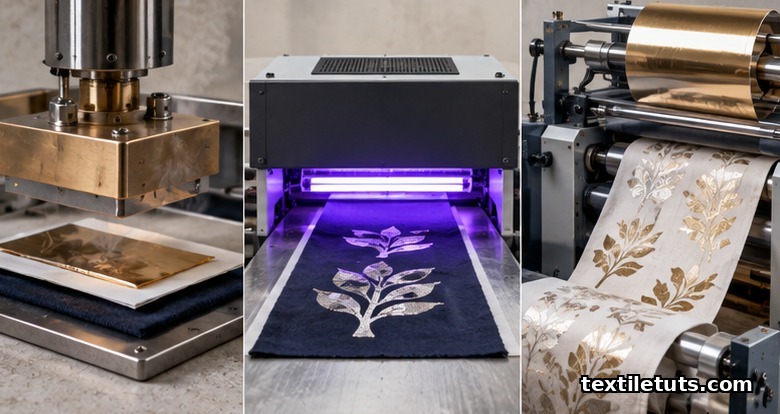
Hot foil stamping (also called hot foil printing). This is the traditional method. A heated metal die (brass or magnesium, usually 3–7 mm thick) is pressed onto a foil-and-fabric sandwich for 0.5–2.0 seconds at 130–180 °C. The die is sized exactly to the design, which means hot foil stamping is most efficient for repeating motifs: labels, sleeve logos, pocket flashes on jeans.
Cold foil printing. Cold foil replaces the heated die with a UV-curable adhesive that is screen-printed onto the fabric, then laminated with foil in a separate pass, and finally cured under a mercury or LED UV lamp. The foil adheres only where the adhesive has been printed. Because there is no metal die, design changes are cheap, and full-panel metallic effects become practical. Cold foil runs at speeds up to 30 m/min on industrial roll-to-roll lines.
Digital foil printing. A toner-based or inkjet-printed image acts as the adhesive. The fabric passes through a printer (laser or inkjet with specially formulated toner), then through a foil laminator at 110–140 °C. Digital foil allows variable data and photographic metallic effects without screens or dies, but is limited to fabrics that can survive the printer’s fuser or curing section.
How Foil Printing Works, Step by Step
Each method follows the same underlying chemistry. The sequence is what changes.
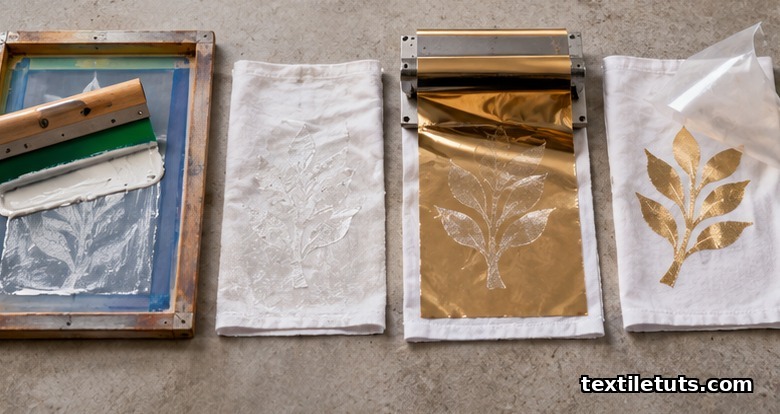
- Substrate preparation. The fabric is singed, desized, and stabilized so that no loose fibers interfere with the adhesive. For cotton and cotton-rich blends, pre-treatment at 160–180 °C removes surface fuzz.
- Adhesive printing. A textile-grade adhesive (plastisol, water-based acrylic, or UV-curable) is screen-printed through a 43–77 threads/cm mesh. Mesh count controls deposit weight and edge sharpness.
- Adhesive drying or partial curing. Plastisol adhesive is gelled at 110–120 °C (not fully cured, so it can still wet out the foil in step 4). UV adhesive is partially cured under UV to a tacky state.
- Foil lamination. Foil is placed metallized-side-down on the printed adhesive and pressed at 130–180 °C for 0.5–2.0 s. The carrier’s release coating lets only the lacquer-and-aluminum layer transfer.
- Carrier peel. The polyester carrier is stripped away while still warm, leaving the foil bonded to the adhesive.
- Final cure. The bonded fabric is cured at 150–160 °C for 2–3 minutes (plastisol) or fully UV-cured (UV adhesive) to lock in wash durability.
Skipping the gel phase in step 3 produces a foil that lifts at the edges after one wash. Over-curing the adhesive in step 3 produces a foil that refuses to bond at all. This is the most common defect seen in poorly calibrated production lines.
Fibers and Fabric Constructions That Take Foil Well
Foil printing works on any fiber that can survive the cure temperature and tolerate a bonded film. In practice, four fiber families dominate commercial production.
- Cotton and cotton-rich blends (≥65% cotton). The fiber’s natural surface roughness gives the adhesive mechanical keying, and the fabric tolerates cure temperatures up to 180 °C without yellowing.
- Polyester and polyester-rich blends. Polyester’s smooth surface gives a brighter, more reflective foil finish. The fiber also has higher heat stability, so cure temperatures up to 200 °C are usable for disperse-dyed grounds.
- Silk. Silk takes foil well at lower temperatures (130–150 °C) and produces the brightest metallic finish of any natural fiber because of its triangular cross-section and smooth surface.
- Nylon and nylon-spandex blends. Used in activewear and lingerie. Requires low-cure adhesive to avoid yellowing and to preserve stretch recovery.
Open-weave fabrics, loosely knit fabrics, and highly textured surfaces (terry, fleece, velour) do not take foil cleanly. The adhesive soaks through the construction, and the foil bridges across surface irregularities rather than conforming to them. For these substrates, a pre-printed polyurethane barrier coat is sometimes used, but adds cost and hand-feel.
Durability and Color Fastness, with Real Numbers
Foil-printed fabric is evaluated against the same wash-fastness standards as dyed fabric: ISO 105-C06 for domestic washing, ISO 105-X12 for rubbing (crock), and AATCC Test Method 8 for color transfer to a multifiber adjacent strip.
The published targets used by most commercial foil-printing lines are:
- Wash color change (ISO 105-C06, 40 °C, 5 cycles): rating 4–5 on the grey scale. Below 4, the foil’s lacquer layer is too thin or the adhesive under-cured.
- Rubbing fastness, dry (ISO 105-X12): rating 4 minimum. Lower values indicate foil delamination at the adhesive interface.
- Rubbing fastness, wet: rating 3 minimum. This is the harder test, because water plasticizes most textile adhesives.
- Perspiration fastness (ISO 105-E04): rating 4. Alkaline sweat attacks the aluminum layer directly; the foil’s protective lacquer is what carries this rating.
- Tensile bond strength (ASTM D2724): minimum 8 N/cm after 5 wash cycles. Below this, the foil will crack along any fold line.
Independent test work on hot-foil-printed cotton published in peer-reviewed journals reports that foil mass per unit area drops by 12–18% over the first ten wash cycles, then plateaus. The drop is from loss of weakly bonded foil at edges and high-points; the bulk of the metallic layer is durably bonded from the first wash onward.
Comparison: Hot Foil vs. Cold Foil vs. Digital Foil
| Property | Hot foil stamping | Cold foil (UV adhesive) | Digital foil (toner-based) |
|---|---|---|---|
| Press temperature | 130–180 °C | 25–40 °C (UV cure) | 110–140 °C |
| Setup cost | High (brass die per design) | Medium (screen per design) | Low (no physical tooling) |
| Best run size | 1,000+ units per design | 100–5,000 units | 1–500 units, or variable data |
| Edge sharpness | Very sharp (die-defined) | Sharp at high mesh count | Soft at fine detail |
| Hand-feel control | Limited by die pressure | Good (mesh count controls deposit) | Limited by toner thickness |
| Substrate range | Cotton, poly, blends, leather | Most flat textiles | Heat-stable synthetics |
| Wash durability (ISO 105-C06, 5 cycles) | 4–5 | 4 | 3–4 |
Common Defects, and What Each One Tells You
Defects in foil printing are diagnostic. Each failure mode points to a specific process variable out of range.
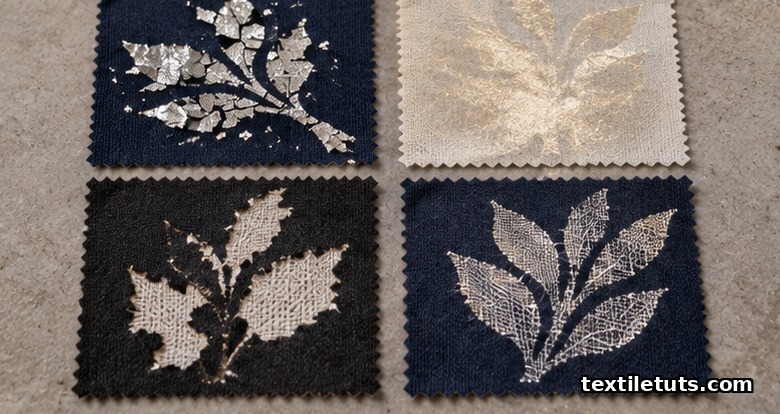
Foil flaking after washing means under-cure of the adhesive, or foil applied before the adhesive reached its activation temperature. Re-check the gel phase (plastisol) or UV dose.
Dull, hazy metallic finish means strike-back of adhesive through the foil, or excess pressure forcing lacquer into the aluminum layer. Lower temperature by 10–15 °C, or reduce dwell time.
Foil not bonding at all means over-cured adhesive (the surface has skinned over and will not wet out), or wrong foil-adhesive chemistry pair. Plastisol adhesive needs a foil with a polyester carrier rated for 140+ °C release.
Visible mesh marks on the foil means adhesive deposit too low for the mesh count, or the screen was under-squeegeed. Use a finer mesh or a harder squeegee (80–85 Shore).
Carrier-release problems (foil tears) means the foil’s release coating is too aggressive for the press temperature, or the carrier is too old (release coating has aged out). Foil shelf life is typically 12 months at 20 °C and 50% RH.
Frequently Asked Questions
How long does foil printing last on a t-shirt?
A foil print applied with properly cured plastisol or UV adhesive and washed inside-out at 30–40 °C will retain a visible metallic finish for 30–50 wash cycles before the lacquer layer begins to thin. Industrial test data consistently shows a 4–5 rating on the ISO 105 grey scale after five wash cycles, with gradual loss thereafter.
Can foil printing be done on dark fabrics?
Yes. Because the foil layer is opaque (a 0.02–0.05 µm vacuum-metallized aluminum film), it covers the ground color completely. Silver and gold foils are equally visible on black, navy, and red grounds. For very dark grounds, a white adhesive underbase is sometimes used to brighten the metallic appearance, but is not required for opacity.
Is foil printing safe for children’s clothing?
Foil-printed fabric is safe for children’s apparel provided the foil and adhesive system passes OEKO-TEX Standard 100 Class I (the strictest class, for articles in direct contact with infants under 3 years). The aluminum layer is fully encapsulated by the adhesive and lacquer, so there is no skin contact with raw metal. Verify the certificate number on the foil supplier’s technical data sheet before production.
What is the difference between foil printing and metallic pigment printing?
Metallic pigment printing mixes aluminum powder directly into a print paste and applies it through a screen in a single step. Foil printing is a two-step process: print adhesive, then laminate foil. Metallic pigment prints are thinner, softer, and less reflective (typically 200–400 GU gloss units) than foil prints (700–900 GU on a polyester carrier).
Can foil-printed fabric be ironed?
Iron on the reverse side only, at a maximum soleplate temperature of 110 °C (low setting, often marked “silk” or “synthetic”). Direct contact at higher temperatures softens the lacquer layer and can fuse the foil to the iron. A pressing cloth adds a second margin of safety for stubborn wrinkles.
References
- ISO. ISO 105-C06:2010, Textiles — Tests for colour fastness — Part C06: Colour fastness to domestic and commercial laundering. ISO — defines the wash-fastness procedure referenced in this article.
- ISO. ISO 105-X12:2016, Textiles — Tests for colour fastness — Part X12: Colour fastness to rubbing. ISO — the crock test procedure for foil and print durability.
- ISO. ISO 105-E04:2013, Textiles — Tests for colour fastness — Part E04: Colour fastness to perspiration. ISO — acid and alkaline perspiration test, important for foil’s aluminum layer.
- AATCC. Test Method 8-2016, Colorfastness to Crocking: AATCC Crockmeter Method. AATCC — the North American standard for color transfer from foil-printed fabric to adjacent strips.
- ASTM International. ASTM D2724-19, Standard Test Methods for Bonded, Fused, and Laminated Apparel Fabrics. ASTM — the bond-strength test used to verify foil adhesion after repeated washing.
- Kaur, A., et al. (2017). “Effect of process parameters on adhesion of hot-foil stamping on cotton fabric.” Journal of Textile and Apparel, Technology and Management, 11(1). ResearchGate — peer-reviewed study reporting the 12–18% foil-mass loss over ten wash cycles cited above.
- OEKO-TEX Association. Standard 100, Class I — Articles for infants up to 3 years. OEKO-TEX — the certification standard referenced for children’s apparel.
This article is the working reference for foil printing on textile substrates. Editorial by Shahrukh Islam, TextileTuts. Sources: ISO 105-C06, ISO 105-X12, ISO 105-E04, AATCC Test Method 8, ASTM D2724, Kaur et al. (2017), OEKO-TEX Standard 100 as cited.


