
Flock Printing

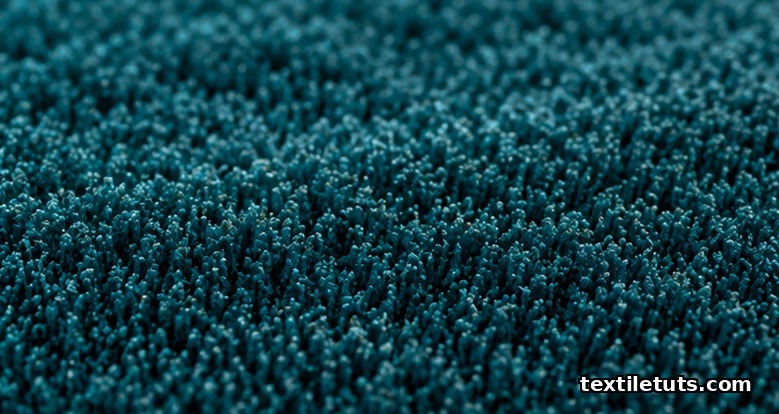
Flock printing is a textile finishing process that deposits short synthetic fibers (typically nylon, polyester, or rayon, 0.5 to 5 mm in length) onto an adhesive-coated substrate inside an electrostatic field of 30 to 100 kV, producing a velvety raised surface with pile heights between 0.3 and 4.0 mm. The finish combines a soft, suede-like hand with measurable durability, and it is used in apparel, upholstery, packaging, and automotive interiors where the look of velvet or felt is required without weaving a pile fabric.
This article explains how flock printing works, the materials and adhesives involved, the two main application methods (electrostatic and mechanical), the test methods that govern its performance, and the trade-offs a designer should know before specifying a flocked finish.
What Is Flock Printing?
Flock printing, also called flocking, is the process of applying short cut fibers (called “flock”) to a substrate that has been pre-coated with adhesive. Once the adhesive cures, the fibers stand upright and remain anchored, creating a textured, velvet-like surface. Unlike woven velvet, the pile is not interlaced with a base cloth; it is glued on top of an existing fabric, which is why flock printing can add a velvety finish to cotton, paper, plastic, or even metal.
The technique has been used industrially since the early 20th century, but the modern electrostatic method became widespread in the 1960s when high-voltage generators became small enough for production lines. Today, flock-printed textiles appear on shoe linings, gift boxes, wall coverings, automotive headliners, and sportswear.
Materials Used in Flock Printing
Three components define a flock print: the substrate (the fabric or surface being decorated), the adhesive (the binder that holds the fibers), and the flock itself.
Substrate. Most flock printing is done on woven or knitted cotton, polyester/cotton blends, or nonwoven fabrics. The substrate must be dimensionally stable during adhesive curing and able to hold the additional weight of the flock. For apparel, substrates typically weigh 80 to 250 g/m², measured per ISO 3801. Stretchy knits are usually heat-set or backed with a stabilizing scrim before flocking, because adhesive curing at 140 to 160 °C can shrink uneven yarns.
Adhesive. Water-based acrylic emulsions dominate flock printing because they cure at 140 to 160 °C without releasing large amounts of solvent. Polyurethane dispersions are used where a softer hand or higher wash resistance is needed. Adhesive coat weight is critical: too little and the flock pulls out under abrasion, too much and the hand becomes stiff. Typical wet add-on is 80 to 150 g/m², controlled by a doctor blade or rotary screen.
Flock fibers. The most common flock is precision-cut nylon (polyamide 6.6) because it has good resilience, takes dye well, and is consistent in length. Other common flock fibers include:
- Nylon (PA 6.6): Best all-around fiber for apparel; tensile strength 4.5 to 6.0 g/denier, good recovery after compression.
- Polyester (PET): Cheaper than nylon, with higher UV resistance; common in outdoor flock and automotive headliners.
- Rayon (viscose): Softest hand, but lower abrasion resistance; used in packaging and decorative goods.
- Cotton: Natural look and feel; less durable, mainly used in specialty decorative goods.
Flock length is specified in “denier × mm,” for example “1.7 denier × 1.5 mm.” Longer flock (3 to 5 mm) gives a deeper pile, while shorter flock (0.5 to 1.0 mm) gives a fine, suede-like effect. Tolerances on cut length are typically ±0.1 mm for electrostatic work; wider tolerances cause uneven pile height.
The Electrostatic Flocking Process
Electrostatic flocking is the most common industrial method for textile flock printing. The substrate is coated with adhesive using a doctor blade, roller coater, or rotary screen. While the adhesive is still wet, the substrate passes over a grounded electrode plate while a high-voltage grid suspended above charges the falling flock.
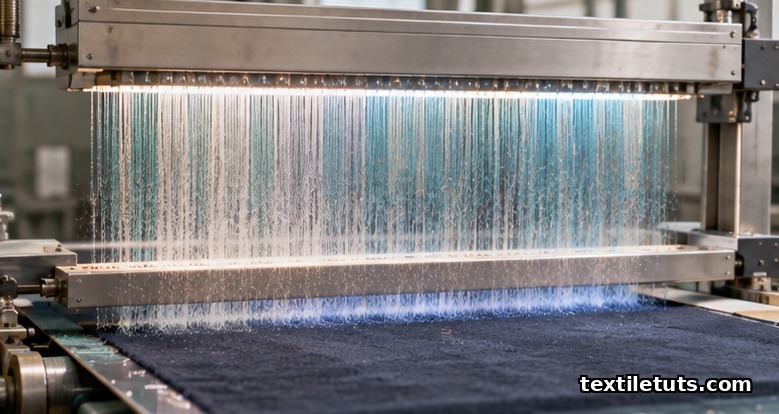
The electrode generates a high-voltage DC field, typically 30 to 100 kV, with the substrate grounded so that the field lines run from the electrode to the substrate. Pre-cut flock fibers, fed from a hopper above, become charged and travel along the field lines, embedding themselves perpendicularly into the adhesive at high velocity. This perpendicular orientation is the reason flock printing produces an even, upright pile rather than the random look of a brushed surface.
After flocking, the substrate passes through a drying and curing oven (140 to 160 °C for acrylic adhesives, dwell time 2 to 4 minutes) to set the binder. Excess flock is vacuumed off the back and sides and recycled back into the hopper. A typical line runs at 10 to 30 m/min depending on substrate weight and pile density. Lines longer than 50 m are common in apparel trim factories.
Mechanical (Beater Bar) Flocking
In beater bar flocking, the substrate is coated with adhesive and passed under a rotating drum fitted with beater bars. The bars vibrate at 50 to 100 Hz and physically beat the flock fibers into the adhesive. No high voltage is involved, so equipment cost is lower and conductive or irregular substrates (curved surfaces, three-dimensional objects, pre-formed plastic parts) can be flocked.
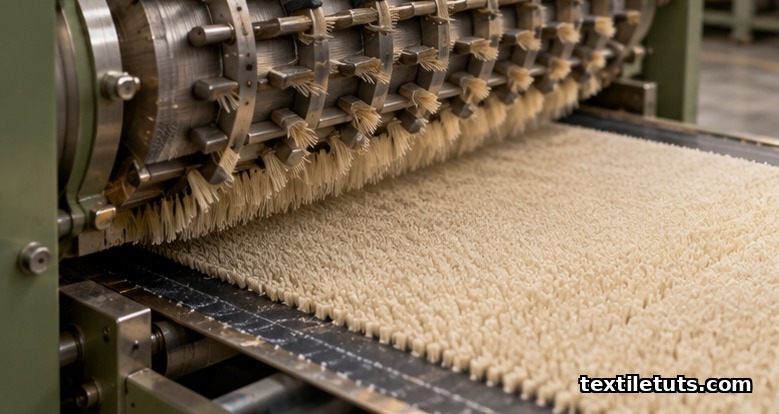
However, beater bar flocking produces a less uniform pile and lower flock density, typically 60 to 80% of the fiber count achieved by electrostatic lines on the same substrate. It is used where deep pile is not required: jewelry packaging, costume fabrics, novelty items, and some automotive trim where the flock is later covered.
Properties and Performance Testing
Flock-printed fabrics are tested against several standardized procedures before they reach the buyer. The most common methods are summarized in the table below.
| Property | Test method | Typical acceptance threshold |
|---|---|---|
| Wash fastness (home laundry) | AATCC TM61 (1A at 40 °C, 2A at 60 °C) | Grade 4 or higher on the 1 to 5 gray scale |
| Dry crocking | AATCC TM8 | Grade 3 minimum, grade 4 typical |
| Wet crocking | AATCC TM8 | Grade 2 minimum, grade 3 typical |
| Abrasion / pile retention | ASTM D4966 (Martindale) | 5,000 cycles without visible pile loss |
| Mass per unit area | ISO 3801 | Within ±5% of declared weight |
| Air permeability | ASTM D737 | Application-dependent (see FAQ) |
| Conditioning before test | ISO 2419 | 20 ± 2 °C, 65 ± 4% RH, 24 h minimum |
| General colour fastness | ISO 105 series | Buyer-specified grade |
ISO 2419 deserves a special note. The standard specifies that textile samples be conditioned at 20 ± 2 °C and 65 ± 4% relative humidity for at least 24 hours before mechanical or colorfastness testing, which removes variability from humidity-driven fiber swelling. Labs that skip this step regularly report artificially poor abrasion or crocking results on flocked samples, because the pile is at a different moisture content than it will be in the field.
Common Applications
Apparel. Hoodie logos, varsity letters, decorative panels on jackets, designer t-shirt graphics, and shoe linings. The velvety surface adds tactile contrast to flat jersey or woven ground, and the localized adhesive application keeps the rest of the garment breathable.
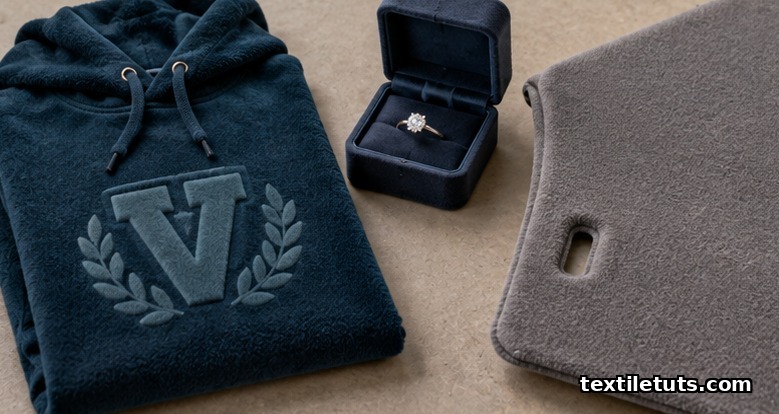
Home textiles. Curtain panels, cushion covers, wallpaper, and decorative throws. Flock-printed wall coverings offer an acoustic benefit: the raised pile absorbs sound in the 500 to 2000 Hz frequency range typical of human voice, lowering reverberation in hotel and office interiors.
Automotive interiors. Headliners, door panels, and sun visors use polyester flock for its UV resistance and ability to reduce glare. Most flock used in this segment is 1.7 to 3.3 denier × 1.0 to 1.5 mm, applied at 80 to 120 g/m² add-on.
Packaging. Jewelry boxes, watch cases, and gift bags use rayon flock because it produces a dense, soft surface that does not scratch polished or plated contents.
Technical textiles. Flock is used on gaskets, brush strips, and medical drapes where the pile holds fluid or provides controlled friction. In these applications, the adhesive is usually a higher-temperature polyurethane rather than standard acrylic.
Frequently Asked Questions
How long does flock printing last on clothing?
A well-bonded flock print on a cotton or cotton-polyester garment typically survives 30 to 50 home wash cycles when washed inside-out at 30 to 40 °C and tumble dried low. Industrial laundering above 60 °C shortens life because the adhesive softens and the pile flattens. AATCC TM61 cycles 1A (40 °C) and 2A (60 °C) are the most common benchmarks used by apparel brands to qualify a flocked garment.
Is flock printing environmentally friendly?
Modern water-based acrylic adhesives have largely replaced solvent-based systems, eliminating most volatile organic compound (VOC) emissions during curing. Nylon and polyester flock can be reclaimed from production waste and re-extruded. The main remaining concern is microplastic shedding during washing, which is mitigated by washing inside-out and using a lint filter on the washing machine. End-of-life recycling of flocked textiles is still difficult because the adhesive prevents clean fiber separation.
Can flock printing be done on any fabric?
Almost any textile substrate can be flocked if it can withstand 140 to 160 °C curing and remain flat during adhesive application. Stretchy knits may need to be stabilized (heat-set or backed with a scrim) to prevent distortion. Very open weaves can bleed adhesive through to the back, so a pre-coat or tighter construction is recommended. Plastic films and nonwovens are also flockable, though the adhesive chemistry usually has to be tuned to the substrate surface energy.
What is the difference between flock printing and velvet?
Velvet is a woven pile fabric where the pile is created during weaving by looping extra yarns over a wire that is later cut. Flock printing adds the pile after weaving by gluing short cut fibers to the surface. Velvet has a deeper, more durable pile; flock printing offers a similar look at lower cost and on substrates that cannot be woven as pile, including logos and panel effects on otherwise flat fabrics.
Does flock printing affect breathability?
Yes. Flock printing reduces air permeability because the adhesive and pile close the inter-yarn pores of the substrate. ASTM D737 can be used to quantify the loss. Light flock under 50 g/m² add-on typically reduces air permeability by 20 to 40%, while heavy upholstery flock over 150 g/m² add-on can reduce it by 70% or more. For sportswear applications, brands usually specify flock add-on below 30 g/m² and run a wear trial before bulk production.
References
- AATCC. Test Method 8: Colorfastness to Crocking. American Association of Textile Chemists and Colorists. https://www.aatcc.org
- AATCC. Test Method 61: Colorfastness to Laundering, Accelerated. American Association of Textile Chemists and Colorists. https://www.aatcc.org
- ASTM International. ASTM D4966: Standard Test Method for Abrasion Resistance of Textile Fabrics (Martindale Abrasion Tester Method). https://www.astm.org
- ASTM International. ASTM D737: Standard Test Method for Air Permeability of Textile Fabrics. https://www.astm.org
- ISO. ISO 3801: Textiles, Woven fabrics, Determination of mass per unit length and mass per unit area. International Organization for Standardization. https://www.iso.org
- ISO. ISO 2419: Textiles, Conditioning and testing atmosphere. International Organization for Standardization. https://www.iso.org
- ISO. ISO 105 Series: Textiles, Tests for colour fastness. International Organization for Standardization. https://www.iso.org
This article is a working reference on flock printing for textile engineers, apparel designers, and curious learners. Editorial by Shahrukh Islam, TextileTuts. Sources: AATCC TM8, AATCC TM61, ASTM D4966, ASTM D737, ISO 3801, ISO 2419, and ISO 105 series as cited.


