
Burnout Printing (Devoré)

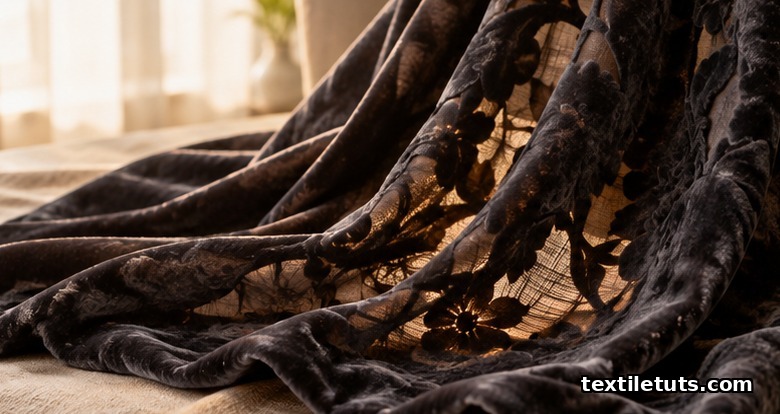
Burnout printing (devoré) is a textile printing technique that locally dissolves one fiber component of a blend fabric using a printed chemical paste, typically 50–60% sodium hydroxide or 8–12% aluminum chloride, leaving a sheer, transparent pattern where the cellulose has been removed while the synthetic or protein fiber remains intact. The technique takes its name from the French verb dévorer (to devour), because the print paste “eats away” the cellulose fibers in the printed areas, producing fabrics with intentionally two-toned drape and transparency. The classic application is a polyester/viscose velvet where the viscose pile is burned out to leave sheer polyester ground beneath, a look no other printing method can replicate.
The chemistry is selective, not reductive: it relies on the well-known alkali-sensitivity of cellulose (cotton, viscose, linen) and the comparative stability of polyester, nylon, or silk under controlled alkaline conditions. The paste is printed onto the fabric, dried, baked at 180–220 °C to activate the reaction, then washed off. The dissolved cellulose leaves the printed area translucent; the unprinted area retains the original fiber blend and full opacity. The result is a fabric with woven-in transparency, not an applied sheer layer.
This article covers the fiber chemistry that makes burnout possible, the print paste formulations, the process steps, the fabric constructions where burnout printing works, the design characteristics of the finished fabric, and the quality-control tests used to verify durability.
Why burnout printing exists: cellulose versus synthetic in one fabric
A burnout print starts with a blend fabric, usually a woven or knit made from two or more fiber types with very different chemical sensitivities. The most common blends are:
- Polyester/cotton (typically 65/35 or 50/50), used for shirting, dress fabrics, and lightweight curtain material. The polyester remains after burnout; the cotton is dissolved.
- Polyester/viscose (rayon) blends, the classic burnout substrate, especially in velvet and velour where the viscose pile can be burned out to leave a sheer polyester ground.
- Silk/viscose blends, used in haute couture and scarf printing. Both fibers are protein- or cellulose-based; the viscose is dissolved and the silk remains, producing an extremely fine sheer pattern with the silk’s natural luster preserved.
- Nylon/cotton blends, less common but used in some technical and fashion applications.
The blend must contain at least 30% cellulose (cotton, viscose, linen, lyocell) for the burnout effect to register visibly. Below 30%, the dissolved portion is too small to produce a clear sheer area. Above 70%, the residual synthetic skeleton may not have enough mechanical integrity to hold together after burnout, especially in woven constructions where the cellulose is part of the load-bearing yarn structure.
The key chemical fact is that concentrated sodium hydroxide solutions swell and dissolve cellulose at elevated temperatures, while leaving the peptide bonds of silk and the ester linkages of polyester largely intact under the same conditions (if the temperature and time are controlled). Aluminum chloride (AlCl₃) paste works by acidic hydrolysis at lower temperatures, useful for substrates where strong alkali would damage the synthetic component.
The print paste: sodium hydroxide versus aluminum chloride
Two paste chemistries dominate commercial burnout printing, chosen by substrate and by desired handle.
Sodium hydroxide paste (alkaline burnout)
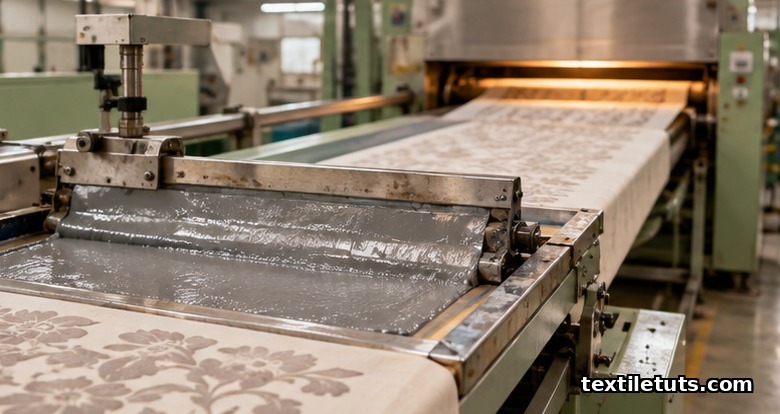
The standard recipe for cellulose/synthetic blends uses 50–60% sodium hydroxide (NaOH, caustic soda) mixed into a print paste with a thickener (typically a starch ether or polyacrylate), a wetting agent, and sometimes glycerin as a humectant to slow surface drying. The high viscosity paste is printed through a rotary or flat screen at typical coat weights of 80–120 g/m². The fabric is dried, then baked at 180–220 °C for 30–90 seconds; the heat activates the NaOH-cellulose reaction, dissolving the cellulose fibers in the printed areas. After baking, the fabric is washed in hot water (70–90 °C) with mild acid (acetic acid) to neutralize residual alkali, then rinsed and dried.
Alkaline burnout produces sharp, well-defined pattern edges and is the workhorse method for polyester/viscose velvet, where the viscose pile is dissolved cleanly without disturbing the polyester ground weave. The main risk is over-treatment: too high a temperature, too long a bake, or too concentrated a paste will degrade the polyester, leaving a brittle, yellowed residual fabric in the burnout area.
Aluminum chloride paste (acidic burnout)
For substrates sensitive to strong alkali, especially silk/viscose blends where silk’s peptide bonds are alkali-sensitive, the paste uses 8–12% aluminum chloride (AlCl₃·6H₂O) in a print paste. The aluminum chloride acts as a Lewis acid, hydrolyzing the cellulose glycosidic bonds when baked at 150–170 °C for 60–120 seconds. The bake temperature is lower than for alkaline burnout, which protects the silk component. After baking, the fabric is washed and neutralized with a mild alkali.
Acidic burnout gives softer pattern edges than alkaline burnout (slight diffusion of the acid during baking), which can be a design feature or a defect depending on the look required.
Resist and additive options
Two design options are common in production:
- Discharge-burnout combination, where a colored dye is added to the burnout paste so the residual synthetic fiber in the burnout area is dyed simultaneously with the cellulose being dissolved. Used for colored sheer patterns.
- Resist-burnout, where a resist agent (wax, synthetic thickener) is printed onto areas of the cellulose component before burnout, leaving raised cellulose patterns against a sheer background.
The burnout printing process, step by step
1. Substrate preparation
The greige blend fabric is scoured, bleached, and sometimes pre-dyed. Pre-dyeing is common when the residual synthetic component is to be a specific color (e.g., a deep navy polyester ground in a burnout velvet that will appear as a sheer navy pattern after burnout). Pre-dyed grounds use disperse dyes for polyester or acid dyes for nylon/silk, applied by exhaust or pad methods and fixed before the burnout print paste is applied.
Fabric construction matters. The blend must have the cellulose and synthetic components in distinct yarn positions for a clean burnout effect. In a polyester/viscose velvet, the pile yarn is typically viscose and the ground yarn is polyester, so burnout of the pile leaves a sheer polyester backing. In a 50/50 polyester/cotton plain weave, burnout dissolves the cotton yarns in the printed areas, leaving the polyester yarns in place and producing a net-like sheer effect.
2. Printing the paste
The burnout paste is applied by rotary screen (production volumes), flat screen (sampling, short runs), or occasionally by digital inkjet where specialized heads can handle the high-viscosity, chemically active paste. Screen mesh counts typically run 60–100 mesh (coarser than pigment print screens) because the paste is thick and the burnout effect does not need fine detail to register.
The paste has a limited working life (8–24 hours depending on storage temperature), so printers mix batches to match the production run length. The fabric must be handled with corrosion-resistant equipment (stainless steel or plastic) because concentrated NaOH or AlCl₃ attacks standard carbon steel and aluminum components.
3. Drying and baking
After printing, the fabric is dried at 100–120 °C to remove surface moisture, then baked at the higher temperature required for the burnout chemistry (180–220 °C for NaOH, 150–170 °C for AlCl₃). Typical dwell times are 30–90 seconds in a stenter or continuous baking oven. The bake is the critical step: insufficient heat gives an incomplete burnout (the cellulose is only softened, leaving a stiff, opaque residue), excessive heat degrades the synthetic component (polyester yellows, silk loses tensile strength).
4. Washing and neutralizing
After baking, the fabric passes through a multi-bath wash sequence. A hot water rinse (70–90 °C) removes the dissolved cellulose fragments and residual paste. For NaOH burnout, an acid neutralization bath (acetic acid at pH 5–6) follows. A final soap-off removes thickener residue and any unfixed dye. The fabric is dried on a stenter under controlled tension to set the final dimensions.
5. Finishing
Depending on the end use, burnout-printed fabric may be softened (silicone emulsion pad), stabilized (resin finish to reduce distortion in the sheer areas), or heat-set (for polyester content). For velvet applications, the pile may be re-raised by brushing or rotary polishing after burnout to restore loft in the unprinted (non-burned) pile areas.
Fabric constructions where burnout printing excels
Velvet and velour
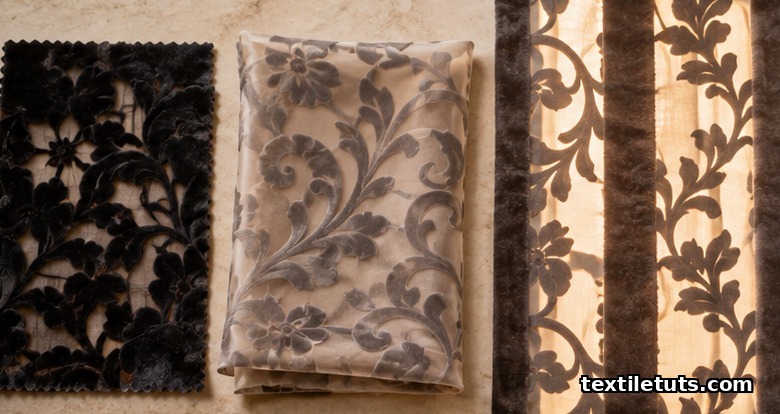
The signature application. Polyester/viscose velvet with a 65/35 to 50/50 ratio is the industry standard for burnout velvets, used in evening wear, scarves, drapery, and decorative textiles. The viscose pile is dissolved, leaving a sheer polyester ground with patterned transparency. The drape becomes much softer in the burned-out areas, producing a fabric with intentional two-zone stiffness.
Dress and blouse fabrics
Polyester/cotton or polyester/viscose blends in plain weave, satin, or crepe constructions. Burnout produces feminine sheer motifs on opaque grounds, popular for summer dresses, blouses, and scarves.
Curtain and home textile
Burnout curtain fabrics (often polyester/cotton or polyester/viscose) create patterns with intentionally varied opacity, allowing partial light transmission. A polyester/cotton burnout velvet curtain produces a sheer pattern in the daytime, providing both privacy and light.
Scarf and accessory fabrics
Silk/viscose blends are prized for luxury scarves, where the silk content gives a soft luster and the viscose burnout gives a fine sheer pattern.
Quality control: testing the burnout effect
Burnout-printed fabric must pass the same colorfastness tests as any printed textile, plus specific tests for the structural integrity of the sheer areas. The standard test references include:
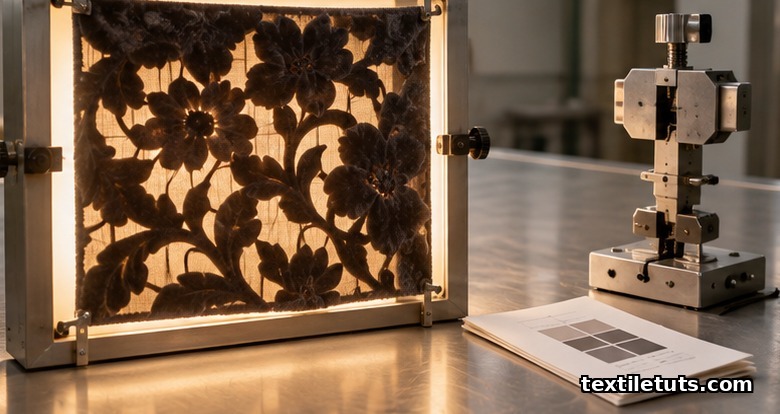
- ISO 105-C06: Colorfastness to domestic and commercial laundering. Burnout prints are tested at 40 °C and 60 °C to ensure the sheer areas do not distort or tear in wash.
- ISO 105-B02: Colorfastness to artificial light (xenon arc). Critical for curtains and drapery where the burnout pattern is exposed to daylight.
- AATCC TM 8: Colorfastness to crocking (dry and wet). The sheer areas are particularly susceptible to crocking because there is less fiber mass to hold the dye.
- ASTM D5034: Tensile strength (grab method). Used to verify that the residual synthetic component in the burnout area retains adequate tensile strength for the end use.
- ISO 13937: Tear strength. Tear strength in the sheer areas is significantly lower than in the opaque areas and must be measured to ensure the fabric is fit for purpose (e.g., a burnout velvet curtain that tears under its own weight is a fabrication failure).
A common in-house test is the “transparency check”: the burned-out area is held over a backlit surface and the evenness of the light transmission is visually assessed. Uneven light transmission indicates incomplete burnout, often caused by insufficient paste deposit, uneven drying, or under-baking.
Common defects and their causes
- Incomplete burnout: opaque or stiff residues in the printed areas. Causes: paste deposit too low, bake temperature too low, dwell time too short, paste aged past its working life.
- Pattern bleeding: design edges that are fuzzy or wider than the screen. Causes: paste too thin (low viscosity), over-baking causing acid/alkali diffusion, fabric movement during baking.
- Yellowing or tendering of residual synthetic: brittle, discolored burnout zones. Causes: bake temperature too high, dwell time too long, residual alkali/acid not fully neutralized.
- Distortion of sheer areas: puckering or stretching in the burned-out zones. Causes: uneven fabric tension during drying or stenter finishing, uneven paste application.
Frequently asked questions
Is burnout printing the same as discharge printing?
No. Discharge printing removes color from an already-dyed fabric using a reducing agent (such as sodium formaldehyde sulfoxylate); the fiber remains intact and only the dye is destroyed. Burnout printing removes the fiber itself (one component of a blend), using an alkali or acid to dissolve the cellulose component, and the fabric is left with sheer areas. The two techniques can be combined: a discharge-burnout paste contains both a reducing agent (to destroy dye) and a fiber-dissolving agent (to dissolve cellulose).
Which fabrics cannot be burnout printed?
Pure cellulosic fabrics (100% cotton, 100% viscose, 100% linen) and pure synthetic fabrics (100% polyester, 100% nylon) cannot be burnout printed because there is no second fiber to remain after the cellulose is dissolved. The technique requires a blend of at least two chemically distinct fiber types, with the cellulose content typically between 30% and 70% of the fabric weight for a clean effect.
Does burnout printing weaken the fabric?
Yes, by design. The sheer areas have a lower fiber mass and lower tensile and tear strength than the unprinted areas, typically 30–60% of the original strength depending on the cellulose content of the blend. For apparel end uses this is generally acceptable because the sheer zones are designed as decorative elements; for load-bearing applications (workwear, upholstery) burnout printing is unsuitable. A properly neutralized and finished burnout fabric is durable to standard laundering at 30–40 °C but should not be bleached or dry-cleaned with harsh solvents, which can degrade the residual synthetic component.
What is the environmental impact of burnout printing?
Burnout printing generates a high-COD (chemical oxygen demand) wastewater load because the dissolved cellulose fragments, residual NaOH or AlCl₃, and thickener residue all end up in the wash water. Modern facilities neutralize the alkaline or acidic effluent, precipitate the dissolved solids, and treat the water through biological and activated-carbon stages before discharge. Aluminum chloride burnout generates an aluminum-containing sludge that requires separate disposal; NaOH burnout is generally easier to treat because the neutralization product (sodium acetate or sodium sulfate) is benign. The polyester or silk residual component is recoverable from process scraps and is recyclable where the blend construction permits.
Can burnout prints be done on knit fabrics?
Yes. Polyester/viscose jersey knits, polyester/cotton interlock, and nylon/viscose knit velours are all substrates for burnout printing. Knits require tighter process control than wovens because the loop structure is more easily distorted by the chemical and thermal treatment, and the burnout areas can lose stitch density (runs) if the process is too aggressive. Lower bake temperatures and shorter dwell times are typical for knit substrates.
References
- ISO. ISO 105-C06:2010, Colorfastness to domestic and commercial laundering. International Organization for Standardization. Standard test method for wash fastness of textile prints.
- ISO. ISO 105-B02:2014, Colorfastness to artificial light: Xenon arc fading lamp test. International Organization for Standardization. Lightfastness test applicable to burnout drapery and apparel.
- ISO. ISO 13937-1:2000, Textiles — Tensile properties of fabrics — Part 1: Determination of maximum force using the strip method. International Organization for Standardization.
- ASTM International. ASTM D5034-21, Standard Test Method for Breaking Strength and Elongation of Textile Fabrics (Grab Test). ASTM International, West Conshohocken, PA.
- AATCC. AATCC Test Method 8-2016, Colorfastness to Crocking: AATCC Crockmeter Method. American Association of Textile Chemists and Colorists, Research Triangle Park, NC.
- Broadbent, A. S. Wet Processes for Textile Printing: Devoré and Burn-Out. In: Handbook of Textile and Industrial Dyeing, Volume 2. Woodhead Publishing (Elsevier), 2011. Peer-reviewed treatise on devoré chemistry and process control.
- Nunn, D. M. The Dyeing of Synthetic Polymer and Acetate Fibres. SDC (Society of Dyers and Colourists), 1979. Historical reference for the disperse-dye chemistry used in pre-dyed burnout grounds.
This article is the working reference for burnout (devoré) printing. Editorial by Shahrukh Islam, TextileTuts. Sources: ISO 105-C06, ISO 105-B02, ISO 13937, ASTM D5034, AATCC TM 8, and Woodhead Publishing as cited.


