
Foam Dyeing Technology

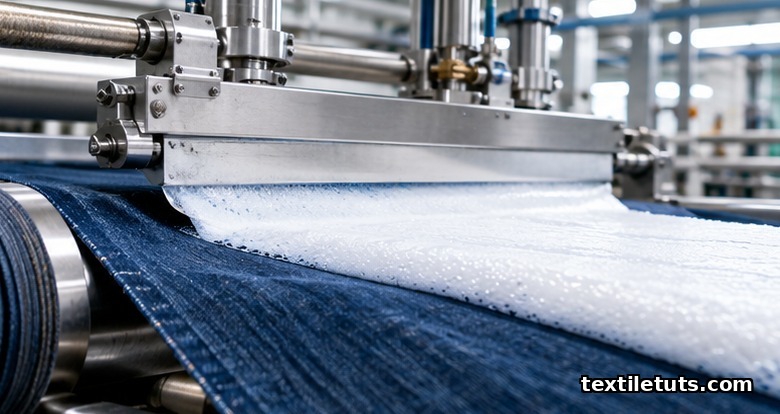
Foam dyeing technology applies dye liquor as a stabilized foam with a blow ratio of 4:1 to 15:1, replacing conventional padding’s 60 to 80 percent wet pickup with 10 to 30 percent wet pickup and reducing water consumption by 50 to 80 percent per kilogram of fabric.
By replacing most of the water in a dye bath with air, foam dyeing cuts drying energy, lowers effluent load, and lets dyers and finishers apply chemistry more evenly across heavy or pile fabrics. This article explains how foam is generated and stabilized, what machinery is used, where the technology is commercially deployed, and where it still has limits.
Below you will find the chemistry of foam, the equipment used to apply it, and a side-by-side comparison with conventional exhaust and pad dyeing.
What is foam dyeing technology?
Foam dyeing is a low liquor application technique where a dye liquor is first converted into a stable foam using air, a surfactant, and mechanical shear, then applied to the fabric surface. The fabric carries the foam into its structure and the liquor is released as the foam collapses. The term covers both coloration (foam dyeing) and chemical finishing (foam finishing), and the underlying physics is identical.
Conventional exhaust dyeing runs at a liquor ratio of 1:6 to 1:15 (kilograms of fabric to liters of water), and pad dyeing applies 60 to 80 percent wet pickup on the fabric weight. Foam dyeing collapses that liquid requirement: by replacing most water with air, the wet pickup drops to 10 to 30 percent on flat fabrics (and can be set much higher on pile constructions), and the fabric still carries the same amount of active dye and auxiliaries per unit weight.
The “blow ratio” is the volumetric ratio of finished foam to the original liquid used to generate it. A blow ratio of 5:1 means 5 parts foam for every 1 part original liquid. Industrial foam finishing typically operates between 4:1 and 15:1, with 8:1 to 12:1 being common for carpet and denim applications.
The chemistry: how the foam is built and held
A working foam is a dispersion of gas bubbles in a thin liquid film. Three things decide whether the foam survives long enough to be useful in a dyeing line: bubble size distribution, surface viscosity, and drainage rate.
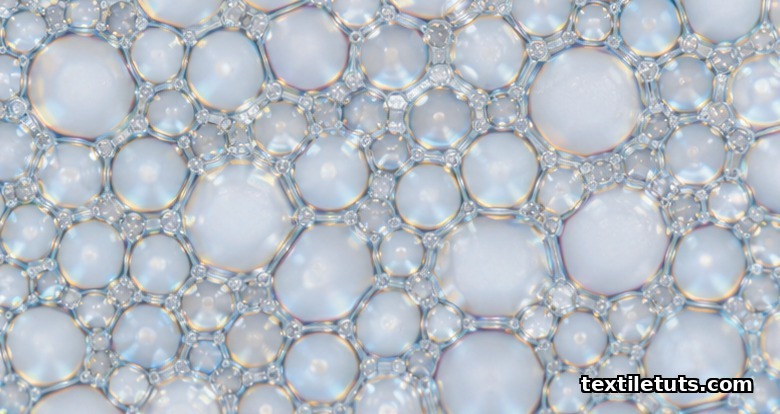
Surfactants lower the surface tension of the liquid film. The most common foamers in textile processing are anionic surfactants such as sodium lauryl sulfate and nonionic surfactants such as alcohol ethoxylates. Typical foamer concentrations range from 0.5 to 2.0 grams per liter of dye liquor, well below the levels used in detergent products, because textile foam is designed to collapse on the fabric rather than persist.
Foam stabilizers, often fatty acid alkanolamides or modified celluloses, slow the drainage of liquid from the lamella between bubbles. Viscosity modifiers such as carboxymethyl cellulose, sodium alginate, or synthetic polyacrylates raise the bulk viscosity of the liquid phase and slow bubble coalescence.
Dyes and auxiliaries added to the formulation must not destabilize the foam. Highly alkaline reactive dye systems can hydrolyze foaming surfactants above pH 12, which is one reason some reactive foam recipes operate at moderated pH and rely on a post-application fixation step. In practice, foam chemists test a given dye and surfactant combination in a graduated cylinder for collapse time before approving the recipe for the production line.
Process and machinery
Industrial foam lines consist of four stages: foam generation, foam application, foam collapse and penetration, and drying or fixation.
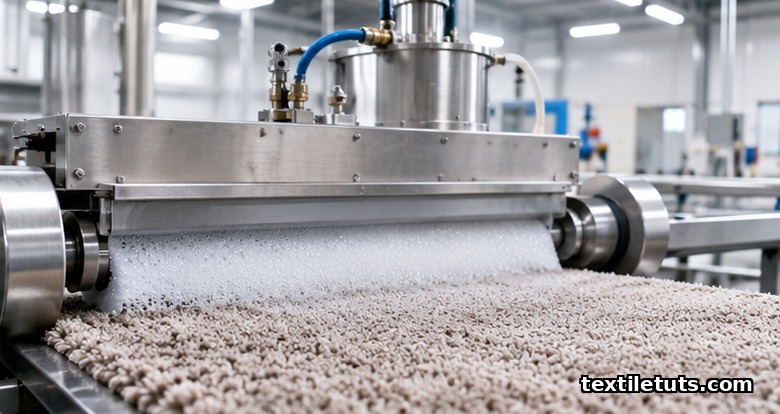
Foam generation. Foam is made in a foamer head that combines dye liquor and compressed air at high shear. Two common designs are dynamic mixers (rotor-stator) and static mixers (a series of fixed baffles inside a tube). Dynamic mixers give finer, more uniform bubbles and are standard in modern lines. Compressed air is metered into the foamer at a controlled rate; the volumetric ratio of air to liquid determines the blow ratio.
Foam application. Four applicator geometries dominate the industry:
- Knife-over-roll: a precisely metered blade lays a uniform foam layer onto fabric moving over a roll. Widely used for carpet backing and flat woven foam finishing.
- Roller coating: foam is picked up by a rotating roller and transferred to the fabric. Common for flat woven fabrics and foam finishing of knits.
- Slide applicator: foam flows down a chute onto an inclined fabric. Used in some technical textile lines for one-sided application.
- Horizontal pad: foam is metered between two nip rollers, similar to a conventional pad but with foam in the nip rather than free liquor.
Collapse and penetration. Once the foam contacts the dry fabric, capillary action pulls the liquid phase into the yarn structure and the foam collapses. Controlled collapse is important: collapse that is too fast gives surface staining, collapse that is too slow gives uneven distribution. Vacuum-assisted collapse or a heated platen can be used to control the rate on sensitive constructions.
Drying and fixation. Because the wet pickup is so much lower, drying energy is reduced roughly in proportion to the pickup drop. A foam line running at 20 percent wet pickup uses about half the drying energy of a pad line at 70 percent wet pickup on the same fabric weight. Reactive dye fixation is normally driven by subsequent steaming or thermofixation at 150 to 180 degrees Celsius.
Comparison with conventional exhaust and pad dyeing
| Parameter | Exhaust dyeing | Pad dyeing | Foam dyeing |
|---|---|---|---|
| Liquor ratio (water per kg fabric) | 6 to 15 L | 0.5 to 1 L (mostly in pad trough) | 0.3 to 0.7 L |
| Wet pickup on fabric | N/A | 60 to 80 percent | 10 to 30 percent (flat), 200 to 300 percent (carpet) |
| Blow ratio | N/A | N/A | 4:1 to 15:1 |
| Drying energy | High | Medium | Low (about half of pad) |
| Effluent volume | Very high | Medium | Low |
| Suitable fabric constructions | Most woven and knit | Open constructions | Carpets, denim, pile, heavy wovens, nonwovens |
| Color uniformity on heavy fabrics | Variable | Variable | Good if foam is well controlled |
Advantages and limitations
Advantages. Foam dyeing can cut water consumption by 50 to 80 percent, cut drying energy by roughly half, and reduce effluent treatment load. Because less water is being moved and evaporated, line speeds can often be raised, and a foam line typically has a smaller footprint than a comparable pad line. Foam also penetrates pile and carpet constructions more evenly than a liquid pad, because the foam structure holds the chemistry in the pile height until the fabric pulls it in.
Limitations. Foam lines are more sensitive to recipe chemistry than pad or exhaust lines. A change in surfactant lot, water hardness, or dye grade can shift bubble size distribution and produce mottle. Foam also struggles on tightly woven, lightweight constructions where the foam cannot wet into the structure before collapsing on the surface, which produces face staining. Reactive dye recipes at high pH can be unstable in foam, so most reactive foam applications use a two-step process: foam apply, then steam-fix.
Process control matters. Bubble size is typically held between 50 and 200 micrometers. Above 200 micrometers, the foam becomes unstable and tends to collapse prematurely during application. Below 50 micrometers, the foam becomes too dense to wet through pile constructions evenly. Foam density on the line is checked by weighing a fixed volume of foam and expressed in grams per liter; a working carpet foam at 10:1 blow ratio runs around 80 to 120 g/L.
Industrial applications
Foam dyeing and foam finishing are most widely deployed in three areas: carpet, denim, and technical textiles.
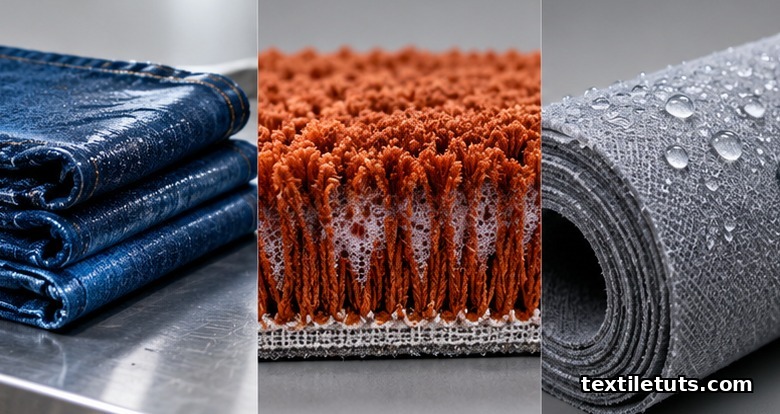
Carpet. Carpet foam dyeing, sometimes called the Küsters or “foam color applicator” process, has been in commercial use since the 1970s. Foam is the dominant method for continuous dyeing of tufted carpet because it carries dye uniformly into a deep pile without flooding the backing. A typical carpet foam line runs at 8:1 to 12:1 blow ratio with wet pickup of 200 to 300 percent on carpet weight, far above the pickup on a flat woven fabric. The carpet foam process handles acid, disperse, and reactive dye classes depending on the fiber (nylon 6, nylon 6,6, polyester, or wool).
Denim. Foam finishing for denim includes application of softeners, desizing agents, and indigo top-dye adjustments. Several foam finishing lines are used for finishing stretch denim where low wet pickup prevents distortion of the elastic fiber.
Technical textiles. Foam application is used to apply fluorocarbon water repellents, flame retardants, and antimicrobial finishes to nonwovens and coated fabrics, where the low wet pickup prevents strike-through and keeps the chemistry on the surface. Foam is also used for finishing geotextiles and automotive interior fabrics where controlled add-on is critical.
Quality control and standards
Foam-dyed fabrics are evaluated against the same colorfastness standards as conventionally dyed fabrics. ISO 105-C06 covers color fastness to domestic and commercial laundering, ISO 105-B02 covers color fastness to artificial light with xenon arc exposure graded against the blue wool scale, and AATCC TM 8 covers color fastness to crocking. Color measurement is done with a spectrophotometer per ISO 13655 or AATCC Evaluation Procedure 6, comparing color difference (delta E) against a standard.
For process control on the foam line itself, ASTM D3514 covers surface changes of textile fabrics, and AATCC TM 150 covers drying and curing performance of foam-finished fabrics. Foam density is typically measured by weighing a fixed volume of foam and expressed in g/L; a working carpet foam at 10:1 blow ratio runs around 80 to 120 g/L.
Frequently Asked Questions
What is the blow ratio in foam dyeing?
The blow ratio is the volumetric ratio of finished foam to the original liquid used to generate it. A 10:1 blow ratio means 10 parts of foam were produced from 1 part of dye liquor. Most industrial foam dyeing lines run between 4:1 and 15:1, with 8:1 to 12:1 being the common range for carpet and denim applications.
How much water does foam dyeing save compared to conventional dyeing?
Foam dyeing typically saves 50 to 80 percent of the water used in a comparable exhaust or pad process. The savings come from the lower wet pickup on the fabric, which means less water enters the system in the first place, less water must be evaporated in drying, and less dye liquor is wasted to effluent.
Can reactive dyes be applied by foam?
Yes, but with caveats. Reactive dye systems above pH 12 can destabilize common foaming surfactants, so most reactive foam recipes operate at moderated pH and rely on a separate steam or thermal fixation step. Commercial lines using reactive dyes by foam typically pair the foam applicator with a steamer running at 150 to 180 degrees Celsius.
What fabrics is foam dyeing not suitable for?
Foam dyeing works poorly on very lightweight, tightly woven fabrics where the foam collapses on the fabric surface before it can wet into the structure, producing face staining. It also requires careful control on very deep pile constructions where under-wetting can leave the pile base uncolored. For these cases, exhaust or pad dyeing remains the safer option.
Does foam dyeing affect color fastness?
When the foam recipe is well controlled, color fastness properties of foam-dyed fabrics (wash, light, crock) are equivalent to those of conventionally dyed fabrics, because the dye chemistry reaching the fiber is the same. The difference is in how the dye gets there, not in the final bond between dye and fiber. Color fastness is still verified against the relevant ISO 105 and AATCC test methods.
References
- International Organization for Standardization. ISO 105-C06:2010, Textiles — Tests for colour fastness — Part C06: Colour fastness to domestic and commercial laundering. iso.org — colorfastness test method widely used to verify foam-dyed fabric performance.
- International Organization for Standardization. ISO 105-B02:2014, Textiles — Tests for colour fastness — Part B02: Colour fastness to artificial light (xenon arc fading lamp test). iso.org — xenon arc exposure test graded against the blue wool reference scale.
- AATCC. AATCC Technical Manual, current edition. aatcc.org — annually updated collection of AATCC test methods including TM 8 (crocking) and TM 150 (foam finishing performance).
- ASTM International. ASTM D3514 / D3514M-16, Standard Test Method for Pilling Resistance and Other Related Surface Changes of Textile Fabrics. astm.org — surface appearance reference relevant to foam-finished carpet and pile fabric evaluation.
- Mahapatra, N. N. Textile Dyeing. Woodhead Publishing India / Elsevier — book chapter covering foam dyeing blow ratio, surfactants, and applicator design in textile coloration.
- Elsevier. Textile Research Journal, articles on foam finishing and foam application in technical textiles. sciencedirect.com — peer-reviewed journal indexing foam application case studies across fiber types.
- MDPI. Polymers journal, sustainable textile finishing special issues. mdpi.com — peer-reviewed open-access journal including foam dyeing of cotton and cellulosic substrates.
This article is the working reference for foam dyeing technology. Editorial by Shahrukh Islam, TextileTuts. Sources: ISO 105-C06, ISO 105-B02, AATCC Technical Manual, ASTM D3514, Mahapatra Textile Dyeing, Textile Research Journal, MDPI Polymers, as cited.


