
Digital Printing and Water Savings

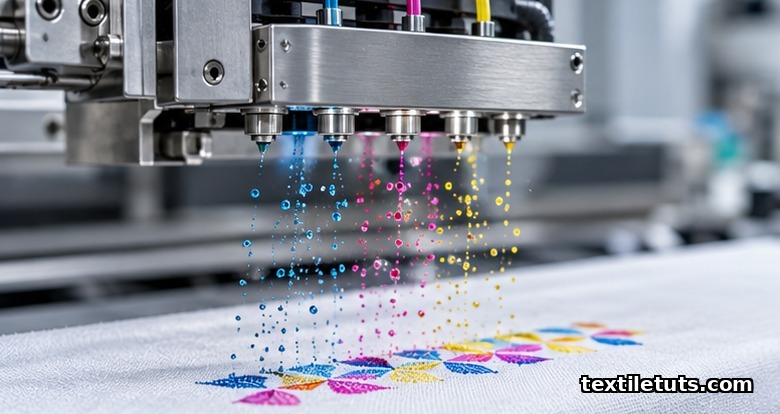
Digital textile printing reduces process water consumption by approximately 60 to 90 percent compared to rotary screen printing with reactive dyes on cotton, with pigment-ink digital routes on cotton using only about 2 to 5 liters of water per kilogram of printed fabric versus 100 to 200 liters per kilogram for conventional reactive screen printing.
The savings come from three structural changes: inkjet print heads deposit dye only where color is needed (no thickener paste in the color formulation), most screens disappear entirely, and the volume of wash water needed to remove hydrolyzed dye and auxiliaries drops sharply. Reactive-ink digital printing, which still requires a wash step to clear unfixed dye, typically uses 10 to 30 L of water per kilogram of fabric, roughly one-fifth to one-sixth of the conventional reactive screen route on cotton.
This guide explains where the water goes in each printing route, which ink chemistry saves the most, what the peer-reviewed life-cycle assessments report, and where digital printing still uses water you should plan for in mill design.
Why Conventional Reactive Printing Uses So Much Water
Rotary screen printing with reactive dyes on cotton has been the workhorse of the industry for decades because reactive dyes form a covalent bond with cellulose under alkaline conditions, giving wash fastness rated 4 to 5 on the ISO 105 grey scale (ISO 105-C06). The cost of that durable bond is water. A typical reactive print line uses water in five distinct stages: color paste preparation, screen washing between colors, fabric pre-treatment, post-printing steaming, and the soaping-off wash that removes unfixed hydrolyzed dye and residual thickener.
Published life-cycle assessments put the process water footprint of cotton knit printing by the conventional reactive route at roughly 100 to 200 L per kilogram of finished fabric, depending on the number of colors, the fabric weight, and the wash-bath configuration. The largest single contributor is the soaping-off step, which can require three to five rinse baths at 80 to 95 °C plus a detergent to reach acceptable fastness on commercial spec.
AATCC Test Method 61 (Colorfastness to Laundering: Accelerated) is the standard method mills use to verify that the wash-off is complete. If residual hydrolyzed reactive dye remains on the fiber, the wash-fastness rating drops below 4 and the fabric fails commercial acceptance for most apparel end uses.
How Digital Printing Cuts Water: The Process
Digital textile printing uses piezoelectric or thermal inkjet print heads (Epson, Ricoh, Kyocera, and Fuji Dimatix print head architectures) to fire drops of 1 to 30 picoliters of ink directly onto fabric that has been pre-treated with a padding liquor. There are no screens to wash between colors and no screens to store. Color changes happen at the print head, and most color-change waste is reduced to a few milliliters of ink line flush.
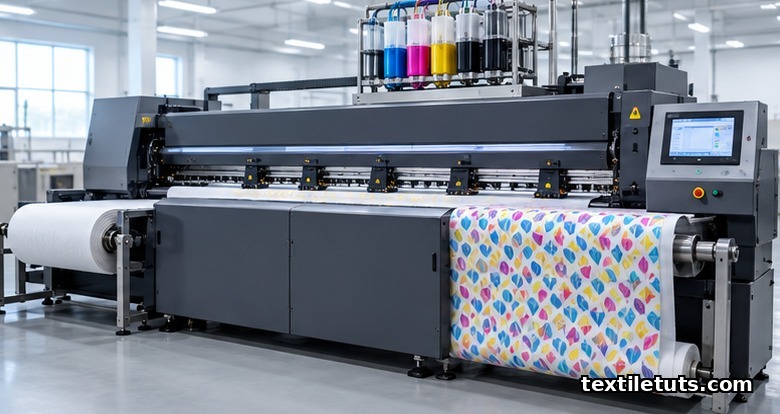
Three structural changes drive the water savings measured in published studies:
- No thickener paste in the color. Conventional reactive printing uses 3 to 5 percent sodium alginate or synthetic thickener in each color paste, which must later be washed out to restore fabric hand. Digital inks carry the dye in a low-viscosity vehicle of 1 to 5 percent auxiliaries, and the unfixed fraction is small enough to clear in one or two rinse baths.
- No screen washing. Color changes happen at the print head; there are no screens to rinse between runs and no per-color wash water.
- Higher dye fixation. Color is applied only where it is needed, so the total dye fixation on the fiber is significantly higher (typically 70 to 90 percent for reactive digital versus 50 to 70 percent for screen), and less hydrolyzed dye needs to be washed off after fixation.
The combined effect, in peer-reviewed studies published in MDPI Sustainability and the Journal of Cleaner Production, is a measured water footprint of 10 to 30 L per kilogram for reactive-ink digital printing versus 100 to 200 L per kilogram for conventional reactive screen printing on cotton of similar mass.
Water Use by Ink Chemistry: Comparison Table
| Process | Ink class | Typical water use (L/kg fabric) | Wash step required | ISO 105 / AATCC wash-fastness rating (typical) |
|---|---|---|---|---|
| Conventional rotary screen, cotton | Reactive | 100 to 200 | Yes, 3 to 5 rinse baths at 80 to 95 °C | 4 to 5 |
| Conventional flat screen, cotton | Pigment | 15 to 30 | Yes, light rinse | 3 to 4 |
| Digital, cotton | Reactive | 10 to 30 | Yes, 1 to 2 rinse baths | 4 to 5 |
| Digital, cotton | Pigment | 2 to 5 | No (cure only at 160 to 180 °C) | 3 to 4 |
| Digital, polyester | Disperse | 5 to 15 | Optional reduction clear | 4 to 5 |
| Digital, silk or nylon | Acid | 15 to 40 | Yes, light rinse | 4 to 5 |
Ranges are from published mill data and life-cycle assessments; values vary by fabric mass, color depth, and machine configuration. Pigment and disperse digital routes eliminate the multi-bath soaping-off step and dominate the low-water end of the table.
Which Ink Class Saves the Most Water
Pigment inks save the most water because they need only a thermal cure (typically 160 to 180 °C for 2 to 4 minutes) to bond the pigment particles to the fiber surface with a binder, with no steaming and no wash-off. A digital pigment line on cotton uses approximately 2 to 5 L of water per kilogram of fabric, almost all of it in the pre-treatment pad bath and the dryer-side condensate. Pigment is also the chemistry with the broadest substrate range, working on cotton, polyester, and blends from the same ink set.
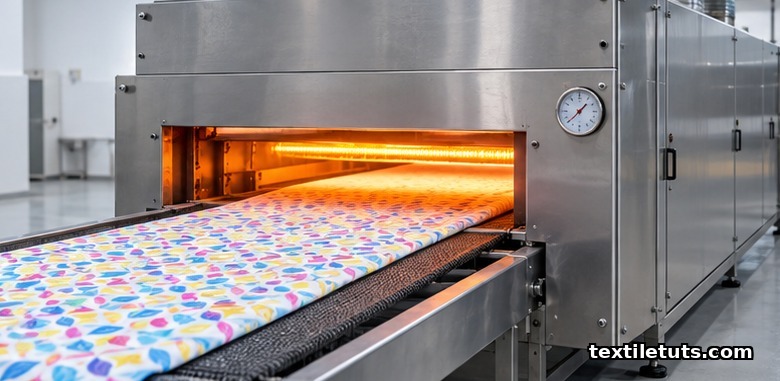
Disperse inks on polyester are the second lowest, at 5 to 15 L per kilogram. Polyester is fixed by thermosol treatment at 190 to 210 °C for 1 to 2 minutes without water, and a reduction-clear wash is needed only for deep shades or when high wet-fastness is required for technical specifications.
Reactive inks on cotton still use the most water among the major digital routes because the dye-fiber bond requires steaming in saturated steam at 100 to 102 °C for 10 to 15 minutes, followed by a wash to remove hydrolyzed reactive dye and any residual auxiliaries. Even so, reactive digital uses 10 to 30 L per kilogram, an 80 to 90 percent reduction over the screen route for the same design.
Acid inks on silk and nylon follow a similar water profile to reactive inks because they also require a fixation steam and a light rinse, but the smaller batch sizes typical for silk print samples give a wider variation in measured water footprint across studies.
Where Digital Printing Still Uses Water
Digital printing is not water-free, and mills should plan for it. The four water-using steps in a digital line are:
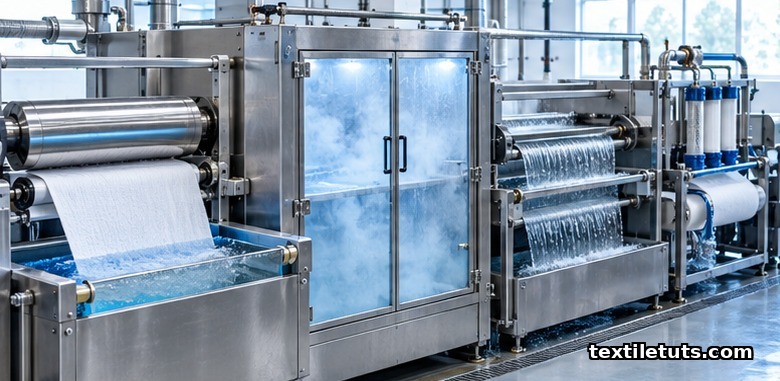
- Pre-treatment padding. Fabric is padded with a sizing or pre-coat liquor (typically water-based) to control ink absorbency and prevent wicking at print head resolution. Pad liquor is reused across batches but is replaced when contamination builds up.
- Steam fixation. Reactive and acid inks need saturated steam at 100 to 102 °C for 10 to 15 minutes. Steam itself is not process water, but the steam generator is fed with treated water and the condensate stream must be managed or recovered.
- Post-wash. Reactive and acid inks require 1 to 2 rinse baths to clear hydrolyzed dye and reach AATCC TM 61 wash-fastness ratings of 4 or higher on the grey scale.
- Equipment cleaning. Print heads and ink delivery lines are flushed during color changes and shutdowns. Modern systems route the flush through filtration and reuse it as pad liquor to reduce net water draw.
For pigment and most disperse applications, the post-wash step drops out entirely, which is where the largest single block of water savings comes from.
Real-World Production Case Studies
Published mill data and peer-reviewed studies converge on a savings band of 60 to 90 percent for digital versus conventional reactive printing on cotton. A 2021 MDPI Sustainability life-cycle assessment of a Portuguese textile printer converting a sample-run line from rotary screen reactive to digital reactive reported an 87 percent reduction in process water and a 91 percent reduction in total effluent, while raising on-demand production efficiency from 65 to 92 percent because color changes no longer required screen changes.
A Cotton Incorporated life-cycle study on print samples reported that digital pigment printing on cotton used approximately 96 percent less process water than rotary screen reactive printing of the same design. The trade-off was a wash-fastness rating of 3 to 4 for pigment versus 4 to 5 for reactive, which restricts pigment to applications where the lower fastness is acceptable, such as fashion apparel, decorative textiles, and short-run promotional product.
These savings are largest at short run lengths, where the per-piece set-up cost of screens and color paste is amortized over very little fabric. For continuous runs above roughly 5,000 to 10,000 meters of a single design on cotton, the rotary screen line remains competitive on water because the per-meter wash water normalizes across the run length.
Frequently Asked Questions
How much water does digital printing save compared to screen printing?
Digital textile printing uses 60 to 90 percent less process water than conventional rotary screen printing with reactive dyes on cotton. Reactive-ink digital printing uses approximately 10 to 30 L of water per kilogram of fabric, compared to 100 to 200 L per kilogram for the conventional reactive screen route on cotton. Pigment-ink digital printing uses even less, around 2 to 5 L per kilogram, because no wash-off step is required.
Does digital printing use any water at all?
Yes. Every digital line uses water for pre-treatment padding, and reactive or acid ink lines add a post-wash step to remove unfixed hydrolyzed dye. Pigment and most disperse ink lines use only pre-treatment water plus cleaning water, which is why pigment is the lowest-water route. Even at the highest end, a pigment digital line uses roughly 2 to 5 L of water per kilogram, mostly for the pre-coat pad and machine cleaning cycles.
Which digital ink class is the most water-efficient?
Pigment inks are the most water-efficient, at 2 to 5 L per kilogram of printed fabric, because they need only thermal curing (160 to 180 °C for 2 to 4 minutes) without steaming or washing. Disperse inks on polyester are next at 5 to 15 L per kilogram, since thermosol fixation is dry. Reactive inks on cotton still require steaming and a wash step, raising their water use to 10 to 30 L per kilogram, but that is still an 80 to 90 percent reduction over screen printing.
Is digital-printed fabric safe for regular washing at home?
Reactive and acid digital prints pass AATCC TM 61 wash-fastness tests at ratings of 4 to 5 on the grey scale, which is comparable to conventional reactive screen prints and acceptable for standard home laundering. Pigment digital prints typically rate 3 to 4 because the pigment is mechanically fixed with a binder rather than chemically bonded to the fiber. For most apparel and home-textile end uses the 3 to 4 rating is acceptable, but high-wear items such as workwear or industrial uniforms usually require the higher fastness of reactive inks.
At what production volume does digital printing lose its water advantage?
The water advantage of digital printing is largest on short runs, sample yardage, and on-demand production. Above roughly 5,000 to 10,000 meters of a single design on cotton, the per-meter wash water of a rotary screen line normalizes across the run length, and the gap narrows. For runs under 500 to 1,000 meters, digital reactive printing is typically the lowest-water option. The crossover point also depends on fabric width, number of colors, and whether pigment, disperse, or reactive ink is selected.
References
- ISO. ISO 105-C06:2010 Textiles, Tests for colour fastness, Part C06: Colour fastness to domestic and commercial laundering. iso.org, Defines the wash-fastness test method referenced for both screen and digital reactive prints.
- ISO. ISO 105-J01:2013 Textiles, Tests for colour fastness, Part J01: General principles for measurement of surface colour. iso.org, Standard for color measurement used to verify digital print shade matching against the master.
- AATCC. Test Method 61-2013 Colorfastness to Laundering: Accelerated. aatcc.org, The accelerated wash test used by mills to confirm hydrolyzed-dye removal after reactive printing.
- MDPI Sustainability. Life Cycle Assessment of Digital Printing in the Textile Industry. 2021, mdpi.com, Reports an 87 percent reduction in process water and a 91 percent reduction in effluent for a sample-run conversion from rotary screen reactive to digital reactive.
- Cotton Incorporated. Life Cycle Assessment of Cotton Textile Printing Methods. cottoninc.com, Reports digital pigment using roughly 96 percent less process water than rotary screen reactive for sample runs on cotton of similar mass.
- ScienceDirect, Journal of Cleaner Production. Environmental assessment of textile printing processes: reactive, disperse, and pigment routes. sciencedirect.com, Comparative life-cycle assessment covering cotton and polyester substrates with conventional and digital routes.
Editorial by Shahrukh Islam, TextileTuts. Sources: ISO 105-C06, ISO 105-J01, AATCC TM 61, MDPI Sustainability (2021), Cotton Incorporated LCA, and Journal of Cleaner Production as cited.


