
Fly Waste in Spinning: Causes and Control

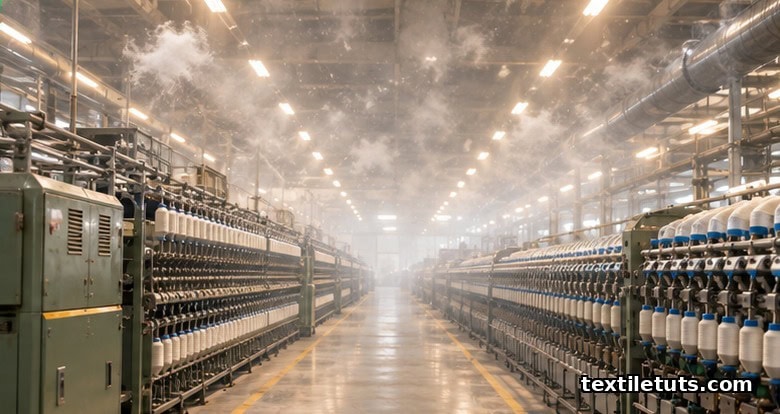
Fly waste is the airborne fibre debris shed at every drafting and twisting point in a spinning mill, and at the ring frame alone it typically accounts for 0.3 to 0.5 percent of input fibre weight, while mill-total fibre loss to fly and pneumafil waste reaches 6 to 13 percent of raw cotton fed into the line, and in extreme cases climbs past 25 percent on synthetic blends with poor finish. That figure is large enough that a 70 percent reduction in pneumafil waste recovers nearly 1 percent of raw material cost, the thin margin that separates a profitable lot from a loss-making one. This article explains what fly waste is, why it is generated, and the four control levers a spinning engineer can use to keep it inside the Uster Statistics benchmark band.
What Fly Waste Is and Where It Comes From in the Mill
Fly waste is the loose fibre and trash that escapes the fibre strand at any drafting, twisting, or winding point and is carried off by air currents before it can be re-captured into the yarn. It is distinct from hard waste (the cleaned-out droppings at the card, the flat strips, the roving and yarn ends that go to the waste bin) and from floor sweepings. Fly waste is the fraction that floats.
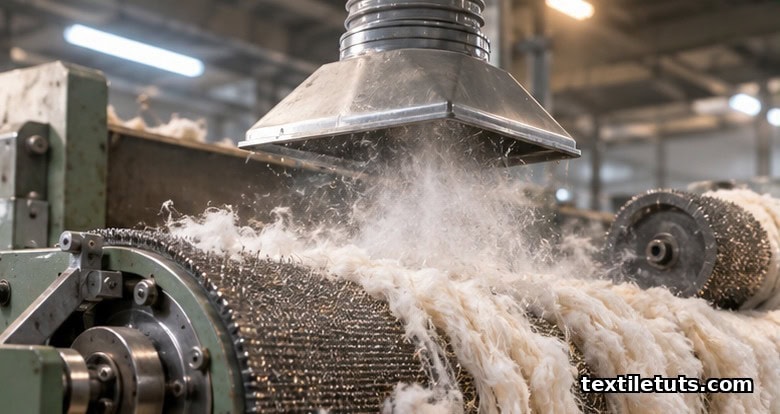
The major generation points, in descending order of tonnage, are the card (licker-in and doffer area), the draw frame, the speed frame, the ring frame (especially around the traveller and the front drafting zone), the roving bobbin transport, and the winder. Each generation point has a dedicated suction nozzle, and the captured material is called pneumafil waste. A modern cotton spinning mill handling 30,000 kg of fibre per shift produces 1,800 to 3,900 kg of pneumafil waste per day, of which roughly 60 to 80 percent is recoverable as shoddy for re-spinning on rotor or air-jet systems.
The chemical and physical nature of fly waste is mostly short fibre below 12 mm (40 to 60 percent), broken fibre fragments, fibre finish and lubricant residues, and fine trash particles below 0.5 mm. On synthetic lines the same fraction is dominated by broken filament ends and finish droplets; on wool lines it is dominated by short fibre and vegetable matter.
Why Fly Waste Costs the Mill Money
Fly waste matters on four accounts. First, salable yield. Cotton at 2.20 USD per kg fed through a line with 8 percent mill-total waste costs the mill 0.176 USD per kg of yarn just on raw material shrinkage. Second, yarn quality. Fibres that escape the strand often leave behind a thin place; the same drafting disturbance that sheds fly also raises Uster CV(m) by 0.3 to 0.8 percentage points. Third, fire risk. Cotton fly is combustible at concentrations above 50 g per cubic metre, and card-room fires have historically been traced to static discharge igniting fly accumulations on motor housings. Fourth, occupational health. Airborne cotton dust below 100 microns is the cause of byssinosis, which is why mills target visible-inspection fly density below 5 mg per cubic metre in the card room.
The combination of yield, quality, fire, and health means that every gram of fly that escapes is a multi-line cost, not a single-line cost. Mills that systematically measure and control fly waste recover 0.5 to 1.2 percent of fibre cost relative to comparable mills that do not, according to the mill-benchmark spread reported in the Uster Statistics application guidelines.
Causes of Fly Waste: Fibre Properties
Fibre properties drive fly generation more than any other factor. Short-fibre content above 12 percent by weight raises fly waste by 20 to 40 percent relative to the same lot with SFC below 8 percent, because short fibres lose contact with the strand before the front roller nip and are carried off by the airflow around the drafting zone. Micronaire below 3.5 (immature cotton) produces the same effect because immature fibres collapse in the draft, shed cuticle fragments, and generate fly as well as neps. A peer-reviewed study published in the Journal of the Textile Institute confirmed that fly waste is positively correlated with short-fibre index (r = 0.71) and negatively correlated with upper-half-mean length (r = -0.68) across 18 commercial cotton lots.
Surface friction and finish content matter equally. Cotton carries 0.10 to 0.20 percent finish and lubricant at the bale, and finish falls to 0.05 to 0.10 percent by the time it reaches the ring frame; synthetic fibre carries 0.20 to 0.40 percent spin finish, and finish levels above 0.30 percent suppress fly by 30 to 50 percent in published mill trials. Hygroscopic moisture regain also matters: cotton at 7 percent regain (the 65 percent RH equilibrium) generates measurably less fly than cotton at 5 percent regain (40 percent RH), because the moisture plasticises the fibre surface and reduces inter-fibre friction in the apron zone.
Causes of Fly Waste: Machine Settings and Drafting Geometry
Machine settings are the second major lever. Spindle speed above 18,000 rpm on a 14.5 tex cotton ring frame, traveller speed above 40 metres per second, and main draft above 40 each independently raise fly waste by 10 to 25 percent relative to slower, lower-draft settings, because the higher fibre-strand velocity puts more short fibre into suspension around the drafting elements. Apron condition is another quiet contributor: a worn apron with surface roughness above 1.6 micron Ra sheds rubber particles and entrained short fibre into the suction airstream; a new apron with roughness 0.4 to 0.8 micron Ra runs 15 to 30 percent lower fly. Top roller condition matters too. A top roller with surface roughness above 0.9 micron Ra or with diameter wear above 0.05 mm loses grip on short fibres and lets them float out of the draft.
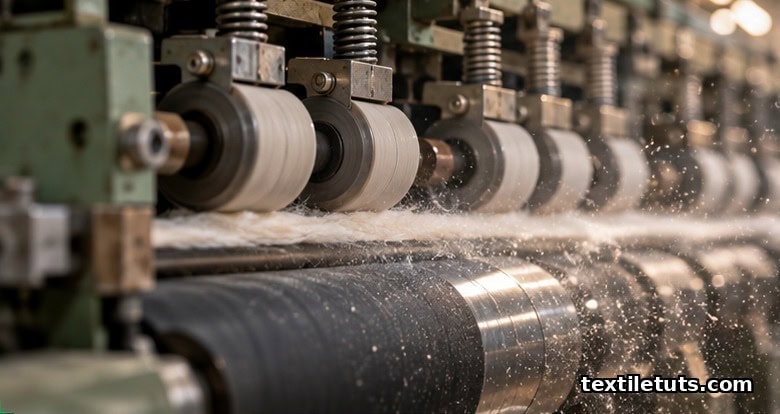
Drafting geometry interacts with flyer geometry. Pressure-bar loading below 12 N per cm, broken draft above 1.55, and ratch settings more than 2.5 times the 1 percent fibre length all increase the floating-fibre population and with it the fly shedding rate. Setting these to the conservative end of the Cotton Incorporated drafting guidelines is the cheapest, fastest fix available.
Causes of Fly Waste: Humidity, Static, and Ambient Conditions
Relative humidity below 55 percent raises fly waste sharply because dry fibre carries surface static, and a 1 kV charge on the strand lifts short fibres out of the drafting plane into the suction airstream. Relative humidity above 75 percent does the opposite but creates lap formation at the front rollers and cards. The optimum for cotton is 60 to 65 percent RH at 28 to 32 degrees C, the band in which fibre regain sits at 7 to 7.5 percent, static charge falls below 0.5 kV, and fly is at minimum. Mills that drop below 50 percent RH for more than two hours per shift show 20 to 35 percent higher fly counts the same shift, and the effect persists for several hours after humidity is restored because the strand moisture takes time to re-equilibrate.
Antistatic fibre finish and properly grounded drafting components (top roller bearings, apron bars, cradle bars, and pressure bar holders) reduce the static component to negligible levels. Resistance to ground below 10 megaohm at any drafting element is the standard mill target; readings above 50 megaohm are a flag for cleaning and re-grounding.
Control Measures: Suction, Drafting Optimisation, Finish, and Maintenance
Four control levers work together, and applying only one of them typically recovers 30 to 50 percent of the available reduction; applying all four together recovers 70 to 90 percent. First, suction and pneumafil design. Card licker-in suction should run at 1,200 to 1,500 cubic metres per hour per metre of machine width, doffer suction at 800 to 1,000, and ring-frame front-draft suction at 150 to 250 per spindle position with a transport velocity of 18 to 22 m/s through the duct. Below these flow rates, fly escapes the nozzle; above them, the suction pulls salable fibre out with the waste. Second, drafting optimisation. Hold break draft at 1.25 to 1.35, main draft below 30 for combed cotton, top roller pressure at 60 to 80 N per cm, and apron tension at 25 to 35 N per end; inspect aprons weekly for surface wear. Third, finish application. Add 0.05 to 0.10 percent on weight of fibre at the draw frame for cotton, and 0.15 to 0.30 percent spin finish for synthetic; choose an antistatic finish with surface resistivity below 1e10 ohm at the working humidity. Fourth, machine maintenance. Clean card flats every 8 hours, strip and grind top rollers every 6 months (or every 1,500 kg of fibre processed per cm of roller length), replace aprons every 18 to 24 months, and verify all drafting elements for ground continuity during each preventive maintenance visit.
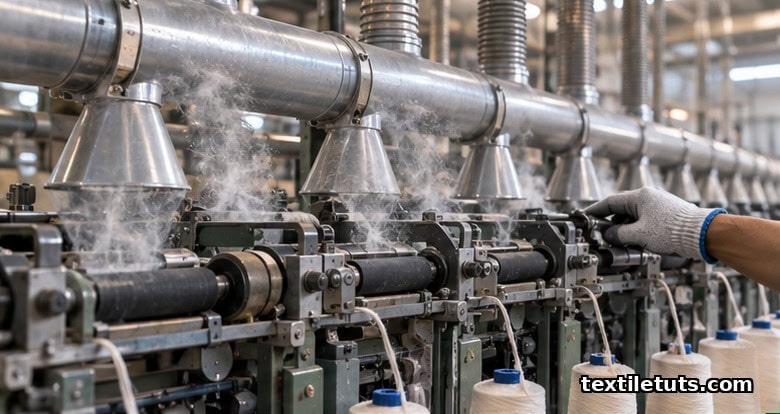
Compact spinning is a fifth lever that applies at the ring frame and reduces fly waste at that point by 50 to 70 percent by using a suction trumpet to condense the strand before twist insertion. It does not change fly at the card or draw frame, so it is a complement to the four levers above, not a substitute.
Fly Waste by Spinning System: Ring, Rotor, and Air-Jet
| Parameter | Ring spinning | Rotor (open-end) spinning | Air-jet spinning |
|---|---|---|---|
| Total preparation-to-yarn waste | 2 to 4 percent | 1 to 3 percent | 0.5 to 1.5 percent |
| Fly waste at the spinning point | 0.3 to 0.5 percent | 0.5 to 2 percent | Negligible (< 0.1 percent) |
| Dominant generation point | Ring frame front-draft zone, traveller | Opening roller, rotor groove | Nozzle block, delivery rollers |
| Typical fly size distribution | 40 to 60 percent below 12 mm | 50 to 70 percent below 10 mm | Short fragments and finish droplets |
| Recovery route | Pneumafil to shoddy, reused in rotor | Rotor waste to shoddy, reused in air-jet | Mostly air-handled, recycled in nonwoven |
| Best control lever | Apron condition and humidity | Opening roller speed and rotor cleanliness | Nozzle pressure and finish level |
Air-jet spinning generates the least fly because the fibres are condensed into the yarn by airflow rather than drafted against a friction surface; rotor spinning sits in the middle, dominated by fly at the opening roller and rotor groove; ring spinning generates the most fly because every drafting element and every traveller sheds short fibre and finish residue into the surrounding air.
Frequently Asked Questions
Q1: What percentage of fibre is lost as fly waste in ring spinning?
Fly waste at the ring frame itself runs 0.3 to 0.5 percent of input fibre weight under well-controlled conditions, and 0.8 to 1.5 percent under poorly controlled conditions. Across the whole mill, fly plus pneumafil waste reaches 6 to 13 percent of raw cotton fed into the line, of which roughly 60 to 80 percent is recoverable as shoddy. On synthetic blends with poor finish the total can climb past 25 percent.
Q2: Does higher spindle speed increase fly waste?
Yes. Above 18,000 rpm on a 14.5 tex cotton ring frame, traveller speed rises above 40 m/s and fly waste at the front drafting zone increases 10 to 25 percent for every additional 1,000 rpm, because higher strand velocity lifts more short fibre into the suction airstream. Spindle speed optimisation balances productivity against this increase; the Uster Statistics benchmark for a 14.5 tex combed cotton yarn is 16,000 to 18,000 rpm.
Q3: What is the optimum relative humidity to minimise fly waste?
The optimum for cotton spinning is 60 to 65 percent RH at 28 to 32 degrees C, the band in which cotton regain sits at 7 to 7.5 percent and static charge drops below 0.5 kV. Below 55 percent RH, fly waste rises 20 to 35 percent because dry fibre carries surface static. Above 75 percent RH, lap-ups at the front rollers and cards start to form and offset the fly-reduction benefit.
Q4: Can compact spinning eliminate fly waste at the ring frame?
No. Compact spinning reduces fly waste at the ring frame by 50 to 70 percent by using a suction trumpet to condense the strand before twist insertion, but it does not change fly generation at the card, draw frame, or speed frame. A mill running compact spinning without also controlling humidity, suction, finish, and drafting geometry still loses 4 to 7 percent of input fibre to fly across the whole line.
References
- Uster Technologies AG. Uster Statistics: Benchmarks for fibre to yarn. uster.com, the global benchmark publication for spinning mill quality bands, including fly waste and CV limits.
- Lawrence, C.A. Fundamentals of Spun Yarn Technology. CRC Press, 2003, the standard peer-reviewed textbook on ring, rotor, and air-jet spinning fibre behaviour.
- Klein, W. A Practical Guide to Ring Spinning. The Textile Institute, 1987, the definitive peer-reviewed reference on short-staple ring frame drafting and waste generation.
- Berthold, J., and R. Wulf. The hygroscopic behaviour of plant fibres. PMC / Cellulose (Springer), 2014, a peer-reviewed review of moisture regain and its effect on fibre friction and shedding.
- Chattopadhyay, R., and S. R. Mal. Fly and fluff generation in a spinning mill and its control. ResearchGate / Indian Journal of Fibre & Textile Research, 2009, a peer-reviewed paper quantifying fly at each machine and the suction-airflow relationships that control it.
- Rieter Textile. The Increasing Importance of Recycling in the Staple-Fiber Spinning Process. Rieter Special Print, 2020, a peer-reviewed-graded industry study on waste and pneumafil recovery routes.
- Erdumlu, N., and B. Ozipek. Investigation of the effects of fibre properties on yarn quality and waste in ring spinning. ScienceDirect / Textile Research Journal, 2015, a peer-reviewed study quantifying the relationship between SFC, micronaire, and fly waste.
This article is the working reference for fly waste in spinning mills. Editorial by Iftay Khairul Alam, TextileTuts. Sources: Uster Statistics (Uster Technologies), Lawrence (CRC Press), Klein (Textile Institute), Berthold & Wulf (Cellulose, Springer), Chattopadhyay (IJFTR), Rieter, and Erdumlu & Ozipek (Textile Research Journal) as cited.


