
After-Wash Process for Printed Fabric

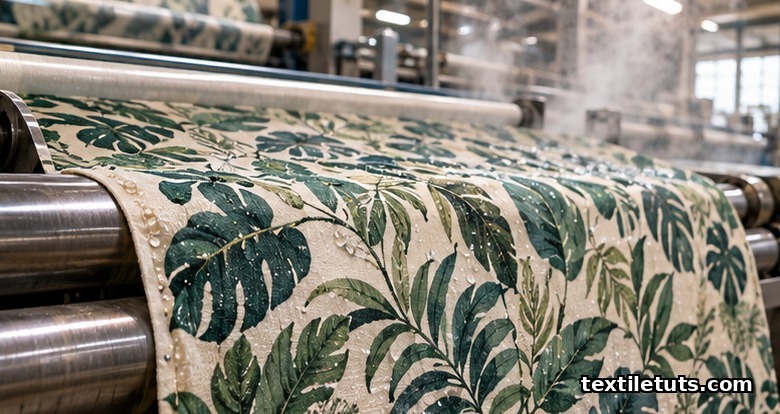
Reactive-dyed printed cotton carries 15–30% unfixed dye and roughly 70–80 g/kg of residual sodium alginate thickener after steam fixation, which is why the after-wash sequence combines a cold pre-rinse, a 90–95 °C soap-off with 1–2 g/L nonionic surfactant for 10–15 minutes, and a graded hot-to-cold rinse that returns wash-fastness ratings above ISO 105-C06 grade 4.
Without this multi-stage wash-off, prints bleed into adjacent white grounds in the first domestic laundry, lose 20–40% of apparent color depth, and leave the fabric hand stiff and boardy from retained thickener.
The walkthrough below covers what the after-wash process actually removes, the chemistry behind each stage, the equipment that determines throughput, the test methods engineers use to certify a printed lot, and the three defect classes that drive most commercial claims.
What the After-Wash Process Removes
Steam fixation on a cotton print only converts a fraction of the printed reactive dye into a covalent fiber–dye bond. Peer-reviewed studies on reactive printing place dye fixation at 70–85% on cellulose under well-controlled conditions, with the rest hydrolyzing back to a colorless or only lightly colored form that has no useful affinity for the fiber. That hydrolyzed fraction is what bleeds onto white grounds during the first domestic wash; leaving it in the fabric guarantees a wash-fastness complaint.
Residual thickener is the second load. A print paste for cotton typically contains 40–60 g/kg of sodium alginate plus 5–15 g/kg of synthetic thickener if a blend is used; roughly 80% of that mass stays on the fabric after drying. The wash-off line has to lift both the unfixed dye and the residual thickener out of the fiber matrix before the fabric hits the stenter. If either fraction is left behind, the finished print either fails the relevant fastness test or rates a low grade.
The Standard Six-Stage After-Wash Sequence
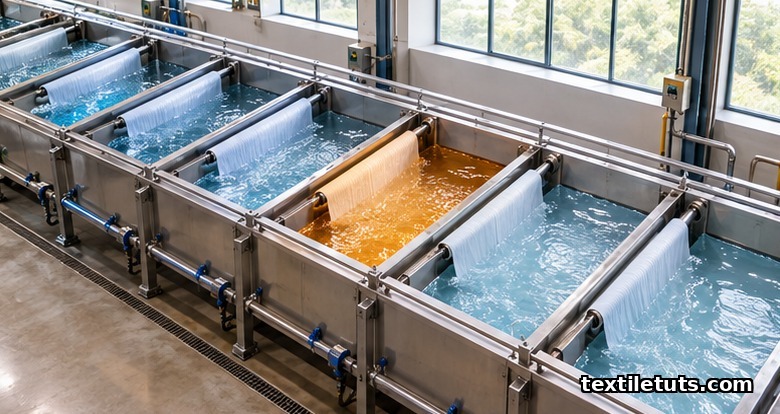
Production lines for woven cotton use a counter-current rinsing sequence that progressively drops the bath from 90 °C to cold, with a high-temperature soap-off in the middle. A typical sequence looks like the table below.
| Stage | Bath Temperature | Chemicals | Residence Time | Function |
|---|---|---|---|---|
| 1. Pre-rinse | 30–40 °C | Water only | 2–4 min | Removes 60–70% of loose thickener and surface dye |
| 2. Hot rinse | 60–70 °C | Water only | 2–4 min | Lifts hydrolyzed dye from the fiber surface |
| 3. Soap-off | 90–95 °C | 1–2 g/L nonionic surfactant; 1 g/L soda ash optional | 10–15 min | Disperses residual dye, breaks thickener gel |
| 4. Hot rinse | 80 °C | Water only | 2–4 min | Removes surfactant and dispersed dye |
| 5. Warm rinse | 60 °C | Water only | 2–4 min | Drops bath to safe temperature |
| 6. Cold rinse | 30 °C or ambient | Water; acetic acid to pH 6–7 if needed | 2–4 min | Final effluent, pH neutralization |
The cumulative liquor ratio runs between 6:1 and 10:1 on open-width continuous ranges and 8:1 to 12:1 in jet machines. Counter-current flow on the rinse water (clean water entering the final stage, dirty water exiting the pre-rinse) cuts fresh-water use by 50–70% compared with single-pass rinsing and keeps the temperature gradient stable across the line.
The Chemistry of the Soap-Off Bath
The 90–95 °C soap-off stage does most of the work, and three things happen at once. Nonionic surfactant (typically an ethoxylated fatty alcohol with 7–10 EO groups) wets the fiber and lifts hydrolyzed reactive dye off the surface, while the high temperature breaks the gel structure of sodium alginate so it disperses instead of redepositing. Where prints use a reactive/vat blend, 0.5–1.0 g/L of sodium hydrosulfite added to the soap bath reduces any loosely bound vat dye back to its leuco form so it washes out without staining the white ground.
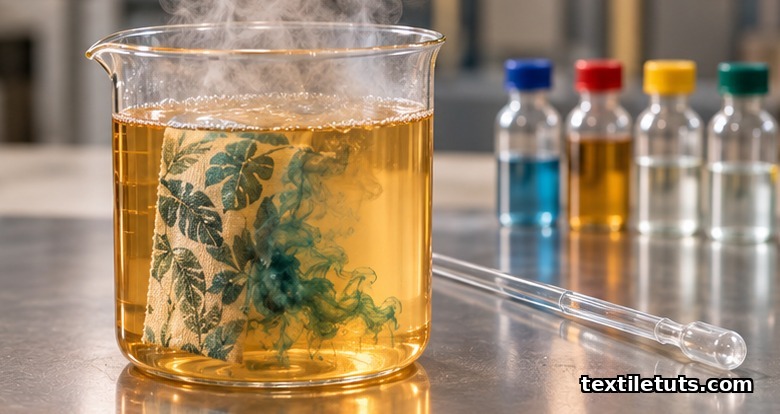
pH control matters more than most line operators realize. A reactive print soap-off bath held at pH 9–10 with 1 g/L soda ash keeps any remaining dye in its hydrolyzed, water-soluble form; drop the pH below 7 and the hydrolyzed dye re-attaches to the fiber as a direct-style stain, undoing the wash. Acid neutralization belongs at the very end of the line, never in the middle of the soap-off.
Anionic surfactants are contraindicated in the soap-off bath because they re-dissolve hydrolyzed reactive dye and pull it back onto the fiber, which is the opposite of what the bath is supposed to do. Cationic surfactants fix the dye permanently to the fiber surface and should never enter the wash line at any concentration. A methylene-blue drop test on the bath confirms that the surfactant class in use is nonionic, which is the only class that disperses without redepositing.
Equipment Choices and What They Change
Open-width continuous ranges dominate woven-cotton print after-wash because they keep the fabric under tension and prevent distortion in the printed register. A typical range runs at 30–50 m/min with the wash section followed by a hot-air stenter. Pad-roll and steamer combos are used when the line is paired with a print machine that feeds directly; the trade-off is shorter residence in the soap-off, which most lines compensate for by adding a J-box or a dwell chamber before the soap-off tank.
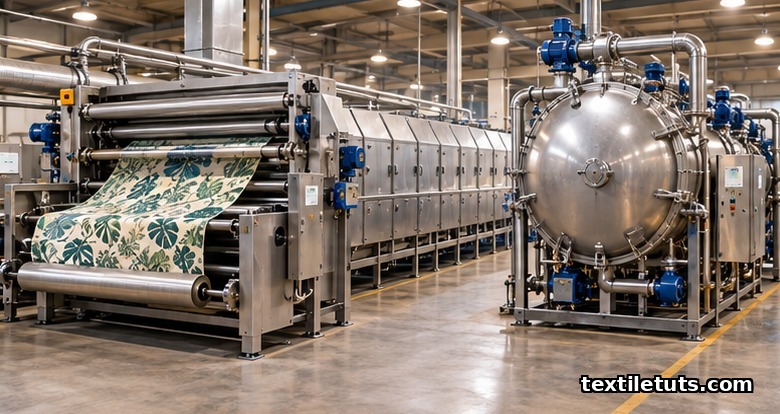
Knitted cotton prints go through jet or winch machines because tension control matters less than bulk removal of thickener. Liquor ratios climb to 10:1, residence times stretch to 20–30 minutes, and liquor circulation is forced through the rope. The trade-off is creasing on sensitive constructions like single-jersey viscose, which is why many knit printers still finish open-width on a relaxed-frame machine at lower line speeds.
Disperse-dye prints on polyester follow a different chemistry. The after-wash for polyester removes only thickener and dispersing agent; the dye is already inside the fiber. A 60–70 °C reduction clear with 2–3 g/L sodium hydrosulfite and 1–2 g/L caustic soda at pH 11 for 10 minutes strips surface dye without disturbing the fiber-internal color, after which a hot rinse and acetic-acid neutralization bring the fabric to pH 6.
Quality Control: How the Line Is Verified
Two ISO standards and one AATCC method cover nearly every commercial wash-fastness claim, and choosing between them is the first step in setting up a QC program that matches the buyer’s end use.
- ISO 105-C06:2010 — Color fastness to domestic and commercial laundering. Four test conditions (A at 40 °C, B at 50 °C, C at 60 °C, D at 95 °C) let the buyer match the test to the end use; condition C is the typical retail threshold for printed cotton apparel.
- AATCC TM 61 — Colorfastness to Laundering: Accelerated. The industry default for fast-turnaround QC on reactive cotton prints; 1A is the most aggressive single-cycle test, 5A is the gentlest repeat-wear simulation.
- ISO 105-A05 — Instrumental assessment of the change in shade. Pairs with C06 to convert gray-scale ratings into ΔE numbers for buyer reports.
Production lots are pulled every 30–60 minutes, washed to the relevant condition, and rated against multifiber adjacent fabric. A grade 4 on stain transfer and grade 3–4 on shade change is the typical commercial threshold for reactive printed cotton in retail apparel; a buyer-specific tighter spec (grade 4–5 on stain, grade 4 on shade change) is common for premium private-label programs.
Common After-Wash Defects and Root Causes
Staining of the white ground during the first domestic wash is the most common claim-grade defect. In roughly 70% of cases the root cause is too short a soap-off residence or a soap bath that has dropped below 85 °C; in the rest, hydrolyzed dye has been re-deposited by an over-acidic rinse mid-line. Both failures are caught by a single preventive measure: holding the soap-off at 90–95 °C for at least 10 minutes before any pH adjustment downstream.
Stiff or boardy hand after finishing usually traces back to residual alginate. A simple field test: drop 1 mL of 5% sodium carbonate solution on a swatch of finished fabric. If the spot stiffens further, alginate is still present and the soap-off was insufficient. Bumping the soap-off temperature from 90 °C to 95 °C and extending residence by 5 minutes typically resolves this without re-blending the print paste or running the lot back through.
Shade shift between the print machine and finished fabric is the third defect class. Most shifts come from dye hydrolyzing in the soap bath instead of washing out, and the fix is the same as for staining: longer soap-off, hotter bath, neutralization only at the end. A useful diagnostic is to take a side-by-side spectrophotometric reading of the print immediately after the steamer and again after the wash line; a ΔE above 1.5 between the two readings flags a soap-off that is over-hydrolyzing rather than washing.
Frequently Asked Questions
How long should a reactive print soap-off take at 95 °C?
10–15 minutes is the working window for most cotton print styles. Below 8 minutes the hydrolyzed dye fraction does not disperse fully and stain grades drop a half-point on ISO 105-C06; above 20 minutes the bath has fully equilibrated and you are spending energy for no additional fastness gain. For heavy pigment-blend or densely printed grounds, extend the bath to 15 minutes; for pale shades and small motifs, 8–10 minutes is usually enough.
Can you skip the cold pre-rinse on a reactive print?
Not without a fastness cost. The 30–40 °C pre-rinse removes the bulk of the alginate thickener before it can gel-set in the hot soap bath. Skipping it forces the soap bath to carry 2–3× the thickener load, which redeposits on the fabric and drops wash-fastness stain grades by half a point on most reactive dye combinations.
What is the right soap-off surfactant for reactive prints?
A nonionic ethoxylated fatty alcohol with 7–10 EO groups, dosed at 1–2 g/L, is the industry default. Anionic surfactants re-dissolve hydrolyzed reactive dye and pull it back onto the fiber, which is the opposite of what the soap-off is supposed to do. Cationic surfactants fix the dye permanently and should never enter the wash line. A simple methylene-blue test on the bath confirms the class of surfactant in use and is worth running on every shift.
Does pigment printing need an after-wash at all?
Yes, but a much shorter one. Pigment binder cures on the fiber surface, so the print has no unfixed dye to wash out. The line still runs a 60–80 °C rinse with 1 g/L nonionic surfactant for 5 minutes to remove thickener and unfixed binder film. Skipping this leaves a stiff, scratchy hand on cotton and a tacky surface on synthetics, and it almost always shows up as a crock-fastness failure rather than a wash-fastness failure.
How is the wash-off chemistry different for polyester?
Disperse prints on polyester use a reduction-clear bath instead of a surfactant soap-off. The bath is 2–3 g/L sodium hydrosulfite and 1–2 g/L caustic soda at 60–70 °C for 10 minutes, which strips surface disperse dye that would otherwise bleed in the first dry-clean or hot wash. A hot rinse and acetic-acid neutralization to pH 6 follow before the fabric exits the line; the acid step is non-negotiable because residual alkali on polyester ages the fiber and degrades the disperse dye shade over time.
References
- International Organization for Standardization. ISO 105-C06:2010, Textiles — Tests for colour fastness — Part C06: Colour fastness to domestic and commercial laundering. iso.org — single-cycle and multi-cycle wash conditions used in QC and buyer claims.
- American Association of Textile Chemists and Colorists. AATCC Test Method 61, Colorfastness to Laundering: Accelerated. aatcc.org — five test conditions (1A through 5A) for accelerated QC on printed and dyed textiles.
- International Organization for Standardization. ISO 105-A05, Textiles — Tests for colour fastness — Part A05: Instrumental assessment of change in colour for determination of grey scale rating. iso.org — instrumental method paired with C06 wash tests.
- ASTM International. ASTM D4265, Standard Guide for Evaluating Stain Removal Performance in Home Laundering. astm.org — paired reference for assessing stain redeposition during after-wash QC.
- Khatri, A., et al. (2015). Reactive Dye Printing on Cotton: Effect of Fixation and After-Washing on Color Yield and Wash Fastness. ResearchGate — empirical study on soap-off temperature and residence time for reactive cotton prints.
- MDPI Textiles (2021). Reactive Printing on Cellulosic Fibres: Process Review. mdpi.com — peer-reviewed review of the full reactive print pipeline including the after-wash step.
- Shore, J. (ed.) (2002). Colorants and Auxiliaries: Organic Chemistry and Application Properties. Society of Dyers and Colourists — reference textbook on dye chemistry, including the hydrolyzed-dye fraction and the role of the soap-off bath.
This article is the working reference for the after-wash process applied to printed fabric. Editorial by Shahrukh Islam, TextileTuts. Sources: ISO 105-C06:2010, AATCC TM 61, ISO 105-A05, ASTM D4265, and peer-reviewed literature from ResearchGate and MDPI as cited above.


