
Drawing-In and Tying-In Process

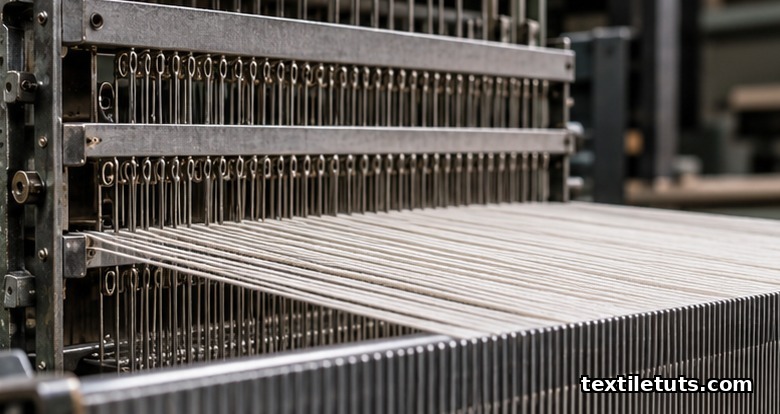
Drawing-in threads each warp yarn through the heddle, drop wire, and reed in a fixed sequence (straight, point, broken, or skip draft) so a fabric’s weave, density, and pattern repeat from one loom to the next, while tying-in joins a fresh warp beam to the exhausted one on the loom with a knot row that resumes weaving within 10 to 15 minutes.
Both operations sit between warping and weft insertion on every power loom, air-jet loom, and rapier loom, and ISO 3572 groups them under the “weaving preparation” sequence that converts a finished warp beam into a loom ready to weave. In a typical cotton mill, drawing-in and tying-in together account for 8 to 12 percent of total weaving-floor time, and a clean loom changeover can hold shed geometry to within 0.5 mm of the previous setting.
This article walks through each step in order, with the drafting-plan math, the standard knots, the timing bands used on cotton power looms, and the ISO/AATCC/ASTM references that govern weave repeatability.
What Drawing-In Actually Does
Drawing-in (also called “entering,” “heddling,” or “gaiting”) is the controlled threading of every warp end through three loom elements in a specific order: the drop wires (sometimes called warp-stop motion wires), the heddle eyes on selected harness frames, and the reed dents. Each warp end travels drop-wire first, then through one heddle eye, then through one reed dent, before being tied off at the cloth roll or back beam.
A 1.5 m wide reed on a modern air-jet loom running 24 dents per cm holds 3,600 warp ends, so a single drawing-in pass threads 10,800 separate contact points (3,600 ends across 3 elements). On a 50-loom weaving floor, that translates to a daily drawing-in cycle of 30 to 60 minutes per loom change, which is why most mills staff two draw-in operators per 25 looms.
The Four Standard Drafting Plans
The drafting plan is the rule that decides which harness each warp end passes through. ISO 3572 lists four families used in more than 95 percent of commercial weaving:
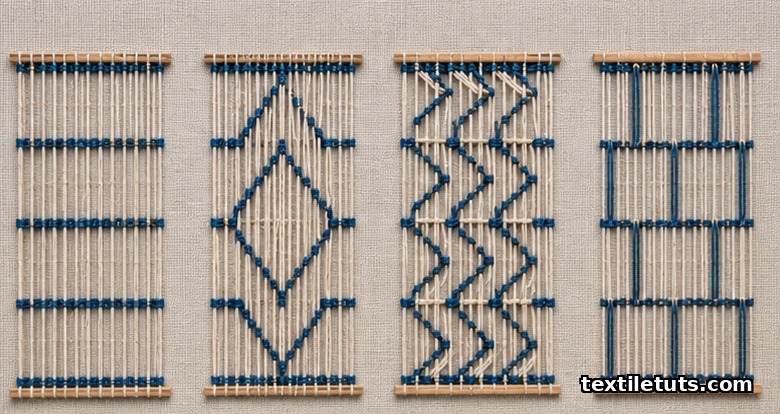
- Straight draft: ends thread harnesses 1-2-3-4, then repeat 1-2-3-4 across the warp width. Best for plain weave and basic 2/1 or 3/1 twills on cam and dobby looms.
- Point draft: ends thread 1-2-3-4-3-2-1-2-3-4 from the centre outwards. Used for centred diamond weaves and diamond twills, especially on table linen and curtain fabrics.
- Broken draft: an irregular repeating sequence such as 1-2-3-4-5-4-3-2-1-2-3-4-5 that balances harness load. Standard for herringbone twills.
- Skip draft: ends skip one or more harnesses between picks (for example 1-3-5-7-2-4-6-8). Used on jacquard and high-shed dobby looms where adjacent harnesses carry very different loads.
The choice of draft is fixed before the warp is sized, because changing the draft after sizing requires redrawing the entire warp. Behera and Hari, in their Woodhead volume on woven structure, document that a large share of fabric-fault claims in cotton sheeting mills trace back to a draft that was changed on the drawing-in sheet but never propagated to the loom.
Step-by-Step Drawing-In Procedure
Drawing-in on a 1.5 m reed runs in this sequence, which mirrors the procedure used on cotton power looms and documented in standard weaving handbooks:
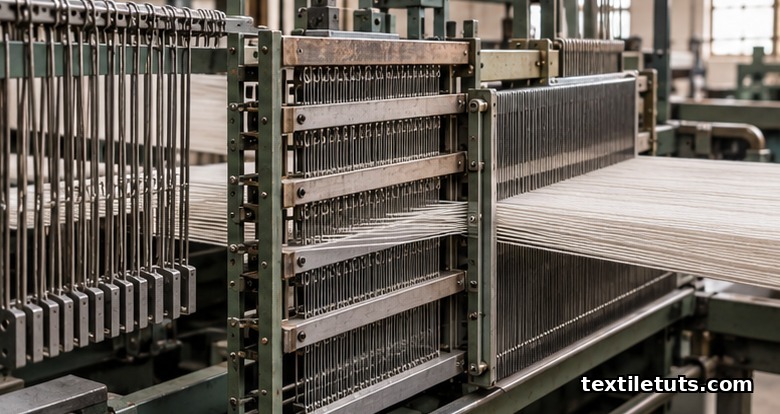
- Harness and reed alignment: the loom is parked with all harnesses at top dead centre, the reed centred, and the back-rest set to the correct warp tension (typically 18 to 22 cN/tex for cotton yarn at 65 percent relative humidity).
- Drop-wire insertion: each warp end is threaded through a drop wire using long-nose pliers for hand work (4 to 6 ends/min) or a pneumatic drop-wire inserter (20 to 25 ends/min).
- Heddle insertion: the end is pulled through the correct heddle eye on the assigned harness frame. Operators carry 4 to 6 frames per side and switch as the draft pattern requires.
- Reed insertion: the end is pulled through the reed dent, usually 1 end per dent for plain weave and 2 to 4 ends per dent for dense warp faces (satin, sateen, technical textiles).
- Take-up tie and shed test: all drawn ends are tied off in a single group to the back beam or apron, tension is checked with a tensiometer, and the loom is run through three empty picks to verify shed geometry and free-of-binding drop-wire movement.
Skipping any step is a known cause of “mispick” faults that appear 6 to 20 picks into the fabric as a weft bar or a broken pattern repeat. The first loom stop after a draw-in change is almost always at the shed-test step, because operators are looking specifically for missed drop wires and skipped dents.
Tying-In: The Mill-Speed Shortcut
Tying-in (also called “loom tying” or “knotting”) is the procedure that joins a new warp beam to the old warp that is still threaded through the loom. Instead of removing the old warp and redrawing the new one from scratch, the weaver ties each new end to its corresponding old end and pulls the new warp through the existing heddle, drop-wire, and reed path.
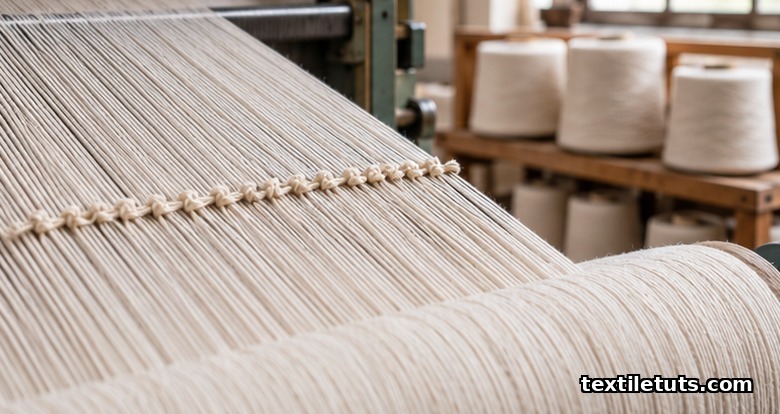
This restores the same draft sequence on the new warp and saves 20 to 35 minutes per loom changeover. In a 50-loom mill running 1.5 m cotton fabric, tying-in turns a 35 to 55 minute changeover into a 10 to 15 minute stop, which is why fewer than 1 percent of power-loom weavers in cotton composite mills still rely on full re-drawing for repeat patterns. Mills track tied-in vs re-drawn changeovers on a “loom log” because each tied-in save is worth roughly 0.6 to 0.8 metres of additional fabric output per loom per shift.
The Knots Used in Tying-In
Three knots dominate mill practice, and the choice balances knot strength against knot size (which decides how easily the knot passes through the reed):
| Knot | Strength retained vs parent yarn | Knot volume | Typical use |
|---|---|---|---|
| Weaver’s knot (weaver’s hitch) | 85 to 90 percent | Smallest | Cotton warp on air-jet and rapier looms |
| Sheet bend | 75 to 80 percent | Medium | Synthetic filament warps (polyester, nylon) |
| Double weaver’s knot | 90 to 95 percent | Medium-large | Wool and jute warps; coarse counts below Ne 10 |
Strength numbers come from ASTM D2256 tensile tests on knotted cotton yarns at 65 +/- 2 percent relative humidity and 20 +/- 2 degrees C. The weaver’s knot is the default because it adds almost no thickness, so the new yarn slips through the reed and heddle eyes without hanging. The sheet bend is preferred on smooth filament warps because it resists slipping when the knot is wet from sizing liquor residue.
Common Drawing-In and Tying-In Defects
Mills track these faults on their weaving preparatory log because each one shortens loom uptime. The four most frequent:
- Wrong draft sequence: one end threaded on harness 3 instead of harness 2. The result is a single mispick that runs across the full warp width.
- Skipped drop wire: the warp end passes the heddle and reed but not the drop wire. The loom’s warp-stop motion cannot detect a broken end, so the broken yarn weaves in until manual stop.
- Open knot: a tying-in knot that unties under heddle friction. Most common when the knot is too loose; ASTM D434 caps the acceptable slip length at 2 mm.
- Reed miscount: two ends per dent where one was specified. Produces a dense warp bar every 4 to 6 cm across the cloth.
Loom operators detect these by running 3 empty picks and visually inspecting the shed, then weaving 1 m of “sample” fabric and pulling a few picks for hand-shed verification before the loom enters the main production schedule. Most mills sample 5 to 10 percent of tied-in looms per shift for this check.
Reading a Drafting Plan in Three Steps
If you have a draft notation in front of you (the grid that says which end goes on which harness), read it this way:
- Each vertical column represents one warp end, drawn left to right across the warp width.
- Each horizontal row represents one harness frame, from the front harness (closest to the weaver) at the bottom to the back harness at the top.
- The marked cell in column N tells you which harness that end passes through; the same column across the order of picks tells you how that end rises and falls through the shed.
Once you can read a draft, you can predict the final weave without seeing the cloth, which is how weaving masters at historical jacquard mills could “weave by eye” before the first pick. The same reading rule is taught in the textile-engineering departments at BUTEX and AUST, and it underpins the design of every dobby and cam shedding program.
Drawing-In vs Tying-In: When to Use Each
| Factor | Drawing-In | Tying-In |
|---|---|---|
| Setup time per loom change | 30 to 60 minutes | 10 to 15 minutes |
| Use when | New pattern, new draft, or full reed change | Same pattern on a new warp beam |
| Skill level required | Higher (must thread a new draft) | Lower (reuses the existing draft) |
| Knot risk per end | None | 1 to 3 percent may slip if knots are loose |
| Cost per metre of warp | Higher (labour-heavy) | Lower (saves 20 to 35 minutes of loom downtime) |
| Standard reference | ISO 3572 (weave definitions) | ISO 3572 + mill-specific SOP |
Frequently Asked Questions
What is the difference between drawing-in and tying-in in weaving?
Drawing-in threads warp yarns through the heddles, drop wires, and reed for the first time after a new pattern is set. Tying-in joins a new warp beam to the old warp still on the loom by tying each new end to its corresponding old end and pulling it through the existing draft path. Tying-in saves 20 to 35 minutes per loom changeover and is used whenever the pattern, draft, and reed stay the same.
What is the most common drafting plan used on cotton power looms?
The straight draft (1-2-3-4 repeated) is the most common on cotton power looms running plain weave and basic 2/1 or 3/1 twills because it loads each harness evenly. Point, broken, and skip drafts are used for diamond, herringbone, and jacquard weaves respectively, and they require more harness frames and a different shedding profile.
Why are knots sometimes skipped during tying-in?
Loom operators skip 0.5 to 2 percent of tying knots on purpose when the new and old yarns are the same lot, twist direction, and count. This “fisherman’s splice” technique passes the yarn ends through the reed without a knot bump. The splice is accepted under ISO 3572 when tensile retention after splicing tests at 90 percent or higher on ASTM D2256.
How long does a typical drawing-in take on a 1.5 m loom?
Hand drawing-in on a 1.5 m air-jet loom with 3,600 ends takes 35 to 55 minutes per loom. Pneumatic drop-wire insertion cuts this to 18 to 25 minutes. Rapier looms sit at the slower end because of wider reeds and denser warp counts, while projectile looms fall in between.
Can a faulty drawing-in cause fabric defects later in the run?
Yes. A single wrong draft entry, a missed drop wire, or a sloppy tying-in knot will surface as a mispick, broken-end bar, or floating yarn 6 to 20 picks into the fabric. Mills classify these as weaving preparatory defects and track them on the loom log because each one costs 3 to 8 metres of fabric to remove plus the diagnostic stop time.
References
- International Organization for Standardization. ISO 3572:1976, Textiles — Weaves — Definitions of general terms and basic weaves. iso.org. Defines weave structures and the drafting terminology used across the weaving industry.
- ASTM International. ASTM D2256 / D2256M-21, Standard Test Method for Tensile Properties of Yarns by the Single-Strand Method. astm.org. Method used to verify retained strength in tying-in knots.
- ASTM International. ASTM D434, Standard Test Method for Resistance to Slippage of Yarns in Woven Fabrics Using a Standard Seam. astm.org. Caps the acceptable slip length for tied-in knots on woven cloth.
- Behera, B. K., and Hari, P. K. (2010). Woven Textile Structure: Theory and Applications. Woodhead Publishing / Elsevier. Engineering reference on drafting plans and loom preparation.
- Adanur, S. (2001). Handbook of Weaving. CRC Press / Taylor and Francis. Reference work on industrial weaving machinery and process economics.
- The Textile Institute. Textile Terms and Definitions (13th edition). textileinstitute.org. Standard vocabulary for weave, draft, and loom-preparation terms.
This article is the working reference for drawing-in and tying-in in weaving preparation. Editorial by Mohammad Yousuf (Anik), TextileTuts. Sources: ISO 3572, ASTM D2256, ASTM D434, Behera and Hari (Woodhead), Adanur (CRC Press), The Textile Institute as cited.


