
Fiber Length: HVI and AFIS

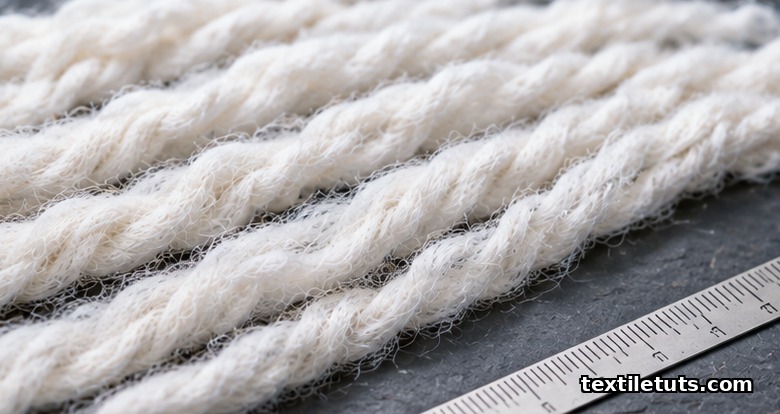
High Volume Instrument (HVI) measures cotton fiber length by optically scanning a parallel fiber beard to report upper half mean length (UHML) and a length uniformity index in roughly 25–30 seconds per sample, while the Advanced Fiber Information System (AFIS) individually electro-mechanically counts about 3,000 fibers per specimen to produce a complete length-by-number and length-by-weight distribution.
HVI is the workhorse of the international cotton trade, classifying every bale that passes through USDA classing offices and most mill intake labs; AFIS sits one step further upstream in the spinning lab, telling the spinner exactly how many short fibers and neps a bale will contribute before it hits the card.
The article below explains how each instrument actually measures length, which parameters each one reports, where the two methods agree and where they diverge, and how to read the numbers when a buyer asks for a 28 mm UHML with a uniformity index above 82.
Why Cotton Fiber Length Still Sets the Price
Cotton sells primarily by length, with strength, micronaire, and color reported alongside. A bale graded at 30 mm UHML can draw down to a 36s Ne (English count) combed yarn with short fiber content below 8% by weight. A 24 mm UHML bale typically tops out at a 20s carded yarn and shows more ends-down at the ring frame, translating directly into lost spindle hours.
Length drives three downstream outcomes that no other single fiber property controls so thoroughly: yarn count capability, yarn evenness, and the nep/surface appearance on the woven or knitted fabric. A 1 mm drop in UHML is associated with an estimated 3–5% increase in spinning waste at the card, and each 1% rise in short fiber content (fibers shorter than 12.7 mm, or 0.5 inch) is associated with a measurable rise in yarn CV (coefficient of variation) on the Uster Tester. Those numbers explain why classing offices report length before micronaire and why spinners spec HVI or AFIS panels on every blend.
What HVI Measures and How It Works
HVI is a family of instruments (Uster HVI, Premier HVI, Lintronics FibroLab) that follow the same physical principle: a comb and brush system forms a parallel fiber beard, and a optical sensor scans across the beard from the clamp to the free end to measure the length profile of roughly 3,000–5,000 fibers in one pass.
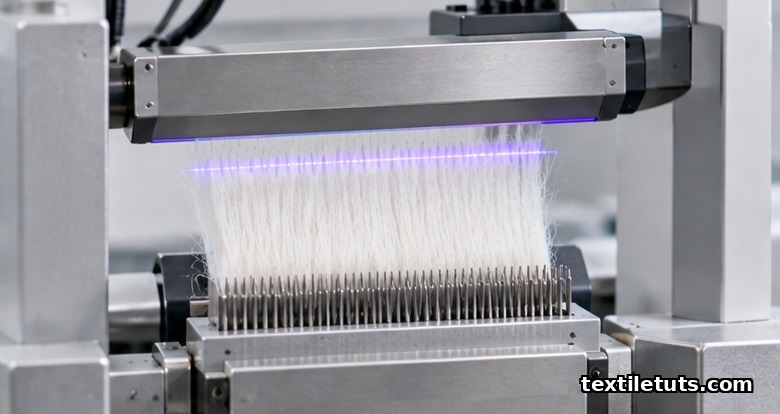
The instrument’s computer then applies the fibrogram math defined in the ASTM fibrogram method, sorting the length distribution into length classes and computing the parameters every classing report prints:
- UHML (Upper Half Mean Length): the mean length of the longer half of the fibers, expressed in inches or millimeters. This is the headline number on every HVI report and on every USDA class card.
- UI (Uniformity Index): the ratio of mean length (ML) to UHML, expressed as a percentage. A typical range is 78–86%; values above 83 are considered premium, while values below 78 indicate high short fiber content.
- ML (Mean Length): the mean of every fiber scanned, reported in inches or millimeters.
- SFI (Short Fiber Index by weight): the percentage of fibers shorter than 0.5 inch (12.7 mm) by weight. Reported on newer instruments; not all classing systems publish it.
ASTM D5867 (“Standard Test Methods for Measurement of Physical Properties of Cotton Fibers by High Volume Instruments”) specifies the HVI test cycle and the calibration routines for UHML, uniformity, micronaire, strength, and color on a single sample. A typical HVI run takes about 25–30 seconds per specimen and consumes roughly 8–10 g of conditioned cotton per test, which is why the method scales to bale-by-bale classing.
What AFIS Measures and How It Works
AFIS was developed by USDA’s Cotton Quality Research Station in the 1980s and commercialized through Uster (now Uster Technologies) and, more recently, Premier. Instead of scanning a beard, AFIS individualizes the fibers: a pinned cylinder or aero-mechanical opener separates fibers one at a time, and a electro-optical sensor passes each fiber through a light beam that records its length and diameter.

AFIS reports length in two parallel distributions, which is what makes the instrument so useful to spinning engineers:
- Length-by-Number (L(n)): the distribution of every fiber counted. This is the histogram a spinner looks at to count short fibers.
- Length-by-Weight (L(w)): the same distribution weighted by fiber linear density. Longer fibers weigh more, so L(w) shifts to the right of L(n). Most yarn-strength math (Martindale, Peirce) is calibrated against L(w), not L(n).
From those distributions, AFIS computes the parameters a spinning engineer actually uses: Mean Length by Number (MLn), Mean Length by Weight (MLw), Upper Quartile Length by Weight (UQLw), Short Fiber Content by Number (SFC(n), fibers shorter than 12.7 mm as a percentage of fiber count), Short Fiber Content by Weight (SFC(w)), and nep counts per gram. ASTM D7719 (“Standard Test Method for Determination of Fiber Length and Length Distribution of Cotton Fibers by AFIS Method”) and ISO 2403 (the manual comb-sorter reference AFIS is benchmarked against) are the standards most often cited when validating AFIS results.
A standard AFIS length test counts about 3,000 fibers per specimen and takes 2–3 minutes, roughly five to six times longer per sample than an HVI test. In practice, mills run AFIS on intake lots, on lay-downs for blends, and on card-cake samples to track how much length the cards are losing.
The Parameters That Matter at the Spinning Frame
When a yarn producer talks about “fiber length,” they usually mean one of three numbers. Knowing which one a number refers to prevents costly confusion on the shop floor:
- UHML (HVI): the international trading grade and the headline figure on USDA class cards. Used for bale-to-bale comparison, contract specification, and HVI-based pricing.
- UQL (AFIS): the length of the upper quartile of fibers by weight. Approximates the upper length that survives drafting, and correlates strongly with yarn tenacity in combed ringspun yarns.
- SFC(n) (AFIS): the percentage of fibers shorter than 12.7 mm by number. The single best predictor of card waste and yarn evenness for ring and rotor spinning.
Rules of thumb the TextileTuts spinning team applies when validating a bale:
- For a combed 36s Ne ring yarn, target UHML ≥ 29 mm, UI ≥ 82, SFC(n) ≤ 8%.
- For an open-end rotor 20s Ne yarn, UHML ≥ 26 mm and UI ≥ 80 are usually sufficient.
- For a premium 80s Ne combed yarn, UHML must reach 32 mm with SFC(n) below 6%.
Those numbers are not universal; they shift with the target yarn count, the rotor or ring diameter, and the type of draft. They are useful, though, for sanity-checking the values reported by HVI and AFIS before a blend goes on the lay-down.
HVI vs AFIS: How the Same Bale Reads on Both
| Property | HVI | AFIS |
|---|---|---|
| Method type | Optical scan of fiber beard | Individual fiber electro-optical count |
| Primary length parameter | UHML (mm or inch) | MLn, MLw (mm or inch), UQLw (mm) |
| Short fiber reported as | SFI (%) where supported | SFC(n) (%) and SFC(w) (%) |
| Sample size | ~3,000–5,000 fibers in one beard | ~3,000 fibers individually counted |
| Test time per specimen | 25–30 s | 2–3 min (multi-fiber test) |
| Standards basis | ASTM D5867 | ASTM D7719; benchmarked to ISO 2403 |
| Throughput at a classing office | ~600 samples / hour | ~100 samples / hour |
| Best use | Bale classification, trading grade | Spinning prediction, blend design, process control |
The two instruments do not measure exactly the same “length,” and the difference shows up in real data. A typical upland cotton bale tested on both instruments will usually report an HVI UHML of about 1.03–1.05 times the AFIS MLw, because UHML averages only the longer half of the fibers while MLw averages every fiber weighted by mass. UI from HVI is also higher than MLw/MLn alone would suggest, because the fibrogram method smooths the tail of the distribution in a way the raw AFIS histogram does not.
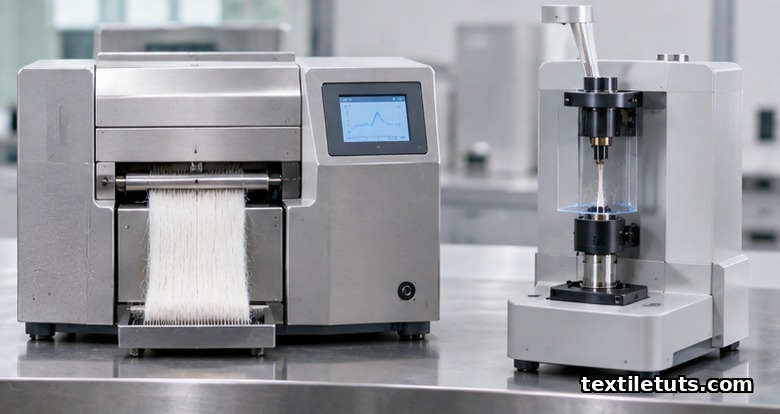
This is why a bale described as “28 mm HVI” should not be confused with a bale described as “28 mm AFIS MLw.” A spinning mill purchasing on the HVI grade and verifying with AFIS should always scale: target AFIS MLw = HVI UHML ÷ 1.04 as a reasonable first pass.
Frequently Asked Questions
What is the difference between HVI UHML and AFIS mean length?
UHML is the mean length of the longer half of the fibers, while AFIS MLw is the mass-weighted mean of every fiber counted. UHML is always larger than AFIS MLw by about 3–5% on the same bale, and UHML ignores the bottom half of the distribution entirely.
Which standard specifies HVI length measurement?
ASTM D5867 specifies the HVI measurement cycle for length, uniformity, micronaire, strength, and color on cotton. ISO 2403 covers the manual comb-sorter length reference method against which both HVI and AFIS are calibrated.
Can AFIS replace HVI for bale classification?
AFIS produces richer length data but at roughly one fifth the throughput of HVI. Mills and classing offices use HVI for routine bale grading and AFIS for blend design, process troubleshooting, and research, where its nep and short-fiber data add value beyond what HVI delivers.
What is a good UHML for ring-spun combed cotton yarn?
A 36s Ne combed ring yarn typically needs UHML of 29 mm or higher, a uniformity index above 82, and SFC(n) below 8%. The 80s Ne combed range usually requires UHML above 32 mm with SFC(n) below 6%; below those thresholds, the yarn evenness and tenacity targets become hard to hold.
Why do HVI and AFIS short fiber numbers sometimes disagree?
HVI reports the SFI by weight only on certain instruments, while AFIS reports both SFC(n) (by fiber count) and SFC(w) (by weight). The two systems also use slightly different short fiber thresholds, with HVI traditionally using 0.5 inch (12.7 mm) and AFIS allowing configurable cut-offs. Calibrating both instruments against the same reference lot at least quarterly keeps the readings comparable.
References
- ASTM International. ASTM D5867 / D5867M — Standard Test Methods for Measurement of Physical Properties of Cotton Fibers by High Volume Instruments. astm.org — covers the HVI test cycle, calibration, and length uniformity math used in cotton classing.
- ASTM International. ASTM D7719 — Standard Test Method for Determination of Fiber Length and Length Distribution of Cotton Fibers by AFIS Method. astm.org — defines the AFIS length-by-number and length-by-weight procedures and reporting formats.
- ASTM International. ASTM D1440 — Standard Test Method for Length and Length Distribution of Cotton Fibers (Array Method). astm.org — the comb-sorter reference method that anchors both HVI and AFIS calibration.
- ISO. ISO 2403:2014 — Cotton Fibres — Determination of Length (Manual Method). iso.org — international comb-sorter reference used by classing laboratories worldwide.
- Bragg, C.K., and Shofner, F.M. “A Brief History of HVI Development and Use in Cotton Classification.” Journal of Cotton Science, Cotton Foundation (peer-reviewed). — describes the optical fibrogram principle behind the HVI length module.
- Krifa, M., and Ethridge, M.D. “Length Distribution of Cotton Fibers: A Predictive Model for AFIS Measurements.” Textile Research Journal, SAGE / SAGE-published peer-reviewed journal. — derives the L(n) and L(w) relationships that AFIS uses to characterize short fiber content.
- Cotton Incorporated. “Fiber Length and Yarn Quality” (Technical Bulletin). cottoninc.com — industry research summary of HVI/AFIS parameters and spinning outcomes.
This article is the working reference for fiber length measurement with HVI and AFIS. Editorial by Iftay Khairul Alam, TextileTuts. Sources: ASTM D5867, ASTM D7719, ASTM D1440, ISO 2403:2014, the Journal of Cotton Science, Textile Research Journal, and Cotton Incorporated as cited above.


