
Feminine Hygiene Textiles

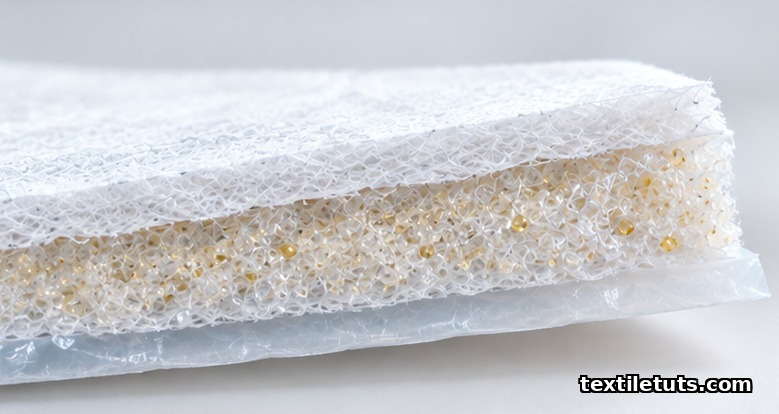
A single-use feminine hygiene pad is a multi-layer composite nonwoven textile that typically weighs 8–15 g in total, pairs a hydrophobic polypropylene or polyester top sheet (15–25 g/m²) with an airlaid absorbent core containing 30–50% sodium polyacrylate superabsorbent polymer (SAP) blended into cellulose fluff, and finishes with a 15–30 g/m² polyethylene or polypropylene backsheet engineered to retain 50 g or more of saline fluid under ISO 11948-1.
The combined stack keeps fluid away from the skin by using capillary gradients across three density zones, and that gradient is what separates a clinically functional pad from a piece of cloth. This guide walks through each layer, the chemistry of the absorbent polymer, the testing standards that govern performance, and how reusable knitted period underwear compares at the fiber and structure level.
What Counts as a Feminine Hygiene Textile
Feminine hygiene textiles cover engineered fabric systems used to absorb or contain menstrual flow, lochia, and light incontinence. They fall into three product families: single-use pads, tampons, and reusable period underwear. Each family uses a different textile construction, but they share a common performance target, which is to keep the skin dry and prevent rewet under mechanical pressure. The global category crosses medical-textile standards because of its skin-contact profile and absorbency claims.
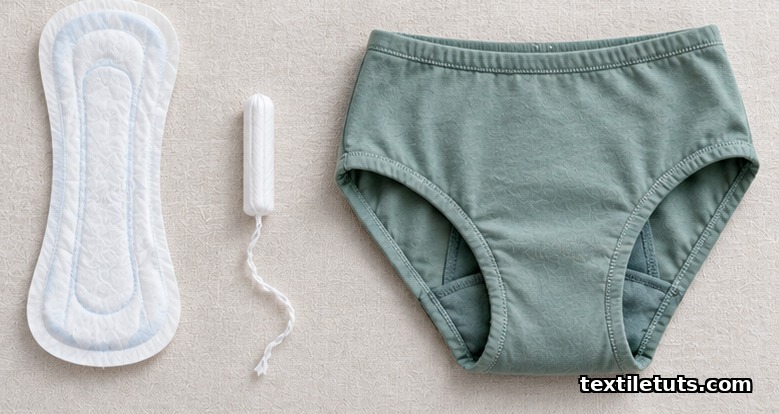
The World Health Organization and UNICEF classify menstrual hygiene products as essential health commodities, and several national pharmacopoeias, including the United States Pharmacopeia and the European Pharmacopoeia, set fiber and absorbency requirements for tampons sold in regulated markets. Outside regulated markets, product performance is governed mainly by ISO nonwoven standards, EDANA voluntary test methods, and AATCC absorbency tests.
The Layered Architecture of a Single-Use Sanitary Pad
A standard single-use pad is a laminate of four engineered nonwoven or film layers. The top sheet sits against the skin and is almost always a hydrophobic-treated polypropylene or polyethylene/polypropylene bicomponent spunbond, point-bonded or through-air bonded to give a soft hand. Typical basis weights run from 15 to 25 g/m², and the hydrophobic finish rewets less than 0.5 g of synthetic blood after standard insult under AATCC TM 130-like protocols when properly formulated.
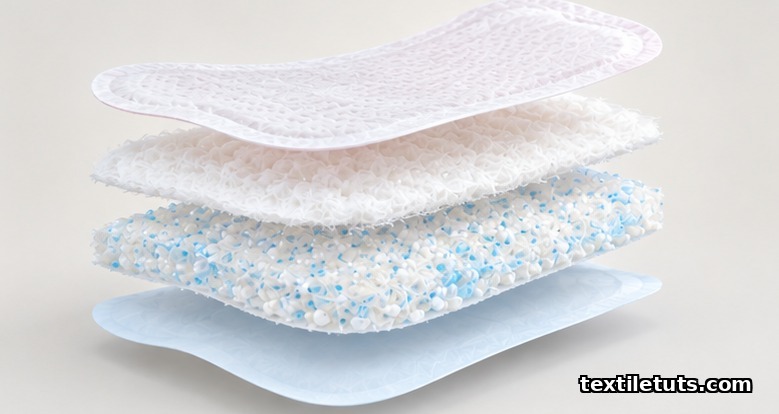
Below the top sheet is the acquisition and distribution layer (ADL), usually a through-air bonded bicomponent nonwoven of 40–80 g/m² that wicks fluid laterally and prevents the absorbent core from being flooded at a single spot. Beneath the ADL sits the absorbent core, the heart of the pad. The core is built from airlaid cellulose fluff (typically bleached softwood kraft) dosed with 8 to 15 g of granular sodium polyacrylate SAP, sometimes shaped into a thin rectangular profile rather than a thick hourglass. The bottom layer is the backsheet, a 15–30 g/m² PE film or a breathable microporous PP/PE film that blocks fluid strike-through. Hot melt adhesive and elastic cuffs around the edges close the laminate.
Superabsorbent Polymer Chemistry and Capacity
Sodium polyacrylate SAP used in feminine hygiene products is a crosslinked copolymer of acrylic acid and sodium acrylate, produced by inverse suspension polymerization. The dry polymer granules absorb 30 to 60 times their own weight in 0.9% saline and lock the fluid into a hydrogel that does not release under pressure, hence the term superabsorbent. Standard grades used in feminine care have centrifuge retention capacity (CRC) values of 28–35 g/g under EDANA ERT 441.2.
The gel strength of the swollen polymer matters as much as its raw capacity. A SAP with high CRC and low gel strength absorbs a lot of fluid but lets it migrate back to the skin under body pressure. Manufacturers therefore tune the crosslink density to balance capacity against absorbency under load (AUL), measured as the gram uptake under 0.3 psi pressure. Higher AUL grades are blended into the core in zones that sit under the body’s main loading points, while higher CRC grades sit in the wings and tail for total capacity.
The placement of SAP inside the core is itself an engineering decision. Older designs sandwiched the polymer as a single uniform layer between two tissue sheets. Newer zoned-core designs use two SAP layers with different particle size distributions and AUL values, separated by a thin cellulose wicking layer, which lets engineers reserve high-AUL polymer for the central insult zone and high-CRC polymer for the side reservoirs.
Tampon Fiber Composition and Test Methods
Tampons are compressed cylindrical plugs of fibers, generally a blend of viscose rayon and cotton, sometimes with a small percentage of polyester or lyocell, formed into a digital or applicator format. A regular absorbency tampon weighs 2.4–3.0 g and absorbs 6–9 g of fluid; a super absorbency tampon can take 12–18 g. EDANA’s voluntary test method EDANA ERT 350.1 (the syngyna test) measures tampon absorbency by weighing fluid uptake in a simulated vaginal model.
The U.S. FDA classifies tampons as Class II medical devices and mandates 21 CFR 801.430 labeling with absorbency ranges. The FDA also requires that tampons sold in the U.S. be tested for dioxin and pesticide residue, and that the rayon content be elemental chlorine free bleached. The European Pharmacopoeia defines composition, foreign fiber limits, and water-soluble substance limits for tampons marketed in EU member states, and ISO 13485 sets the quality management framework that manufacturers follow regardless of geography.
Reusable Period Underwear: Knitted Structure and Fiber Choices
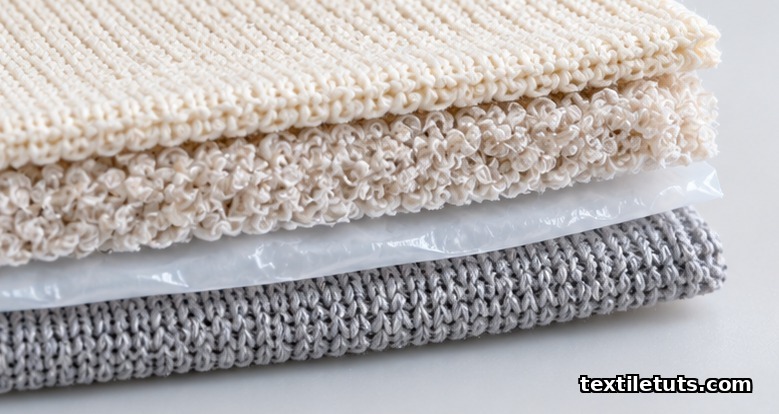
Period underwear relies on a different textile strategy. Instead of superabsorbent polymer, it uses a multi-layer knitted construction that traps fluid by capillary and surface tension forces. The typical stack is a moisture-wicking knit of merino wool, modal, or fine-gauge cotton against the skin, a middle absorbent layer of cotton/bamboo/viscose French terry or double-knit at 200–300 g/m², and a moisture-barrier outer layer of tightly knitted polyester with a TPU (thermoplastic polyurethane) laminate coating. Total pad weight per pair runs 50–90 g, and absorbency claims of 20–30 mL are typical for a moderate-flow day panty.
Care studies published in textile journals have measured residual staining and bacterial load after 40–60 wash cycles at 40 °C and 60 °C. Knitted period underwear loses 8–15% of its absorbency after 60 wash cycles at 60 °C, with the loss concentrated in the cotton and bamboo absorbent layers. Synthetic-fiber period underwear tends to retain more absorbency through high-temperature cycles but can retain odor-causing bacteria if the wash chemistry is not balanced. Laundering at 60 °C with an oxygen-based bleach typically delivers the best long-term performance for both fiber families.
Standards That Govern Absorbency and Skin Safety
Several ISO standards anchor the category. ISO 11948-1 (the Rothwell method) measures the total absorbent capacity of an incontinence pad by full immersion in saline and is widely used for sanitary pads. ISO 9073 covers nonwoven test methods: ISO 9073-6 for absorbency, ISO 9073-10 for dry particulate matter, ISO 9073-12 for demand absorbency. ISO 13485 is the quality management system used by manufacturers of feminine hygiene medical devices. AATCC TM 79 measures rewet, and AATCC TM 130 measures stain release after washing, which is more relevant to reusable products.
Biocompatibility for products in contact with intact skin is evaluated under ISO 10993-5 (cytotoxicity) and ISO 10993-10 (irritation and sensitization), even for products that are not classified as medical devices. EDANA’s voluntary test methods (ERT series) cover a wider set of parameters including strike-through, wetback, and rewet, and most brand-side product engineers run all three in tandem before qualifying a raw material change.
Comparison of Feminine Hygiene Textile Families
| Property | Single-use Pad | Tampon | Reusable Period Underwear |
|---|---|---|---|
| Primary structure | Laminated nonwoven with SAP core | Compressed fiber plug (rayon/cotton) | Multi-layer knit with TPU laminate |
| Typical absorbency (mL) | 30–80 | 6–18 | 10–30 |
| Skin-contact layer | Hydrophobic PP/PE spunbond | None (inserted) | Merino/modal/cotton knit |
| Backsheet | PE film 15–30 g/m² | None (vaginal canal) | TPU-laminated polyester |
| Key standard | ISO 11948-1, ISO 9073-6 | FDA 21 CFR 801.430, EDANA ERT 350.1 | AATCC TM 130, ISO 6330 |
| Rewet under load | < 1 g | Not applicable | 1–3 g |
| Cycle life | Single use | Single use | 40–60 wash cycles |
Frequently Asked Questions
What is the absorbent material inside a sanitary pad?
The absorbent core of a single-use sanitary pad is a blend of cellulose fluff pulp, made from bleached softwood kraft, and sodium polyacrylate superabsorbent polymer (SAP) granules. The fluff distributes the fluid while the SAP locks it in as a gel, with a typical ratio of 60–70% fluff to 30–40% SAP by weight in modern ultrathin pads.
Are organic cotton pads safer than regular pads?
Organic cotton pads replace the polypropylene top sheet with a 100% cotton nonwoven and remove the chlorine bleaching step from the absorbent core, which lowers the residual dioxin level. Independent peer-reviewed work has not found a clinically meaningful difference in skin irritation rates between organic cotton top-sheet pads and standard spunbond pads in healthy users, though users with diagnosed fragrance or additive sensitivity often prefer them.
How much fluid can a tampon absorb?
Tampon absorbency is graded by the FDA’s six-range system: under 6 g (light), 6–9 g (regular), 9–12 g (super), 12–15 g (super plus), 15–18 g (ultra), and over 18 g (ultra plus) of saline uptake per tampon. Choosing the lowest absorbency that meets your flow reduces the risk of microtears and supports the lowest toxic shock syndrome risk profile in FDA guidance.
Do reusable period underwear really work for heavy flow?
Period underwear from reputable brands holds 20–30 mL per pair, equivalent to roughly two regular tampons. For heavy flow, many users pair period underwear with a tampon or menstrual cup as a backup rather than rely on the underwear alone. The structural limit is the absorbent layer’s thickness; thicker padding helps but adds visible bulk under fitted clothing.
What does ISO 11948-1 actually measure?
ISO 11948-1 measures total absorbent capacity by weighing a pad before and after full immersion in 0.9% saline for 30 minutes, draining for 5 minutes, and reweighing. It reports the absolute fluid pickup in grams. ISO 11948-2 (the Cincinnati method) is a more demanding version that simulates dynamic fluid insult; newer product sheets tend to report both because ISO 11948-1 alone can overstate real-world performance.
References
- International Organization for Standardization. ISO 11948-1:1996 — Urine-absorbing aids — Part 1: Whole-product testing (Rothwell method). Standards governing sanitary pad total capacity.
- International Organization for Standardization. ISO 9073-6:2003 — Textiles — Test methods for nonwovens — Part 6: Absorption. Foundation method for nonwoven absorbency measurement.
- European Disposables and Nonwovens Association (EDANA). EDANA ERT 350.1 — Syngyna Test Method for Tampon Absorbency. Voluntary absorbency method for tampons.
- U.S. Food and Drug Administration. 21 CFR 801.430 — User labeling for menstrual tampons. Required absorbency range labeling for tampons.
- European Pharmacopoeia. Tampons, Menstrual (current monograph). Defines composition, foreign fiber, and water-soluble limits for tampons sold in EU markets.
- International Organization for Standardization. ISO 10993-5:2009 — Biological evaluation of medical devices — Part 5: Tests for in vitro cytotoxicity. Biocompatibility baseline for skin-contact hygiene products.
- American Association of Textile Chemists and Colorists. AATCC TM 130 — Soil Release: Oily Stain Release Method. Wash-and-stain test method used to evaluate reusable period underwear.
This article is the working reference for feminine hygiene textiles, covering pad laminate structure, SAP chemistry, tampon fiber construction, period underwear knitting, and the ISO/AATCC/EDANA test methods that govern performance. Editorial by Md. Asad Ullah (Meem), TextileTuts. Sources: ISO 11948-1, ISO 9073-6, ISO 10993-5, EDANA ERT 350.1, FDA 21 CFR 801.430, European Pharmacopoeia, and AATCC TM 130 as cited.


