
Adult Incontinence Products

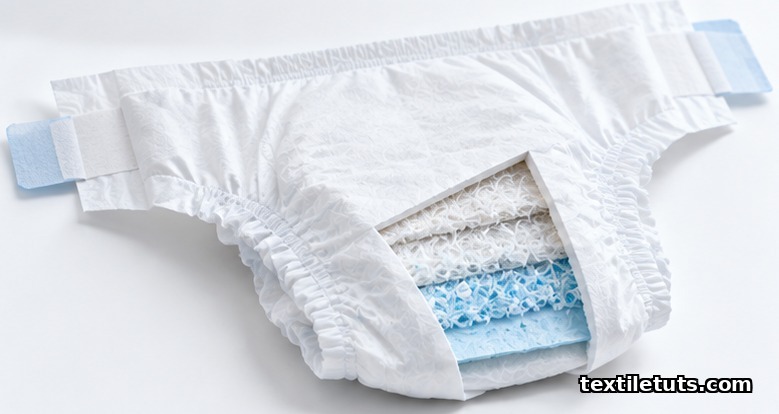
Adult incontinence products are single-use absorbent hygiene items built from a layered nonwoven construction with a superabsorbent polymer (SAP) core that retains 30 to 50 times its own weight in 0.9% saline, with premium tab-style briefs reaching absorption capacities of 1,500 to 3,000 mL under the ISO 11948-2 demand-absorbency method.
The category covers four main product formats (tab-style briefs, pull-on underwear, pads, and underpads) and is one of the largest commercial applications of technical-textile nonwovens.
This guide walks through the layer-by-layer construction of these products, the test methods that grade them, and the material science behind leak protection and skin dryness.
What Counts as an Adult Incontinence Product
Adult incontinence products are disposable absorbent hygiene items used to manage involuntary loss of bladder or bowel control. The category intersects with medical textiles and personal-hygiene nonwovens. ISO 15621:2017 defines the category, the test methods, and the labeling requirements for adult absorbent incontinence aids used outside medical settings.
Globally, an estimated 423 million people lived with some form of urinary incontinence in 2018, according to a Springer Open / BMC Public Health prevalence study that surveyed data from 30 countries. That scale makes adult incontinence products one of the highest-volume personal-care nonwoven categories by mass, alongside feminine-hygiene and baby diapers, which together account for several million metric tons of nonwoven fabric per year.
The Five Functional Layers of an Adult Brief
Modern tab-style briefs and pull-on underwear share the same five-layer architecture, with each layer performing a specific fluid-management task:
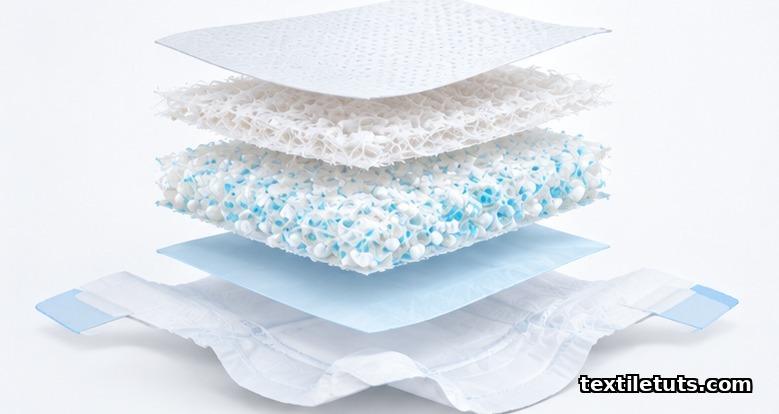
| Layer | Material | Function |
|---|---|---|
| Top sheet (acquisition) | Hydrophobic/hydrophilic spunbond polypropylene, 15 to 25 g/m² | Passes liquid quickly to the core, keeps skin dry |
| Acquisition/distribution layer (ADL) | Air-laid through-air bonded nonwoven, often surfactant-treated | Spreads fluid across the core to prevent pooling |
| Superabsorbent core | Cellulose fluff pulp mixed with sodium polyacrylate SAP | Absorbs and locks away liquid (1 g SAP retains 30 to 50 g of 0.9% saline) |
| Back sheet | Spunbond-Meltblown-Spunbond (SMS) polyethylene/polypropylene laminate | Liquid barrier plus breathability and low noise |
| Closure system | Hook-and-loop refastenable tapes (briefs) or elastic side panels (pull-ons) | Fit and re-fastening |
The key design parameter is the top sheet’s rewet value, the amount of liquid that returns to the skin when pressure is reapplied. AATCC TM 195 measures this rewet along with overall moisture-management performance, and lower numbers mean better dryness. Premium products typically keep rewet below 0.5 g under 4.4 kPa applied pressure.
How Absorbency Is Measured (ISO 11948)
The two reference standards for incontinence-product absorbency are ISO 11948-1 (the Rothwell method) and ISO 11948-2 (the demand-absorbency or “manikin” method). They give very different numbers, which is why two products can both claim “high absorbency” and still rank differently on a data sheet.
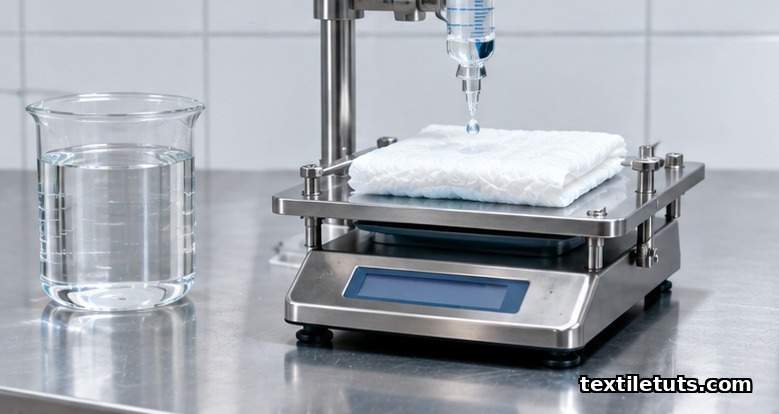
ISO 11948-1 submerges the full product in a saline bath and weighs the mass gain. ISO 11948-2 simulates real conditions by dosing fluid in small repeated doses under load, until the product leaks. Practical ranges from published industry test data:
- Light pads (stress incontinence): 200 to 400 mL (ISO 11948-1)
- Moderate pads: 400 to 900 mL (ISO 11948-1)
- Daytime tab-style briefs: 1,500 to 2,200 mL (ISO 11948-2)
- Maximum-overnight briefs: 2,200 to 3,000+ mL (ISO 11948-2)
Manufacturers often print the ISO 11948-1 figure on pack because the numbers look higher. Caregivers comparing two products should always check which ISO method is being used before choosing.
Material Components and Their Roles
Superabsorbent Polymer (SAP)
SAP is a cross-linked sodium polyacrylate hydrogel supplied as a granular powder. SAP loadings typically range from 30% to 50% of total core weight. Higher loadings give more capacity but raise stiffness against the body, so designers balance core mass against acquisition rate.
Fluff Pulp
Fluff pulp is a long-fiber, low-density cellulose sheet, generally southern pine or eucalyptus, defibered in-line during product conversion. The fluff holds the SAP granules in place, wicks fluid laterally, and adds bulk so the brief keeps shape under load.
Nonwoven Coverstocks
The top sheet and back sheet are spunbond or spunbond-meltblown (SMS, SSMMS) fabrics in the 10 to 30 g/m² range. The top sheet is treated with a topical hydrophilic finish (often a siloxane or fatty-acid amide surfactant) so urine passes through quickly. The back sheet is a microporous film or an SMS laminate that holds liquid in but lets water vapor out, with typical moisture-vapor transmission rates (MVTR) of 1,000 to 5,000 g/m²/24 h when measured by ASTM E96.
Product Formats and When Each Is Used
Four formats cover the spectrum from light stress incontinence to heavy overnight protection. The choice is driven by absorbency needs, mobility, and the user’s ability to change the product unaided.
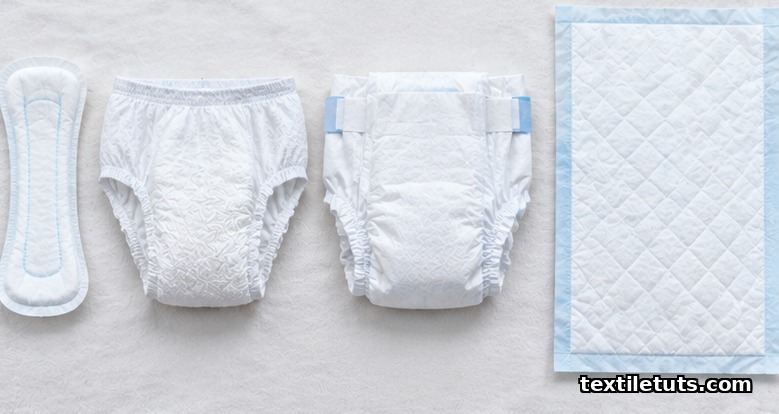
Pads and Liners
Light to moderate loss, used inside regular underwear. Capacity typically 200 to 900 mL (ISO 11948-1). Designed for stress incontinence triggered by coughing, sneezing, or exercise.
Pull-On Underwear
Worn and removed like regular underwear, suited for mobile users with moderate to heavy loss. Capacity 800 to 1,800 mL (ISO 11948-2). Elastic side panels give a secure fit under clothing.
Tab-Style Briefs (All-in-Ones)
Refastenable hook-and-loop side tapes, suited for users with limited mobility or caregiver-assisted changes. Capacity ranges 1,500 to 3,000 mL (ISO 11948-2). The heaviest overnight briefs sit in this category.
Underpads (Chux)
Flat absorbent pads placed on bedding or chairs to catch leaks and protect surfaces. Typical sizes 60 × 90 cm. Used alongside a wearable product, not in place of one.
Skin Health, pH, and Dermatological Testing
Prolonged moisture exposure breaks down skin barrier function. The mean stratum corneum surface pH sits around 4.5 to 5.5 on healthy skin but shifts toward 6.5 under prolonged wet occlusion, raising dermatitis risk. Two standardized tests guide the dermatological claims on pack:
- AATCC TM 195 profiles how fast moisture moves through the top sheet and how much stays on the surface.
- ASTM E96 grades the back sheet’s breathability in MVTR, which controls skin-side moisture build-up.
Top sheets are now commonly treated with skin-friendly surfactants, aloe, chamomile, or shea butter, and dermatologically tested under patch-test protocols similar to those used for cosmetics. Products carrying the Skin Health Alliance or Dermatest seal have passed 24 to 48 hour occlusion patch tests on human volunteers.
Sustainability and End-of-Life
A standard tab-style brief weighs 70 to 120 g, with roughly 35% to 50% of that mass being superabsorbent SAP, 30% to 40% fluff pulp, and the remainder nonwoven, elastic, and adhesive components. None of the layers are biodegradable under standard conditions. Used briefs are classified as sanitary waste in the EU under Directive 2008/98/EC and are generally incinerated or landfilled.
Research published in MDPI Polymers reviewed biodegradable absorbent cores made from chitosan-based hydrogels and bamboo-derived cellulose, but these materials currently retain roughly 60% to 70% of the saline capacity of sodium polyacrylate, and mainstream adult products still rely on synthetic SAP. Several manufacturers are now selling reusable cloth undergarments with replaceable pads as a partial alternative, although reusable briefs hold only about 300 to 800 mL and require a stronger secondary pad for overnight use.
How to Pick the Right Product
Match the product to the loss volume, mobility, and skin-sensitivity profile:
- Estimate average void volume and frequency, and use the ISO 11948-2 figure, not the higher ISO 11948-1 number.
- Account for mobility: pull-ons for active users, tabs for users who need caregiver-assisted changes.
- Check the top sheet’s rewet (AATCC TM 195) and the back sheet’s MVTR (ASTM E96) to manage skin health.
- If skin is fragile, look for products carrying a published dermatological or skin-health certificate.
- For overnight use, choose a tab-style brief rather than a pad; pads below 1,500 mL (ISO 11948-2) will not last a full 8 hours.
Frequently Asked Questions
What is the absorbency of an adult incontinence brief?
Tab-style briefs typically hold 1,500 to 3,000 mL of 0.9% saline under the ISO 11948-2 demand-absorbency method, and 2,500 to 4,500 mL under the older ISO 11948-1 Rothwell submersion method. The Rothwell figure is always higher because it tests the product with no applied pressure; the demand-absorbency method simulates real loading over time and matches what users actually experience.
How does adult incontinence underwear differ from a menstrual pad?
Adult incontinence briefs carry 1,500 to 3,000 mL (ISO 11948-2), versus 5 to 15 mL for a typical menstrual pad. The construction follows the same four-zone logic (top sheet, acquisition layer, superabsorbent core, back sheet), but incontinence briefs include a much larger SAP core, elastic leak guards at the legs, refastenable tabs, and odor-control additives in the ADL.
Can incontinence briefs cause skin irritation or rashes?
Prolonged wet contact shifts skin surface pH and raises the risk of irritant dermatitis. Choosing products with low rewet (under 0.5 g on AATCC TM 195) and breathable back sheets (MVTR above 1,000 g/m²/24 h per ASTM E96) reduces this risk. Patch-tested products with aloe or skin-friendly surfactants are available for sensitive skin.
Are there reusable adult incontinence products?
Yes. Reusable cloth briefs made from cotton or polyester with built-in absorbent cores can be laundered through roughly 200 to 300 standard wash and dry cycles based on manufacturer durability data. Reusables have lower liquid capacity (typical 300 to 800 mL) and usually require a stronger secondary pad for overnight use.
How should used briefs be disposed of?
Used briefs are classed as sanitary waste. In the EU they must be collected per Directive 2008/98/EC; in the U.S. they should be sealed in a disposable bag, then discarded with household waste unless local rules call for separate handling. They should never be flushed, because the swollen SAP causes pipe blockages and municipal plants are not designed to treat that mass.
References
- International Organization for Standardization. ISO 11948-1:1996 Urine-absorbing aids — Part 1: Whole-product testing. Geneva: ISO. Submersion-based absorbency method (Rothwell).
- International Organization for Standardization. ISO 11948-2:1998 Urine-absorbing aids — Part 2: Methods for determining the absorption of products used at the body. Geneva: ISO. Demand-absorbency method.
- International Organization for Standardization. ISO 15621:2017 Absorbent incontinence products for personal hygiene — Evaluation methods. Geneva: ISO. Defines the category and labeling requirements.
- AATCC. AATCC TM 195-2017 Liquid Moisture Management Properties of Textile Fabrics. Research Triangle Park, NC: American Association of Textile Chemists and Colorists. Test method for rewet and surface moisture.
- ASTM International. ASTM E96/E96M-22 Standard Test Methods for Gravimetric Determination of Water Vapor Transmission Rate of Materials. West Conshohocken, PA. Test method for back-sheet MVTR.
- Irwin, D. E., et al. (2018). Worldwide prevalence estimates of urinary incontinence in men and women. BMC Public Health, Springer Open. Estimates of 423 million adults affected globally across 30 countries.
- European Commission. Directive 2008/98/EC on waste (Waste Framework Directive). Brussels: Official Journal of the European Union. Classification of sanitary waste.
This article is the working reference for nonwoven absorbent hygiene products used in adult incontinence care. Editorial by Md. Asad Ullah (Meem), TextileTuts. Sources: ISO 11948-1, ISO 11948-2, ISO 15621, AATCC TM 195, ASTM E96/E96M-22, BMC Public Health (Springer Open), EU Directive 2008/98/EC.


