
Biodegradable Medical Textiles

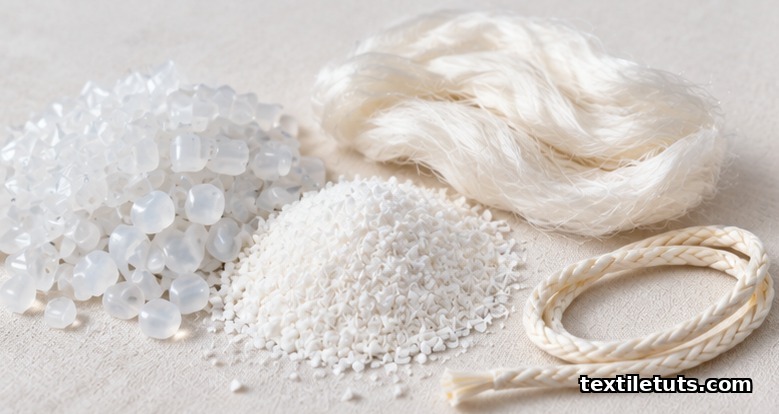
Biodegradable medical textiles are textile structures engineered to degrade in vivo within predictable timeframes, ranging from 14 days for fast-absorbing sutures to over 24 months for load-bearing scaffolds, while meeting ISO 10993 biocompatibility requirements for medical devices.
These textiles use natural polymers such as collagen, chitosan, and alginate, alongside synthetic bioresorbable polymers including polylactic acid (PLA), polyglycolic acid (PGA), and polycaprolactone (PCL), that break down through hydrolysis or enzymatic action into non-toxic metabolites. They are essential for absorbable sutures, advanced wound dressings, hernia meshes, vascular grafts, and tissue engineering scaffolds, where permanent implants would cause long-term complications or require surgical removal.
This article explains the material science behind biodegradable medical textiles, walks through the four major application categories, maps the testing standards that govern their approval, and answers the most common questions textile engineers and clinical buyers ask when specifying these materials.
What Makes a Medical Textile Biodegradable?
In medical contexts, biodegradable (more accurately, bioresorbable) refers to materials that degrade in physiological conditions, typically 37 degrees C in aqueous media at pH 7.4, and are either metabolized, excreted, or incorporated into tissue. The two primary mechanisms are hydrolytic degradation, where water cleaves polymer ester bonds, and enzymatic degradation, where proteases or glycosidases break down natural polymers.
The defining feature of a biodegradable medical textile is controlled loss of mechanical function matched to the healing timeline. A skin suture does not need to last 12 months; a vascular graft does. ASTM F2150 (Standard Guide for Characterization and Testing of Biomaterial Scaffolds Used in Tissue-Engineered Medical Products) treats degradation kinetics as a critical design parameter alongside porosity, surface chemistry, and mechanical properties.
Three clinical terms distinguish the end-state of these materials. Bioresorbable means the polymer fully dissolves and is cleared from the body. Bioabsorbable means fluid penetrates the material and leads to loss of mass. Biodurable means the material resists degradation and remains for years. Medical textile engineering treats these as a spectrum rather than binary states, with textile construction (woven, knitted, braided, nonwoven) modifying the bulk degradation profile beyond what the base polymer alone would predict.
Materials Used in Biodegradable Medical Textiles
The polymer families used in biodegradable medical textiles fall into natural and synthetic groups, each with predictable degradation behavior.
Synthetic bioresorbable polyesters: PLA, PGA, and PCL are the workhorses of absorbable medical textiles, all of which degrade by hydrolysis of ester linkages. PLA (glass transition temperature around 60 degrees C) loses tensile strength over 6 to 24 months depending on crystallinity and molecular weight. PGA loses strength within 2 to 4 months. PCL, with its much lower glass transition temperature of around minus 60 degrees C, degrades over 2 to 4 years, making it suitable for long-term implants such as hernia meshes. Copolymers such as poly(lactic-co-glycolic acid) (PLGA) are tuned for intermediate absorption profiles.
Natural polymers: Collagen, chitosan, alginate, silk fibroin, and hyaluronic acid are widely used in wound dressings, hemostatic sponges, and tissue engineering scaffolds. Chitosan, derived from crustacean shell chitin, degrades via lysozyme and has hemostatic and antimicrobial properties. Alginate dressings absorb 15 to 20 times their weight in wound fluid, forming a gel that maintains a moist healing environment. Collagen sponges and films are absorbed by the body in 2 to 8 weeks depending on crosslinking.
Composite and hybrid structures: Many commercial products combine natural and synthetic phases to tune degradation and cell response. A common example is a Vicryl (polyglactin 910) braided suture coated with polyglactin 370 and stearic acid for smoother tissue passage, where the lubricant layer slows initial hydration by a few hours.
Absorbable Sutures: The Established Benchmark
Absorbable sutures are the highest-volume application for biodegradable medical textiles, with global consumption exceeding 1.5 billion units annually. Their absorption profiles are well-characterized because they have been in clinical use since the 1970s.
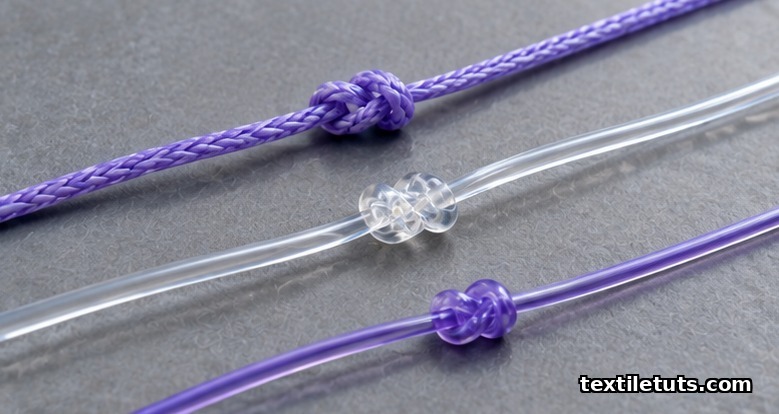
Vicryl (polyglactin 910, a 90:10 glycolide:lactide copolymer) retains roughly 50% of its initial tensile strength at 21 days and is fully absorbed between 56 and 70 days. Monocryl (poliglecaprone 25, a glycolide-caprolactone copolymer) retains 50% strength at 7 days and absorbs in 90 to 120 days. PDS II (polydioxanone) retains 50% strength at 28 days and is fully absorbed by 180 to 210 days. These figures are derived from in vivo implantation studies in line with ASTM and United States Pharmacopeia (USP) tensile-strength retention guidelines.
Suture construction affects performance beyond the polymer choice. Braided sutures handle more easily and tie securely but can harbor bacteria in capillary spaces, so they are often coated. Monofilament sutures have lower tissue drag and no interstices, but the single-fiber cross-section limits knot security. For biodegradable sutures, the construction choice interacts with degradation because surface area per unit volume is much higher for multifilament braids, accelerating hydrolytic loss.
Wound Dressings and Hemostats
Biodegradable textiles are widely used in advanced wound care, particularly for chronic wounds (diabetic ulcers, pressure injuries), burns, and post-surgical sites. The category includes woven, knitted, and nonwoven forms.
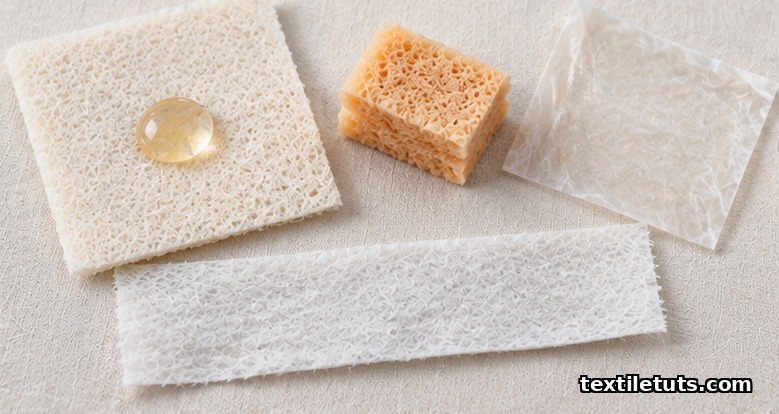
Alginate dressings, made from calcium and sodium alginate fibers, form a gel on contact with wound exudate and donate calcium ions that aid hemostasis. They are typically indicated for moderate to heavily exuding wounds and biodegrade as the wound heals. Chitosan dressings, available as nonwovens and films, accelerate clotting by aggregating red blood cells and platelets; this property is exploited in rapid hemostatic products such as chitosan-coated gauze and chitosan granules.
Nonwoven structures dominate this category because they offer high surface area, controlled porosity, and tunable fluid handling. Spunlaid and meltblown PLA nonwovens have been investigated as biodegradable alternatives to polypropylene for single-use drapes and gowns, with pilot studies reporting complete composting within 90 days under industrial conditions.
Tissue Engineering Scaffolds and Surgical Meshes
Tissue engineering scaffolds are 3D textile structures that support cell attachment, proliferation, and guided tissue formation before the scaffold degrades and is replaced by native extracellular matrix. Knitted and braided PLA scaffolds have been clinically approved for vascular grafts, while nonwoven and electrospun PCL scaffolds are used in cartilage and skin regeneration.
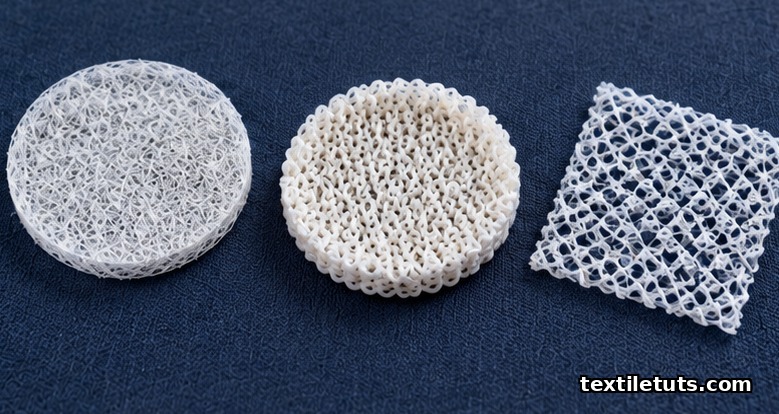
The key design parameters are porosity (typically 50 to 90%), pore size (100 to 500 micrometers for cell infiltration and vascularization), and fiber diameter. ASTM F2450 (Standard Guide for Assessing Microstructure of Polymeric Scaffolds for Use in Tissue-Engineered Medical Products) provides a reference framework for measuring these parameters via mercury intrusion porosimetry, scanning electron microscopy, and micro-computed tomography.
For hernia repair, lightweight composite meshes combine slowly degrading fibers with resorbable components to balance mechanical support and tissue integration. Clinical evidence supports reduced chronic pain compared with heavyweight permanent polypropylene meshes, although long-term recurrence data continue to be collected.
Testing Standards for Biodegradable Medical Textiles
The standards framework spans biocompatibility, mechanical performance, degradation kinetics, and scaffold characterization. ISO 10993 (Biological Evaluation of Medical Devices) is the central biocompatibility series, with 31 parts covering cytotoxicity (ISO 10993-5), sensitization and irritation (ISO 10993-10), implantation effects (ISO 10993-6), and sample preparation (ISO 10993-12). For medical textiles with direct tissue contact longer than 30 days, the full implantation, sensitization, and genotoxicity suite is typically required.
ASTM standards cover scaffold and device-specific testing. ASTM F2150 guides scaffold characterization, ASTM F2450 covers microstructure assessment, and ASTM F2739 guides in vitro degradation of absorbable porous scaffolds. For sutures, USP General Chapter 881 specifies tensile-strength retention benchmarks, while ASTM F1635 covers in vitro degradation testing of resorbable sutures using controlled pH buffers.
AATCC standards apply less often to implants but are useful for textile processing controls, including AATCC TM100 (antimicrobial finishes) for wound dressings with antimicrobial claims. Accredited labs such as Intertek and SGS run ISO 10993 panels under GLP conditions, generating the data files used in FDA 510(k) and EU MDR submissions.
Material Comparison: Common Biodegradable Textile Polymers
| Polymer | Source | Degradation Time | Tensile Strength at Implantation | Common Application |
|---|---|---|---|---|
| Collagen | Bovine or porcine dermis | 2 to 8 weeks | Low to moderate | Hemostats, wound dressings |
| Chitosan | Crustacean shell | 4 to 12 weeks | Low | Hemostatic dressings, scaffolds |
| Alginate | Brown seaweed | 1 to 4 weeks | Low | Wound dressings |
| PGA | Synthetic | 2 to 4 months | High | Sutures (Dexon) |
| PLA | Synthetic (renewable) | 6 to 24 months | High | Scaffolds, meshes, fixation devices |
| PLGA (90:10) | Synthetic | 2 to 3 months | High | Sutures (Vicryl) |
| PCL | Synthetic | 2 to 4 years | Low to moderate | Long-term meshes, scaffolds |
| Polydioxanone | Synthetic | 6 to 9 months | High | Monofilament sutures (PDS II) |
Frequently Asked Questions
What is the difference between bioabsorbable and bioresorbable sutures?
Bioabsorbable refers to material that is broken down and assimilated by the body, while bioresorbable refers to material that fully dissolves and is metabolized or excreted. In practice the terms are used interchangeably for suture labeling, although regulatory submissions (FDA, EU MDR) distinguish absorption profile from elimination profile. Vicryl is bioresorbable because it hydrolyzes into glycolic and lactic acids that enter normal metabolic pathways, satisfying both definitions in most clinical contexts.
How long does a Vicryl suture retain its strength?
Vicryl (polyglactin 910) retains approximately 50% of its initial tensile strength at 21 days post-implantation and roughly 0% at 28 days, with complete mass absorption between 56 and 70 days. These figures assume implantation in subcutaneous tissue at 37 degrees C; values shift in either direction depending on tissue pH, mechanical load, and infection status.
Are biodegradable medical textiles safe for patients with polymer allergies?
Allergic reactions to PLA, PGA, and PCL are rare in clinical literature, but natural polymers (collagen, chitosan) carry a higher risk of immune response in sensitized individuals. Chitosan allergy is reported primarily in patients with shellfish hypersensitivity, although purified medical-grade chitosan has most residual proteins removed. ISO 10993 sensitization and implantation testing is the standard screen before any new textile construction is marketed.
What are the main disadvantages of biodegradable medical textiles?
The three primary disadvantages are limited shelf life (PLA sutures typically have a 3 to 5 year shelf life due to hydrolytic aging even in dry packaging), higher unit cost compared with permanent polypropylene, and unpredictable in vivo degradation rates in patients with metabolic disorders, infection, or compromised healing. For these reasons, biodegradable textiles are not used where permanent mechanical support is required.
Do biodegradable textiles reduce medical waste?
Yes, but the impact is conditional on disposal pathway. PLA and chitosan textiles compost fully under industrial composting conditions (58 degrees C, controlled humidity) within 90 to 180 days. In hospital incineration, the waste-reduction benefit is minimal because most single-use medical textiles are incinerated regardless of composition. The greater clinical benefit is reduced patient re-operation and shorter hospital stays, not landfill diversion.
References
- International Organization for Standardization. ISO 10993-1:2018, Biological evaluation of medical devices, Part 1: Evaluation and testing within a risk management process. iso.org.
- ASTM International. ASTM F2450-18, Standard Guide for Assessing Microstructure of Polymeric Scaffolds for Use in Tissue-Engineered Medical Products. astm.org.
- ASTM International. ASTM F2150-19, Standard Guide for Characterization and Testing of Biomaterial Scaffolds Used in Tissue-Engineered Medical Products. astm.org.
- ASTM International. ASTM F1635-16, Standard Test Method for In Vitro Degradation Testing of Hydrolytically Degradable Polymer Resins and Fabricated Forms for Surgical Implants. astm.org.
- Middleton, J.C., Tipton, A.J. (2000). Synthetic biodegradable polymers as orthopedic devices. Biomaterials, 21(23), 2335-2346. sciencedirect.com.
- Nair, L.S., Laurencin, C.T. (2007). Biodegradable polymers as biomaterials. Progress in Polymer Science, 32(8-9), 762-798. sciencedirect.com.
- Rinaudo, M. (2006). Chitin and chitosan: Properties and applications. Progress in Polymer Science, 31(7), 603-632. sciencedirect.com.
- United States Pharmacopeia. USP General Chapter 881, Sutures, Tensile Strength. usp.org.
This article is the working reference for biodegradable medical textiles. Editorial by Md. Asad Ullah (Meem), TextileTuts. Sources: ISO 10993, ASTM F2450, ASTM F2150, ASTM F1635, USP Chapter 881, and peer-reviewed papers in Biomaterials, Carbohydrate Polymers, and Progress in Polymer Science as cited.


