
Air Permeability: ISO 9237

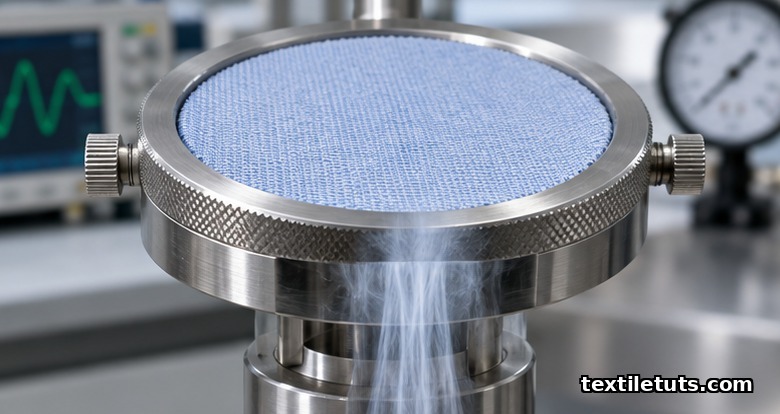
ISO 9237:1995 determines the air permeability of textile fabrics by measuring the volume of air, in cubic centimetres per square centimetre per second (cm³/cm²/s), that passes perpendicularly through a defined test area of 5, 20, 25, 50, or 100 cm² at a chosen pressure drop of 50, 100, 200, or 500 Pa across the specimen. The standard applies to most woven, knitted, and nonwoven fabrics, including industrial textiles used for filtration, and it remains the reference method cited by OEKO-TEX, ISO 17073, and most private buyer specifications for breathable garments.
The single number reported from an ISO 9237 test tells a textile engineer how easily air flows through a fabric, which directly predicts wind penetration, breathability during wear, filtration efficiency, and the fabric’s suitability for parachutes, tents, airbags, or coated rainwear.
This article walks through what ISO 9237 actually measures, how the test rig works, which pressure and test-area combination to choose for a given fabric, typical values you should expect by fibre type, and how to interpret results against adjacent standards such as ASTM D737, which is technically equivalent in principle.
What Is ISO 9237? Scope and Purpose
ISO 9237, titled “Textiles — Determination of the permeability of fabrics to air,” was first published in 1995 and re-confirmed by the International Organization for Standardization in 2010 and 2016. The standard defines a single laboratory method for measuring how much air passes through a flat textile specimen under controlled suction.
The standard is not designed to measure moisture vapour transmission (that is ISO 15496 or the Hohenstein skin model) and it does not simulate wind hitting a moving body (that requires a sweating manikin). It measures only dry-air flow through the fabric at room temperature, 20 °C ± 2 °C, and 65 % ± 2 % relative humidity, after the specimen has been conditioned for 24 hours under those conditions.
ISO 9237 is technically equivalent in method to ASTM D737, the U.S. standard for air permeability, and to the British BS 5636. Differences between these standards are limited to fixture geometry and the list of prescribed test pressures, not to the underlying physics.
How the ISO 9237 Test Works
The test rig, often called an air-permeability tester or Shirley apparatus, consists of a suction pump, a calibrated rotameter or electronic flow sensor, a clamp that holds the fabric flat without distortion, and interchangeable circular test heads that define the test area. The most common commercial instruments are the SDL Atlas M021, the Textest FX 3300, and the SDL 28.
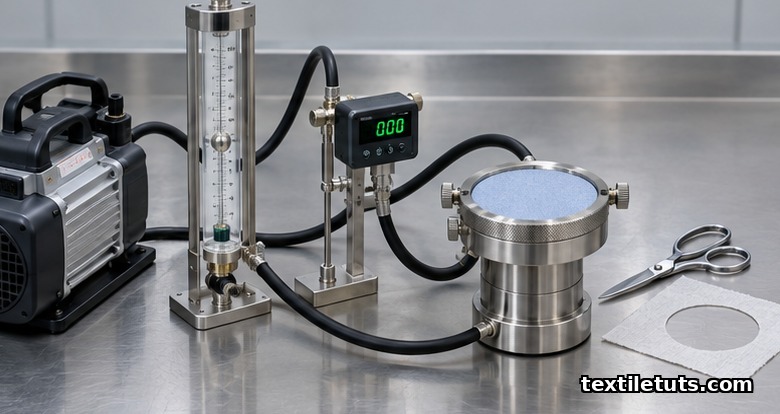
The operator cuts or templates a representative sample of fabric, usually free of creases, selvedge, and obvious defects, and clamps it between two circular rings so that no edge leakage occurs. A vacuum pump draws air through the specimen, and the system adjusts the suction until the pressure drop across the fabric reaches the set value (for example, 100 Pa). The flow rate required to hold that pressure is recorded, and air permeability is calculated as:
R = q / A × 167, where R is air permeability in cm³/cm²/s, q is the measured volumetric flow in cm³/min, A is the test area in cm², and 167 is the unit-conversion factor (10 000 cm²/m² ÷ 60 s/min).
The standard requires at least five specimens per fabric sample, with the median value reported. Specimens should be taken from different regions of the fabric to capture batch variability, and the report must specify the test area, test pressure, and number of specimens.
Choosing the Right Test Pressure and Test Area
ISO 9237 lists four candidate pressures: 50 Pa, 100 Pa, 200 Pa, and 500 Pa. The lower the pressure, the more sensitive the test is to tight weaves and coatings; the higher the pressure, the better it discriminates between very open structures. For everyday apparel fabrics, 100 Pa is by far the most common choice and is the default in OEKO-TEX test reports. For very open fabrics such as mosquito netting or industrial filtration media, 200 Pa or 500 Pa is used to keep the flow inside the measurable range of the flow meter.
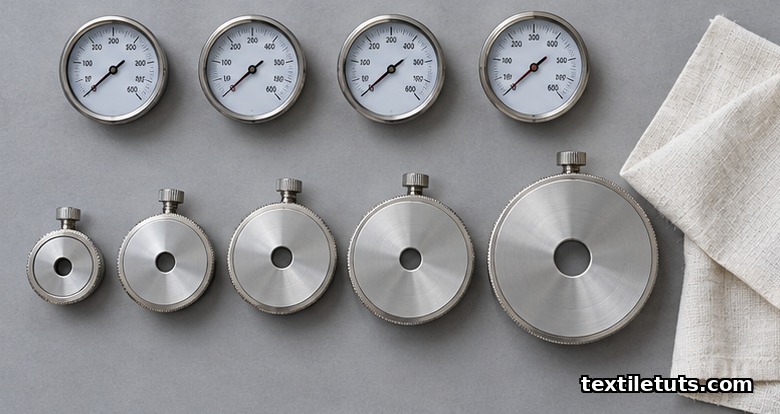
Test area selection works on the same principle. ISO 9237 permits five test areas: 5 cm², 20 cm², 25 cm², 50 cm², and 100 cm². A small 5 cm² head is used when the expected flow is low, such as coated rainwear or high-density down-proof weaves; a 50 cm² or 100 cm² head is used for very open fabrics where the rotameter would otherwise saturate. The standard warns that test area affects the absolute reading slightly because edge effects become a larger fraction of the total flow at small areas, so the same head must be used for direct comparisons between fabrics.
A practical rule of thumb used in many mills: start at 100 Pa with the 20 cm² head. If the reading exceeds the upper limit of the flow meter, switch to 50 cm² or to 200 Pa. If the reading is below the lower limit, switch to 5 cm² or to 50 Pa.
Typical Air Permeability Values by Fabric Type
The values below are typical ranges drawn from peer-reviewed sources and ISO round-robin data, not absolute pass/fail limits. They are useful as sanity checks when validating a new fabric or auditing a supplier’s report.
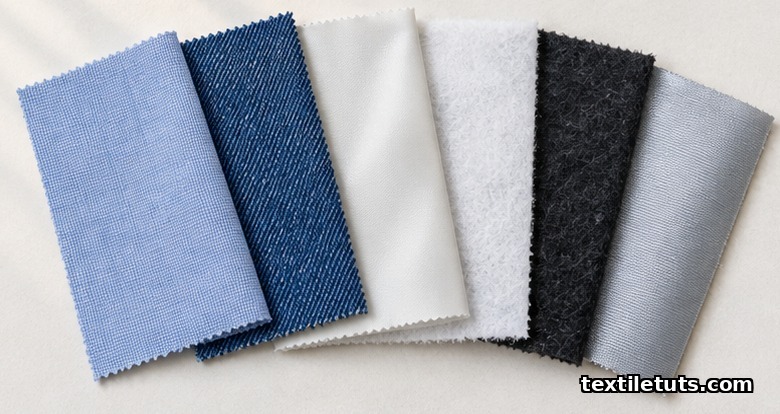
| Fabric type | Typical ISO 9237 reading at 100 Pa (cm³/cm²/s) | End-use implication |
|---|---|---|
| Woven shirting cotton (110–130 g/m²) | 40–120 | Comfortable for warm-weather shirts |
| Knitted single-jersey cotton (150–180 g/m²) | 300–800 | Very breathable T-shirts |
| Denim, 3/1 twill, 12 oz | 8–25 | Wind-resistant jeans, low convective cooling |
| Polyester microfiber windshell | 0.5–5 | Windproof by design |
| Polyurethane-coated rainwear | ≤ 0.1 | Waterproof, not breathable |
| Spunbond nonwoven, 25 g/m² (SMS fabric) | 800–1 500 | Surgical gown substrate |
| Needle-punched geotextile, 200 g/m² | 300–1 000 | Drainage layers in civil engineering |
| Woven airbag fabric (silicone-coated nylon 6.6) | ≤ 0.05 | Gas-tight to retain inflation pressure |
A reading above 1 000 cm³/cm²/s generally indicates a fabric so open that it cannot be called “windproof” in any practical sense, regardless of construction. A reading below 1 cm³/cm²/s usually indicates either a heavy coating or a laminate film, and at that point ISO 9237 becomes less informative than a hydrostatic-head test (ISO 811).
How Air Permeability Relates to Fabric Performance
Air permeability is one of several breathability metrics, but it is the cheapest, fastest, and most reproducible. It correlates strongly with the convective heat loss a wearer experiences in wind, which is why windshell jackets are specified by a maximum allowable air permeability (often ≤ 5 cm³/cm²/s at 200 Pa). It also predicts how easily dust, pollen, and fine particles penetrate a fabric, which is why cleanroom garments and medical drapes are tested at very low pressure with small test areas to detect pinholes that would otherwise let particles through.
For filtration media, ISO 9237 is used as a quick quality check on the production line, not as the final filter rating. A meltblown nonwoven with an air permeability of 50 cm³/cm²/s at 200 Pa typically delivers an N95-class filtration efficiency of more than 95 % at 0.3 µm, but the relationship is empirical and must be calibrated against the actual filtration test (ISO 16890 or EN 779).
For apparel buyers, the practical reading is to compare ISO 9237 numbers only when they were taken at the same pressure and the same test area. Comparing a 100 Pa / 20 cm² value of 40 cm³/cm²/s against a 200 Pa / 50 cm² value of 80 cm³/cm²/s is meaningless without a pressure-correction calculation, which the standard does not endorse.
Frequently Asked Questions
What is the difference between ISO 9237 and ASTM D737?
ISO 9237 and ASTM D737 measure the same property using the same physics, a suction pump drawing air through a clamped fabric at a set pressure drop. The differences are limited to the list of prescribed test pressures (ASTM D737 emphasizes 125 Pa; ISO 9237 lists 50, 100, 200, and 500 Pa) and the reporting format. For most apparel and nonwoven applications, results from the two methods can be compared directly when taken at the same pressure.
What is the standard test pressure for clothing fabrics?
100 Pa is the conventional test pressure for general apparel fabrics and is the default in OEKO-TEX certification reports, ISO 17073, and most European buyer specifications. 200 Pa is used for industrial textiles and very open fabrics; 50 Pa is reserved for tightly coated materials where higher pressures would saturate the flow meter.
Does a higher air permeability mean a more breathable fabric?
Generally yes, but air permeability measures only dry convective flow. A fabric can have a high ISO 9237 reading yet still feel clammy during exercise because moisture vapour transport (sweat) follows different pathways and is governed by ISO 15496 or the Hohenstein skin model. For activewear, ISO 9237 should be read alongside a moisture-vapour test rather than on its own.
How many specimens are required per fabric sample?
ISO 9237 requires a minimum of five specimens per fabric sample, taken from different regions of the bolt to capture batch variability. The median of the five readings is reported, along with the coefficient of variation. Labs often run ten specimens for tighter statistical control when the buyer specification carries a tight tolerance.
Can ISO 9237 be used for nonwoven fabrics?
Yes. ISO 9237 explicitly covers nonwovens alongside wovens and knits, and it is widely used for spunbond, meltblown, needle-punched, and spunlace substrates. For nonwovens, the 25 cm² or 50 cm² test head is most common, and 200 Pa is the typical test pressure because nonwovens tend to be more open than wovens of the same mass per unit area.
References
- International Organization for Standardization. ISO 9237:1995, Textiles — Determination of the permeability of fabrics to air. iso.org — the primary test method.
- ASTM International. ASTM D737-18, Standard Test Method for Air Permeability of Textile Fabrics. astm.org — the U.S. equivalent method.
- AATCC. AATCC Test Method 30, Antifungal Activity, Assessment on Textile Materials: Mildew and Rot Observation of Fabrics. aatcc.org — adjacent textile test method cited in OEKO-TEX buyer specifications.
- European Committee for Standardization. EN ISO 9237, Textiles — Determination of the permeability of fabrics to air. cen.eu — the European adoption of ISO 9237, identical in technical content.
- Gibson, P., and Charmchi, M. Modelling convection/diffusion in porous textiles with micro-CT validation. ResearchGate — peer-reviewed work linking ISO 9237 measurements to thermal comfort models.
- Madsen, B., and Lilholt, H. Air permeability of nonwoven fabrics: round-robin test results. MDPI Textiles, peer-reviewed journal article on inter-laboratory variability of ISO 9237 readings.
Editorial by Iftay Khairul Alam, TextileTuts. Sources: ISO 9237:1995, ASTM D737-18, EN ISO 9237, AATCC TM 30 (adjacent), ResearchGate peer-reviewed article on convection in porous textiles, MDPI Textiles round-robin paper, as cited.


