
Fabric Stiffness: ASTM D1388 (Cantilever)

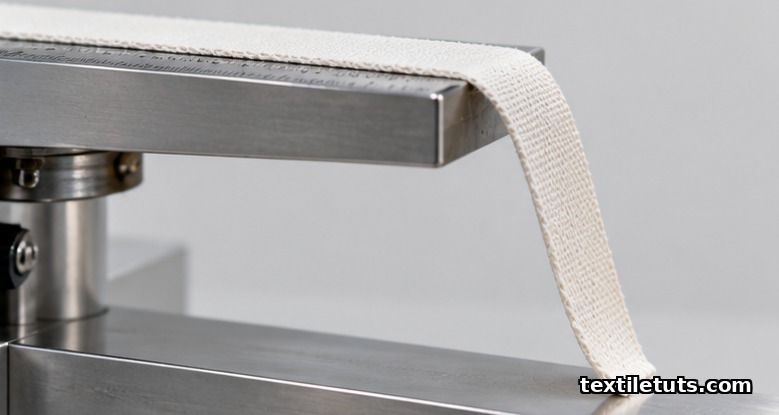
ASTM D1388 measures fabric stiffness by sliding a 25 mm × 200 mm specimen off a horizontal platform until the tip touches an inclined reference surface set at 41.5°, recording the overhang length L at contact, and converting it into bending length c = L/2 (cm) and flexural rigidity G = W × c³ (mg·cm), where W is the fabric areal density in mg/cm².
This standard test method (reapproved as ASTM D1388-18) covers woven, knitted, and nonwoven fabrics and gives textile engineers a direct, low-cost way to compare hand feel, drape, and roll-up behavior between samples without tensile testing hardware.
The article below walks through the cantilever principle, the apparatus, the step-by-step procedure, the calculation with worked numbers, the relationship to ISO 4604 and AATCC Test Method 91, the factors that move the result, and a practical interpretation guide for fabric developers and quality teams.
What the Cantilever Test Actually Measures
Fabric stiffness is not a single number. It is the combined resistance of a textile to bending, which is shaped by fiber bending modulus, yarn twist, yarn linear density, fabric sett (threads per cm in warp and weft), yarn crimp, cover factor, and any finishing chemistry (resin, calendering, coating, heat-setting) sitting on the surface.
ASTM D1388 reports two related quantities:
Bending length (c), in cm: the length of fabric that will bend under its own weight to a defined angle. A long bending length means the fabric is stiff; a short bending length means it drapes easily.
Flexural rigidity (G), in mg·cm: the bending resistance of a fabric per unit width, computed as G = W × c³, where W is the fabric weight per unit area in mg/cm². Because c is cubed, small changes in bending length produce large changes in flexural rigidity. A fabric with c = 1.0 cm and W = 20 mg/cm² (200 g/m²) gives G = 20 × 1.0³ = 20 mg·cm. Doubling the bending length to 2.0 cm pushes G to 20 × 2.0³ = 160 mg·cm, an eight-fold jump from a single doubling of bending length.
Apparatus and Specimen Geometry
The standard specifies two interchangeable options that share the same calculation logic. Option A is the inclined-plane cantilever (sometimes called the fixed-angle or platform method). Option B is the heart-loop method.
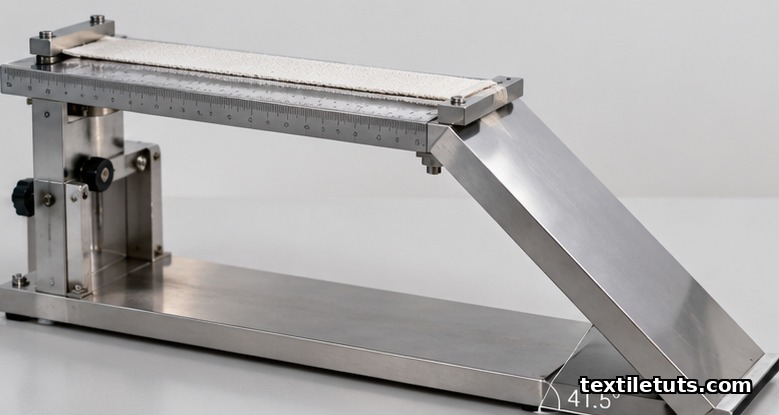
For Option A, the apparatus consists of a horizontal platform with a linear scale along its top surface and a reference plane mounted just below the leading edge at an angle of 41.5° from horizontal. A specimen 25 mm wide by 200 mm long is laid flat on the platform, slid forward at a controlled speed of about 120 mm/min, and the overhanging length (L) is read at the instant the specimen tip touches the inclined surface. The bending length is computed from:
c = L / 2 (when the reference angle is 41.5°)
This geometric relationship follows from the cantilever beam equation for uniform self-weight bending. The 41.5° angle is not arbitrary; it is the angle at which L equals 2c under ideal conditions for a uniform strip, which is why the standard names it explicitly.
Option B uses the same 25 mm × 200 mm specimen but forms the strip into a heart-shaped loop by bringing the two ends together. The loop hangs vertically and the loop height (in cm) is read directly from a calibrated scale; that height equals the bending length c.
Step-by-Step Procedure (Option A)
The ASTM D1388 Option A sequence is designed to remove operator bias and conditioning drift:
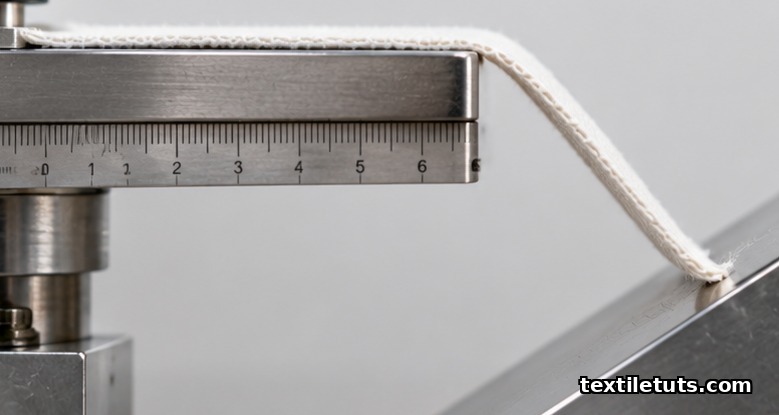
- Cut and condition the specimens. Cut at least four specimens per direction (warp and weft for woven; wale and course for knit) and condition them at 21 ± 1 °C and 65 ± 2 % relative humidity for at least 4 hours, per ASTM D1776.
- Mount the specimen. Place the specimen flat on the horizontal platform with one short end aligned flush with the leading edge of the platform.
- Advance at controlled speed. Slide the specimen forward at approximately 120 mm/min until its tip touches the inclined reference surface.
- Record overhang length (L). Read L to the nearest 1 mm.
- Reverse and re-measure. Slide the specimen back and repeat three times. Then reverse the specimen face-up versus face-down to average out surface asymmetry.
- Compute bending length and flexural rigidity. c = L / 2 and G = W × c³. Report warp and weft directions separately.
Single readings on the same operator can vary by 5 to 10 %, while averaging four readings per direction typically brings the coefficient of variation below 4 %, which is the level most quality teams use as an internal repeatability target.
Worked Calculation with Real Units
Take a woven cotton shirting fabric with an areal density of 150 g/m². Convert to the units ASTM D1388 uses:
W = 150 g/m² × (1 mg / 0.001 g) × (1 m² / 10,000 cm²) = 150 / 10 = 15 mg/cm²
Suppose the measured overhang L is 3.0 cm in the warp direction. Then:
c = L / 2 = 3.0 / 2 = 1.5 cm
G = W × c³ = 15 × 1.5³ = 15 × 3.375 = 50.6 mg·cm
The same fabric in the weft direction might measure L = 2.4 cm, giving c = 1.2 cm and G = 15 × 1.728 = 25.9 mg·cm. The warp is roughly twice as stiff as the weft in this example, which is typical of a fabric with higher warp crimp or higher warp thread density.
Bending modulus (Q) can also be derived if the fabric thickness t is known: Q = 12 G / t³. A 0.30 mm (0.03 cm) shirting gives Q = 12 × 50.6 / 0.03³ ≈ 22.5 million mg·cm⁻¹, useful when comparing across fabrics of very different weights.
Comparison With Related Standards (ASTM, AATCC, ISO)
ASTM D1388 is one of three closely related stiffness methods a textile lab will routinely run. The table below summarises the operating differences.
| Property | ASTM D1388 (Option A) | AATCC Test Method 91 | ISO 4604 |
|---|---|---|---|
| Principle | Cantilever, 41.5° inclined plane | Heart-loop, hanging height | Cantilever (fixed-angle) for reinforcement fabrics |
| Specimen size | 25 mm × 200 mm | 25 mm × 200 mm | Defined per reinforcement type |
| Output | Bending length c and flexural rigidity G | Bending length c only (loop height) | Flexural rigidity per unit width |
| Typical use | General woven, knit, nonwoven fabrics | Lightweight apparel fabrics in routine QC | Technical textiles and reinforcement scrims |
| Last reapproval | 2018 (D1388-18) | Reapproved periodically | Reinforcement-fabric scope |
The three methods agree on the underlying bending-length definition, which makes cross-references between labs straightforward. The main practical difference is that AATCC Test Method 91 only outputs c (and uses loop height directly), while ASTM D1388 outputs both c and G, and ISO 4604 is most often used on reinforcement fabrics where the test conditions are tailored to the substrate.
Factors That Move the Result
Because flexural rigidity depends on c³, anything that increases bending length has an outsized effect on the final stiffness number. The factors below are the levers textile engineers most often adjust to hit a target stiffness:
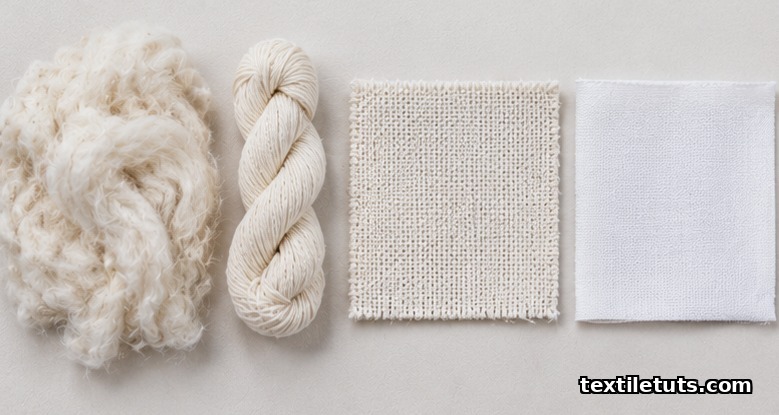
- Fiber bending modulus: glass and aramid fibers produce far higher G values than cotton or viscose at the same areal density, which is why aramid reinforcement fabrics in ISO 4604 sit at G values orders of magnitude above apparel cottons.
- Yarn twist: higher twist increases yarn stiffness and bending length up to the optimum, after which extra twist softens the yarn and reduces G.
- Yarn linear density and sett: heavier yarns and tighter sett both raise bending length, with c³ compounding the effect.
- Finishing chemistry: resin finishing, calendaring, and heat-setting all raise bending length. A light resin finish can double the flexural rigidity of a cotton shirting.
- Moisture content: conditioning at 65 % RH is mandatory because moisture plasticises most fibers. A fabric tested at 90 % RH can read 20 to 40 % lower in bending length than the same fabric at 65 % RH.
- Test direction: woven fabrics almost always read stiffer in the warp than the weft because of higher warp crimp and thread density. Knits read stiffer in the wale (lengthwise) direction for the same reason.
Interpreting the Numbers in Practice
For apparel, the practical question is not “is the fabric stiff?” but “is it stiff enough to retain shape, but soft enough to drape?” A typical mid-weight woven cotton shirting sits at c between 1.2 and 2.0 cm (G between roughly 25 and 150 mg·cm at 150 g/m²). Heavier denim can push c above 3.0 cm, while a soft viscose challis at 100 g/m² can sit below c = 1.0 cm.
For technical textiles, the comparison moves to flexural rigidity per unit width. A glass-fibre reinforcement scrim used in composites typically reads G in the tens of thousands of mg·cm, several orders of magnitude above any apparel fabric. Comparing apparel fabrics with composite reinforcements through G alone can be misleading, which is why bending modulus Q (with thickness factored out) is often the more informative number when crossing product categories.
Frequently Asked Questions
What is the difference between bending length and flexural rigidity in ASTM D1388?
Bending length c (cm) is the geometric length at which a fabric strip bends to a 41.5° angle under its own weight. Flexural rigidity G (mg·cm) is the bending resistance per unit width and is computed as G = W × c³, where W is the fabric areal density in mg/cm². Bending length is the direct measurement; flexural rigidity is a derived quantity that lets fabrics of different weights be compared on the same scale.
How does ASTM D1388 Option A differ from Option B (heart loop)?
Option A slides a flat specimen off a horizontal platform and reads the overhang length L when the tip touches a 41.5° reference surface, giving c = L / 2. Option B forms the same 25 mm × 200 mm specimen into a heart-shaped loop and reads the loop height directly, which equals the bending length. Both options feed the same G = W × c³ calculation. Option A is more common in formal QC labs; Option B (which is the same procedure as AATCC Test Method 91) is faster for routine production checks.
How many specimens do I need for a reliable ASTM D1388 reading?
The standard calls for at least four specimens per fabric direction (warp and weft for woven, wale and course for knit). A practical QC target is a coefficient of variation below 4 % across the four readings. Single-specimen readings should not be used to make supplier accept/reject decisions because operator bias and surface asymmetry can each shift L by 5 to 10 %.
Why does my fabric read stiffer in the warp than in the weft?
Woven fabrics almost always have higher warp thread density than weft density, plus higher warp crimp (the warp yarns sit more bent in the fabric). Both factors raise the bending length in the warp direction, and because flexural rigidity scales with c³, even small differences in c produce large differences in G. A 20 to 50 % warp-versus-weft difference in G is normal for a balanced plain weave, and a much larger ratio points to a deliberately unbalanced construction.
Does resin finishing change the ASTM D1388 result a lot?
Yes. A light resin or easy-care finish on cotton can raise the bending length by 30 to 60 %, which translates to a 120 to 400 % jump in flexural rigidity because G scales with c³. This is the main reason resin-finished cotton shirting feels crisper off the bolt than the same greige fabric before finishing. If you are comparing greige and finished samples, run ASTM D1388 on both and expect the finished sample to read significantly stiffer.
References
- ASTM International. ASTM D1388-18 Standard Test Method for Stiffness of Fabrics. ASTM International, West Conshohocken, PA. The current version of the test method used in this article.
- ASTM International. ASTM D1776 / D1776M-20 Standard Practice for Conditioning and Testing Textiles. ASTM International. The conditioning protocol (21 °C, 65 % RH) referenced inside ASTM D1388.
- American Association of Textile Chemists and Colorists. AATCC Test Method 91: Stiffness of Fabrics. AATCC Technical Manual. The heart-loop method that shares ASTM D1388’s underlying bending-length definition.
- International Organization for Standardization. ISO 4604:1978 Reinforcement textiles — Determination of conventional flexural stiffness of reinforcement fabrics. ISO. The international equivalent used for reinforcement and technical textiles.
- Peirce, F. T. (1930). The “Handle” of Cloth as a Measurable Quantity. Journal of the Textile Institute Transactions, 21(9), T377-T416. The original cantilever bending-length derivation that ASTM D1388 builds on.
- Hu, J. (Ed.). (2008). Fabric Testing. Woodhead Publishing (now part of Elsevier). A reference text covering cantilever, heart-loop, and Kawabata-style stiffness methods in parallel.
- Bao, L., Sato, Y., & Yokura, H. (2019). Effects of Yarn and Fabric Construction on the Bending Properties of Textile Fabrics. Textile Research Journal, 89(15), 3064-3076. Peer-reviewed study on the parameter interactions behind ASTM D1388 results.
This article is the working reference for ASTM D1388 fabric stiffness testing using the cantilever method. Editorial by Iftay Khairul Alam, TextileTuts. Sources: ASTM D1388-18, ASTM D1776, AATCC Test Method 91, ISO 4604, Peirce (1930), Hu (2008), and Bao et al. (2019), as cited.


