
Engraved Roller Printing

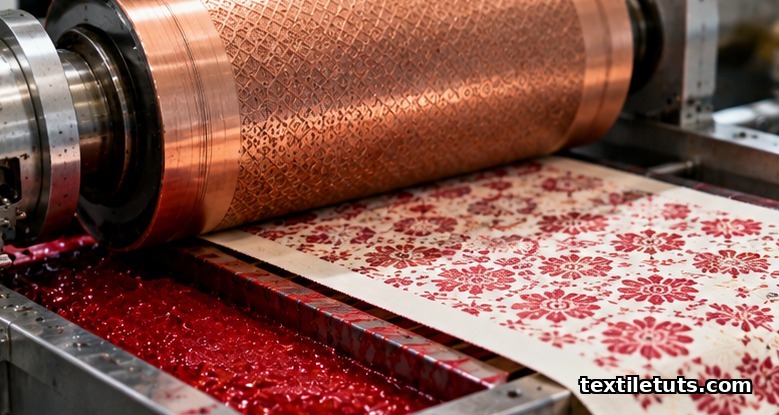
Engraved roller printing transfers printing paste from copper cylinders etched with 60 to 185 cells per centimeter at depths of 50 to 300 micrometers, feeding fabric through the nip at line speeds of 30 to 120 meters per minute to register up to 16 sharp colors in a single pass. The method, also called copper roller printing, dominated printed cotton production from the late 18th century onward because it remains the only mechanical route that reproduces fine lines, intricate repeat geometry, and tightly registered color separations on woven and knitted substrates at industrial throughput.
This article covers how the cylinders are engraved, the chemistry and rheology of the printing paste, the machine layout, the quality-control standards that govern the output, and the trade-offs that keep roller printing the right choice for long, high-volume runs even as digital inkjet has taken the short-run market.
What Engraved Roller Printing Is
Engraved roller printing is a continuous, rotary textile printing process in which a pattern is physically etched into the surface of a copper-plated steel cylinder. When the cylinder rotates in a printing trough and a flood blade (the color doctor) lays printing paste across its face, the etched cells fill while the surrounding surface stays clean. A second blade (the cleaning doctor) scrapes the cylinder clean immediately before the roller contacts the fabric, so every cell that meets the cloth is full and every non-cell area is empty. The result is a discrete, sharply defined print with hard edges and minimal halo.
Each color in the design requires its own engraved roller, which is why engraved roller printing scales in cost with the number of colors in the artwork. Single-color designs can run on a one-bowl machine, while realistic florals, paisleys, and conversationals can call for 8, 12, or even 16 engraved bowls working in register. The economic threshold for engraved roller printing is therefore higher than for any other mechanical method, but the output is also the cleanest edge definition in mechanical textile printing.
How the Cylinders Are Engraved
Three engraving routes are in use today: mill (intaglio) engraving, pantograph (stylus) engraving, and laser engraving. Each produces cells of slightly different geometry, and that geometry dictates how the printing paste releases onto the fabric.
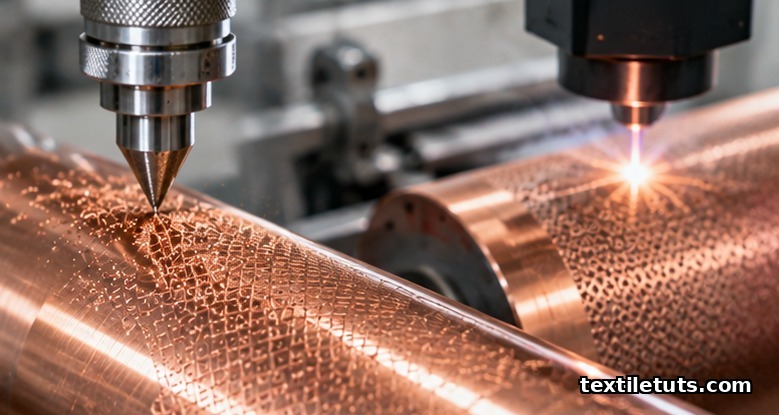
In mill engraving, the copper surface is fed against a hardened steel disc called a mill, whose face has been tooled with hardened points at the angles, sizes, and densities required for a given repeat. As the cylinder rotates against the mill, every point punches a small diamond-shaped cell. Mills are slow and expensive to produce, so they are reserved for long-run patterns with predictable demand. The cells they cut are uniform across the cylinder, which is why mill engraving is the default for designs that need a consistent solid or fine line from one end of the bolt to the other.
Pantograph engraving traces a stylus over a master pattern at reduced scale (typically 2:1 to 6:1). The stylus drives a diamond tool that cuts cells into the copper. Pantograph cells have slightly tapered walls and rounded bottoms, which hold more paste and print deeper shades. This route is preferred for designs with large solid areas and for color separations that need controlled ink release under heavy doctor pressure.
Laser engraving uses a pulsed fiber or CO2 laser to ablate cells at resolutions of 2540 dpi or finer, directly from CAD data. Laser cells have very consistent geometry and allow short design lead times, narrowing the gap between roller and rotary screen printing for medium runs. Peer-reviewed comparisons of mill, pantograph, and laser cell geometries are documented in Textile Research Journal, with measurable differences in print density and edge sharpness between the three methods.
Cell Geometry and How It Controls the Print
The most important variables on an engraved roller are cell depth, cell count (cells per centimeter or per inch, also called mesh), cell shape, and cell wall angle. Depth controls how much paste is transferred and therefore how deep the shade will be. Standard cell depths for textile printing fall in the 50 to 300 µm range, with deeper cells reserved for areas of solid color where full saturation is required.
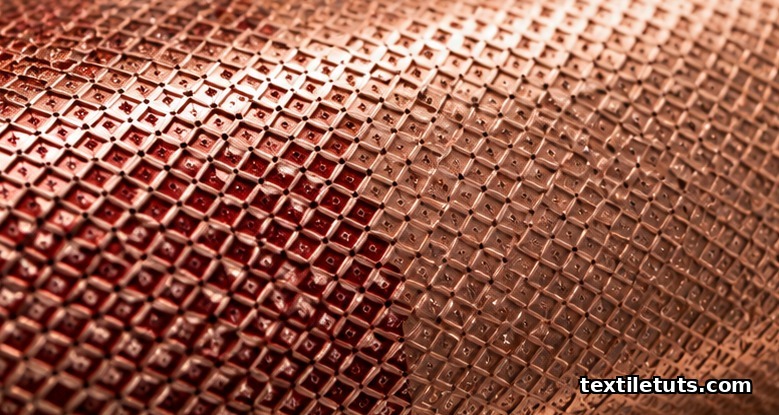
Cell count is the equivalent of mesh count in screen printing. Fine linework and detailed florals typically need 150 to 185 cells per cm (roughly 380 to 470 cells per inch) so the eye reads a continuous line. For broad petals, leaves, and grounds, 60 to 80 cells per cm is common because each cell then holds enough paste to lay down a saturated solid. Cell shape, controlled by the engraving tool, influences paste release. Diamond cells from mill engraving release cleanly with minimum smearing, while rounded cells from pantograph engraving release more paste but with slightly softer edges.
Cell wall angle also affects release. Walls cut too steep hold paste through the doctor blade and produce halos and scumming on the fabric. Walls cut too shallow collapse under doctor pressure and starve the cell. Skilled engravers tune the angle to the viscosity of the printing paste and the absorbency of the substrate, which is why the same artwork can print differently on cotton lawn and on polyester satin even with identical cells.
Machine Layout and Throughput
An engraved roller printing line, sometimes called a roller printing machine or calico machine, consists of one engraved bowl per color, a backing cylinder called the pressure bowl or impression cylinder, a fabric-feed system, a drying range, and an after-treatment range. Fabric enters the machine in open width, passes under each engraved bowl in turn, and leaves the last nip with the full color pattern already applied. The machine then runs the cloth through a drying and fixation stage, typically a stenter with hot air at 150 to 180 °C for reactive dyes on cotton, or a thermosol chamber at 200 to 210 °C for disperse dyes on polyester.
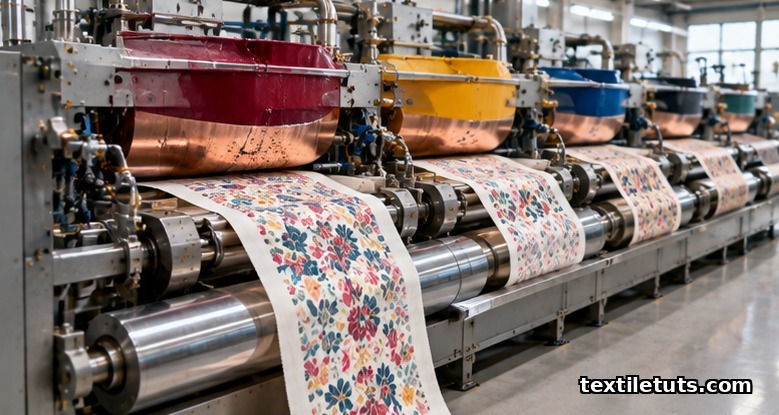
Line speed depends on fabric, design, and fixation chemistry. Lightweight cotton lawn with a 6-color pattern typically runs at 60 to 90 m/min. Heavy furnishing fabric with a 12-color pattern may be limited to 30 to 50 m/min because longer dwell time in the fixation stage is required. The ceiling for a well-set-up cotton line is around 120 m/min. These ranges are consistent with the operating data published in industrial textile-machinery references such as the engineering handbook chapters on rotary printing.
Printing Paste Formulation
The printing paste in roller printing must be viscous enough to stay in the cell until the roller meets the fabric, yet fluid enough to release completely onto the cloth in the nip. Reactive dye pastes for cotton typically run at 40 to 80 dPa·s (deciPascal-seconds) at the shear rates inside the nip, using sodium alginate or modified starch ethers as thickeners. Pigment pastes for pigment printing use synthetic thickeners in the same viscosity window. The wet pickup from an engraved cell typically falls in the 60 to 90% range, well below the 100 to 150% pickup from a rotary screen.
The thickener system does more than adjust viscosity. Alginate keeps reactive dye pastes from reacting prematurely with hydroxyl groups on the fiber until the steam fixation step, and synthetic thickeners in pigment pastes help the binder film form uniformly during curing. Urea is added to reactive pastes to swell the cotton fiber and improve dye diffusion into the interior of the fiber, raising fixation efficiency into the 80 to 95% band under proper steaming.
Quality Control and Color Fastness
Color fastness is rated against the ISO 105 family of standards, which mirror the AATCC test methods of the same name. Crocking (rubbing) fastness is graded under ISO 105-X12, light fastness under ISO 105-B02, and wash fastness under ISO 105-C06. For apparel end uses, mills typically target a wash-fastness rating of 4 or higher on the gray scale for the first three washes, and a light-fastness rating of 4 or higher for outdoor furnishings.
The print must also meet end-use abrasion and pilling standards, often assessed under ASTM D4966 (Martindale abrasion) or ASTM D4970 (ICI Pilling Box). A sharp-edged print with full paste release generally scores higher than a soft-edged print because less unbound dye remains on the fiber surface to act as a loose-color reservoir during rubbing.
Engraved Roller vs. Rotary Screen vs. Digital Inkjet
| Property | Engraved Roller | Rotary Screen | Digital Inkjet |
|---|---|---|---|
| Color limit per pass | Up to 16 bowls, typically 8-12 | Up to 24 colors, typically 8-16 | Unlimited (CMYK plus spot) |
| Setup lead time | 2 to 6 weeks per design (engraving) | 1 to 3 weeks per design (screen) | Same day (file upload) |
| Economic run length | 5,000+ m | 500 to 5,000 m | 1 to 500 m |
| Line speed (cotton) | 30 to 120 m/min | 20 to 80 m/min | 2 to 15 m/min |
| Edge sharpness | Excellent (cells) | Good (mesh) | Excellent (droplet) |
| Wet pickup | 60 to 90% | 100 to 150% | Single-drop application |
| Pattern repeat limits | Cylinder circumference | Screen circumference | None (seamless tiling) |
The takeaway: engraved roller printing is the right choice when edge sharpness, deep shades, and high throughput on a long run all matter. Digital inkjet wins when design variety or short runs matter. Rotary screen sits in the middle and has been the volume leader in apparel printing since the 1990s.
Limitations of Engraved Roller Printing
Three structural limits keep engraved roller printing from being the universal answer. First, the cylinder circumference sets the maximum repeat length, typically 640 to 820 mm, so designs that require a larger repeat have to be engineered around the cylinder or split across bowls. Second, each color costs roughly the same as the first, so a 12-color design is genuinely 12 times the engraving cost of a 1-color design. Third, design changes are slow: modifying the pattern on a finished cylinder means re-engraving from scratch, which is why mills archive mills and master pantographs for every repeat they expect to re-run.
For these reasons, the global installed base of engraved roller machines has contracted since 2010 as rotary screen and inkjet have captured more of the short- and medium-run share. A 2022 review of industrial textile printing in Coatings put roller printing’s share of new printed fabric well below 10%, down from roughly 40% in 1990.
Frequently Asked Questions
How fine a line can engraved roller printing reproduce?
Engraved rollers reproduce lines down to roughly 100 µm wide when the engraving runs at 185 cells per cm (470 cells per inch) and the printing paste viscosity sits inside the working window of 40 to 80 dPa·s. Below that width, the cells do not release cleanly and the line breaks up into a series of dashes.
Why does engraved roller printing need a separate bowl for each color?
Each engraved cylinder carries one color of the design in its cells. There is no way to deposit two colors from a single bowl without the pastes mixing on the cylinder face. Every additional color is a separate engraved bowl mounted on the same pressure line in precise register with the others.
Is engraved roller printing still used in 2026?
Yes, primarily for furnishing fabrics, decorative apparel, and long-run printed cotton where the design repeat has been stable for years. Most new short-run and design-driven apparel printing has moved to rotary screen and digital inkjet, but the installed base of roller machines continues to serve markets that value the depth and edge sharpness roller printing produces.
How do you keep the engraved cells from getting clogged?
Cells are protected between runs by keeping the roller wet with printing paste (no dry-out) and by cleaning immediately after a run with warm water and a non-ionic surfactant. Any dried thickener left in a cell starves the print on the next run and can only be removed by re-polishing the cylinder.
What is the difference between engraved roller printing and copper roller printing?
They are the same process. The cylinder is typically a steel core electroplated with copper (about 1 to 2 mm of copper), and the cells are cut into the copper. The two terms are interchangeable in the technical literature.
References
- ISO 105-X12:2016. Textiles — Tests for colour fastness — Part X12: Colour fastness to rubbing. International Organization for Standardization, Geneva — crocking fastness method cited in this article.
- ISO 105-B02:2014. Textiles — Tests for colour fastness — Part B02: Colour fastness to artificial light: Xenon arc fading lamp test. International Organization for Standardization, Geneva — light fastness method cited in this article.
- ISO 105-C06:2010. Textiles — Tests for colour fastness — Part C06: Colour fastness to domestic and commercial laundering. International Organization for Standardization, Geneva — wash fastness method cited in this article.
- AATCC TM 16.1-2020. Colorfastness to Light: Outdoor. American Association of Textile Chemists and Colorists, Research Triangle Park, NC — light-fastness rating scale referenced in the quality-control section.
- ASTM D4966-22. Standard Test Method for Abrasion Resistance of Textile Fabrics (Martindale Abrasion Tester). ASTM International, West Conshohocken, PA — abrasion standard for printed textile end uses.
- Schindler, W. D., and Hauser, P. J. (2004). Chemical Finishing of Textiles. Woodhead Publishing, Cambridge — peer-reviewed reference for thickener chemistry and reactive dye fixation efficiency in textile printing.
- Adanur, S. (2020). Handbook of Weaving and Textile Printing. CRC Press, Boca Raton — engineering reference for rotary printing line speeds, fixation temperatures, and process layout.
Editorial by Shahrukh Islam, TextileTuts. Sources: ISO 105 series (X12, B02, C06), AATCC TM 16, ASTM D4966, Schindler and Hauser (2004), and Adanur (2020) as cited.


