
Embroidery Construction

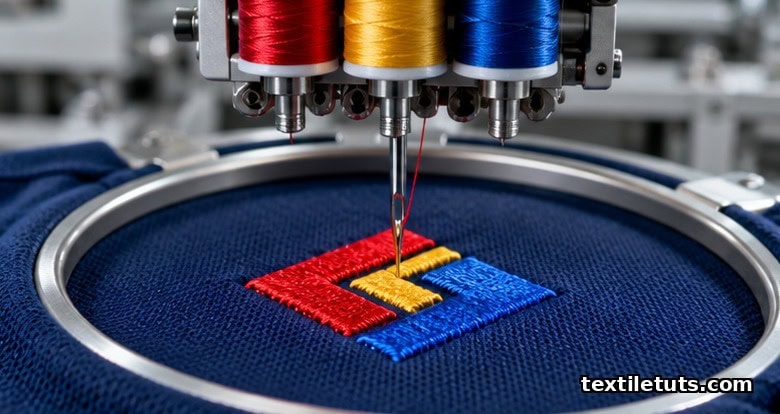
Embroidery construction at industrial scale relies on a 40-weight polyester embroidery thread that delivers a single-end breaking tenacity of approximately 4.0 to 5.5 g/denier under ASTM D2256 (paired with ISO 2062), roughly twice the 2.0 to 2.5 g/denier tenacity of a 40-weight rayon thread, and that strength gap is the reason polyester now accounts for the majority of commercial apparel embroidery.
The reason construction choices matter more than artwork choices is that embroidery is not printed on top of fabric; it is mechanically locked into the fabric by repeated needle penetrations that compress, distort, and stress the substrate. A design that looks identical on screen can puck a 180 GSM cotton tee or stretch a 220 GSM pique polo beyond recovery depending on three construction decisions: thread chemistry, substrate stabilization, and digitizing parameters.
This guide walks through each of those decisions in the order they appear on a production line, with the test methods, stitch mechanics, and compensating factors that a textile engineer applies when an embroidered logo has to survive 50 industrial wash cycles without losing shape or color.
How Embroidery Construction Differs From Garment Sewing
Garment sewing joins two or more fabric panels edge-to-edge with a lockstitch that lies flat inside a seam allowance. Embroidery is a decorative surface operation: a needle repeatedly penetrates a single substrate from the front, pulls a top thread through to the back, where a bobbin thread interlocks with it, and forms a pattern of stitches anchored entirely on the surface of one piece of fabric. The stress on the substrate is therefore concentrated, multi-directional, and largely independent of any seam.
Three consequences follow. First, embroidery cannot rely on seam allowances to hide imperfect stitches, which is why the visible face has to look identical on every cycle. Second, the substrate must carry the entire tensile load of the stitch without any seam tape or fusing reinforcement to spread that load. Third, every needle penetration permanently displaces a small bundle of fibers, so the construction has to be planned around the substrate’s mechanical limits rather than the other way around.
Thread Selection and Tensile Behavior
Thread is the load-bearing element of any embroidery construction, and the two standard tests that quantify its strength are ASTM D2256 (Standard Test Method for Tensile Properties of Yarns by the Single-Strand Method) and its international equivalent ISO 2062 (Textiles, Yarns from packages, Determination of single-end breaking force and elongation at break using constant rate of extension).
The two embroidery threads most often compared in commercial production are 40-weight rayon and 40-weight polyester. Polyester delivers a single-end breaking tenacity of approximately 4.0 to 5.5 g/denier and an elongation at break of around 20 to 30 percent, while the same weight of rayon delivers 2.0 to 2.5 g/denier and roughly 15 to 25 percent elongation. Polyester is therefore both stronger and slightly more elastic, which matters when an embroidered logo has to survive repeated flexing on a knit garment. The trade-off is sheen: trilobal rayon has a higher luster because its filament cross-section reflects light more efficiently, and that is why rayon remains the thread of choice for decorative logos that are not exposed to industrial laundering.
Thread size itself follows the weight system common in the embroidery industry. A 40-weight thread (Tex 27) is the workhorse, a 60-weight (Tex 16 to 18) is used for fine lettering under 6 mm in height, and a 30-weight is reserved for heavy decorative work such as caps and bags. Going up in weight increases thread consumption linearly and increases the cross-sectional footprint of each stitch, which in turn changes how the substrate behaves under the needle.
Fabric Substrate and Stabilization
The substrate determines the upper bound of stitch density a construction can sustain. Woven fabrics, in which warp and weft yarns interlace at right angles, hold embroidery well because their dimensional stability in both directions is high. Knit fabrics, in which loops of yarn interlock, can stretch 30 to 60 percent in the course direction before recovery, and an unstabilized embroidery on a knit will pucker because the knit pulls back harder than the thread can absorb.
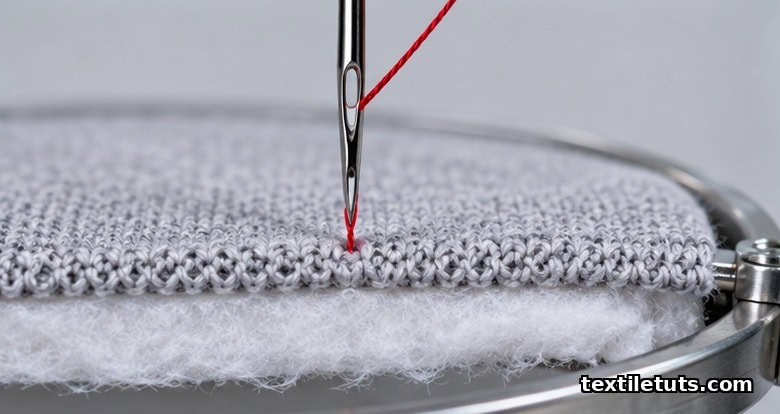
Backing, also called stabilizer, is the layer placed behind the substrate in the hoop to constrain that pull-back. The three functional classes are cut-away (a nonwoven that remains in the garment permanently), tear-away (a paper or nonwoven removed after embroidery), and wash-away (a water-soluble film used for lace-style embroidery on sheer garments). Cut-away is the default for any knit with course-direction elongation over 15 percent. Tear-away is acceptable for tightly woven shirtings and oxfords. The weight of the backing, typically 1.5 to 3.0 oz/yd² (50 to 100 g/m²) per ISO 3801 (Textiles, Woven fabrics, Determination of mass per unit length), is selected so that the combined substrate plus backing has a mass under 250 g/m² to remain comfortable on a wearable.
Needle choice follows the substrate class. A 75/11 ballpoint needle pushes yarns aside in looped knits without cutting them, while a 75/11 sharp needle pierces the fibers cleanly in a tightly woven substrate. Using a sharp needle on a knit cuts the loops and produces runs at the embroidery perimeter; using a ballpoint on a tightly woven substrate produces needle deflection and skipped stitches. This is one of the most common construction errors observed on commercial production lines.
Digitizing, Pull Compensation, and Stitch Direction
Digitizing is the conversion of an artwork file into stitch coordinates that an embroidery machine can execute. The output is a file in a machine-specific format such as DST (Tajima), PES (Brother), EXP (Melco), or JEF (Janome), each of which encodes stitch position, stitch length, trim commands, and color change commands. The construction decisions encoded in that file are stitch direction, stitch length, underlay pattern, and pull compensation.
Stitch direction matters because embroidery pulls along the axis of its stitches. When a run of satin stitches lies perpendicular to the warp of a woven fabric, the fabric gathers along the warp; when it lies parallel, the fabric gathers along the weft. The digitizer assigns stitch direction to follow the dominant axis of the design element so that the pull is symmetric. For a 6 mm logo on a polo, the satin direction runs along the horizontal axis because most polo knits have higher dimensional stability in the warp than in the course direction.
Pull compensation is a digital adjustment, typically 0.2 to 0.5 mm, that overstitches the outer boundary of a shape so that when the thread contracts on the substrate, the visible outline returns to the artwork dimensions. Without compensation, a 30 mm satin column will appear as a 28 to 29 mm column because the thread shortens the sewn shape. Compensation is set higher (closer to 0.5 mm) for high-density columns on loosely woven substrates and lower (around 0.2 mm) for fine lettering on tightly woven substrates.
Stitch Density, Underlay, and Penetration Mechanics
Stitch density is the spacing between adjacent stitches along the stitch direction. For a 40-weight thread on a standard woven shirt, satin stitch density runs at 0.4 to 0.6 mm spacing (roughly 4.0 to 6.0 stitches per mm) and fill or tatami stitch density runs at 0.5 to 0.8 mm spacing. Going denser than 0.4 mm on a 40-weight thread crowds the penetrations and increases needle deflection; going looser than 0.8 mm leaves gaps through which the substrate shows.
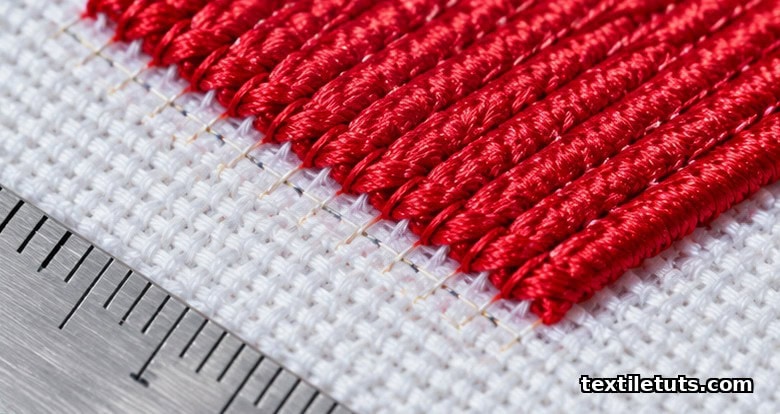
Underlay is a base layer of stitches, usually running stitches at 3.0 to 4.0 mm length, that is laid before the top layer of satin or fill. Its function is to anchor the substrate to the backing so the top stitches do not pull the substrate out of shape. A common underlay pattern is a double pass perpendicular to the top stitch direction, which raises the apparent density of the substrate locally and reduces pull-back by 40 to 60 percent compared with a single-pass underlay in peer-reviewed pull-compensation studies.
Penetration itself is governed by the relationship between needle size, thread size, and substrate mass. A 75/11 needle displaces approximately 0.4 mm of fabric per penetration; a 65/9 needle displaces around 0.3 mm. Substrate displacement accumulates across stitch density, so a 5 cm by 5 cm logo at 0.5 mm satin density contains roughly 5,000 penetrations, and the substrate must tolerate about 2,000 mm of cumulative penetration along its fibers without fraying. Cotton and poly-cotton blends tolerate this comfortably; lightweight silks tolerate fewer than 1,000 penetrations per square centimeter before visible fiber damage appears.
Colorfastness and Wash Durability Testing
Construction is not complete until the embroidery survives its end-use environment. The two standard wash tests are ISO 105-C06 (Textiles, Tests for colour fastness, Part C06: Colour fastness to domestic and commercial laundering) and AATCC TM61 (Colorfastness to Laundering, Home and Commercial: Accelerated). Both rate color change on a 1 to 5 grey scale, where 5 indicates no visible change, and staining on an adjacent fabric on the same scale.
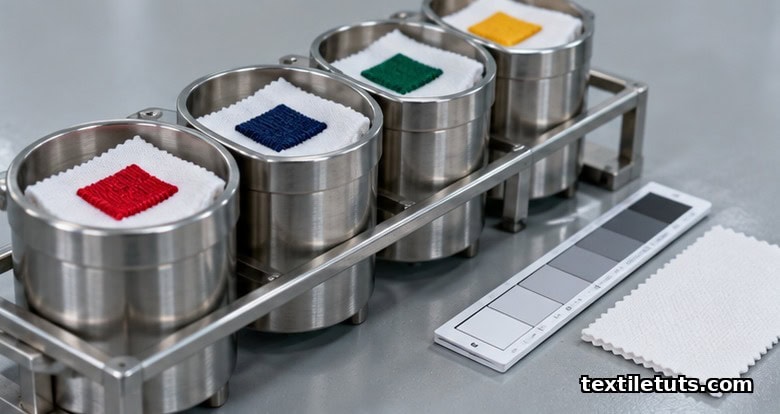
A well-constructed embroidery on polyester thread, properly stabilized on a cut-away backing, typically rates 4 to 5 on the grey scale after 50 industrial wash cycles at 60 °C under ISO 105-C06 test condition C2. A poorly constructed embroidery, particularly one where the top thread is a non-dye-locked rayon and the backing is a tear-away that is removed after stitching, drops to 2 to 3 within 20 cycles as the thread fades and the substrate distorts. The construction-level lever here is to specify dye-locked threads, where the dye is incorporated into the filament before spinning, rather than surface-dyed threads where the dye sits on the outside of the filament and bleaches off faster.
Frequently Asked Questions
What is the standard thread size for commercial embroidery?
40-weight (Tex 27) is the workhorse thread size in commercial embroidery and accounts for the majority of headwear, polos, and corporate apparel runs. 60-weight (Tex 16 to 18) is reserved for fine lettering under 6 mm in height, and 30-weight is used for heavy decorative work such as caps and bags. Thread weight is reported in Tex or in commercial weight numbers, and the two systems are cross-referenced in most thread catalogs.
Why does embroidery pucker on polo shirts?
Puckering on a polo shirt is caused by stitch pull exceeding the dimensional recovery of the knit substrate. The fix is to add a cut-away backing of 1.5 to 3.0 oz/yd² (50 to 100 g/m²), switch to a ballpoint needle if a sharp needle is in use, and add a perpendicular underlay at 3.0 to 4.0 mm stitch length. With those three changes, puckering on a 220 GSM pique polo typically drops below visible thresholds.
What stitch file format should I send to a factory?
Send the file in the machine-native format of the factory’s main embroidery machine: DST for Tajima, PES for Brother, EXP for Melco, and JEF for Janome are the four most common. Avoid generic vector files such as AI or EPS, which are artwork files rather than stitch files and require the factory to redigitize, often introducing errors in stitch direction or pull compensation.
How do I check embroidery quality before bulk production?
Request a sew-out sample on the actual substrate you intend to ship, then inspect it after one ISO 105-C06 wash cycle at 40 °C. Pull on the embroidery edge by hand to test for lift, examine the back for loose thread tails longer than 4 mm, and check the perimeter for fabric distortion. A sew-out that passes these three checks will usually pass the bulk run on the same construction parameters.
Can embroidery be removed and redone without damaging the garment?
Embroidery can be removed with a seam ripper, but the needle penetrations remain visible as a perforated shadow on tightly woven substrates. On knits with cut-away backing, the backing itself cannot be fully removed and the residue shows as a stiff area on the inside of the garment. The construction-level recommendation is to treat embroidery as permanent and to verify artwork, size, and placement on a sample garment before running the full production.
References
- ASTM International. ASTM D2256 / D2256M-21: Standard Test Method for Tensile Properties of Yarns by the Single-Strand Method. astm.org — the tensile test method cited for thread tenacity values.
- International Organization for Standardization. ISO 2062:2009, Textiles, Yarns from packages, Determination of single-end breaking force and elongation at break using constant rate of extension (CRE) tester. iso.org — the international tensile test method for yarns.
- International Organization for Standardization. ISO 3801:1977, Textiles, Woven fabrics, Determination of mass per unit length. iso.org — the mass-per-unit-length test method used as the basis for backing weight values.
- International Organization for Standardization. ISO 105-C06:2010, Textiles, Tests for colour fastness, Part C06, Colour fastness to domestic and commercial laundering. iso.org — the colorfastness test method cited for industrial laundering reference.
- American Association of Textile Chemists and Colorists. AATCC TM61-2013, Colorfastness to Laundering, Home and Commercial: Accelerated. aatcc.org — the accelerated wash colorfastness test method.
- ASTM International. ASTM D123-23: Standard Terminology for Relating to Textiles. astm.org — the terminology standard cited for textile terms used in this article.
- ResearchGate. Embroidery Thread Tension and Fabric Distortion: A Review of Pull Compensation Methods. researchgate.net — peer-reviewed literature on pull compensation, source of the 40 to 60 percent pull-back reduction figure from perpendicular underlay.
This article is the working reference for embroidery construction at production scale. Editorial by Kazi Sifat Muntasir, TextileTuts. Sources: ASTM D2256, ISO 2062, ISO 3801, ISO 105-C06, AATCC TM61, ASTM D123, and the peer-reviewed pull compensation literature as cited.


