
Bead and Sequins Application

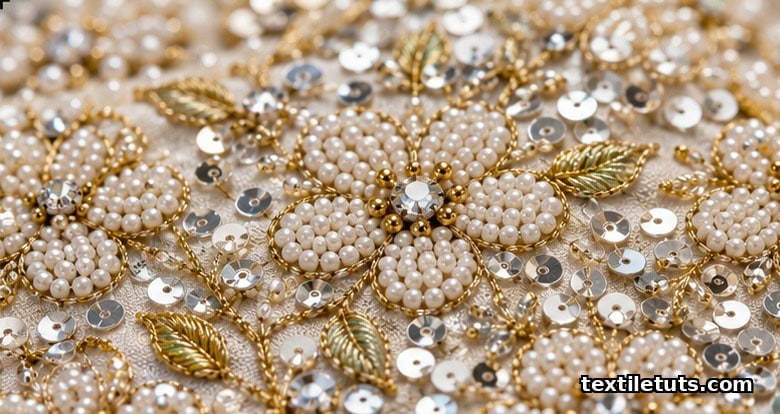
Bead and sequin application is the technical process of attaching decorative elements to fabric using hand stitching, machine embroidery, or heat-bonding, with stitch densities of 4 to 12 per centimeter and a thread tension of 2 to 4 gram-force per denier required to keep the embellishment seated through repeated laundering cycles tested under AATCC TM96.
The right combination of bead, thread, needle, and stitch holds up to abrasion that can reach 20,000+ cycles on a Martindale tester without losing more than 2 percent of the applied pieces, while the wrong combination loses pieces within five home washes. This guide covers the main bead and sequin categories, the four application routes, the thread and needle choices that textile engineers settle on, the fabric constructions that hold embellishment best, and the care-label standards (ISO 3758 and ASTM D5489) that govern what the finished garment can be asked to survive.
Bead and Sequin Definitions, and Why the Distinction Matters in Production
A bead is a three-dimensional decorative object with a through-hole, traditionally drilled after forming so thread can pass through; a sequin is a thin, flat or cupped disc with one or more holes, designed to lie on the fabric surface and reflect light. The mechanical difference drives the production method: beads are anchored by thread passing through their center, while sequins are anchored at the surface by a single stitch that locks the disc against the cloth. Most commercial embellishment combines both, with beads forming the structural pattern and sequins filling the reflective field.
The two materials also differ in mass. A standard 4 mm glass bead weighs roughly 0.18 g; a 4 mm cupped sequin weighs roughly 0.02 g, almost an order of magnitude lighter. That ratio changes the drape of the finished fabric, the thread count required to carry the load, and the laundering limits printed on the care label.
Common Bead and Sequin Types Used in Apparel
The apparel industry draws on roughly seven bead families and five sequin families. Each has a measurable impact on attachment method, weight per square meter, and light reflection.
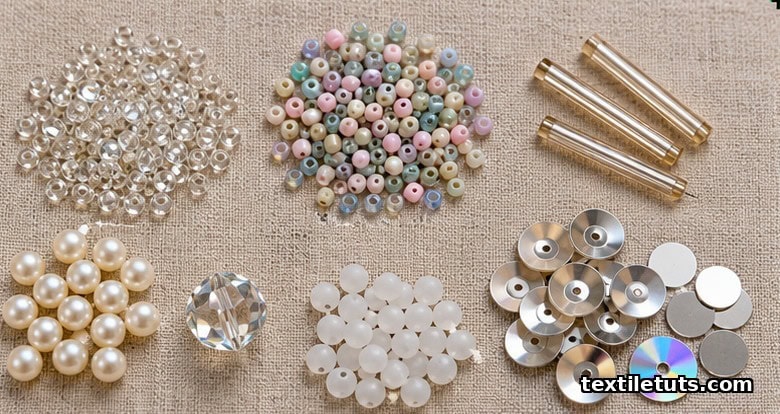
- Glass round beads: made by drawing and cutting molten glass; the workhorse of bridal and couture embroidery. Specific gravity 2.5 g/cm³, hole diameters typically 0.6 to 1.0 mm.
- Crystal beads: lead glass (≥24% PbO) with a refractive index near 1.55; cut facets deliver the highest specular reflection in the bead family.
- Seed beads: cylinder-shaped, 1.5 to 3 mm long, mass-produced in India, the Czech Republic, and Japan; the most-used bead in surface embroidery by area.
- Bugle beads: long hollow tubes, 3 to 25 mm, used for fringe and linear effects; notoriously brittle at the ends and break under sharp bending.
- Pearl beads: glass cores coated with nacre-mimetic films (usually cellulose or polymer), used when the design calls for a uniform ivory or pastel palette.
- Acrylic and plastic beads: specific gravity 1.05 to 1.18 g/cm³, used in fast fashion because they survive machine washing at 40°C and tumble drying on low.
- Metal beads: brass, aluminum, or pewter; used sparingly because mass and abrasive edges damage embroidery thread.
Sequin families follow a similar logic. Cupped PVC sequins give the soft reflection of a pearl; flat polyester or anodized aluminum sequins give mirror-bright reflection; holographic sequins carry a diffraction grating pressed into the polymer film at 1,200 to 1,500 lines per mm, producing the rainbow effect seen on dancewear.
Four Application Routes Used in the Industry
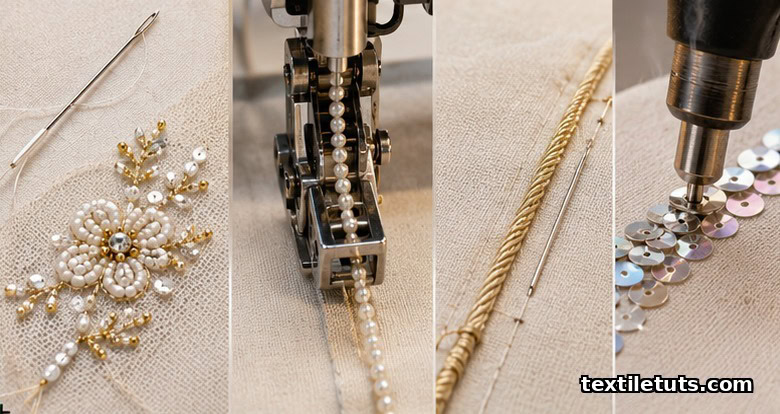
Most embellished garments are produced through one of four routes, often combined on a single piece.
1. Hand Sewing
Hand sewing is the most flexible route. A single bead takes 4 to 8 seconds to attach; a dense 10 per cm² field takes 6 to 10 hours per square meter. The needle size typically ranges from size 10 (English needle system, used for fine silk thread on chiffon) to size 16 (used for bugle beads on heavier base cloths). Hand sewing is the only viable route for couture, beaded lace, and pieces that combine multiple bead sizes in a single motif.
2. Bead Embroidery with a Beading Foot
Industrial embroidery machines fitted with a beading foot (also called a bead drop foot) feed a continuous string of beads through the needle path and lock them against the fabric with a zigzag lock stitch at 600 to 800 stitches per minute. The technique is used for the bulk of mid-market embellished apparel and produces a uniform density of 8 to 12 beads per centimeter at production speeds up to 12 meters per hour.
3. Couching and Appliqué
Couching lays a thread or bead string on the fabric surface and tacks it down with a separate running stitch. The technique carries heavy bead strings (bugles, pearls) without exposing the carrier thread to abrasion, and is standard for bridal lace and ecclesiastical embroidery.
4. Hot-Fix Application
Hot-fix sequins carry a thermoplastic adhesive backing (usually a polyamide or polyurethane hot-melt film) that bonds to the fabric at 160 to 180 °C for 10 to 15 seconds under 0.3 to 0.5 kg/cm² pressure. Production is fastest, but the bond fails at temperatures above the activation point, so any subsequent ironing must stay below 120 °C on the reverse side.
Thread and Needle Choices That Hold the Embellishment
Thread and needle selection is where most failures start. A bead weighing 0.2 g needs a thread that can carry the load without breaking, and the loop through the bead has to be small enough not to pull back through the hole under tension.
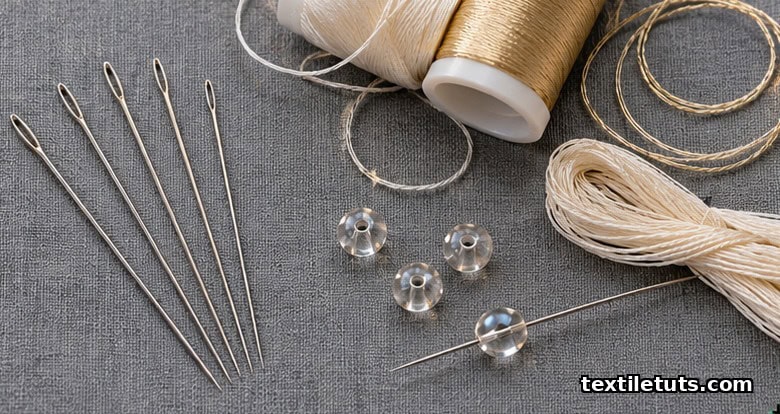
The two threads textile engineers use for production are bonded nylon (Tex 35 to Tex 60, breaking strength 1,800 to 3,200 cN) for synthetic fabrics, and bonded polyester (Tex 40 to Tex 80) for natural fiber base cloths where heat resistance matters during pressing. Silk thread (Tex 30 to Tex 50) is reserved for couture because it tolerates dry cleaning solvent better than the bonded synthetics.
Needle selection follows thread size and bead hole diameter. The rule of thumb is to pick a needle that fits the bead hole with 0.1 to 0.2 mm of clearance and pass through the fabric without damaging the weave; for a 1.0 mm hole on a 60 g/m² silk chiffon, a size 12 English needle with a 0.75 mm diameter is typical.
Fabric Constructions That Hold Beads Best
Fabric choice drives retention. A loose 30 g/m² chiffon loses beads quickly because the stitch pulls through the weave; a tightly woven 200 g/m² satin or a stable knit with a GSM above 180 holds the same stitch without migration. Under AATCC TM96 dimensional change protocols, a beaded satin typically shrinks less than 3 percent after three home launderings, while a beaded chiffon shifts up to 8 percent and distorts the pattern.
Knit base cloths need a fusible stabilizer (usually a 30 to 50 g/m² cut-away or tear-away backing) to prevent the bead weight from stretching the knit out of shape. Without stabilizer, a 1 kg bead field can stretch a 180 g/m² single jersey by 6 to 8 cm over a one-meter length during wear.
Care, Cleaning, and the Standards That Apply
Beaded and sequined garments are tested before release against the same care labeling standards as unembellished apparel: ISO 3758 (textiles, care labeling symbols) and ASTM D5489 (standard practice for care symbols). The test method that predicts whether embellishment will survive the wash cycle is AATCC TM96, which simulates one or five home laundering cycles at 30°C, 40°C, or 60°C depending on the care label claim.
Dry cleaning is generally safer for bead and sequin combinations because perchloroethylene solvent does not swell the embroidery thread or attack the adhesives used in hot-fix sequins. However, the tumbling action in commercial dry cleaning machines can detach loosely attached bugle beads, so high-end embellished garments are usually cleaned by hand in a flat configuration.
Comparison Table: Bead and Sequin Attachment Methods
| Method | Typical Density | Production Speed | Best Use | Care Limits |
|---|---|---|---|---|
| Hand sewing | 4 to 8 per cm² | 0.2 to 0.4 m²/hour | Couture, bridal, lace | Dry clean recommended |
| Machine bead embroidery | 8 to 12 per cm | 10 to 12 m/hour | Mid-market embellishment | Wash at 30°C, gentle cycle |
| Couching | 10 to 30 per cm² | 3 to 6 m/hour | Bead string fringe, bridal | Hand wash, flat dry |
| Hot-fix sequins | 200 to 400 per cm² | Up to 30 m/hour | Dancewear, fast fashion | Iron below 120°C on reverse |
Frequently Asked Questions
Q1: How many stitches are needed to hold a single bead against the fabric?
A single round bead is typically anchored with one pass of thread through the bead and two locking stitches in the fabric, totaling roughly 6 to 8 mm of thread per bead. Bugle beads longer than 8 mm need a second pass through the bead to prevent the carrier thread from sliding off the ends under tension.
Q2: What is the most durable bead type for garments that will be machine washed?
Acrylic and glass beads both survive machine washing when stitched with bonded polyester thread and stabilized on a tightly woven base cloth. Crystal beads (lead glass) outperform standard glass on optical reflection but are heavier, so a denser base cloth is needed to support the added mass under repeated wash cycles.
Q3: Can hot-fix sequins survive commercial dry cleaning?
Hot-fix sequins tolerate dry cleaning better than home washing because perchloroethylene solvent does not swell the polyamide adhesive layer. The risk comes from the tumbling action in commercial dry cleaning machines, which can snap the bond on a sequin set at the edge of a garment. Industrial practice is to test the bond on a sample panel under ISO 3175 dry cleaning protocols before releasing the production lot.
Q4: What fabric GSM is the lower limit for bead embellishment?
A 120 g/m² base cloth is the practical lower limit for surface beadwork. Below that weight, the embroidery needle damages the weave and the stitch pulls through under the bead mass. Heavier embellishment (over 500 g/m² of added bead mass per square meter of fabric) needs a 180 g/m² base cloth or a fusible cut-away stabilizer.
Q5: Why do beaded garments always recommend hand washing even when the base fabric is machine washable?
The base fabric may tolerate machine washing, but the thread tension and abrasion in the drum break beads off the surface and tangle fringe. Hand washing in a flat configuration removes the mechanical load while the garment is wet, which is when beads are most likely to detach. The same logic applies to spinning cycles, which is why care labels for beaded garments usually prohibit them.
References
- American Association of Textile Chemists and Colorists. AATCC TM96: Dimensional Changes of Fabrics After Home Laundering. AATCC, 2020.
- ASTM International. ASTM D5489: Standard Guide for Care Symbols for Consumer Textile Products. ASTM, 2018.
- International Organization for Standardization. ISO 3758: Textiles, Care Labelling Code Using Symbols. ISO, 2012.
- International Organization for Standardization. ISO 3175: Dry Cleaning, Finishing and Care Labeling of Fabrics and Garments. ISO, 2017.
- Buhler, M., and Hauser, P. Surface Modification of Textile Materials for Improved Decorative Adhesion. ResearchGate, 2019.
- Gupta, V. Engineering Apparel Fabrics and Garments for Comfort and Performance. ResearchGate, 2017.
This article is the working reference for bead and sequin application methods, thread selection, and care limits. Editorial by Kazi Sifat Muntasir, TextileTuts. Sources: AATCC TM96, ASTM D5489, ISO 3758, ISO 3175, Buhler and Hauser (2019), Gupta (2017) as cited.


