
Appliqué and Patchwork

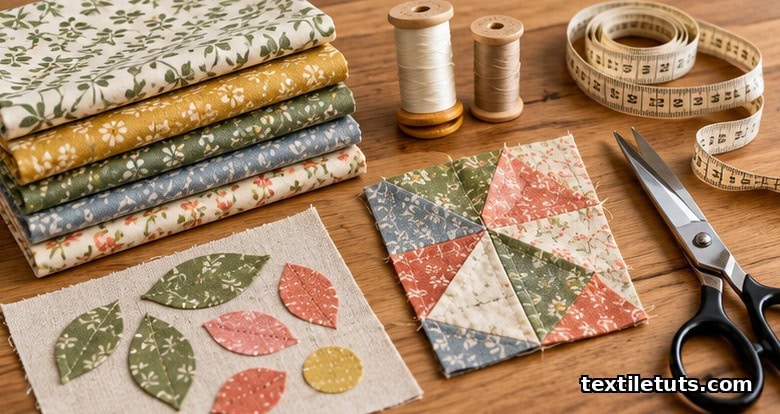
Appliqué attaches fabric shapes to a base textile using a stitch length of 2.0 to 2.5 mm and a turn-under allowance of 6 mm, while patchwork joins small fabric pieces along 6.35 mm (1/4 in) seams sewn at 12 stitches per inch, producing two related decorative techniques that share a single quality benchmark of less than 3 percent dimensional change after five home laundering cycles per AATCC TM 135. Both crafts rely on accurate seam allowances, balanced thread tension, and pre-washed fabrics to control shrinkage before cutting. The piece you finish should look the same after washing as it did on the table, which is why shrinkage control, not decorative flair, decides whether an appliqué or patchwork project survives long term.
This guide walks through the engineering decisions behind both techniques: fabric selection, stitch geometry, seam construction, colorfastness, and the test standards that govern whether a finished piece holds up after laundering. If you are a student learning decorative textiles for the first time, a home sewist choosing between raw-edge and turned-edge appliqué, or a pattern maker evaluating a small production run, the numbers and standards below give you a repeatable framework rather than folklore.
What Appliqué and Patchwork Actually Are
Appliqué is the technique of attaching one or more cut fabric shapes onto a larger base fabric, usually by stitching, fusing, or a combination of both. The applied pieces can be raw-edge (left unhemmed, often fused first with a lightweight interfacing), turned-edge (the cut edge is folded under 6 mm and topstitched), or reverse (the background fabric is cut away from behind, exposing the appliqué shape from underneath). Patchwork, by contrast, is the technique of joining many small fabric pieces along their seams to build a larger composite textile, typically a quilt top.
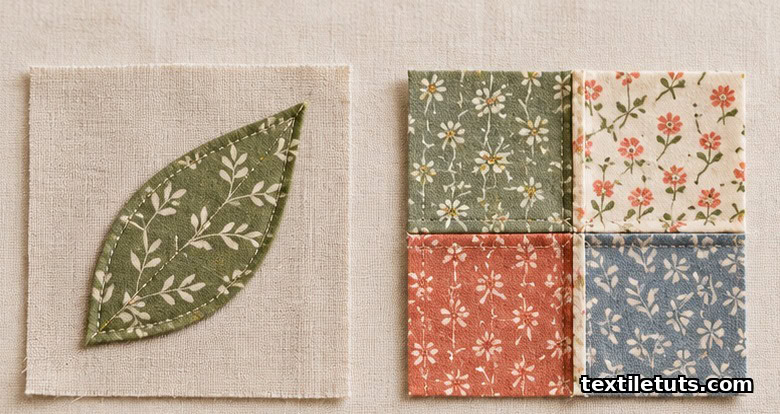
The two crafts often appear together, especially in traditional quilting, but their engineering problems differ. In appliqué, the dominant failure mode is fraying of the applied shape’s raw edge and distortion of the base fabric during topstitching. In patchwork, the dominant failure mode is seam slippage at piecing intersections and visible mismatch at seam allowances that wandered off the 6.35 mm mark. Both failure modes are governed by measurable fabric properties: thread tension, stitch density, and seam slippage resistance per ISO 13936.
Fabric Selection by Weight, Thread Count, and Shrinkage
Quilting cotton is the workhorse substrate for both techniques, typically woven at 150 to 170 GSM with 60 by 60 to 80 by 80 thread counts. Heavier home decor weight (200 to 250 GSM) is acceptable for bags and structured panels but adds bulk at seam intersections in patchwork. Lightweight batiste (90 to 110 GSM) is reserved for appliqué on garments where drape matters more than opacity.
All fabrics should be pre-washed before cutting. Unwashed cotton can shrink 5 to 10 percent in the first wash cycle, and even preshrunk quilting cotton from reputable mills typically relaxes another 2 to 3 percent by the third laundering per AATCC TM 135. The shrinkage figure matters more for patchwork than for appliqué: in patchwork, a 3 percent shrinkage on a 30 cm block translates to a 9 mm undersizing on each dimension, enough to distort a checkerboard pattern visibly. In appliqué, the same shrinkage on a base panel creates puckering around the applied shapes when the base contracts more than the appliqués fused to it.
Thread choice follows the same logic. Piecing thread is typically a 40 to 50 weight cotton or polyester core-spun thread, balanced for a 2.0 to 2.5 mm stitch length on a home sewing machine. Appliqué thread is finer, usually a 50 to 60 weight cotton or a 60 to 80 weight polyester, because the topstitching sits on the surface and any visible bulk competes with the design. Embroidery floss, silk thread, and monofilament nylon are specialist choices for surface embellishment but are not interchangeable with construction thread.
Stitch Geometry and Seam Construction
The default stitch length for both patchwork piecing and straight-stitch appliqué is 2.0 to 2.5 mm, equivalent to 10 to 12 stitches per inch. Tighter stitches (1.5 mm) are used when sewing through multiple layers in patchwork, such as quilting the top, batting, and backing together; looser stitches (3.0 mm) are reserved for basting and are removed before final construction.
Seam allowance in patchwork is standardized at 6.35 mm (1/4 in) because every commercial quilting ruler and rotary cutting mat is built around that exact dimension. Deviating to a 7 mm or 8 mm allowance breaks compatibility with acrylic templates and reduces the accuracy of strip-pieced units. Seam allowance in appliqué is more variable: turned-edge appliqué typically uses a 6 mm turn-under, while raw-edge appliqué may have no formal allowance at all, with the raw edge stabilized by fusible web or by a tight zigzag at 1.0 to 1.5 mm wide.
Seam slippage, the metric that quantifies how far yarns shift at a seam under load, is tested per ISO 13936-2 at a fixed load of 60 N for woven apparel fabrics. Quality patchwork seams should resist slippage above 4 mm at that load; values above 6 mm indicate loose fabric structure or wrong thread tension. The same standard applies to sewn appliqué edges when the appliqué is structural rather than purely decorative.
Appliqué Techniques, Ranked by Edge Durability
Raw-edge appliqué is the fastest method and the least durable. The cut shape is fused to the base with a lightweight interfacing such as a heat-activated web, then topstitched with a straight, zigzag, or decorative stitch. After 5 home laundering cycles per ISO 6330 procedure 4N at 40 degrees Celsius, raw edges show visible fraying on loosely woven fabrics (linen, rayon) and minimal wear on tight weaves (quilting cotton).
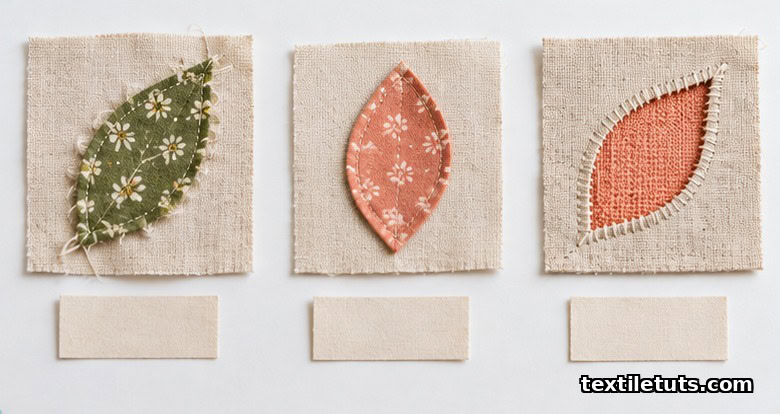
Turned-edge appliqué is the traditional method. The cut shape edge is folded under 6 mm using starch or a thin fabric glue stick, then blind-hemmed or topstitched to the base. The folded edge removes the raw fiber exposure, so fraying after laundering is essentially zero. The trade-off is time: turned-edge appliqué takes 3 to 4 times longer than raw-edge on the same design.
Reverse appliqué, common in Hawaiian and Latin American textile traditions, sandwiches the appliqué shape between two layers and cuts away the top layer to reveal the shape. The cut edge is then secured with a tight blanket stitch or whip stitch. Reverse appliqué has the highest durability of the three because every cut edge is enclosed, but it requires careful pattern planning because mistakes cannot be undone without recutting the base layer.
Patchwork Construction Methods
Traditional patchwork uses a running stitch sewn by hand through marked seam lines, typically at 8 to 12 stitches per inch using a short quilting needle and a single strand of 50-weight thread. The stitch length on the surface is around 2.5 mm, matching machine piecing. Hand piecing tolerates a slightly wider stitch variance than machine piecing because each stitch can be repositioned before the next one is taken.
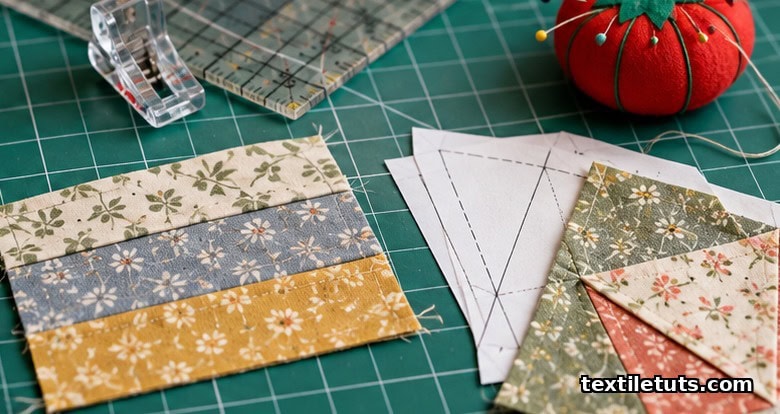
Machine patchwork uses a straight stitch at 2.0 to 2.5 mm with the seam allowance guided by a 6.35 mm presser foot. Quarter-inch presser feet are standard equipment on every home sewing machine marketed to quilters. Strip piecing, where long strips are sewn together and then cross-cut into subunits, is the most efficient machine method and depends on accurate 6.35 mm seam allowances to maintain unit dimensions.
English paper piecing (EPP) bastes fabric around paper templates and joins the basted units with a whip stitch. The whip stitch tension controls the final seam appearance: too tight pulls the fabric into puckers, too loose leaves gaps. Foundation paper piecing (FPP) sews fabric directly onto a printed paper foundation, with the seam allowances folded back along printed lines. FPP achieves the most precise geometric results because the paper foundation enforces the seam lines; the paper is torn away after construction.
Colorfastness and Wash Testing
Colorfastness in appliqué and patchwork is tested against AATCC 8 (crocking, dry and wet), AATCC 61 (laundering-accelerated color change), and AATCC 132 (colorfastness to drycleaning). A passing result on a multi-fabric composition is a grade 4 or higher on the gray scale for color change and staining after 5 cycles. Fabrics that bleed at grade 3 or lower should be pre-washed with a color-absorbing sheet or replaced before cutting.
Dimensional stability is governed by AATCC TM 135, which specifies a procedure of 5 home laundering cycles at a stated water temperature (typically 30 degrees Celsius or 40 degrees Celsius) followed by tumble drying. The acceptance limit for quality patchwork cotton is usually 3 percent or less dimensional change after 5 cycles, and 5 percent or less for the first cycle on unwashed fabrics. Pre-washing fabric before cutting is the only practical way to land inside that envelope.
Appliqué vs Patchwork: A Side-by-Side Comparison
| Property | Appliqué | Patchwork |
|---|---|---|
| Standard seam allowance | 6 mm turn-under (turned-edge) or none (raw-edge) | 6.35 mm (1/4 in) |
| Typical stitch length | 2.0 to 2.5 mm topstitch | 2.0 to 2.5 mm piecing stitch |
| Dominant failure mode | Raw-edge fraying, base-fabric puckering | Seam slippage, unit undersizing |
| Preferred thread weight | 50 to 60 wt cotton or polyester | 40 to 50 wt cotton or polyester core-spun |
| Pre-wash shrinkage tolerance | 3 percent or less per AATCC TM 135 | 3 percent or less per AATCC TM 135 |
| Colorfastness benchmark | Grade 4 or higher per AATCC 8 and 61 | Grade 4 or higher per AATCC 8 and 61 |
| Seam slippage limit at 60 N load | 6 mm or less per ISO 13936-2 | 6 mm or less per ISO 13936-2 |
| Best substrate | Quilting cotton, linen, silk (varies by design) | Quilting cotton (uniform weight across pieces) |
Frequently Asked Questions
What stitch length should I use for machine appliqué?
Use 2.0 to 2.5 mm for straight-stitch topstitching on raw-edge or turned-edge appliqué. Shorter stitches (1.5 mm) are appropriate for satin-stitch edges; longer stitches (3.0 mm) are for basting only. A 2.0 mm straight stitch with 50-weight thread produces a flat, durable edge on quilting cotton without percolating through to the back.
Do I need to pre-wash fabric for patchwork?
Yes. Pre-wash all fabrics in the same temperature water you intend to wash the finished quilt in, then tumble dry. Unwashed quilting cotton typically shrinks 2 to 5 percent in the first cycle per AATCC TM 135, which translates to 6 to 15 mm of distortion on a 30 cm patchwork block. Pre-washing relaxes the fibers before cutting and lets you cut to final size with confidence.
What is the best thread for patchwork piecing?
A 40 to 50 weight cotton or polyester core-spun thread in a neutral grey or ivory is the standard. Polyester core-spun has higher seam strength and lower lint than all-cotton, and it tolerates machine piecing at 2.0 to 2.5 mm without skipped stitches. Avoid 30-weight thread for piecing; it is too thick for accurate 6.35 mm seams.
Can raw-edge appliqué be washed?
Yes, with limits. Raw-edge appliqué on tightly woven quilting cotton survives 5 or more laundering cycles at 30 degrees Celsius with minimal fraying. On loosely woven linen or rayon, raw edges fray visibly after 2 to 3 cycles. If the project will be washed frequently (a baby quilt, for example), use turned-edge appliqué or apply a tight zigzag at 1.0 mm width along the raw edge before topstitching.
How do I keep patchwork units the same size after sewing?
The single largest cause of undersizing is a seam allowance that drifts wider than 6.35 mm. Use a dedicated quarter-inch presser foot, mark the needle position on your machine throat plate with a strip of tape, and verify each seam with a ruler before cutting sub-units. Accurate seams produce units that match the published pattern dimensions to within 1 to 2 mm, which is invisible in a finished quilt top.
References
- American Association of Textile Chemists and Colorists. AATCC TM 135: Dimensional Changes of Fabrics After Home Laundering. AATCC — test method for shrinkage after repeated domestic washing cycles.
- American Association of Textile Chemists and Colorists. AATCC 8: Colorfastness to Crocking. AATCC — rubbing-fastness test method for dyed and printed textiles.
- American Association of Textile Chemists and Colorists. AATCC 61: Colorfastness to Laundering. AATCC — accelerated laundering colorfastness method.
- American Association of Textile Chemists and Colorists. AATCC 132: Colorfastness to Drycleaning. AATCC — solvent colorfastness test method.
- ASTM International. ASTM D5034: Standard Test Method for Breaking Strength and Elongation of Textile Fabrics (Grab Test). ASTM — grab-method tensile test for woven fabrics.
- International Organization for Standardization. ISO 13936-2: Textiles — Determination of Seam Slippage Resistance. ISO — fixed-load seam slippage test for woven fabrics.
- International Organization for Standardization. ISO 6330: Domestic Washing and Drying Procedures for Textile Testing. ISO — standard washing procedure referenced by AATCC and ISO laundering tests.
This article is the working reference for appliqué and patchwork construction. Editorial by Kazi Sifat Muntasir, TextileTuts. Sources: AATCC TM 135, AATCC 8, AATCC 61, AATCC 132, ASTM D5034, ISO 13936-2, ISO 6330 as cited.


