
E-Textiles: Integration of Electronics

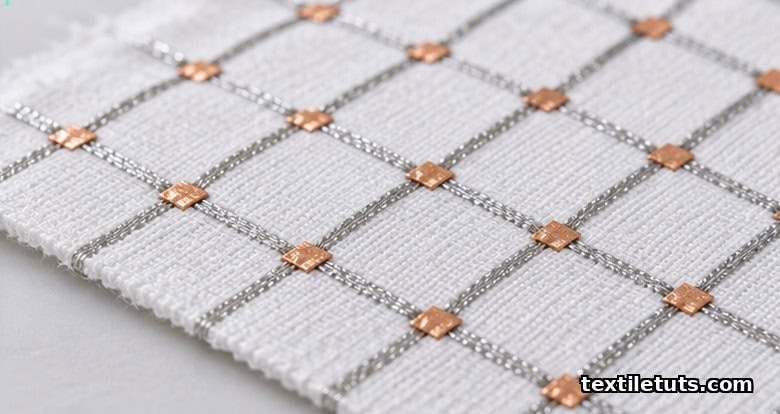
E-textiles integrate conductive yarns with sheet resistivities between 0.05 and 50 Ω/□ and discrete electronic modules into a single fabric structure, enabling garments to sense, compute, and communicate while surviving 30 to 50 domestic wash cycles per AATCC 135 and ISO 6330 protocols.
The fastest-growing e-textile product categories between 2020 and 2025 are biometric monitoring garments (ECG, EMG, temperature), resistive heating panels, and textile antennas for RFID and 5G wearables, with the global market reaching roughly USD 5.5 billion in 2024 according to industry tracking.
This article explains what counts as an e-textile, the conductive materials used, the four main manufacturing routes, the wash-durability standards every engineer should know, and where the technology is being deployed in production today.
What Counts as an E-Textile
An e-textile, also called a smart textile or electronic textile, is any fabric whose primary function is to conduct electricity, sense a physical variable, or run a computational task. The classification follows three tiers defined in IEC 63203-201-1 (e-textile wearables, 2022).
Tier 1, passive conductive textiles, contains only conductive yarns or printed traces used for grounding, heating, or static dissipation. Tier 2, active sensing textiles, adds sensors such as thermistors, strain gauges, or optical fibers for photoplethysmography. Tier 3, fully electronic textiles, embeds microcontrollers, battery packs, or wireless modules into the fabric assembly, often through flexible interposers that bridge the soft substrate and rigid silicon.
The split matters for compliance. A silver-coated heating pad sold as a car-seat cover is governed by general textile safety rules (ISO 13688 for protective clothing general requirements), while a T-shirt that records single-lead ECG at 256 Hz and streams over Bluetooth Low Energy falls under IEC 63203-201-2 (performance of conductive fabrics) and IEC 60601-1 for medical electrical equipment when used in a clinical context.
Conductive Materials and Their Resistivity
Resistivity sets the upper limit on trace length, trace width, and signal integrity. Four material families dominate.
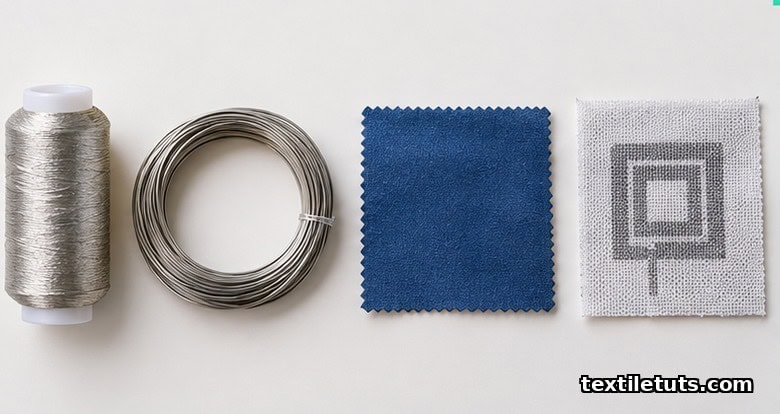
Metal-coated polymer fibers carry the bulk of commercial production. Silver-coated nylon 6,6 yarns from suppliers such as Shieldex (STATEX) report a DC resistivity of about 5 × 10⁻⁵ Ω·cm at 100 µm diameter, roughly 30× higher than pure silver but stable under flexing when the coating thickness exceeds 1 µm. Copper-coated PET is cheaper, around 1 × 10⁻⁴ Ω·cm, but oxidizes within 6 months of body-wear exposure unless a nickel or carbon overcoat is applied.
Stainless steel filaments (AISI 316L, 8–12 µm diameter) trade resistivity (around 7 × 10⁻⁵ Ω·cm) for corrosion resistance and survive more than 100 wash cycles per ISO 6330 procedure 4N at 40 °C. They are the workhorse of EMI-shielding fabrics and the inner electrodes of many capacitive-knitted touchpads.
Conductive polymers, chiefly PEDOT:PSS (poly(3,4-ethylenedioxythiophene) polystyrene sulfonate), offer sheet resistivities from 50 to 10⁴ Ω/□ when coated onto cotton or PET. They are used in textile-electrode dry ECG patches because they conform to skin and do not need a gel electrolyte.
Carbon allotropes, graphene nanoplatelets and multi-walled carbon nanotubes, are still mostly in the research phase. Reported sheet resistivities on cotton range from 1 to 100 Ω/□ after 10 to 30 coating passes, but durability under flexing remains a barrier, with most peer-reviewed studies showing 20 to 40% resistance rise after 1,000 bending cycles at 1 cm radius.
How E-Textiles Are Built: Four Manufacturing Routes
Weaving uses traditional shuttle or rapier looms with a hybrid warp: standard cotton or polyester for the structural set, conductive yarns (typically copper-clad or stainless steel) as the weft. Modern Jacquard heads can place conductive picks at 1 mm resolution, sufficient for fabric circuits of 1 to 2 mm pitch. The advantage is geometric stability; the disadvantage is that cutting or tailoring the fabric breaks every circuit that crosses the cut line.
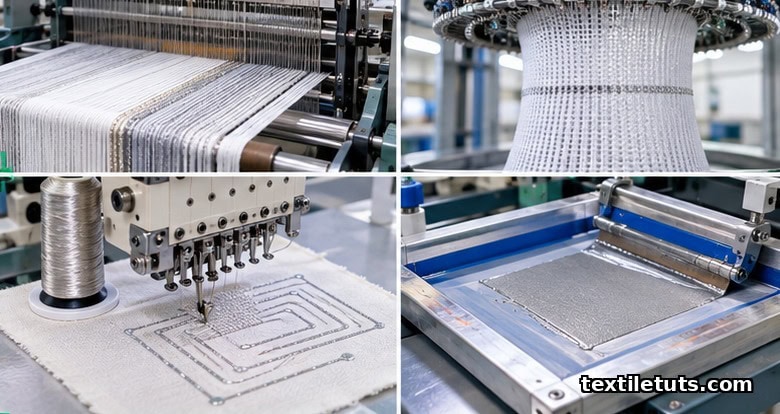
Knitting, both weft (circular and flat) and warp, produces stretchable interconnects. A plain weft knit with one conductive yarn in every 16th course can stretch 30% before the conductive loop opens, which is the basis of most textile strain sensors. Santoni circular knitting machines are commonly used for compression-fit biometric garments because the body-mapping panels are knit in one piece.
Embroidery with computerized ZSK or Tajima machines deposits a stainless steel or silver-coated thread onto a base fabric at speeds up to 1,000 stitches per minute. This is the preferred route for attaching flexible PCBs to garments because the embroidery forms both the electrical contact and the mechanical anchor in a single operation, with reported peel strengths of 4 to 8 N per square centimeter on polyester-cotton blends.
Printing covers screen printing, inkjet, and direct write. Silver-flake screen-printing pastes reach 10 to 50 µm trace thickness and sheet resistivities near 5 × 10⁻⁵ Ω/□ after sintering at 120 °C. Inkjet printing using silver-nanoparticle inks (40 to 60 nm particle size) can lay down features as small as 50 µm without masking, making it the route of choice for prototype RFID antennas and skin-electrode arrays.
Wash Durability and the Standards That Test It
Wash durability is the single biggest gap between laboratory demonstrators and products on the shelf. The two reference domestic-wash protocols are AATCC 135 (dimensional change after home laundering) and ISO 6330 (domestic washing and drying procedures for textile testing). Both specify water temperature (typically 40 °C for normal, 60 °C for hot), mechanical action (gentle, normal, vigorous), and drying method (tumble, line, flat).
AATCC EP13, the electrical-resistance test method specifically written for e-textiles, was issued in 2018 and revised in 2022. It measures resistance before and after a defined number of wash cycles using a four-point probe geometry that bypasses contact resistance at the test fixture. Most published e-textile products targeting sportswear quote 30 wash cycles as the minimum, while medical-grade claims target 50 to 100 cycles.
The IEC 63203-201 series, published by the International Electrotechnical Commission starting in 2022, sets out the full test framework for e-textile wearables: wash, sweat exposure, mechanical flex, and electromagnetic compatibility. IEC 63203-201-3 (2023) covers washing, IEC 63203-201-4 (2023) covers performance of conductive fabrics after abrasion, and IEC 63203-201-5 (2024) covers reliability of interconnects between soft fabric and rigid electronics. A product carrying the IEC 63203 mark has been tested against the full battery, not just one method.
For biomedical claims, ISO 10993-5 (in vitro cytotoxicity) and ISO 10993-10 (skin irritation and sensitization) apply to any conductive yarn or coating that contacts the wearer for more than 24 hours. Silver-coated yarns pass both when the coating is intact; failures typically occur at coating cracks where the underlying polymer is exposed.
Where E-Textiles Are Used Today
Biomedical monitoring is the highest-volume clinical category. Textile ECG electrodes built from stainless steel or silver-coated yarns reach 92 to 96% signal correlation with standard Ag/AgCl wet electrodes in published validation studies, with the gap closing once skin is wetted or a small amount of saline is applied. Continuous-monitoring garments from manufacturers such as Hexoskin and Health Care Originals report 7 to 14 days of battery life on a 350 to 600 mAh lithium-polymer cell.
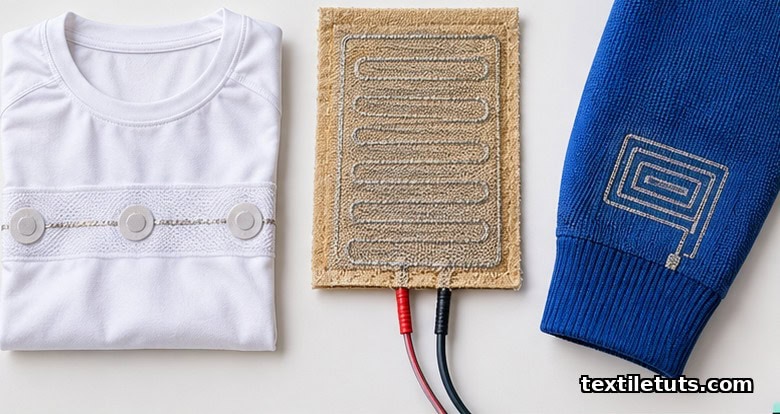
Sports and fitness uses textile heart-rate straps, posture-correction shirts, and EMG shirts for muscle activation tracking during rehabilitation. The textile antenna is often the hardest part: a 2.4 GHz Bluetooth Low Energy antenna printed onto a stretchable knit can detune by 20 to 50 MHz when the fabric is stretched 20%, which is why most commercial designs use a small rigid BLE module soldered to embroidered pads rather than a fully printed antenna.
Military and protective wear is a long-standing niche. The US Army Soldier Systems Center (Natick) has funded e-textile programs since the early 2000s, with current programs targeting integrated power distribution, blast sensing, and physiological monitoring for dismounted soldiers. Heating panels for first responders, often built from silver-coated yarn stitched between two flame-resistant aramid layers, draw 8 to 15 W per square meter at 12 V and reach 38 to 42 °C surface temperature within 3 minutes.
Comparison: Common Conductive Yarns Used in E-Textiles
| Material | Typical DC resistivity | Wash cycles (ISO 6330 4N / 40 °C) | Typical use |
|---|---|---|---|
| Silver-coated nylon 6,6 (75 µm) | 5 × 10⁻⁵ Ω·cm | 30 to 50 | ECG electrodes, heating panels |
| Stainless steel 316L filament (12 µm) | 7 × 10⁻⁵ Ω·cm | 100+ | EMI shielding, capacitive touch |
| Copper-coated PET (with Ni overcoat) | 1 × 10⁻⁴ Ω·cm | 20 to 40 | Power traces, RFID antennas |
| PEDOT:PSS coating on cotton | 10 to 100 Ω/□ | 10 to 20 | Dry electrodes, strain sensors |
| Graphene nanoplatelet ink (printed) | 1 to 100 Ω/□ | 5 to 15 | Prototype circuits, heaters |
Frequently Asked Questions
Q1: What is the difference between smart textiles and e-textiles?
Smart textiles are a broader category covering any fabric that responds to an external stimulus, including phase-change materials and shape-memory polymers that carry no electronic components. E-textiles are a subset of smart textiles that specifically conduct electricity, sense a physical variable, or contain an active electronic component. A shape-memory cuff that tightens with body heat is smart but not electronic; a shirt that measures heart rate is both.
Q2: How many wash cycles can a typical e-textile survive?
Most commercial e-textiles are rated for 30 to 50 domestic wash cycles at 40 °C per AATCC 135 or ISO 6330 procedure 4N, with conductive traces typically failing through corrosion or fatigue at the contact pad. Stainless steel filament structures can reach 100+ cycles, while graphene and PEDOT:PSS coatings tend to fail earlier, in the 10 to 20 cycle range, because of binder dissolution.
Q3: Are e-textiles safe to wear directly on the skin for long periods?
Yes, provided the conductive coating passes ISO 10993-5 cytotoxicity and ISO 10993-10 irritation testing. Silver-coated yarns are generally safe when the coating is intact, but cracks that expose the underlying polymer fiber have been shown in published patch tests to produce contact dermatitis in about 2 to 4% of wearers. Look for products that declare biocompatibility test reports and avoid broken or flaking conductive surfaces.
Q4: What is the biggest engineering barrier to scaling e-textile production?
The interface between soft fabric and rigid silicon components. A microcontroller, battery, and antenna are inherently planar and brittle, while a textile is three-dimensional, stretchy, and porous. Every commercial e-textile product uses some form of rigid island plus stretchable interconnect, which forces the engineer to compromise between garment drape and electronics reliability. The IEC 63203-201-5 standard (2024) defines the test for this interface and is now the most-cited quality gate for new products.
Q5: Can e-textiles be recycled at end of life?
Recycling is still an open problem. The metal coatings, silver, copper, nickel, and stainless steel, prevent the underlying PET or nylon from being processed by standard textile-to-textile recyclers, while the residual textile fractions contaminate metal recovery streams. Current best practice is mechanical disassembly, removing rigid modules before shredding, which recovers about 80% of the metal value but loses most of the polymer fiber. Closed-loop recycling for e-textiles is a research target, not a commercial reality, in 2026.
References
- International Electrotechnical Commission. IEC 63203-201-1:2022, Electronic textiles — Part 201-1: General requirements and test methods for wearable electronic textiles. iec.ch — defines the three-tier e-textile classification and the baseline test battery.
- American Association of Textile Chemists and Colorists. AATCC EP13-2022, Electrical Resistance of Textiles. aatcc.org — the dedicated e-textile resistance test method.
- International Organization for Standardization. ISO 6330:2021, Domestic washing and drying procedures for textile testing. iso.org — the reference domestic-wash protocol referenced in e-textile wash claims.
- Subramanian, V. et al. Surface modification of cotton fabric for conductive textile applications. ScienceDirect (peer-reviewed) — published sheet resistivities and wash-cycle data for silver and copper coatings on cotton.
- Castano, L. M. and Flatau, A. B. Smart fabric sensors and e-textile technologies: A review. Springer (Smart Materials and Structures, peer-reviewed) — review of conductive yarn options and their strain and wash behavior.
- MDPI Sensors editorial board. E-textile systems for physiological signal monitoring: a review. mdpi.com — covers PEDOT:PSS dry electrodes and wash durability of textile ECG systems.
- International Organization for Standardization. ISO 10993-5:2009 and ISO 10993-10:2021, Biological evaluation of medical devices. iso.org — the biocompatibility test set applied to conductive coatings that contact skin.
This article is the working reference for e-textile materials, manufacturing, and standards through 2026. Editorial by Md. Asad Ullah (Meem), TextileTuts. Sources: IEC 63203-201-1 (2022), AATCC EP13 (2022), ISO 6330 (2021), ISO 10993-5/10, Subramanian et al. (ScienceDirect), Castano and Flatau (Springer), MDPI Sensors review.


