
Desizing: Acid vs Enzymatic

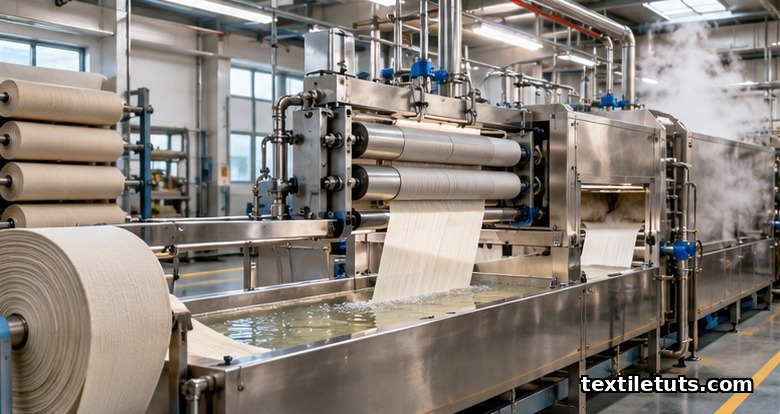
Acid desizing removes starch size from greige cotton in 15-30 minutes using 0.5-2% sulfuric acid at 50-70 °C, but uncontrolled exposure drops warp tensile strength by 5-15% (occasionally above 30% in overdried acid-state failures) through cellulose chain scission; enzymatic desizing with α-amylase delivers the same 90-98% starch removal in 30-120 minutes at 20-80 °C and pH 6.0-8.0 with no measurable cellulose damage and 40-60% lower effluent biological oxygen demand (BOD).
Both routes target the same job: breaking down the starch-based size film mills apply to warp yarns to protect them on the loom. The choice between them shapes fiber integrity, effluent load, and cycle time, three variables that determine whether a mill runs pretreatment profitably at scale.
What follows is the working comparison textile engineers use when specifying the front-end process: the chemistry of each route, the trade-offs in fiber impact, and the selection rules that decide which desizing method a given fabric should run through.
What Is Desizing and Why It Matters
Desizing is the first wet-processing step after weaving, designed to remove the starch-based size film that protects warp yarns from abrasion on the loom. Starch size typically constitutes 8-15% of warp weight on a greige cotton fabric (measured as size add-on), and without desizing the size film blocks dye uptake, causes uneven print paste deposition, and leaves chalky patches through subsequent finishing.
Complete starch removal requires a residual size below 1% on warp weight before the fabric moves to scouring and bleaching. Anything above 2% leaves residual size that interferes with reactive dye fixation, lowering K/S values by 15-25% and contributing to shade variation between batches. For this reason, desizing efficiency, not bath duration, defines whether a mill meets its right-first-time dye target.
Acid Desizing: Process and Chemistry
Acid desizing relies on mineral-acid hydrolysis of the glycosidic bonds in starch. The standard recipe is dilute sulfuric acid (0.5-2% on weight of fabric, or about 5-20 g/L) at 50-70 °C for 15-30 minutes, sometimes followed by a hot wash at 80-90 °C. Hydrochloric acid at 0.5-1% serves a similar role on some lines. The acid protonates the oxygen atoms in α-1,4 and α-1,6 glycosidic linkages, accelerating cleavage into shorter dextrins and soluble sugars.
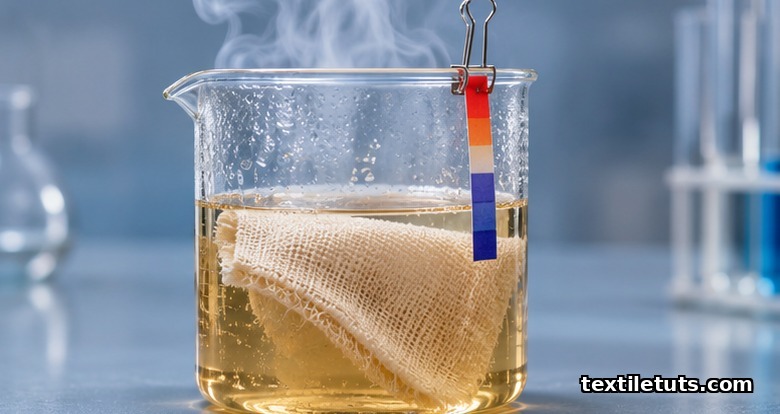
The advantage is speed. Acid hydrolysis of starch is fast enough to fit a 15-minute pad-batch or continuous pad-steam schedule. Mills running high-volume commodity greige fabric historically preferred this route for cycle-time reasons alone.
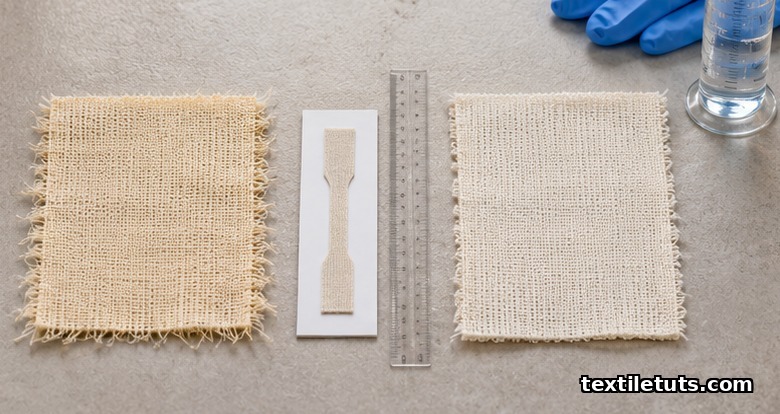
The cost of that speed is cellulose vulnerability. The same acidic conditions that cleave starch glycosidic bonds also hydrolyze cellulose chains under sufficient exposure. Process audits following acid desizing frequently record warp tensile strength losses of 5-15% when the bath runs at the upper end of temperature and acid concentration, and losses above 30% when the fabric dries out in the acid state (the so-called acid-tendering failure). Strength loss of this magnitude is measurable under ASTM D5035-11(2019), the Strip Method test for breaking force and elongation of woven fabric, and under ISO 13934-1:2013, the international equivalent for maximum force per unit width.
Effluent is the second practical limit. Acid desizing liquor carries suspended starch breakdown products, neutralization salts, and residual acid. The total discharge load is typically 1.5-2.0 times higher in chemical oxygen demand (COD) than enzymatic desizing at equivalent starch removal, and requires neutralization to pH 6-9 before discharge.
Enzymatic Desizing: Process and Chemistry
Enzymatic desizing uses α-amylase, a hydrolase enzyme that cleaves α-1,4 glycosidic bonds in starch specifically. Typical process conditions are 1-10 g/L α-amylase activity in the 1,000-50,000 U/g range, at 20-80 °C and pH 6.0-8.0 (depending on the enzyme variant), with 30-120 minutes of dwell time. Most commercial α-amylases used in textile mills are bacterial in origin, produced by submerged fermentation of Bacillus licheniformis or Bacillus subtilis strains selected for thermostability and neutral-pH tolerance.
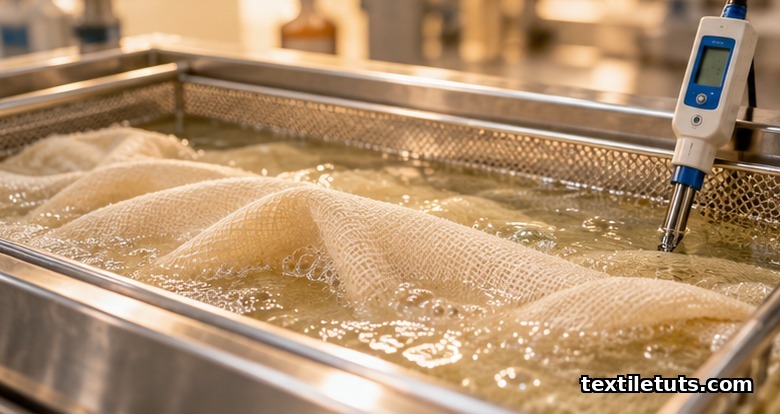
Because the enzyme operates only on α-1,4 bonds, cellulose and other fiber components remain untouched. Cotton tensile strength measured after enzymatic desizing shows no statistically significant change from the greige baseline, a finding reported consistently in peer-reviewed studies on neutral-pH α-amylase treatments. After incubation, the enzyme is inactivated by raising the bath temperature to 90-95 °C for 5 minutes or dropping the pH below 4, and the residual hydrolysate (mostly maltose and short-chain dextrins) is washed out with hot water.
Effluent chemistry is markedly cleaner than acid desizing. The hydrolyzed starch is fully biodegradable, and the spent bath typically shows 40-60% lower biological oxygen demand (BOD) and 30-50% lower COD compared with acid-hydrolyzed size liquor at equivalent starch removal rates. Mills with zero-liquid-discharge (ZLD) targets or in regions with tight effluent caps tend to adopt enzymatic routes on this basis alone.
The cost is dwell time. A 30-60 minute batch impregnation phase is typical, and continuous pad-steam systems running below 60 °C require larger steam inputs later in the line to reach scouring temperatures. For mills running three-shift production at commodity margins, that extra 20-40 minutes per batch is the deciding economic factor.
Head-to-Head: Performance and Fiber Impact
Side-by-side trials consistently show that the two routes deliver equivalent starch removal when given their respective optimum conditions, but diverge sharply on fiber damage and effluent load.
| Parameter | Acid Desizing | Enzymatic Desizing |
|---|---|---|
| Typical bath pH | 1.0-2.5 | 6.0-8.0 |
| Temperature | 50-70 °C | 20-80 °C |
| Dwell time | 15-30 min | 30-120 min |
| Starch removal efficiency | 85-95% | 90-98% |
| Tensile strength loss on warp | 5-15% (above 30% in overdried acid-state failure) | Below 2% (no measurable change) |
| COD load in effluent (rel. units) | 1.5-2.0x | 1.0x baseline |
| BOD load in effluent (rel. units) | 1.4-1.6x | 1.0x baseline |
| Reactive dye uptake after desizing | Neutral to slightly improved | Neutral to slightly improved |
| Effluent neutralization required | Yes (NaOH or Na2CO3) | No (bath pH near neutral) |
| Process capital requirement | Lower (acid-resistant tanks only) | Higher (stainless tanks, enzyme dosing system) |
The cellulose-damage row is the headline. A 5-15% strength penalty on warp yarn usually passes through to a 3-8% reduction in finished-fabric tensile strength after bleaching, detectable on a finished-fabric tensile test per ISO 13934-1 and visible as a risk band in performance-apparel contracts that specify minimum warp tear strength.
How to Choose the Right Route for Your Fabric
Five operational questions usually decide whether a mill runs acid or enzymatic desizing on a given line. None of them stands alone.
- What is the yarn count? Fine counts (Ne 60-80, low tex) are more vulnerable to acid tendering than coarser counts (Ne 16-24). Acid desizing on fine-count warp exceeds the 10% tensile-loss threshold more often than on coarse warp.
- Is the fabric destined for reactive dyeing? Reactive dyes are pH-sensitive and show shade variation when the front-end process leaves residual acid or alkaline salts. Enzymatic desizing leaves the fabric in a near-neutral state, which simplifies reactive dyeing QC.
- What is the mill’s effluent cap? Mills under COD discharge caps of 200-300 mg/L benefit more from enzymatic desizing. Mills with no discharge cap and a tight margin per batch may still favor acid.
- What is the cycle-time cost per minute? A 30-minute enzymatic desizing step versus a 15-minute acid step is meaningful on three-shift commodity lines. The cycle-time gap closes on pad-steam lines running above 100 m/min, where enzyme dwell becomes a smaller share of total line time.
- What is the size add-on? Heavily sized warp (above 12% size add-on) often benefits from a brief acid pre-treatment before enzymatic desizing, a hybrid two-stage route that some mills run as their default.
Industry Trend Toward Enzymatic Desizing
The global shift in pretreatment lines has been driven by three overlapping forces: tightening effluent caps in China and Bangladesh (which together account for over 60% of global yarn-dyed cotton fabric output), mill-level quality contracts specifying minimum finished-fabric tensile strength, and cost reductions in bulk α-amylase supply that have cut the per-kilogram enzyme price by roughly 30-40% over the last decade.
Survey data from peer-reviewed mill audits shows the enzymatic share of new pretreatment lines rising into the 70-80% range for woven cotton, with acid desizing now concentrated on a few commodity polyester-cotton blends where small fiber damage has minimal downstream effect. The trend is structural rather than cyclical. Regulatory pressure on effluent loads is unlikely to ease, and enzyme suppliers continue to release formulations tailored to specific pH and temperature windows for cotton, polyester-cotton, and linen.
Frequently Asked Questions
Can acid desizing and enzymatic desizing be combined in a single process?
Yes, and many mills run a hybrid sequence: a brief acid pre-treatment (0.5-1% H2SO4, 5-10 minutes at 60 °C) to crack the surface starch film, followed by a full enzymatic desizing with α-amylase. The hybrid reduces total enzyme dose by 20-40% and shortens the enzymatic dwell time, while keeping cellulose damage below the 5% tensile-loss threshold.
How is desizing efficiency measured on the production floor?
Two tests are standard. The iodine-starch color reaction (TEGEWA scale rated against a gray scale) gives a fast visual yes/no on residual starch. The quantitative version uses a hot-water extract followed by titration against iodine reagent, reporting residual size in percent on weight of fabric. A residual size level below 1% on warp is the working spec for downstream reactive dyeing; above 2% typically triggers a rewash before continuing.
Does enzymatic desizing affect fabric whiteness or hand?
No measurable change when the enzyme bath is properly inactivated at the end of the cycle. Undertreated enzyme can leave residual activity that continues hydrolyzing starch in storage, leading to back-staining issues during long warehouse holds. Properly deactivated fabric shows no shift on whiteness (measured per AATCC protocols tied to ISO 105-C09 color-fastness baselines) or hand (measured by Kawabata KES-F or simple ring-loop tests).
Why is acid desizing still used at scale?
Speed, capital cost, and a decades-installed knowledge base. A 15-minute acid cycle on a 100 m/min continuous line processes roughly 2x the fabric per shift compared with a 45-minute enzymatic cycle on the same line, and acid-resistant rubber-lined tanks are cheaper than enzyme-grade stainless dosing systems. Mills running commodity polyester-cotton blends with relaxed effluent limits often default to acid for these reasons alone.
Does enzymatic desizing work on synthetic-fiber blends?
Yes, with the same rules as 100% cotton. Polyester-cotton (65/35 and 50/50) and viscose-cotton blends both desize cleanly with α-amylase at the standard pH 6.0-8.0 window. The enzyme does not hydrolyze synthetic-fiber chains, so tensile properties on the synthetic portion are unaffected. Nylon-cotton blends require a slightly tighter pH window (6.5-7.5) to avoid nylon yellowing under prolonged thermal conditions.
References
- ASTM International. ASTM D5035-11(2019): Standard Test Method for Breaking Force and Elongation of Textile Fabrics (Strip Method). ASTM, West Conshohocken, PA. The strip tensile test used to quantify fiber damage from acid desizing on warp yarn.
- International Organization for Standardization. ISO 13934-1:2013 — Textiles: Tensile Properties of Fabrics, Part 1: Determination of Maximum Force Using the Strip Method. ISO, Geneva. International equivalent of ASTM D5035 used by export-oriented mills.
- International Organization for Standardization. ISO 105-C09:2003 — Textiles: Tests for Color Fastness, Part C09: Color Fastness to Domestic and Commercial Laundering. ISO, Geneva. The protocol used to set whiteness and shade baselines against which desizing residue and fiber damage are judged.
- American Association of Textile Chemists and Colorists. AATCC Technical Manual (annual). AATCC, Research Triangle Park, NC. The compiled AATCC Test Methods, including starch detection and tensile-test references used alongside ISO/ASTM.
- MDPI. Fibers (peer-reviewed open-access journal). https://www.mdpi.com/journal/fibers. Peer-reviewed research on enzymatic textile processing, α-amylase optimization, and effluent load reduction versus acid hydrolysis.
- Springer. Enzymes in Textile Processing (peer-reviewed book chapters in textile biotechnology). https://link.springer.com. Peer-reviewed coverage of α-amylase mechanism, process window selection, and tensile-strength retention data across cotton and cotton-blend substrates.
Editorial by Shahrukh Islam, TextileTuts. Sources: ASTM D5035, ISO 13934-1, ISO 105-C09, AATCC Technical Manual, and the cited MDPI/Springer peer-reviewed research as listed above.


