
Denim Standards and Quality Control

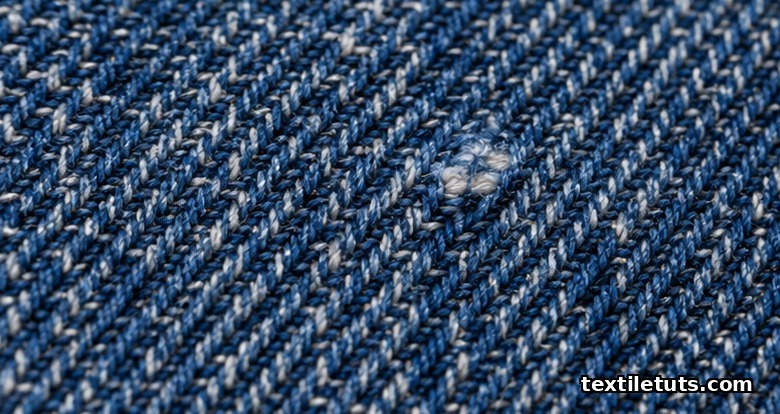
Denim quality is graded against a handful of standardized tests, not personal preference: fabric mass per unit area measured under ISO 3801, breaking strength under ASTM D5034 (typically 400 to 800 N in the warp direction for a 14 oz/yd² denim), and dimensional change under AATCC TM 135 with a target of 3% or less after five home laundering cycles.
These three metrics, plus colorfastness, tear strength, and seam performance, define what mills, brands, and laboratories mean when they call a fabric “good denim.” This guide walks through each standard, the numbers that matter, and the failure modes that buyers and QC teams should watch for on every shipment.
What Denim Standards Cover and Why They Exist
Denim is a woven fabric built with indigo-dyed warp yarns (almost always cotton) and undyed or lightly tinted weft yarns in a 3/1 or 2/1 twill weave. Because denim is a commodity that passes through cotton farmers, spinning mills, indigo dyeing ranges, weaving mills, finishing plants, garment factories, and retail, every step needs a reproducible test to confirm the fabric still meets the specification the brand ordered.
The international standards system, ISO, ASTM, and AATCC, gives the supply chain a shared vocabulary. A fabric labeled “14 oz/yd², ≤3% shrinkage, 4/4 colorfastness” means the same thing to a buyer in Dhaka, a merchandiser in Los Angeles, and a laboratory in Hong Kong. Without those numbers, “premium denim” is just a marketing phrase rather than a measurable claim.
The most commonly cited standards for woven cotton denim cluster into five categories: mass per unit area, tensile properties, dimensional stability, colorfastness (washing, light, rubbing), and structural integrity (seam slippage, tear strength). Each category uses one or more named test methods, and most QC protocols run all five before a roll is approved for shipment.
Fabric Mass per Unit Area (Weight): ISO 3801
Denim weight is the first number a buyer specifies, and it drives almost every downstream property. Light-weight denim runs 5 to 9 oz/yd² (170 to 305 g/m²) and is used for shirts and summer-weight jeans. Mid-weight denim, the jeans standard, runs 10 to 13 oz/yd² (340 to 440 g/m²). Heavy denim for selvedge and workwear runs 14 to 21 oz/yd² (475 to 710 g/m²).
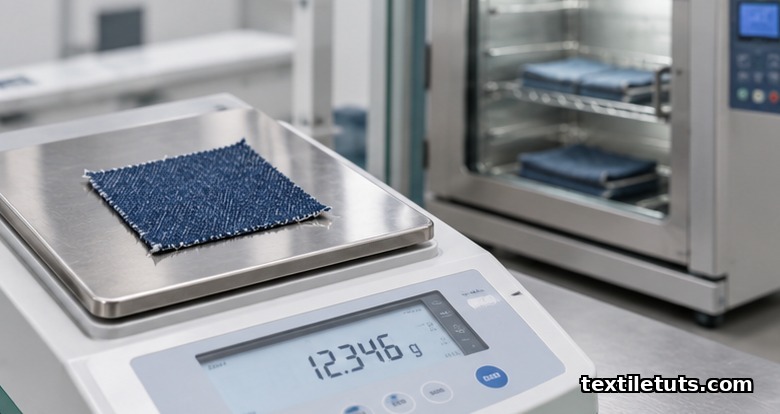
ISO 3801 specifies the method: cut a conditioned specimen of known area, weigh it on a calibrated balance, and divide by the area. The specimen must be conditioned at 20 ± 2 °C and 65 ± 4% relative humidity for at least 24 hours before weighing, so the moisture regain of cotton is stable. Tolerance on a denim shipment is usually ± 3% from the target weight.
For example, an 11.5 oz/yd² denim at 3% tolerance can legally arrive between 11.16 and 11.85 oz/yd². A QC technician who finds the roll at 10.8 oz/yd² has a legitimate reject on the spot, and the shipment cannot be cleared by simply averaging across the lot.
Tensile Strength: ASTM D5034 and ISO 13937
Tensile strength tells you how much force the fabric can take before it tears apart, and it is the single most predictive mechanical test for woven denim. Two grab methods dominate: ASTM D5034 (the U.S. standard) and ISO 13937-2 (the international counterpart).
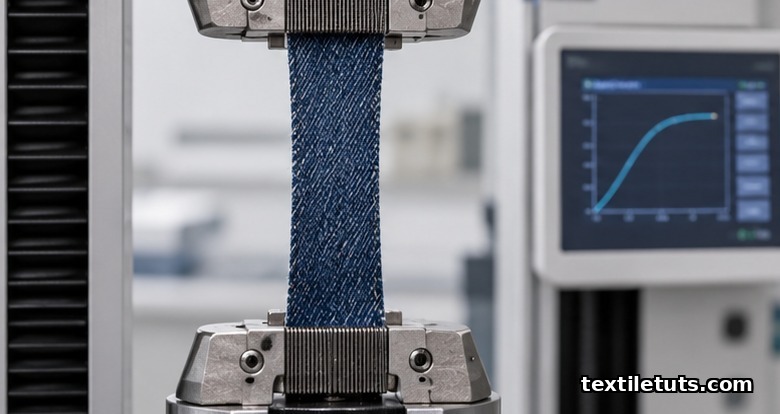
For a 14 oz/yd² cotton denim, typical warp breaking strength runs 700 to 1100 N (around 700 N for a ringspun, 900 to 1100 N for a double-ringspun), and weft runs 400 to 600 N. Anything below 400 N warp is a flag, because consumer jeans fail first along the warp direction, at the seat seam and along the knee line.
ASTM D5034 grips a 100 mm × 150 mm specimen in the central 25 mm × 25 mm area, while ISO 13937-2 uses a 100 mm × 200 mm specimen with a 50 mm jaw face. Both pull at 50 mm/min until rupture. Results depend heavily on yarn count and yarn twist, so a mill quoting a “premium” specification should also disclose whether the warp is ring-spun, open-end, or core-spun.
The Elmendorf tear test (ASTM D1424 or ISO 13937-1) is the partner test for measuring how the fabric behaves once a tear starts. Heavy denim typically shows 60 to 120 N warp tear and 50 to 100 N weft tear. Below 50 N warp tear, a snag becomes a runaway tear.
Dimensional Stability: AATCC TM 135
Shrinkage is the metric that drives returns. A pair of jeans that grows two sizes in the wash loses a customer. AATCC TM 135 is the standard home-laundering test: five cycles of machine wash at a specified temperature (typically 40 °C for consumer jeans, sometimes 30 °C for dark indigo), tumble dry at the specified setting, then measure the dimensional change in warp and weft.
The accepted QC limit for sanforized denim is 3% or less in warp and 3% or less in weft after five cycles. Unsanforized (shrink-to-fit) denim can legally show 8 to 12% warp shrinkage, and that is the entire selling point. The two are sold as different products; one is not “lower quality” than the other.
ISO 5077 covers the same procedure for general textiles, and ISO 6330 is the corresponding domestic washing procedure. The key variables are water temperature, agitation type, and drying method. A “cold wash, line dry” specification will produce a smaller dimensional change than a “warm wash, tumble dry” specification, so QC reports should always cite which procedure was used.
Colorfastness: ISO 105 and AATCC Test Methods
Indigo dye is famous for crocking (transferring onto skin, seats, and shoes) and for fading in unpredictable patterns. Three colorfastness tests cover the most common failures:
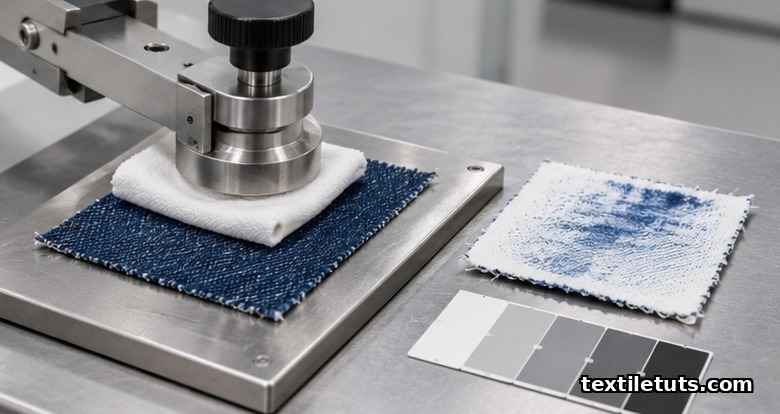
- ISO 105-C10 or AATCC TM 61: colorfastness to washing. Grades run 1 to 5; consumer denim typically requires grade 3-4 minimum for shade change and grade 3 minimum for staining on adjacent fabric.
- ISO 105-X12 or AATCC TM 8: colorfastness to rubbing (crocking). A dry crock rating of 4 and a wet crock rating of 2-3 is the industry minimum for indigo denim. Wet crock is the harder specification to meet.
- ISO 105-B02 or AATCC TM 16: colorfastness to light (xenon arc). For jeans sold as outdoor wear, grade 4 after 40 hours is typical.
Indigo’s chemistry explains why these tests are demanding. Indigo is a vat dye that binds to cotton only loosely, so repeated washing releases micro-particles. Pre-reduced indigo, sulfur-bottom indigo, and rope-dyed indigo all behave slightly differently, and a mill changing dye chemistry without retesting colorfastness will fail the QC gate on the first bulk shipment.
Yarn Quality and Weave Construction
Two denim-specific properties deserve attention because they drive the “hand” and the visual character of the fabric: yarn count and weave density.
Yarn count for cotton denim is expressed in the English cotton count system (Ne), which is the number of 840-yard lengths per pound. A 7 Ne warp is heavier than a 10 Ne warp. Most consumer denim uses 7 to 12 Ne warp and 7 to 14 Ne weft. The yarn count and twist multiplier (TM, typically 3.8 to 4.5 for warp) determine both strength and hairiness.
Fabric density is counted in threads per inch (TPI) or threads per centimeter. A 3/1 right-hand twill denim for jeans typically runs 70 to 80 ends per inch (warp) and 40 to 50 picks per inch (weft). ASTM D3775 covers the yarn-counting method. Weave density is the second-strongest predictor of weight and tensile strength after yarn count itself.
Common Denim Defects Caught in QC
QC teams reject denim for three reasons more than any others: weight out of tolerance (the most common bulk-fail), width out of tolerance (ASTM D3774 measures fabric width, usually required at 28 to 32 inches for jeans), and visible defects classified under ASTM D5430. The D5430 system assigns point values to defects such as slubs, broken picks, knot spots, oil stains, and yarn variation, and a roll fails if the defect points per 100 yards exceed the contract’s allowance (typically 25 to 40 points).
Shade variation between rolls is the second-most-common reject. Mills cut fabric into lots and assign shade bands (A, B, C, and so on), but a roll that drifts more than one band from the standard triggers a “shade off” rejection at the garment plant. Spectrophotometer measurements (typically under the CIELab system) back up the visual grading and provide a numeric record.
pH is a quieter requirement but still part of the QC gate. AATCC TM 81 measures the pH of an aqueous extract from the fabric, and the requirement is usually 4.5 to 7.5. Indigo and sulfur dyes can leave the fabric alkaline, and alkaline fabric irritates skin and accelerates dye bleeding. A mill that skips the final neutralization wash will fail pH on the first inspection.
Frequently Asked Questions
What is the most important denim quality test?
For consumer jeans, dimensional stability under AATCC TM 135 (target ≤3% warp shrinkage after five home laundering cycles) is the most important test, because it determines whether the jeans still fit after the customer washes them. Tensile strength under ASTM D5034 is the second most important, because it predicts seam failure along the seat and knee.
How is denim weight measured?
Denim weight is measured under ISO 3801 by cutting a conditioned specimen of known area, weighing it on a calibrated balance, and dividing by the area. Results are reported in ounces per square yard (oz/yd²) in the U.S. market and grams per square meter (g/m²) in most other markets. Conditioning at 20 °C and 65% relative humidity is required to stabilize the moisture regain of cotton.
Why does indigo denim bleed, and how is bleeding tested?
Indigo is a vat dye with weak bonding to cotton fibers, which is why indigo crocking onto skin, seat fabric, and shoes is normal. Crocking is measured under ISO 105-X12 or AATCC TM 8 with a Crockmeter that rubs a white cotton square against the denim under a 9 N load for 10 strokes. A dry crock rating of 4 and a wet crock rating of 2-3 is the industry minimum for indigo denim.
What is the difference between sanforized and unsanforized denim?
Sanforized denim is compressed at the mill in a sanforizer (a heated rubber-belt press) to remove most of the residual shrinkage, and it tests under 3% warp shrinkage in AATCC TM 135. Unsanforized denim skips that step and tests 8 to 12% warp shrinkage. The two are sold as different products, and unsanforized denim is not lower quality; it is just sold to customers who want to control the final fit themselves.
What is the difference between ASTM D5034 and ISO 13937?
Both measure grab tensile strength, but the specimen geometry differs. ASTM D5034 grips a 100 mm × 150 mm specimen in the central 25 mm × 25 mm area, while ISO 13937-2 uses a 100 mm × 200 mm specimen with a 50 mm jaw face. Both report breaking force in newtons. A QC report should always state which method was used, because the values are not directly interchangeable.
References
- International Organization for Standardization. ISO 3801:1977 — Textiles — Woven fabrics — Determination of mass per unit length and mass per unit area. iso.org.
- ASTM International. ASTM D5034-21 — Standard Test Method for Breaking Strength and Elongation of Textile Fabrics (Grab Test). astm.org.
- American Association of Textile Chemists and Colorists. AATCC TM 135 — Dimensional Changes of Fabrics after Home Laundering. aatcc.org.
- International Organization for Standardization. ISO 105-C10:2006 — Textiles — Tests for colour fastness — Part C10: Colour fastness to washing with soap or soap and soda. iso.org.
- International Organization for Standardization. ISO 13937-2:2000 — Textiles — Tensile properties of fabrics — Determination of maximum force using the grab method. iso.org.
- ASTM International. ASTM D1424-21 — Standard Test Method for Tearing Strength of Fabrics by Falling-Pendulum (Elmendorf) Apparatus. astm.org.
- American Association of Textile Chemists and Colorists. AATCC TM 8 — Colorfastness to Crocking (AATCC Crockmeter Method). aatcc.org.
- ASTM International. ASTM D5430-21 — Standard Test Methods for Visually Inspecting and Grading Woven Fabrics. astm.org.
This article is the working reference for denim standards and quality control. Editorial by Sabbir Ahmed, TextileTuts. Sources: ISO 3801, ISO 105-C10, ISO 13937-2, ASTM D5034, ASTM D1424, ASTM D5430, AATCC TM 135, and AATCC TM 8 as cited.


