
Denim Sanding and Grinding

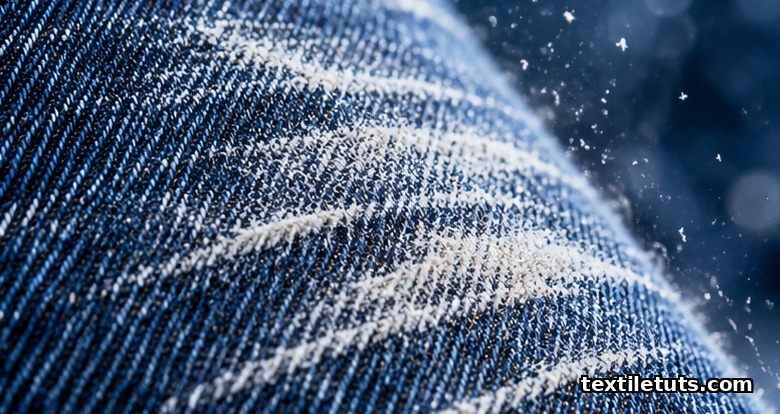
Denim sanding and grinding are mechanical abrasion finishes that remove 30–60% of the surface indigo dye from twill warp yarns using 60–400 grit abrasives at 2–4 bar pneumatic pressure, exposing the undyed white weft core and producing the worn, frosted look on most pre-distressed jeans.
The effect is a controlled imitation of natural wear, completed in 5–20 minutes per garment instead of the months of friction a real pair of jeans needs to fade visibly.
This article covers how denim sanding and grinding work, the equipment and grit grades used, the effect on yarn and fabric strength, where the step sits in a denim finishing sequence, the worker-safety issues that pushed the industry toward enclosed robotic cells, and the laser and ozone alternatives now competing with mechanical abrasion.
Why indigo can be sanded off in the first place
Denim is woven as a 3/1 right-hand twill: indigo-dyed cotton warp yarns float over undyed white cotton weft yarns. The blue color sits in a thin dye ring around each warp fiber, usually the outer 8–15% of the yarn cross-section. The cotton core of every warp yarn stays white.
When an abrasive removes part of that dyed outer layer, the undyed core shows through. The twill pattern reads lighter and more textured, and the contrast between dyed and undyed fiber mimics years of friction.
The same mechanism explains why indigo bleeds in the wash and why denim fades along creases: the dye is on the surface, not inside the fiber, so anything that scuffs the surface also removes color.
Sanding vs. grinding: same family, different intensity
Both operations belong to the dry-mechanical abrasion family, but they target different areas and use different grit grades.
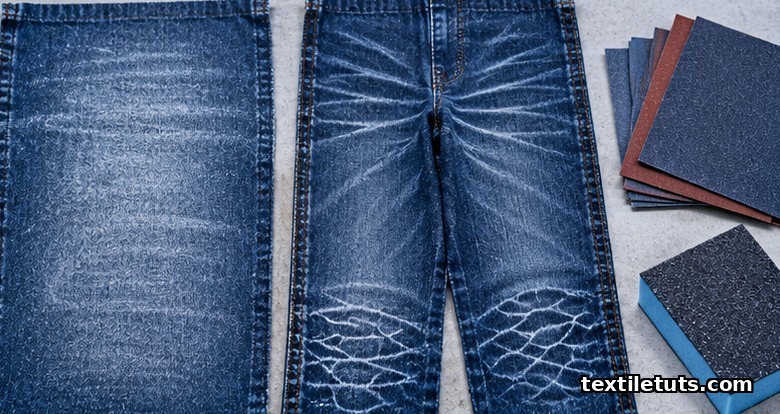
Grinding is the heavy step. Mills run garments under rotating abrasive rollers with 60–120 grit paper, applying 2–4 bar pneumatic pressure across broad zones such as thighs, knees, and seat. The result is a uniform frost over a large surface, the look seen on most vintage-style straight-leg jeans.
Sanding is the detail work. Operators use 220–400 grit hand blocks or computer-controlled robotic arms to draw specific patterns: whiskers around the crotch, honeycombs behind the knee, knee lines, and pocket-edge highlights. A skilled operator can reproduce the wear pattern of a six-month-old pair of jeans inside ten minutes.
Wet sanding, where the abrasive block is dipped in water or a softener solution, gives a softer, less dust-intensive result and is often used on stretch denim containing 2–5% elastane to avoid heat-fusing the elastane fibers.
Equipment in a modern denim finishing line
Two setups dominate. Older mills use a pot-and-rivet grinding machine, a rotating abrasive cylinder mounted inside a stainless-steel drum. Garments are loaded with the abrasive cylinder and tumbled for 5–15 minutes depending on the target effect. Output is high, but pattern variation between garments runs 20–30%.

Newer installations use robotic sanding arms with 6-axis motion paths. The operator programs a 2D pattern from a digital template (often a photograph of the desired wear), and the robot reproduces it consistently across thousands of identical garments. A factory producing 100,000 pairs per month can hold pattern variance below 5% using a robot, versus 20–30% variance from hand sanding.
Abrasive media is usually aluminum-oxide or silicon-carbide paper bonded to a foam backing. Foam backing gives a softer hand and avoids cutting through the yarns, important when sanding weft floats on lightweight 8–10 oz fabric.
Effect on yarn, fabric, and seam strength
Removing fiber from the surface has a measurable cost. ISO 13934-1 strip tensile testing on a typical 13.5 oz indigo twill shows warp tensile strength drops by 8–15% after heavy grinding, and tear strength measured by ISO 13937-1 (wing-shaped) drops by 10–20%, depending on grit and pressure.
Weft yarns, which the sanding action exposes more than warp, lose more mass but proportionally less strength because the warp carries most of the load. Heavier 14–16 oz denims tolerate sanding better than lightweight 8–10 oz fabric because the longer float structure hides the abrasion more uniformly.
Seams and bartacks are the failure points after sanding. The most abrasive action lands on raised seam allowances, and most warranty returns on pre-distressed jeans trace back to abrasion-thinned seam edges, not panel failure. Mill pattern makers often add a tacking stitch inside high-abrasion zones to compensate.
Where sanding and grinding sit in the finishing sequence
| Step | Purpose | Sequence position |
|---|---|---|
| Desizing | Remove starch size from weaving | 1 |
| Stone or enzyme washing | Bulk color removal and softening | 2 |
| Grinding | Heavy abrasion on broad areas | 3 |
| Sanding (manual or robotic) | Pattern detailing: whiskers, honeycombs | 4 |
| Laser marking (optional) | Reproduce patterns without abrasives | 4a (alt.) |
| Rinsing and softening | Remove dust, restore hand feel | 5 |
| Drying and finishing | Stabilize dimensions | 6 |
Sanding always runs after the bulk stone or enzyme wash, never before. The earlier wash removes loose surface fibers and equalizes dye depth, so the sanding reveals a stable white core rather than scraping partially-dyed weak fibers. Sanding before washing would create a dusty, uneven surface and accelerate re-deposition of indigo onto undyed areas.
Worker safety: the cotton-dust and silica-dust problem
Dry mechanical abrasion generates two regulated dust streams: cotton lint from the fabric itself, and fine particles from the abrasive paper. Historically, both caused occupational lung disease. NIOSH classifies chronic cotton-dust exposure as a cause of byssinosis, an irreversible airway narrowing also known as brown lung.

Modern mills handle this in three ways. First, every sanding station sits inside a local exhaust ventilation hood that captures dust at the source. Second, robotic sanding cells keep the operator out of the dust envelope entirely. Third, water-based wet sanding reduces airborne dust by 80–90% versus dry sanding on the same grit.
Mills also track exposure with personal dust monitors at the operator position. The OSHA permissible exposure limit for cotton dust in yarn and fabric manufacturing, set in 29 CFR 1910.1043, is 0.200 mg/m³ across an 8-hour shift. Most automated lines now operate well below that ceiling.
Laser and ozone as sanding alternatives
The two fastest-growing alternatives to mechanical sanding are CO₂ laser marking and ozone bleaching. Lasers ablate the surface dye with a controlled heat pulse, removing color without cutting into the fiber surface, so fabric strength stays within 1–3% of the original. Laser systems can also reproduce an exact pattern from a digital photograph, which is why most fast-fashion denim has moved to laser-only distressing for high-volume lines.
Ozone bleaching fades indigo chemically rather than mechanically, and is often combined with light mechanical sanding to add texture. The combination reduces dust and fiber loss while still producing a hand-sanded look, and is now standard on most premium denim finishing lines.
Both alternatives have trade-offs. Laser systems cost $80,000–$200,000 per unit, and ozone requires sealed reaction chambers with off-gas treatment. For low-volume or artisanal denim, mechanical sanding still gives the most controllable pattern and the lowest capital outlay.
Frequently Asked Questions
What grit sandpaper is used for denim sanding?
Fine hand sanding uses 220–400 grit aluminum-oxide or silicon-carbide paper. Heavier grinding on broad zones uses 60–120 grit. Most robotic sanding cells switch automatically between two grit heads depending on whether the pass is a base grind or a detail pass.
Does denim sanding damage the fabric?
Yes, measurably. ISO 13934-1 strip tensile tests show warp tensile strength drops 8–15% after heavy grinding, and ISO 13937-1 tear tests show 10–20% loss. The greatest damage lands on raised seams and bartacks, which is why most warranty claims on pre-distressed jeans trace back to seam edges rather than panel failure.
Can stretch denim be sanded without damaging the elastane?
Yes, but only with wet sanding or laser. Dry mechanical sanding generates enough heat at the abrasive contact point to fuse 2–5% elastane fibers to the cotton, leaving hard shiny patches. Wet sanding with water or silicone softener keeps the surface temperature low and avoids elastane damage. Most mills reserve elastane-blend denim for laser or wet sanding only.
Is denim sanding bad for the workers?
Dry sanding generates cotton dust and abrasive dust, both linked to occupational lung disease. The OSHA permissible exposure limit for cotton dust in textile manufacturing, set under 29 CFR 1910.1043, is 0.200 mg/m³ over an 8-hour shift. Modern automated cells enclose the sanding head and exhaust dust through local ventilation, and robotic systems keep the operator out of the dust envelope entirely. Wet sanding cuts airborne dust by 80–90% versus dry sanding at the same grit.
What is the difference between sanding and stone washing?
Stone washing is a wet chemical-mechanical process that uses pumice or synthetic stones in a washing machine to remove indigo dye uniformly across the whole garment. Sanding is a dry mechanical process that targets specific areas and creates localized wear patterns. Stone washing removes 10–30% of surface dye evenly; sanding can remove up to 60% in targeted zones. Most modern denim uses both, with stone washing first for base color and sanding second for pattern detail.
References
- International Organization for Standardization. ISO 13934-1:2013, Textiles — Tensile properties of fabrics — Part 1: Determination of maximum force using the strip method. iso.org — the standard method for measuring tensile strength loss after abrasion finishing.
- International Organization for Standardization. ISO 13937-1:2000, Textiles — Tear properties of fabrics — Part 1: Determination of tear force using ballistic pendulum method (Elmendorf). iso.org — referenced in denim tear-strength testing after grinding.
- American Association of Textile Chemists and Colorists. AATCC Test Method 61, Colorfastness to Laundering, Home and Commercial: Accelerated. aatcc.org — the standard wash-fastness test applied after pre-distressed denim finishing.
- Occupational Safety and Health Administration. Cotton Dust Standard, 29 CFR 1910.1043. osha.gov — the U.S. permissible exposure limit for cotton dust in yarn and fabric manufacturing.
- Tarhan, M., and B. Becerir. “Effects of Various Denim Washing Processes on the Color and Fastness Properties of Indigo-Dyed Cotton Denim Fabrics.” Journal of the Textile Institute, Taylor & Francis — peer-reviewed data on how different abrasion treatments change indigo depth and wash fastness.
- Kayseri, G. Ö., et al. “Effects of Different After-Treatments on the Color Characteristics of Indigo-Dyed Cotton Denim Fabric.” Textile Research Journal — peer-reviewed study covering color-loss percentages across sanding and enzyme treatments.
This article is the working reference for denim sanding and grinding in textile finishing. Editorial by Shahrukh Islam, TextileTuts. Sources: ISO 13934-1, ISO 13937-1, AATCC TM 61, OSHA 29 CFR 1910.1043, Journal of the Textile Institute, Textile Research Journal, as cited.


