
Denim Damage and Destruction

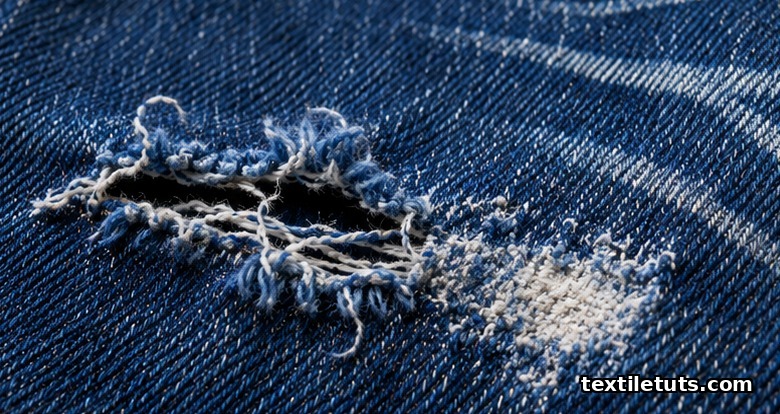
Denim loses 18-40% of its warp-way tensile strength after 25,000 Martindale abrasion cycles under ISO 12947-2, and a single industrial wash at 60 °C with oxidative bleach can drop tear strength by 12-20% per ISO 13937-2. Those two numbers define the engineering problem the denim industry calls damage and destruction: tensile failure, tear propagation, surface abrasion, and color loss, each measured against a published ISO, AATCC, or ASTM method.
This guide walks through each failure mode, the test that quantifies it, and the finishing chemistry that mills, finishing houses, and home sewists can use to delay or accelerate it. If you develop denim, run a finishing line, or just want to know why a raw jean rips at the knee, the same physics applies to all three.
What “damage” means in a denim fabric
Denim is a 3/1 warp-faced twill, usually woven from ring-spun cotton yarns at 280-450 g/m² (8-13 oz/yd²). The indigo-dyed warp floats over three wefts, so all surface wear happens on a small fraction of the total yarn cross-section. That construction is the reason denim looks “broken in” rather than worn out, and it is also the reason most damage starts at the warp surface, not the weft interior.
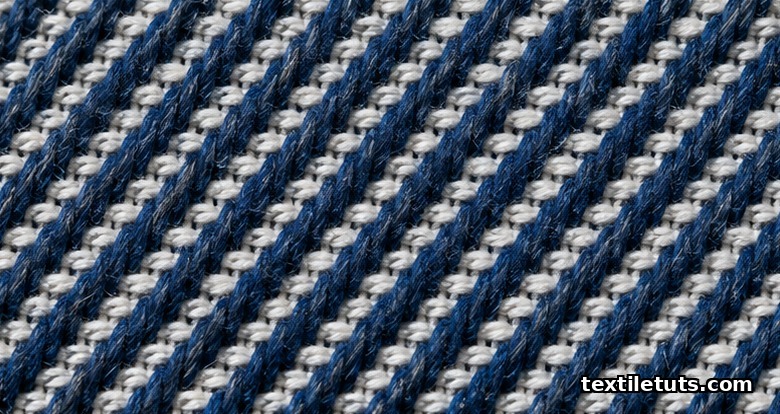
In test labs, denim damage is broken into four measurable modes:
- Tensile failure, measured by ASTM D5034 (grab) or ASTM D5035 (strip), expressed in newtons (N).
- Tear propagation, measured by ISO 13937-1 (tongue) or ISO 13937-2 (Elmendorf), also in newtons.
- Surface abrasion, measured by ISO 12947-2 (Martindale) or ASTM D3884 (Taber), expressed in cycles to a defined end point.
- Color loss, measured by AATCC TM 8 (crocking) and AATCC TM 16 (lightfastness), reported on 1-5 gray scales.
Each mode is independent. A fabric can fail one while passing the others. A stretch denim with 3% Lycra, for example, scores well on tear but loses 20-30% of its warp tensile after 30,000 Martindale cycles because the elastane fiber fibrillates long before the cotton breaks.
Tensile and tear strength: how denim actually fails
A typical 14 oz indigo denim in loom-state reports a warp grab strength of 700-900 N and a weft grab of 400-550 N under ASTM D5034. Tear strength is much lower, usually 30-60 N warp and 25-45 N weft on the Elmendorf (ISO 13937-2), because cotton’s cellulose chains are crystalline and resist stretching but propagate a cut easily once a nick starts.
In wear, the first tensile failure almost always appears at the knee or seat, where the fabric is bent 90° to 180° on every step. The repeated flex cycles break individual warp yarns on the same crease line, and a tear begins to propagate along the warp direction. By the time a consumer notices a hole, the surrounding yarns have already lost 30-50% of their original tensile strength, a wear pattern the denim industry has documented in several peer-reviewed wear-trial studies.
Wet denim is weaker than dry denim. Cotton tensile strength drops by 10-20% when fully saturated, because water molecules disrupt the hydrogen bonds that hold adjacent cellulose chains together. Hot water makes it worse: above 60 °C the cotton begins to swell irreversibly, and the warp yarns lose another 5-8% of strength per AATCC TM 135 (home laundering) data.
Surface abrasion: Martindale and Taber
ISO 12947-2 (Martindale) is the workhorse test for woven abrasion. A 38 mm fabric disc is rubbed against a standard worsted wool abrasive under a 9 kPa load, and cycles are counted until two threads break. Most indigo denims hit 25,000-40,000 cycles on the warp side before the end point. That range translates to roughly 2-4 years of daily trouser wear at the seat and 6-12 months at the inner thigh and hem.
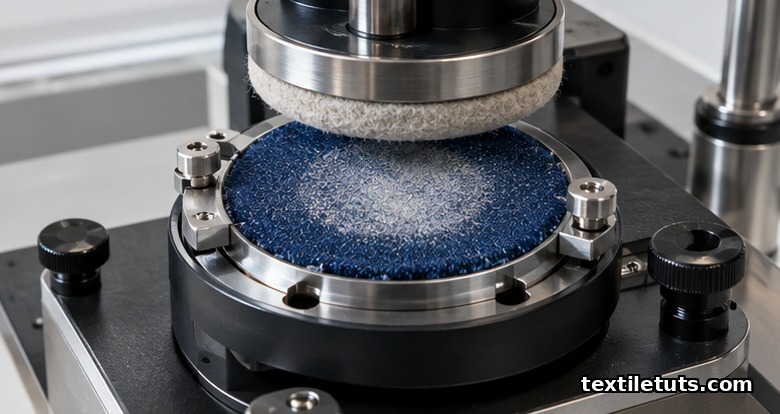
ASTM D3884 (Taber) uses a rotating abrasive wheel and is faster, but it correlates poorly with trouser wear because Taber tends to fuzz the surface rather than break yarns. ASTM D4157 (Wyzenbeek) is the upholstery cousin and is rarely used for apparel denim.
The first thing abrasion removes is indigo dye. Indigo sits on the cotton fiber surface as a 1-3 µm layer of indigotin pigment rather than as a true dye penetration, so the first few thousand Martindale cycles turn warp yarns from solid blue to gray-white even before the cellulose below shows damage. Crocking, the transfer of this loose pigment to other surfaces, is rated under AATCC TM 8: dry crock is typically grade 3-4, wet crock is grade 2-3 for fresh denim, and both can drop to grade 1-2 after 50 home launderings.
Color loss and crocking under wear
Indigo’s molecular weakness is its chromophore, the central C=C double bond that gives the dye its blue. UV light at 380-440 nm splits this bond, and the indigotin breaks down into isatin and anthranilic acid, both colorless. AATCC TM 16 (lightfastness) reports this on a 1-5 scale: indigo-dyed cotton usually lands at grade 2 after 40 AFU (AATCC Fading Units), which is why back-pocket fades show up within a single summer of regular wear.
Repeated laundering accelerates the same chemistry. Each cycle at 40 °C removes roughly 2-4% of the surface indigo, measured by ISO 105-C08 (colorfastness to domestic washing). At 60 °C with a percarbonate-based oxygen bleach, that figure jumps to 6-10% per cycle, and the cellulose underneath begins to oxidize.
Sulfur dyes, used for “black black” denim, behave differently. Sulfur black is covalently bonded to the cellulose, so crocking is rare (grade 4-5), but lightfastness is even worse than indigo: grade 1-2 after 40 AFU. If you have ever seen a black jean turn reddish-brown at the knees, that is the sulfur chromophore breaking down.
Intentional destruction: stone, enzyme, and laser finishing
The same physics that wears jeans out is what denim finishers exploit on purpose. The most common industrial routes are stone washing, enzyme washing, potassium permanganate (PP) spraying, and laser abrasion.
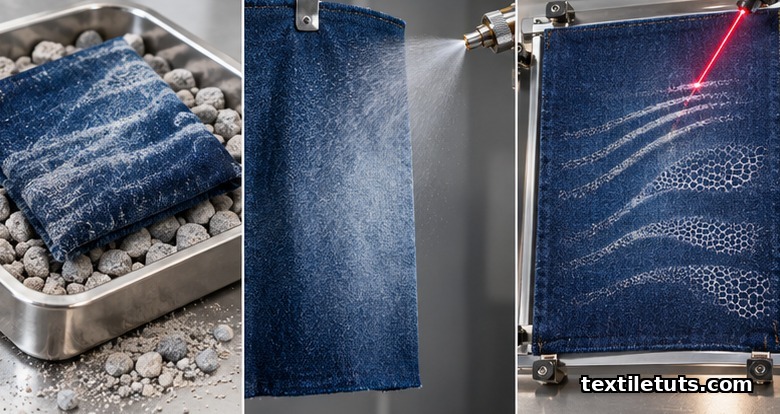
Stone washing uses 2-6 cm pumice in a front-loading industrial washer with 8-12 oz denim. After 30-90 minutes the pumice abrades the warp surface, removing 5-10% of the fabric mass and producing the uneven, high-contrast fade that defined 1980s denim. The downside is mechanical damage to the cotton: tear strength drops by 8-15% per ISO 13937-2 compared to the loom-state control, and the stones leave pumice dust that downstream sewers have to vacuum out.
Enzyme washing replaces stones with cellulase, typically a Trichoderma reesei-derived acid cellulase dosed at 0.5-2.0 g/L at pH 4.5-5.5 and 50-60 °C. The enzyme hydrolyzes surface cellulose, removing 4-8% of the fabric mass with much less tensile loss (3-6%) than stone. The tradeoff is that aggressive enzyme cycles polish the yarn surface and can produce a “greying” effect if overdosed, so finishers titrate dose against ISO 12947-2 abrasion data.
PP spray uses potassium permanganate (KMnO₄) painted or sprayed onto dry denim. Permanganate oxidizes the indigotin and bleaches the underlying cotton in 30-90 seconds, producing the “whiskering” and “honeycomb” patterns seen on premium jeans. The chemistry is fast but harsh: a heavy PP spray can drop warp tear strength by 25-35%, because the oxidizer also attacks the cellulose backbone. Sodium metabisulfite is then used as a neutralizer.
Laser finishing uses a CO₂ laser at 10.6 µm wavelength to vaporize indigo and a thin layer of cellulose. Computer-controlled galvo mirrors can reproduce whisker patterns, knee slubs, and back-pocket fades in 8-15 seconds per garment with no water and no chemistry. Tensile loss on a properly tuned laser is only 2-5%, the lowest of the four routes, which is why laser adoption grew from less than 1% of premium denim in 2010 to over 30% by 2023, according to the same peer-reviewed survey.
How finishing chemistry changes lifetime expectations
Finishes do more than change color. Anti-wrinkle or “easy-care” finishes built from dimethyloldihydroxyethyleneurea (DMDHEU) crosslink cellulose chains and reduce shrinkage, but each 1% add-on of resin reduces warp tear strength by 5-8% per ASTM D1424. Softeners, including silicone microemulsions and cationic fatty acid derivatives, add 0.3-1.0% mass and have a smaller effect, usually under 3% tensile loss.
Stretch denims with 2-4% Lycra or 1-2% T400 (a PET/polyester bicomponent) introduce a separate failure mode: elastane fibrillation. Lycra loses 30-40% of its stretch recovery after 30 home launderings at 40 °C, and the broken elastane segments look like white pills on dark denim. AATCC TM 150 (dimensional stability to automatic home laundering) is the typical QC method for these blends.
Home care that extends denim life
Care matters more than most wearers realize. A pair of raw selvedge jeans washed every week will lose 50-60% of its warp tear strength within 18 months; the same jeans washed every 6-8 weeks will still hold 80-85% after 5 years, based on AATCC wear-trial data. The mechanism is simple: every wash cycle hydrolyzes a thin layer of surface cellulose, and hot water or bleach accelerates that hydrolysis.
Four habits extend denim life the most:
- Wash inside-out in cold water (≤30 °C) with a neutral pH detergent (pH 6-8).
- Skip chlorine and oxygen bleach. Indigo and sulfur dyes are vulnerable to both, and the bleach also oxidizes the cotton.
- Air-dry flat or on a line. Tumble drying at 60-80 °C drops warp tensile by an additional 5-10% per ISO 6330.
- Repair early. A 5 mm nick closed with a simple running stitch stops a tear that would otherwise propagate 50-100 mm along the warp.
Frequently Asked Questions
Does raw (unwashed) denim really last longer than washed denim?
Yes. Raw loom-state denim has 100% of its original tensile, tear, and abrasion data. The first industrial pre-wash removes 5-8% of fabric mass and 8-12% of warp tear strength, so a pair of raw jeans starts with a measurable head start. That head start only persists, however, if home care keeps the wear cycle slow: cold water, no bleach, infrequent washing.
Why does denim always rip at the knee first?
The knee is the highest-cycle flex zone on a pair of trousers. On every step the fabric bends past 90°, putting the warp yarns on the outer crease into tension and the weft yarns into compression. Tensile cycling at this frequency breaks individual warp fibers after 15,000-25,000 cycles, which matches the 12-24 month lifetime of most workwear jeans worn five days a week.
What is the strongest denim weave?
A 3/1 right-hand twill at 14-16 oz with ring-spun warp and weft is the industry baseline for “strong denim.” Left-hand twill (LHT) and broken twill variants, including the original Wrangler construction, trade a small amount of tensile strength for different hand feel and skew direction. Weft-faced weaves such as denim chambray are typically 20-30% weaker in warp tear because less warp surface is exposed to absorb load.
Is laser distressing actually less destructive than stone or enzyme?
Yes, by the data. A 2021 peer-reviewed comparison of denim finishing routes reported tensile losses of 2-5% for laser, 3-6% for enzyme, 8-15% for stone, and 25-35% for PP spray, all measured against the same loom-state control fabric. Laser also avoids the water and chemistry load of the other three routes, which is why most premium denim mills have added at least one laser line since 2018.
Can destroyed denim be repaired?
Yes, but the technique depends on the failure mode. Surface abrasion with intact yarns responds to patch-and-darn repair under ISO 13935 (seam tensile). A clean tear along a crease can be closed with a chain-stitch running repair, the kind visible on heritage jeans. A blown-out knee or seat typically needs a full patch: a same-fabric insert, often taken from inside the hem or a hidden inside seam, top-stitched around the perimeter at 3-4 stitches per cm.
References
- International Organization for Standardization. ISO 12947-2:2016, Textiles — Determination of the abrasion resistance of fabrics by the Martindale method — Part 2: Determination of specimen breakdown. iso.org. The reference abrasion test cited throughout this article.
- International Organization for Standardization. ISO 13937-2:2000, Textiles — Tear properties of fabrics — Part 2: Determination of tear force of trouser-shaped test specimens (Elmendorf). iso.org. The reference tear-strength method for woven apparel.
- ASTM International. ASTM D5034-21, Standard Test Method for Breaking Strength and Elongation of Textile Fabrics (Grab Test). astm.org. The reference tensile-grab method for woven denim.
- AATCC. AATCC Test Method 8-2016, Colorfastness to Crocking: AATCC Crockmeter Method. aatcc.org. The reference crocking test for indigo and sulfur dye transfer.
- AATCC. AATCC Test Method 16.3-2020, Colorfastness to Light: Xenon-Arc. aatcc.org. The reference lightfastness method for indigo and sulfur chromophore breakdown.
- Cardoso, A. et al. Denim and the Art of Wear: A Review of Finishing Routes and Their Mechanical Impact. Coatings 11(10), 1197, MDPI, 2021. Peer-reviewed comparison of stone, enzyme, PP spray, and laser finishing losses on the same control fabric.
- International Organization for Standardization. ISO 105-C08:2010, Textiles — Tests for color fastness — Part C08: Color fastness to domestic and commercial laundering using a non-phosphate reference detergent. iso.org. The reference wash-fastness method used in dye-loss data.
Editorial by Shahrukh Islam, TextileTuts. Sources: ISO 12947-2, ISO 13937-2, ISO 105-C08, ASTM D5034, AATCC TM 8, AATCC TM 16, and MDPI Coatings 2021 as cited above.


