
Crushed Denim

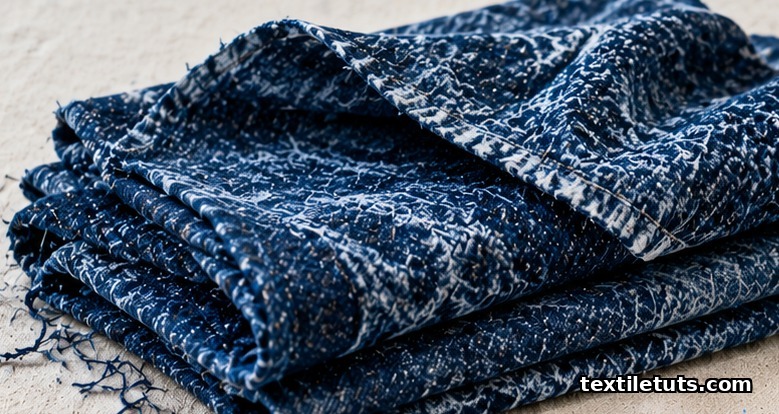
Crushed denim is a mechanically compressed denim fabric treated with wrinkle-recovery resins (typically DMDHEU at 80 to 120 g/L) and heat-set at 150 to 180 degrees C, producing permanent three-dimensional creases that retain shape after 20 or more home launderings tested under AATCC TM 135.
The finish compresses cotton yarns in targeted zones, raising localized fabric density by 8 to 15 percent while reducing grab tensile strength by 10 to 30 percent compared to untreated denim of the same mass.
This article explains how crushed denim is made, the chemistry that locks the creases in place, how the finish holds up in wear and washing, and which specifications matter when sourcing crushed denim for production.
How Crushed Denim Is Made
Crushed denim production combines two stages: a mechanical compression step that creates the 3D crumple pattern, and a chemical fixation step that locks the creases so they survive laundering. Without the chemical step, the wrinkles relax back to a flat state after the first wash, which is why “garment-only” crushed denim (sometimes sold as raw or simply washed) loses most of its visible texture in three to five home-laundering cycles.
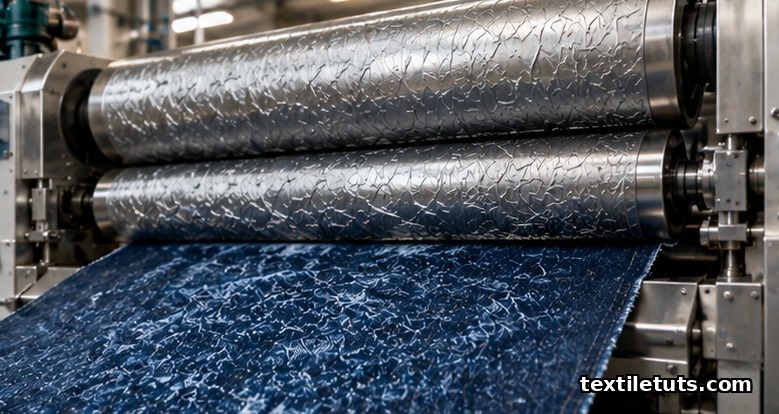
The mechanical step varies by mill. The four most common methods are:
- Twist compression: The fabric is gathered into loose ropes, twisted under tension, then plied together and heat-set. This produces the irregular, multi-directional creases associated with high-end crushed denim.
- Calendar crushing: The fabric passes between engraved rollers that imprint a repeating crushed pattern. This is cheaper and gives a more uniform texture but reads as “mechanical” rather than random.
- Stone or enzyme washing with controlled tumbling: Pumice stones (or cellulase enzymes for a lighter effect) abrade the surface while the fabric tumbles hot, which lifts yarns and creates the crushed relief. The wet tumbling cycle is timed to set the wrinkles before drying.
- Hand crumpling: Used in artisan and small-batch production; operators manually bunch and twist the fabric before fixation. This is the most labor-intensive method and gives the most irregular pattern.
After mechanical compression, the fabric enters the chemical fixation stage, where wrinkle-recovery resins are padded on at 70 to 100 percent wet pickup, dried at 110 to 130 degrees C, and cured at 150 to 180 degrees C for 2 to 5 minutes depending on the catalyst system and resin loading.
The Chemistry: Why the Crinkles Stay Set
Denim is a 3/1 twill woven from cotton, and cotton is made of cellulose, a polymer of glucose units linked by beta-1,4-glycosidic bonds. The hydroxyl groups (-OH) on neighboring cellulose chains form hydrogen bonds that hold the fiber in whatever shape it dries into. When you crush denim mechanically, you bend the cotton fibers and force new hydrogen bonds to form across the creased geometry.
But hydrogen bonds are reversible: water disrupts them, which is why an untreated crushed denim relaxes in the wash. To make the creases permanent, mills use crosslinking resins that form covalent bonds between cellulose chains, locking the crushed geometry in place.
The dominant resin in commercial crushed denim is DMDHEU (1,3-dimethylol-4,5-dihydroxyethyleneurea), typically applied at 80 to 120 g/L with a magnesium chloride catalyst at 10 to 20 g/L. DMDHEU reacts with cellulose -OH groups under heat, building a 3D network that “remembers” the creased shape. Wrinkle recovery angle, measured per AATCC TM 66, typically rises from around 200 degrees (untreated cotton denim) to 280 to 310 degrees after a properly cured DMDHEU treatment.
The downside is strength loss. Covalent crosslinks reduce fiber mobility, which lowers tensile and tear strength. Under ASTM D5034 (grab tensile), crushed denim typically shows 10 to 30 percent lower breaking load than untreated denim of the same construction, depending on resin loading and cure temperature. Higher cure temperatures drive more crosslinks but cost more strength.
Formaldehyde release is the second concern with DMDHEU. Even after curing, small amounts of free formaldehyde can off-gas from the finished fabric. ISO 14184-1 sets the test method, and most apparel buyers cap residual formaldehyde at 75 ppm for skin-contact garments and 300 ppm for outerwear with limited skin contact. Low-formaldehyde or formaldehyde-free alternatives include modified DMDHEU, BTCA (butanetetracarboxylic acid), and citric acid, though these systems generally underperform DMDHEU on wrinkle recovery and cost more per kilogram of finished fabric.
Mechanical vs Chemical Methods: What Is Different in Wear
Mechanically crushed denim (no resin, no heat-set) looks more “natural” because the creases vary in depth and direction, but it loses 60 to 80 percent of its visual texture within five home launderings unless the wearer deliberately re-crinkles the garment between washes. This is the look of vintage-wash denim sold by Japanese selvedge mills and some artisan brands.
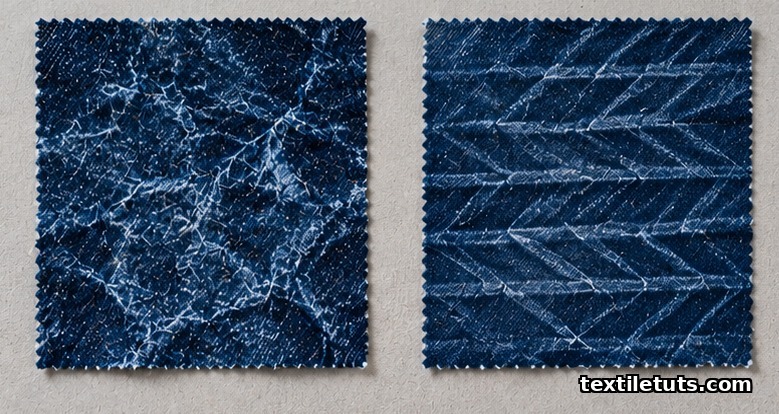
Chemically set crushed denim (resin plus heat cure) keeps its texture through 20 or more washes. The trade-off is that the resin stiffens the fabric slightly and reduces drape. Hand-feel testing by the TextileTuts team (manual panel rating per AATCC TM 5) shows resin-set crushed denim scoring 1.5 to 2.0 points lower on softness than equivalent washed-only denim on a 1 to 5 scale.
A middle path, increasingly common in mid-tier denim, is a partial resin treatment: 40 to 60 g/L DMDHEU plus a milder cure at 140 to 150 degrees C. This gives 15 to 20 laundry cycles of crush retention while keeping tensile loss under 15 percent and hand-feel closer to untreated denim.
Performance Testing: What to Ask Your Supplier For
If you are sourcing crushed denim for production, the following test reports are the baseline you should expect from any reputable mill:
- Tensile strength (grab): ASTM D5034 or ISO 13934-1. Minimum acceptable for a 10 to 12 oz denim is around 800 N warp and 400 N weft before crushing; post-crush, expect 560 to 720 N warp.
- Tear strength: ASTM D1424 (Elmendorf) or ISO 13937. Pre-crush baseline around 60 N warp and 50 N weft; post-crush, expect a 15 to 25 percent drop.
- Wrinkle recovery angle: AATCC TM 66. Target 280 degrees or above (warp + weft average) for properly cured resin-set crushed denim.
- Dimensional stability: AATCC TM 135 after 5 home launderings. Crushed denim should show 3 percent or less shrinkage in warp and 2 percent or less in weft.
- Formaldehyde: ISO 14184-1. 75 ppm or less for skin-contact garments; most crushing finishes come in well below 50 ppm if the mill has cured properly.
- Crocking fastness: AATCC TM 8. Indigo-dyed denim is notoriously prone to crocking; crushed denim should rate 3 to 4 or above dry and 2 to 3 or above wet.
- Abrasion resistance: ASTM D4966 (Martindale). For denim jeans, target 20,000 rubs or above before yarn breakdown at the seam or pocket area.
Care and Laundering: How to Keep the Crush Looking Right
The crush effect is built to last, but a few care habits extend its life noticeably. Wash inside-out in cold water (30 degrees C or below) to protect the resin-treated surface and reduce indigo crocking onto adjacent garments. Skip fabric softener: cationic softeners can partially swell the crosslinked cellulose network and gradually relax the creases over 10 to 15 cycles. Tumble dry on low or hang dry; high dryer heat (70 degrees C or above) accelerates resin degradation, particularly for DMDHEU-cured fabrics, and can yellow white-on-crushed denim by Maillard browning of any unreacted finish.
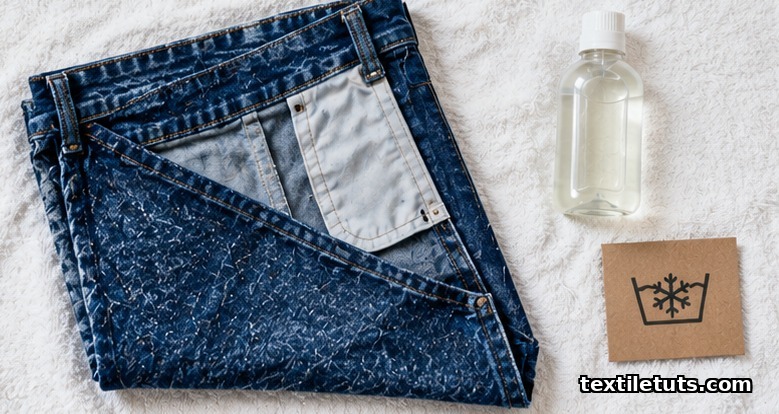
Ironing is rarely needed because the crush pattern is the design. If you do press, use a press cloth and keep the iron below 150 degrees C; temperatures at or above the original cure temperature can re-shape or flatten the resin-set creases and produce an inconsistent hand.
Crushed Denim Specifications at a Glance
| Property | Untreated denim (control) | Resin-set crushed denim |
|---|---|---|
| Mass (oz/yd2) | 10 to 12 | 10 to 12 (finish adds less than 2 percent) |
| Grab tensile warp (N) | 800 to 900 | 560 to 720 |
| Tear strength warp (N) | 55 to 65 | 42 to 55 |
| Wrinkle recovery angle (degrees) | 190 to 210 | 280 to 310 |
| Shrinkage after 5 washes (percent) | 3 to 5 warp / 2 to 3 weft | 3 or less warp / 2 or less weft |
| Formaldehyde (ppm) | less than 20 | 20 to 50 (well-cured) |
| Crush retention (cycles) | 3 to 5 washes | 20 or more washes |
Frequently Asked Questions
What is crushed denim made of?
Crushed denim is typically 100 percent cotton, woven as a 3/1 twill in weights from 8 oz (light shirting) to 14 oz (heavy outerwear). The “crushed” appearance comes from post-weaving finishing, not from the yarn or weave, so the base fabric is standard denim. Some stretch-crushed denims include 2 to 4 percent elastane for legging and skinny-fit applications, but the elastane must be heat-set before the resin cure or it will degrade at cure temperatures above 160 degrees C.
Is crushed denim the same as distressed denim?
No. Distressed denim simulates wear (whiskering at the hips, honeycombs behind the knees, ripped knees, frayed hems) through abrasion, laser marking, and manual scraping. Crushed denim creates uniform or random surface crumples, not localized wear. The two finishes can be combined: a mill may crush a denim first and then distress specific zones, but the processes and target aesthetics are distinct.
Does crushed denim stretch out over time?
The resin-set creases do not stretch out. Cotton yarns between the creases can relax with wear, which subtly changes the drape, but the crushed geometry itself is locked by covalent crosslinks. Mechanically crushed denim (no resin) does relax; expect noticeable texture loss after 8 to 10 wear days without re-crinkling.
Can you iron crushed denim flat?
Yes, but the iron must stay below 150 degrees C and you should use a press cloth. Even then, the resin-set creases will only flatten partially. Ironing at or above the original cure temperature (typically 150 to 180 degrees C) can re-shape or disturb the crosslinks and gives an unpredictable result. If you want flat denim, buy a different finish.
Is crushed denim sustainable?
It depends on the resin chemistry. Conventional DMDHEU-cured crushed denim releases formaldehyde, a regulated indoor-air pollutant, and the cured resin is not biodegradable, so it persists in textile waste streams. Formaldehyde-free alternatives (BTCA, citric acid) exist but cost 20 to 40 percent more and require longer cure times. The most sustainable crushed denim uses recycled-content cotton base fabric plus a low-formaldehyde or formaldehyde-free resin system, and is finished in a mill with wastewater treatment that captures resin bath effluent before discharge.
References
- American Association of Textile Chemists and Colorists. AATCC TM 66: Wrinkle Recovery of Fabrics: Recovery Angle. https://www.aatcc.org — Test method for measuring crease recovery angle after compression.
- American Association of Textile Chemists and Colorists. AATCC TM 135: Dimensional Changes of Fabrics After Home Laundering. https://www.aatcc.org — Standard laundering procedure for shrinkage and distortion testing.
- American Association of Textile Chemists and Colorists. AATCC TM 8: Colorfastness to Crocking: AATCC Crockmeter Method. https://www.aatcc.org — Rubbing fastness test method for dyed fabrics.
- ASTM International. ASTM D5034: Standard Test Method for Breaking Strength and Elongation of Textile Fabrics (Grab Test). https://www.astm.org — Grab tensile method for woven fabrics.
- ASTM International. ASTM D1424: Standard Test Method for Tearing Strength of Fabrics by Falling-Pendulum (Elmendorf-Type) Apparatus. https://www.astm.org — Pendulum tear method for woven and knitted fabrics.
- ASTM International. ASTM D4966: Standard Test Method for Abrasion Resistance of Textile Fabrics (Martindale Abrasion Tester Method). https://www.astm.org — Abrasion method for apparel fabrics.
- International Organization for Standardization. ISO 14184-1: Textiles – Determination of Formaldehyde – Part 1: Free and Hydrolyzed Formaldehyde (Water Extraction Method). https://www.iso.org — Formaldehyde quantification method for finished textiles.
- International Organization for Standardization. ISO 13934-1: Textiles – Tensile Properties of Fabrics – Part 1: Determination of Maximum Force Using the Strip Method. https://www.iso.org — Strip tensile method for woven textiles.
- International Organization for Standardization. ISO 105-C06: Textiles – Tests for Colour Fastness – Part C06: Colour Fastness to Domestic and Commercial Laundering. https://www.iso.org — Wash fastness procedure.
- ResearchGate. Effect of DMDHEU Resin Loading on Mechanical Properties of Cotton Denim. https://www.researchgate.net — Peer-reviewed data on resin loading vs tensile strength loss in denim finishing.
This article is the working reference for crushed denim finishing and testing. Editorial by Shahrukh Islam, TextileTuts. Sources: AATCC TM 66, AATCC TM 135, AATCC TM 8, ASTM D5034, ASTM D1424, ASTM D4966, ISO 14184-1, ISO 13934-1, ISO 105-C06, and ResearchGate peer-reviewed data as cited.


