
Bleach Wash: Potassium Permanganate

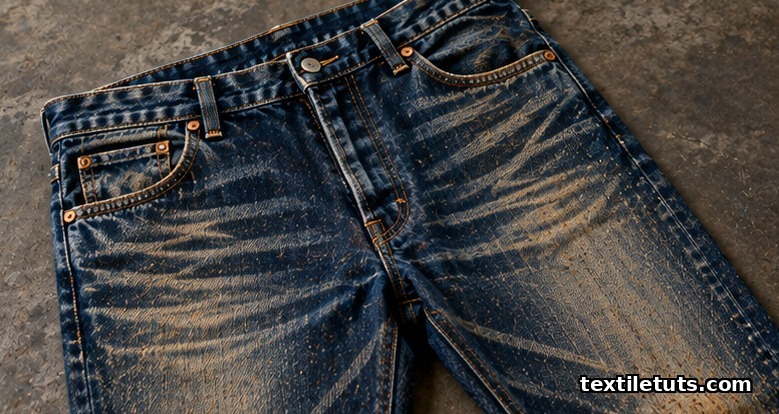
Potassium permanganate (KMnO4) bleach wash is an oxidative denim-finishing process that fades indigo-dyed denim to a yellow-brown cast by spraying or padding the fabric with 20 to 60 g/L KMnO4 at pH 2 to 4 for 10 to 30 seconds, followed by neutralization with oxalic acid or sodium metabisulfite.
The manganese dioxide (MnO2) brown stain that defines a “permanganate” or “PP spray” finish comes from the in-situ reduction of Mn(VII) to Mn(IV) on the fiber surface, and it is removed only after a reducing step that converts MnO2 to soluble Mn(II) salts. Because the reaction is surface-selective, KMnO4 produces high-contrast whiskers, rivet marks, and pocket outlines on indigo denim without the deep strength loss that sodium hypochlorite causes on the same substrate.
This article covers the chemistry, the process variables that control contrast, the strength and fastness trade-offs, the safer alternatives now used in production, and the practical questions mill technicians ask when they convert from chlorine bleach to permanganate spray.
What Is Potassium Permanganate Bleach Wash?
Potassium permanganate bleach wash, often called PP spray, perm wash, or manganese spray in denim mills, is a dry-side finishing process applied to garments or fabric after desizing and stone-washing. KMnO4 is dissolved at 20 to 60 g/L in water, acidified with phosphoric or acetic acid to pH 2 to 4, and applied by spray gun, drip bar, or exhaustion in a rotary drum. The MnO2 residue is then reduced with oxalic acid (8 to 15 g/L), sodium metabisulfite (5 to 12 g/L), or hydrogen peroxide, and the garment is rinsed, softened, and tumble-dried.
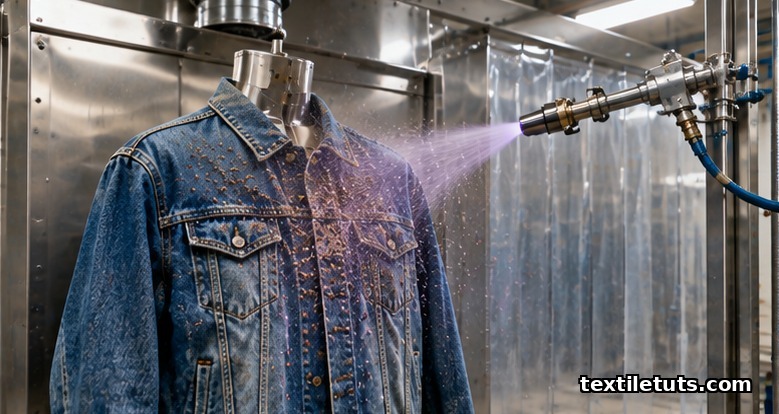
The end effect is a warm, yellowish, sun-faded cast on indigo-dyed denim with sharp localized contrast at seams, pocket edges, and stone-impact points. Because KMnO4 attacks indigo chromophore by oxidative cleavage of the C=C bond in the indigotin molecule, the color shift is permanent and stable to subsequent home laundering.
The Chemistry: Why KMnO4 Behaves Differently From Hypochlorite
Indigo dye on denim is in its reduced, water-soluble leuco form during dyeing and re-oxidizes to insoluble indigotin (C16H10N2O2) on the fiber. Both hypochlorite (ClO-) and permanganate (MnO4-) break the conjugated C=C–C=O system that gives indigotin its blue color, but they do it through different pathways.
Hypochlorite is a strong, non-selective oxidant (E0 = +1.48 V at pH 7). It bleaches evenly across the fabric surface and continues to attack the cellulose backbone once the indigo is exhausted, which is why a 30 to 60 g/L hypochlorite bath at pH 11 can cut warp tensile strength by 20 to 35 percent in 20 minutes. Permanganate is also a strong oxidant (E0 = +1.51 V in acid) but its reduction product, MnO2, is a brown solid that deposits on the fabric. The visible MnO2 acts as a built-in indicator: where the permanganate lands, the brown stain tells the operator the reaction happened, and the brown is later stripped by a reducing agent.
The accepted reaction sequence is:
2 KMnO4 + H2O → 2 MnO2 (s) + 2 KOH + 3 [O] (in-situ nascent oxygen)
Manganic stain is cleared by:
MnO2 + H2C2O4 + 2 H+ → Mn2+ + 2 CO2 + 2 H2O
The Mn2+ ion is colorless and water-soluble, so a thorough hot rinse (60 to 80 °C) at pH 5 to 6 is the last step before drying.
Process Variables That Control the Look
Three operating variables set the contrast level of a permanganate finish: KMnO4 concentration, pH, and contact time.
- KMnO4 concentration: 20 to 30 g/L gives a soft, even fade suitable for light-wash jeans; 40 to 60 g/L produces the high-contrast vintage look with pronounced whiskers; above 70 g/L the gain in whiteness is marginal but the risk of cellulose damage rises sharply.
- pH: KMnO4 oxidizing power is highest in strongly acidic conditions (pH below 2). Most mills run at pH 3.0 to 4.0 to keep acid use modest and avoid hydrolyzing the indigo.
- Contact time: 10 to 30 seconds of wet contact is typical. Longer dwell times darken the MnO2 deposit without increasing the color removal on the indigo.
- Temperature: Room temperature (25 to 30 °C) is standard. Raising the bath to 50 to 60 °C accelerates the reaction by roughly 30 percent but also accelerates cellulose scission.
- Mechanical action: Spraying under air pressure (3 to 5 bar) drives KMnO4 into the yarn interstices and creates the speckled effect. Dripping or padding yields broader, more uniform bleached zones.
Step-by-Step: Industrial Garment Wash Recipe
- Pre-treatment: Desize at 60 to 70 °C for 15 minutes with 1 to 2 g/L alpha-amylase; rinse.
- Stone wash (optional): Add pumice or synthetic abrasive at 0.5 to 1.0 kg per garment for 20 to 40 minutes to create the base mechanical fade.
- Rinse and drain so the garment carries less than 60 percent wet pickup.
- Permanganate spray: Spray 30 to 50 g/L KMnO4 solution at pH 3.0 to 3.5, using 30 to 60 mL per garment, in a dedicated spray booth with local exhaust. Tumble for 1 to 2 minutes to distribute.
- Oxidation hold: Allow 10 to 20 minutes of contact so the MnO2 develops fully.
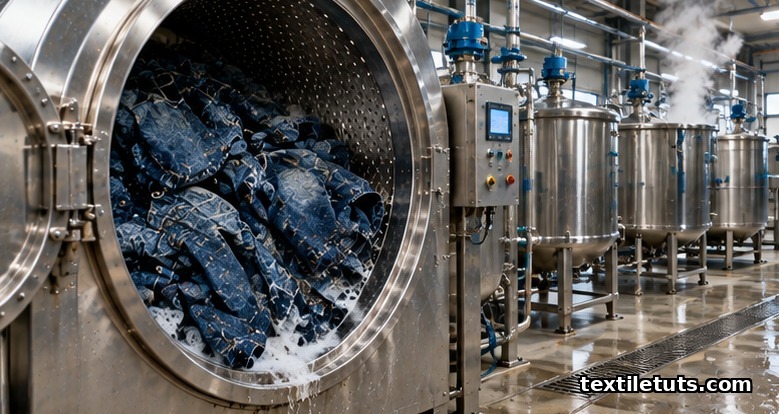
- Neutralization: Add 8 to 15 g/L oxalic acid or 5 to 12 g/L sodium metabisulfite at 50 to 60 °C for 10 to 15 minutes, until the brown stain clears.
- Hot rinse at 70 to 80 °C, then a neutralization rinse with 1 to 2 g/L sodium carbonate to pH 6 to 7.
- Softener finish with 2 to 4 g/L cationic or micro-silicone softener, tumble dry.
For small-batch or atelier work, the same chemistry holds but KMnO4 is best handled as a fresh solution prepared daily. KMnO4 spontaneously reduces in light and in the presence of organic impurities, so a 50 g/L stock solution loses about 5 to 10 percent of its oxidizing strength per day at room temperature.
Comparison: PP Spray vs Other Denim Bleaches
| Property | Potassium permanganate | Sodium hypochlorite | Ozone (gas) | Laser (dry) |
|---|---|---|---|---|
| Oxidant strength (E0) | +1.51 V (acid) | +1.48 V (pH 7) | +2.07 V | Thermal / ablative |
| Typical concentration | 20 to 60 g/L | 30 to 80 g/L | 5 to 15 g/L dissolved O3 | n/a |
| Water use | Medium (spray) | High (exhaustion) | Low (gas) | None |
| Effect on warp tensile loss | 5 to 15 percent | 20 to 35 percent | 8 to 18 percent | 2 to 6 percent |
| Color cast after wash | Yellow-brown warm | Cool blue-grey | Cool blue-grey | Depends on base shade |
| AOX effluent load | None | High (adsorbable halogen) | None | None |
| Worker exposure risk | Skin/respiratory irritant | Chlorine gas on acid contact | Lung irritant | Class 4 laser eye/skin |
| Achievable contrast (1 to 5) | 4 to 5 | 3 to 4 | 2 to 3 | 4 to 5 (patterned only) |
The table reflects process ranges reported in peer-reviewed denim-finishing studies and mill technical sheets; mill-specific conditions will shift the numbers within these bands. AATCC TM-190 colorfastness to home laundering is the standard reference test for the wash-fastness numbers, and ISO 105-A05 grey-scale rating is the standard reference for the color-change scores.
Strength, Fastness, and Effluent Considerations
Warp tensile strength loss after a properly controlled PP spray is typically 5 to 15 percent, compared with 20 to 35 percent for a hypochlorite bleach under comparable contrast. The reason is selectivity: KMnO4 attacks the indigo chromophore faster than it scissions cellulose glycosidic bonds, so the dye is consumed before the fiber is seriously weakened. Cotton warp tear strength follows the same trend when measured per ISO 13937-1.
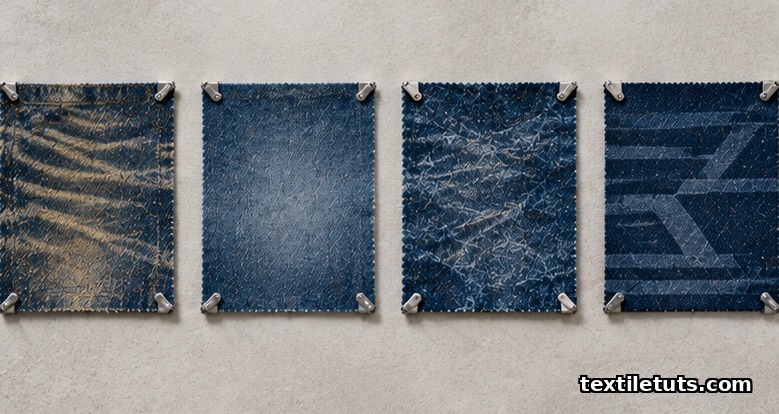
Color fastness is generally good. After PP spray followed by oxalic acid neutralization, indigo denim typically scores 4 to 5 on the ISO 105-A05 grey scale for color change after five home laundries per AATCC TM-190, with a slight warm shift toward yellow that washers and designers usually describe as “vintage cast.” Staining on adjacent white pocket linings is 3 to 4, which is acceptable for most retail specs but should be confirmed with the buyer’s standard.
Effluent is the headline environmental issue. Although KMnO4 itself does not generate adsorbable organic halogens, the Mn2+ wash water is a heavy-metal stream. A typical mill producing 10,000 jeans per day discharges 30 to 80 kg of dissolved manganese per day unless it is precipitated as Mn(OH)2 at pH 9 to 10 and filtered. Several denim mills in Bangladesh, Turkey, and Mexico now route permanganate wash water through a manganese-removal step before biological treatment; the sludge is sent to a secured landfill.
Safety and Handling Notes for the Workshop
KMnO4 is a strong oxidizer and a dermal and respiratory irritant. Solid KMnO4 crystals and concentrated solutions stain skin, clothing, and concrete brown, and the stain is removed only by reducing agents such as sodium metabisulfite or dilute oxalic acid followed by washing. Operators should wear chemical-splash goggles, an acid-vapor cartridge (not a dust mask), nitrile gloves, and a closed-front apron. The spray booth must have local exhaust ventilation that captures at the application gun, because aerosolized permanganate is irritating to the upper respiratory tract even at 5 mg/m3.
KMnO4 must never be mixed with organic solvents, glycerol, hydrogen peroxide, or reducing agents in concentrated form; the mixture can ignite. Storage is in opaque HDPE containers, away from sunlight and from any combustible materials, in a cool, dry, ventilated area. Spilled solid should be swept up dry, not washed with a wet mop, because wet KMnO4 on a floor will stain the concrete and can react with any organic residue.
Frequently Asked Questions
How long does potassium permanganate spray take to develop the full bleach effect?
Visible MnO2 brown develops within 2 to 3 minutes of spray contact, and the full indigo oxidation is reached in 10 to 20 minutes. Most production lines hold the garment for 15 minutes before the oxalic acid or metabisulfite neutralizing step.
What is the right KMnO4 concentration for a vintage high-contrast wash?
For a strong vintage cast on 11 to 13 oz indigo denim, mills typically use 40 to 60 g/L KMnO4 at pH 3.0 to 3.5, with 30 to 60 mL sprayed per garment. Going above 60 g/L adds little extra whitening and increases the manganese load in the effluent.
Does permanganate bleach wash damage the fabric?
A well-controlled PP spray reduces warp tensile strength by 5 to 15 percent, compared with 20 to 35 percent for a hypochlorite bleach at similar visual contrast. The drop is concentrated in the most-exposed surface fibers, so it does not usually translate into a service-life problem for denim jeans.
Can permanganate spray be done without a stone wash first?
Yes. The PP spray alone gives a clean, high-contrast vintage finish without pumice. Stone wash before PP spray softens the hand and adds a sandy speckle; skipping the stones yields a smoother surface and is common for women’s and lighter-weight denim.
How is the manganese removed from the wash water?
Raising the pH to 9 to 10 with sodium hydroxide or lime precipitates Mn2+ as Mn(OH)2, which is filtered out as a sludge. The clarified water then goes to biological treatment. Sludge is typically dewatered to 25 to 35 percent solids and sent to a secured landfill; some facilities blend it with fly ash for stabilization.
References
- International Organization for Standardization. ISO 105-C09:2010, Textiles — Tests for colour fastness — Part C09: Colour fastness to domestic and commercial laundering — Oxidative bleach response. iso.org — Standard reference for oxidative bleach response on textiles.
- International Organization for Standardization. ISO 105-A05:1996, Textiles — Tests for colour fastness — Part A05: Instrumental assessment of change in colour for determination of grey scale rating. iso.org — Grey-scale rating method used to score color change after PP spray.
- AATCC. AATCC Test Method 190-2014, Colorfastness to Home Laundering: Accelerated. aatcc.org — Reference wash test used to score fastness after permanganate finishing.
- International Organization for Standardization. ISO 13937-1:2000, Textiles — Tear properties of fabrics — Part 1: Determination of tear force using ballistic pendulum method (Elmendorf). iso.org — Standard test for tear-strength retention cited in denim-finishing reports.
- Khan, M. M. R., et al. Effects of potassium permanganate oxidation on denim yarn properties. ResearchGate — Peer-reviewed study on the tensile and colorimetric response of indigo denim to KMnO4 spray at varied concentrations.
- MDPI. Sustainable denim finishing: a review of oxidative and enzymatic bleaching alternatives. mdpi.com — Open-access review covering permanganate, ozone, laccase, and laser routes for denim whitening.
- International Organization for Standardization. ISO 6330:2012, Textiles — Domestic washing and drying procedures for textile testing. iso.org — Standard domestic-wash cycles used to confirm the durability of the PP spray finish.
This article is the working reference for potassium permanganate bleach wash on indigo denim. Editorial by Shahrukh Islam, TextileTuts. Sources: ISO 105-C09, ISO 105-A05, ISO 13937-1, ISO 6330, AATCC TM-190, MDPI review on denim finishing, and the Khan et al. study on KMnO4 oxidation of denim yarn, as cited above.


