
Carbon Nanotube Fibers

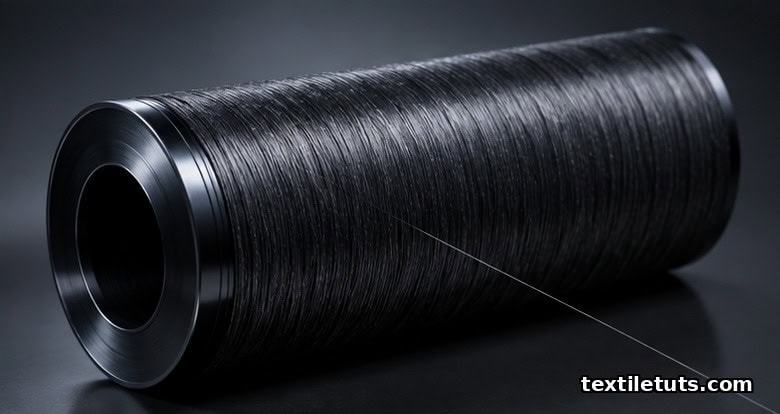
Carbon nanotube (CNT) fibers achieve tensile strengths of 1.0 to 8.0 GPa and specific electrical conductivities of 1.0 to 5.0 × 10⁶ S·m²/kg, beating copper wire on a per-weight basis by roughly a factor of ten while weighing only 1.3 to 1.8 g/cm³.
These same fibers pair specific thermal conductivity above 350 W/(m·K) with electromagnetic shielding effectiveness over 90 dB at sub-millimeter thickness, putting them in the same specific-strength class as aramid (Kevlar 49: ≈2.1 GPa·cm³/g) while remaining conductive.
Below, you will find what carbon nanotube fibers are, the three industrial routes used to spin them, the realistic property ranges reported in peer-reviewed papers, how they compare with aramid, pitch-based carbon fiber, and copper, and which applications have already moved past the laboratory.
What Are Carbon Nanotube Fibers?
A carbon nanotube is a seamless cylinder of graphene, usually 1 to 50 nanometers in diameter and many micrometers long. A carbon nanotube fiber is a continuous, macroscopic yarn that bundles billions of these individual tubes, all coaxially aligned along the fiber axis.
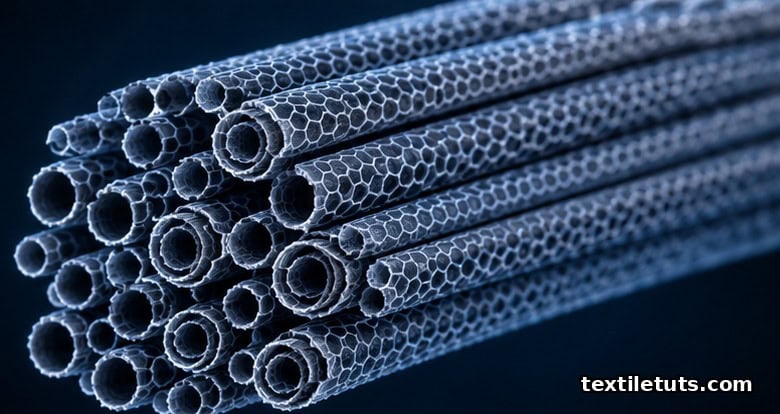
The two dominant nanotube geometries are single-walled (SWNT, one wall) and multi-walled (MWNT, several nested walls). SWNT fibers typically achieve the highest electrical conductivity because every wall participates in conduction, while MWNT fibers tend to carry higher tensile loads at lower cost because their larger diameter eases handling.
The defining difference from conventional textile fibers is multifunctionality. Mechanical strength, electrical conductivity, thermal conductivity, and chemical stability all sit in one filament. Polymer fibers must trade off these properties; carbon fibers are conductive but brittle; aramids are strong but insulating; copper conducts well but is mechanically weak and heavy.
How Carbon Nanotube Fibers Are Made
Three manufacturing routes dominate the open literature. Each starts with a feedstock of carbon nanotubes and ends with a continuous filament.
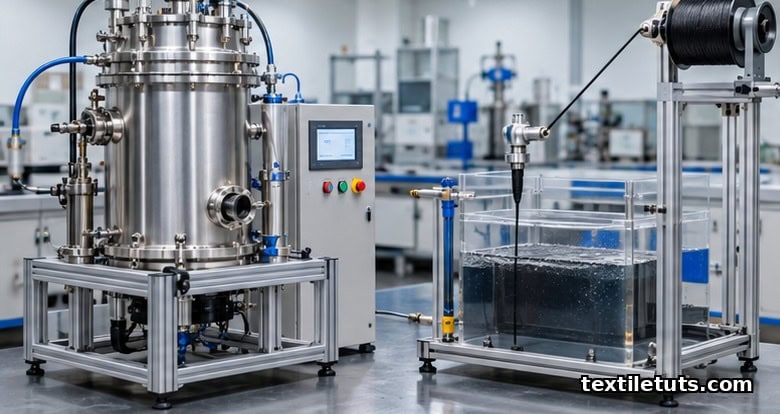
Wet Spinning from a Superacid Solution
Carbon nanotubes disperse in chlorosulfonic acid at concentrations of 6 to 8 wt%. The dope is extruded through a spinneret into a coagulation or wash bath, where the acid is removed and the tubes condense into a continuous fiber. Behabtu et al. (2008) reported this route as the first process to spin kilometers of continuous CNT fiber at industrially relevant line speeds, with reported bundle tensile strengths in the 1 to 3 GPa range.
Direct Spinning from a CVD Gas-Phase Reactor
In chemical vapor deposition (CVD), a hydrocarbon feedstock plus an iron, cobalt, or nickel catalyst decomposes inside a heated reactor. Nanotubes grow as a floating aerogel that is drawn directly out of the reactor and densified by liquid contraction or mechanical twisting. This route produces neat or twisted fibers up to several hundred meters long per run and is used by research groups at Rice University and Teijin Aramid.
Forest Spinning and Twist Spinning
In the forest route, vertically aligned CNT arrays grown on a silicon wafer are drawn into a sheet and twisted into a yarn. Optional chlorosulfonic acid densification raises density and improves load transfer. Twist spinning is the simplest laboratory route and is widely used to benchmark fiber properties.
Mechanical, Electrical, and Thermal Properties
Reported ranges are wide because fiber performance depends heavily on tube type, alignment, densification, and post-treatment. The table below summarizes realistic best-in-class values drawn from peer-reviewed sources.
| Property | CNT fiber (SWNT) | CNT fiber (MWNT) | Typical test method |
|---|---|---|---|
| Tensile strength | 1.0 to 8.0 GPa | 1.0 to 4.0 GPa | ASTM D3039 single filament |
| Young’s modulus | 70 to 300 GPa | 50 to 150 GPa | ASTM D3039 |
| Specific tensile strength | 0.6 to 5.0 GPa·cm³/g | 0.5 to 2.5 GPa·cm³/g | derived from strength ÷ density |
| Electrical conductivity | 10⁶ to 10⁷ S/m | 10⁵ to 10⁶ S/m | ASTM D4496 four-point probe |
| Thermal conductivity | up to 350 W/(m·K) | up to 200 W/(m·K) | transient electrothermal |
| Density | 1.3 to 1.8 g/cm³ | 1.5 to 1.9 g/cm³ | ASTM D792 |
| Failure strain | 1.0 to 10% | 1.0 to 6% | ASTM D3039 |
Even the lower bounds already place CNT fibers in the structural range of high-performance aramids and pitch-based carbon fibers. The most striking advantage is specific electrical conductivity. Copper wire delivers roughly 6 × 10⁴ S·m²/kg, while reported CNT fibers have reached 1 × 10⁶ S·m²/kg at fiber scale, an order of magnitude better per unit mass.
Comparison With Aramid, Carbon Fiber, and Copper Wire
| Material | Tensile strength | Specific strength | Electrical conductivity | Density |
|---|---|---|---|---|
| CNT fiber (SWNT) | 3.0 GPa (typical) | 2.0 GPa·cm³/g | 5 × 10⁶ S/m | 1.5 g/cm³ |
| Kevlar 49 (aramid) | 3.0 GPa | 2.1 GPa·cm³/g | insulator | 1.44 g/cm³ |
| Pitch-based carbon fiber | 3.5 GPa | 1.9 GPa·cm³/g | 1 × 10⁵ S/m | 1.8 g/cm³ |
| Copper wire (annealed) | 0.22 GPa | 0.025 GPa·cm³/g | 5.96 × 10⁷ S/m | 8.96 g/cm³ |
Two patterns stand out. First, on a per-weight basis, CNT fibers carry roughly 80 times more load than copper at one-sixth the weight. Second, only CNT fibers combine high specific strength with high specific conductivity; aramid is non-conductive and copper is mechanically weak. Conventional carbon fiber is conductive but its tensile strength does not exceed Kevlar’s, so the multifunctional slot belongs to CNT.
Applications of Carbon Nanotube Fibers
Aerospace Tethers and Cables
NASA has flown CNT-fiber specimens on the International Space Station under the Materials International Space Station Experiment (MISSE), testing them against atomic oxygen and vacuum UV. Lightweight conductors reduce launch mass and resist corrosion in low Earth orbit better than copper-based alternatives.
EMI Shielding and Conductive Textiles
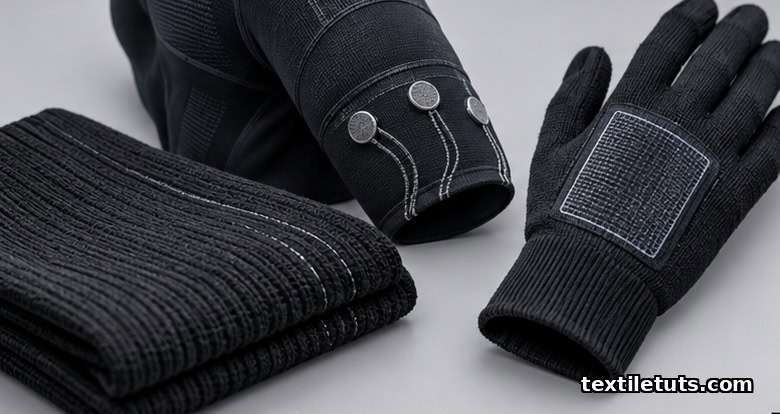
CNT yarns woven or knitted into fabrics absorb and reflect electromagnetic radiation. Published shielding effectiveness exceeds 90 dB at 1 GHz when fabric area density exceeds about 40 g/m², sufficient for sensitive electronics enclosures without the brittleness of metal mesh. This makes CNT textiles attractive for RF-sensitive medical, defense, and consumer-electronics housings.
Structural Health Monitoring
A single CNT-fiber tow embedded in a polymer composite changes its electrical resistance under strain. The same fiber that reinforces the part can therefore act as a built-in strain sensor, removing the need for separate foil gauges in some composite structures. This dual reinforcement-plus-sensing role is a recurring research theme in the technical-textile literature.
Personal Wearable Electronics
CNT fibers can be knotted, sewn by hand or machine, and washed. Demonstrated products include textile heating elements, electrocardiogram (ECG) electrode garments, and capacitive touch panels integrated into jackets and gloves. Because the fiber is itself the conductor, no metallic coating is required.
Challenges That Limit Widespread Adoption
Despite the headline numbers, three engineering problems still constrain CNT fibers outside the laboratory.
Cost
High-purity SWNT feedstocks currently sell for several hundred US dollars per kilogram, well above aramid and conventional carbon fiber. Manufacturing throughput is also below the rate required for commodity textiles. MWNT fibers are cheaper, but their property ceiling is lower, so cost versus performance trade-offs persist.
Property Variability
Mechanical and electrical numbers vary noticeably from batch to batch because defect density, tube length distribution, and alignment cannot yet be controlled with the precision that melt spinning achieves for polyester or that pyrolysis achieves for carbon fiber. This makes quality-control protocols a current research priority.
Standardization and Testing
Standard test methods for high-performance CNT fibers are still being drafted at ASTM and ISO. Until single-filament tension, conductivity, and gauge-length protocols converge, cross-lab data comparisons remain approximate and procurement specifications are hard to write.
Frequently Asked Questions
Q1: Are carbon nanotube fibers stronger than Kevlar?
On a per-weight basis, well-aligned SWNT fibers reach specific strengths of 2.0 to 5.0 GPa·cm³/g, comparable to or above Kevlar 49’s 2.1 GPa·cm³/g. In absolute terms, published peak tensile strengths reach 8.0 GPa, well above typical aramid values of 3.0 to 3.6 GPa. The catch is consistency: most published CNT fiber data report highest values rather than guaranteed minimums.
Q2: Do carbon nanotube fibers conduct electricity as well as copper?
Best reported SWNT fibers reach electrical conductivities of 8 × 10⁶ to 1 × 10⁷ S/m, lower than copper’s 5.96 × 10⁷ S/m. Adjusted for density, however, specific conductivity of CNT fibers (≈ 5 × 10⁶ S·m²/kg) substantially exceeds copper (≈ 6.6 × 10⁵ S·m²/kg), so CNT fibers win on a per-weight basis and in any application where mass matters, like aerospace tethers and wearable electronics.
Q3: Are CNT fibers safe to handle and wear against the skin?
Continuous fibers behave like textile filaments and do not shed respirable fragments under normal handling. Toxicological concerns in the open literature focus on loose, powdered CNT material. Finished CNT yarns and woven fabrics have not been classified as hazardous in published skin-contact studies, though long-term dermal exposure data remain limited and prudent handling of powders upstream is still required.
Q4: Can carbon nanotube fibers be dyed or finished like ordinary textiles?
CNT fibers are black, so dye-based coloration is not practical. Color is typically introduced by overcoating with pigments or by blending with conventional yarns. Surface finishes (sizing, plasma treatment) are routinely applied to improve wetting, abrasion resistance, and adhesion in composite matrices.
Q5: What is the largest carbon nanotube fiber length reported?
Continuous wet-spun SWNT fibers have been reported at lengths of several kilometers per bobin. Direct-spun aerogel fibers from CVD reactors are typically limited to a few hundred meters per run because of reactor geometry. Both lengths exceed what woven and knitted fabrics need, where individual tows are normally under 50 m before splicing or plying.
References
- Behabtu, N., et al. Spinning of carbon nanotube fibers from the liquid phase. Science, 2008. — first continuous wet-spun CNT fiber route at industrially relevant line speeds.
- Lu, W., et al. Carbon nanotube fibers with high specific electrical conductivity. Advanced Materials, 2012. — conductivity benchmark for SWNT fibers.
- Mokaberi, B., et al. Carbon nanotube fibers: properties, manufacturing, and applications. Materials (MDPI), 2022. — comprehensive MDPI review covering spinning routes and applications.
- Mirabootalebi, S. Carbon nanotube fibers: processing, properties, and application. Journal of Materials Science (Springer), 2022. — Springer review of mechanical and electrical property data.
- Taylor, L. W., et al. Carbon nanotube fibers for structural health monitoring. Composites Part B, 2023. — embedded strain-sensing data in polymer composites.
- National Aeronautics and Space Administration. MISSE-RamCAT CNT Fiber Exposure Flight Experiment. NASA Technical Reports Server, 2020. — on-orbit durability data from the International Space Station.
- ASTM D3039/D3039M-17. Standard Test Method for Tensile Properties of Polymer Matrix Composite Materials. ASTM International. — widely used single-filament tension protocol for CNT fibers.
This article is the working reference for carbon nanotube fibers. Editorial by Md. Asad Ullah (Meem), TextileTuts. Sources: Behabtu et al. (2008), Lu et al. (2012), Mokaberi et al. (2022), Mirabootalebi (2022), Taylor et al. (2023), NASA NTRS (2020), and ASTM D3039 as cited.


