
Batch Pretreatment Process

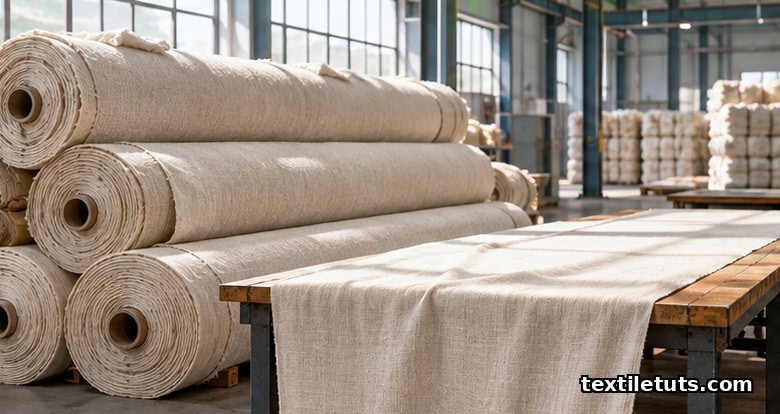
Batch pretreatment of cotton fabric is a three-stage wet process (desizing at 60-90 °C, alkaline scouring at 90-100 °C with 2-5% sodium hydroxide, and peroxide bleaching at 85-95 °C with 2-5% hydrogen peroxide at pH 10.5-11) that removes sizing agents, non-cellulosic impurities, and natural pigments to reach a wettability of under 2 seconds and a Berger whiteness index of 70-85 before dyeing.
This sequence raises reactive-dye uptake by 30-50%, cuts down-stream dyebath rejects, and gives the substrate the uniformity that piece-dyeing and printing require.
The sections below walk through each chemical stage, the parameters that govern quality, the equipment that carries the bath, and the standards used to grade the output.
What “Batch” Means in Textile Pretreatment
Batch pretreatment is the umbrella term for the wet preparation steps applied to greige (loomstate) fabric before dyeing or printing. The word “batch” refers to fabric being processed as discrete lots inside a closed vessel (a winch beck, a jet dyeing machine, or a jigger) rather than running open-width through a continuous range. Each lot typically weighs 50-300 kg in a jet machine or 200-1,000 kg in a winch, with a liquor ratio (the weight of bath against the weight of fabric) of 1:6 to 1:10 depending on substrate and machine.
The three principal chemical stages are:
- Desizing, hydrolyzing or oxidizing the sizing film left on warp yarns by the weaving shed.
- Scouring, emulsifying waxes, pectins, proteins, and seed-coat fragments in a hot alkaline bath.
- Bleaching, decolorizing natural pigments and residual motes with an oxidant.
Singeing (the burning-off of protruding surface fibers with a gas flame at 800-1,000 °C) usually precedes the wet stages and is treated as the first step of a complete pretreatment line. A combined desize-scour-bleach (“D-S-B”) bath is common in jet and winch plants; the four-bath sequence (singe then desize then scour then bleach) is reserved for premium or technical articles where each stage needs its own controlled chemistry.
Step 1: Singeing
Cotton yarns shed 5-15% of their fibers as surface hairiness during weaving. Singeing passes the fabric over an open gas flame at 1,000-1,200 °C flame temperature for 0.1-0.3 seconds, leaving a clean, lint-free face. The effect is graded against AATCC Test Method 21, which scores the surface for protruding fibers on a 1-5 scale; acceptable singeing scores are 4 or 5.
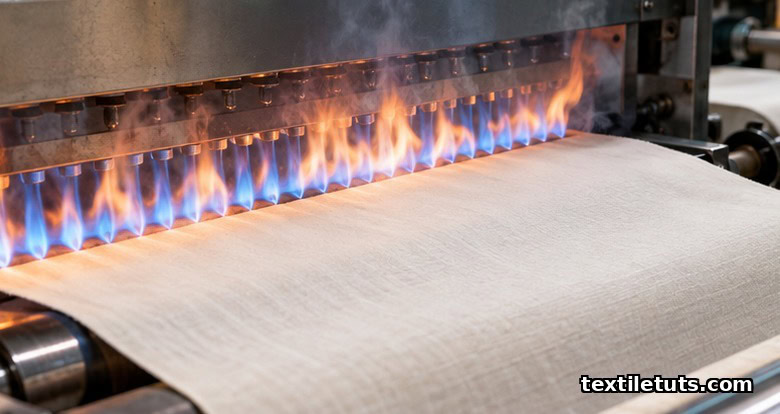
Polyester and polyester-cotton blends run slower (0.5-1.0 seconds exposure) to avoid melt-beading, which the same test would grade as a Class 3 defect. A desize immediately after singeing is essential, because the heat sets any residual size on the surface and makes downstream removal harder.
Step 2: Desizing
Warp yarns are coated with a sizing film (typically 60-70% starch, plus PVA or acrylic for filament blends) to survive the abrasion of weaving. The size film must be removed before scouring; otherwise it forms an alkali-resistant crust that blocks scouring chemicals from reaching the fiber.
Enzymatic desizing uses α-amylase at 2-5 g/L and runs at 60-90 °C and pH 6.5-7.5 for 30-60 minutes. The enzyme hydrolyzes starch to soluble dextrins, which are then washed out. Oxidative desizing uses sodium bromite at 1-3 g/L or hydrogen peroxide at 2-5 g/L and runs at 80-100 °C; the cycle is faster (15-30 minutes), which makes it the preferred route in jet machines where cycle time dominates the cost model.
Residual size is quantified by AATCC Test Method 97, which uses a TEGEWA scale from 1 (poor removal) to 9 (complete removal); a score of 7 or higher is the industry floor. Below 7, the size residue causes dye streaks in the next process and the lot is rejected back to scouring.
Step 3: Alkaline Scouring
Raw cotton carries 4-12% by weight of non-cellulosic impurities: waxes (0.4-1.0%), pectins (0.9-1.2%), proteins (1.0-1.3%), and mineral salts (1-2%). Scouring dissolves these with sodium hydroxide (NaOH) at 2-5% on weight of fabric (o.w.f.) plus 0.5-1.0% anionic or non-ionic wetting agent at 90-100 °C for 30-90 minutes. Effective scouring raises the fabric’s wettability (measured by AATCC Test Method 79, the standard drop test) to a sink-time under 5 seconds, with under 2 seconds typical for premium knits.
The reaction mechanism is straightforward. NaOH saponifies the wax esters to soluble soaps and converts pectic acid to sodium pectate, which the surfactant emulsifies. Modern recipes add chelators (EDTA or sodium gluconate at 0.5-1.0 g/L) to sequester calcium and magnesium ions, which would otherwise precipitate the surfactant as a scummy lime soap. The recipe window is tight: NaOH below 1.5% o.w.f. leaves the fabric under-scoured, while above 6% o.w.f. it can hydrolyze cellulose and lower the degree of polymerization by 5-10%.
After scouring, a hot rinse at 80 °C followed by a cold rinse drops the fabric pH below 9. Any pH above 10 at the end of scouring will bleed into the bleach bath and over-activate the peroxide.
Step 4: Peroxide Bleaching
Bleaching decolorizes the natural pigments (mainly flavonoid-type compounds) and any seed-coat hull fragments that survived scouring. Hydrogen peroxide (H₂O₂) at 2-5% o.w.f. with sodium silicate (Na₂SiO₃, 1-3% o.w.f.) as a stabilizer and NaOH (1-2% o.w.f.) for pH control is the industry workhorse. The bath runs at 85-95 °C for 45-90 minutes at pH 10.5-11.0.
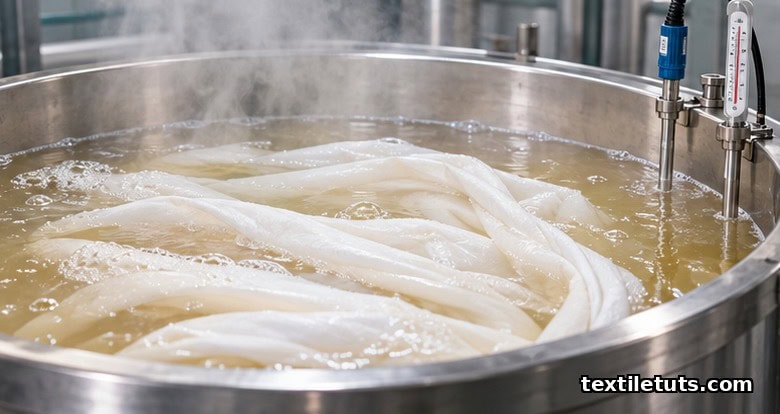
The bleaching action is a coupled redox loop: perhydroxyl anion (HOO⁻) attacks the conjugated chromophore in the pigment, breaking the double bond. Sodium silicate forms a colloidal film around the peroxide molecule that buffers radical release; without it, the peroxide decomposes too quickly and over-oxidizes the cellulose, reducing its tensile strength by 15-25%.
Whiteness is measured against a barium sulfate white standard. The Berger Whiteness Index (AATCC Test Method 110) reads 70-85 for fully bleached cotton without optical brightener, with the upper end reserved for goods that receive a separate brightener treatment.
Optional Step: Mercerization
For premium woven cotton, mercerization treats the scoured and bleached fabric with 22-30% w/w NaOH at 20-30 °C for 30-60 seconds under controlled tension. The caustic converts the cellulose I crystal lattice to cellulose II, increasing luster, dye uptake (typically 20-30% over non-mercerized cotton), and tensile strength (10-15%). Slack mercerization, run without tension, raises the fabric’s stretch and absorbency for towel and knit applications. The step is energy-cheap but water-intensive, so it is typically run before the wet bleach sequence to share rinsing water.
Process Parameters and Quality Windows
Every step of the sequence is governed by a tight window. The table below summarizes the operating ranges most often used in production batches.
| Step | Temperature | Time | pH | Key Chemical (% o.w.f.) |
|---|---|---|---|---|
| Desizing (enzymatic) | 60-90 °C | 30-60 min | 6.5-7.5 | α-amylase 0.2-0.5% |
| Desizing (oxidative) | 80-100 °C | 15-30 min | 7-9 | H₂O₂ 2-5% or NaBrO₂ 0.1-0.3% |
| Scouring | 90-100 °C | 30-90 min | 12-13 | NaOH 2-5% + surfactant 0.5-1.0% |
| Bleaching | 85-95 °C | 45-90 min | 10.5-11.0 | H₂O₂ 2-5% + Na₂SiO₃ 1-3% |
| Mercerization | 20-30 °C | 30-60 s | >14 | NaOH 22-30% |
Process control rests on three repeatability levers: liquor ratio (held within ±5% of the setpoint), temperature profile (a ramp rate of 1-2 °C/min during heating and a controlled cool-down under 3 °C/min), and bath chemistry, verified at every cycle by pH probe and redox titration. Drift in any one of the three typically shows up as a dye-rejection on the next machine.
Equipment: Winch, Jet, and Jigger
The three batch machines most often used for pretreatment differ in agitation and fabric handling.
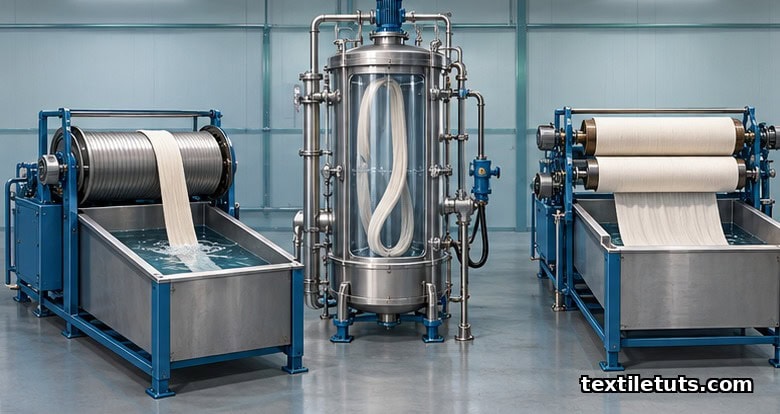
- Winch beck: a deep trough with a rotating reel that draws a 200-1,000 kg rope of fabric through the bath at 30-60 m/min. Best suited to knits and light wovens; LR 1:8-1:10.
- Jet dyeing machine: a pressurised tube that circulates fabric at 100-200 m/min via a venturi. Runs at LR 1:6-1:8, the lowest water-use option, and dominates in modern greenfield mills.
- Jigger: an open-width machine that rolls fabric from one beam to another through a shallow trough at 30-50 m/min. Used for wovens that would crease in rope form; LR 1:4-1:6.
Jet machines have largely displaced winches in newer plants because they cut water consumption by 30-40% and shorten cycle time by 20-30%. The trade-off is higher capital cost and a steeper learning curve on fabric-rope tension control.
Common Defects and How They Are Caught
Most pretreatment failures do not show up until the dyeing stage. Five patterns account for roughly 80% of in-house rejections on the floor:
- Wicking lines: residual size blocks dye absorption in stripes. Detected by AATCC Test Method 79; root cause is a desizing bath below 70 °C or an enzyme dose under 2 g/L.
- Uneven bleaching: hot spots in the bath over-oxidize the cellulose. Visible as yellow-brown stains after dyeing; checked by AATCC Test Method 110.
- Seed-coat particles: surviving hull fragments show up as dark specks under dyed fabric. Caused by scouring NaOH under 2% o.w.f.; tested by ISO 2313.
- Strength loss: peroxide overdose or bath temperature above 100 °C cuts tensile strength by 15-25%. Verified per ASTM D5035 (grab method).
- Residual alkali: incomplete neutralization after scouring shifts the dye-bath pH. Caught by pH check of the final rinse, with a target of pH 6.5-7.5.
Each defect points back to a single chemical or physical lever. The fastest way to clear a rejection is to walk back through the recipe and check the last parameter that changed.
Sustainability Pressures and Closed-Loop Water
Bleach effluent is the main environmental hot spot in batch pretreatment. Modern plants recover 50-70% of process water through counter-current rinsing and route the recovered caustic to a scouring bath, where residual alkalinity is reused as make-up NaOH. Hydrogen peroxide can be neutralized to water and oxygen with catalase enzyme at 5-10 ppm before discharge, eliminating residual peroxide that would otherwise damage the activated sludge in the wastewater plant.
The move to combined desize-scour-bleach baths cuts total water use by 25-35% versus four separate stages, at the cost of less flexibility to adjust a single step. For plants running 20-50 styles per month, the trade is usually worth it.
Frequently Asked Questions
What is the difference between batch and continuous pretreatment?
Batch pretreatment processes fabric in discrete lots inside a closed vessel (winch, jet, or jigger), typically 50-1,000 kg per charge. Continuous pretreatment runs open-width fabric through a pad-steam range at 40-100 m/min, suited to long runs of a single style. Batch is more flexible and dominates in mills producing 20-50 styles per month.
Why is hydrogen peroxide preferred over sodium hypochlorite for bleaching?
Peroxide operates at pH 10.5-11 and decomposes to water and oxygen, so it does not generate adsorbable organohalogens (AOX). Sodium hypochlorite bleaches faster (15-30 minutes at room temperature) but produces chloroform and other AOX species, which face strict discharge limits under the EU Industrial Emissions Directive.
Can polyester-cotton blends be pretreated in a single bath?
Yes, but the temperature must stay below 110 °C and the NaOH charge must drop to 1-2% o.w.f. to spare the polyester, which begins to hydrolyze above 3% NaOH at 95 °C. Most plants run a combined D-S-B at 95 °C for 60 minutes with NaOH 1.5%, H₂O₂ 3%, and a non-ionic surfactant at 0.5%.
How is whiteness measured on pretreated fabric?
The Berger Whiteness Index (AATCC Test Method 110) is the standard. A spectrophotometer measures reflectance at 457 nm against a barium sulfate white standard, and the result is reported on a 0-100 scale. Most bleached cotton without optical brightener reads 70-85; with brightener, 100+ is common.
What is the largest source of fabric strength loss during pretreatment?
Peroxide bleaching is the chief culprit. Cellulose oxidation by the perhydroxyl anion cleaves the polymer chain, dropping the degree of polymerization. Tensile-strength losses above 10% (ASTM D5035) point to an over-dosed bath (H₂O₂ above 5% o.w.f.) or a runaway temperature above 100 °C.
References
- International Organization for Standardization. ISO 105-C06: Textiles — Tests for colour fastness — Part C06: Colour fastness to domestic and commercial laundering. iso.org — defines the wash-fastness conditions used to confirm dye uptake after pretreatment.
- American Association of Textile Chemists and Colorists. AATCC Test Method 79: Absorbency of Textiles. aatcc.org — the drop test that grades scouring effectiveness.
- American Association of Textile Chemists and Colorists. AATCC Test Method 110: Whiteness of Textiles. aatcc.org — the Berger Whiteness Index method cited in the bleaching section.
- American Society for Testing and Materials. ASTM D5035: Standard Test Method for Breaking Force and Elongation of Textile Fabrics (Strip Method). astm.org — tensile-strength verification used to flag over-bleaching.
- Hashem, M. M. Development of a one-step process for desizing, scouring, and bleaching of cotton fabric. Carbohydrate Polymers, 79(3), 727-730 (2010). doi.org/10.1016/j.carbpol.2009.10.003 — peer-reviewed study validating combined D-S-B chemistry.
- Bhatti, I. A., Adeel, S., & Siddique, S. Effect of UV radiation on the dyeing of cotton fabric with reactive dyes. Journal of Saudi Chemical Society, 18(5), 578-582 (2014). doi.org/10.1016/j.jscs.2012.11.006 — peer-reviewed paper covering post-pretreatment dye-uptake behavior.
- Trotman, E. R. Dyeing and Chemical Technology of Textile Fibres. 6th ed., Charles Griffin & Co., London, 1984. — the standard textile-chemistry textbook covering pretreatment chemistry.
Editorial by Shahrukh Islam, TextileTuts. Sources: ISO 105-C06; AATCC TM 79, AATCC TM 110; ASTM D5035; Carbohydrate Polymers (2010); Journal of Saudi Chemical Society (2014); Trotman (1984) as cited.


