
Container Loading Inspection

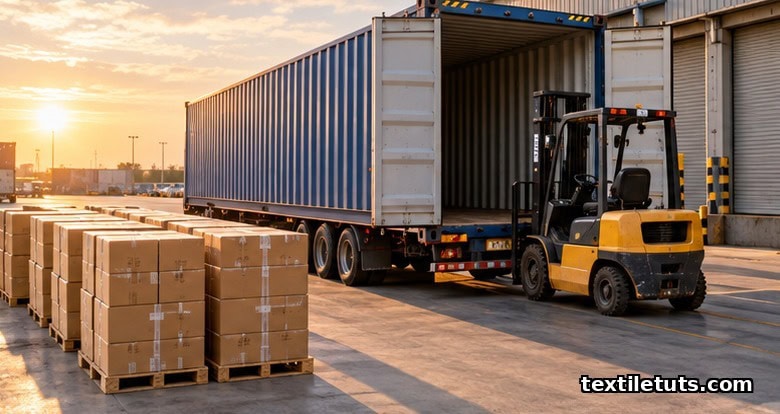
A container loading inspection (CLI) is a final pre-shipment check performed at the supplier’s facility that combines a 7-point container condition survey, an AQL-based carton sampling audit, and a documented sealing record, and it typically catches 3 to 7 percent of finished garments that would otherwise reach the buyer with hidden defects.
For shipments of 5,000 to 50,000 garments packed in 200 to 1,500 cartons, the inspector pulls 32 to 500 units using ISO 2859-1 sample tables at AQL 1.0 for major defects and 2.5 for minor defects, then approves or rejects the lot based on what the table shows.
This guide walks through every step an experienced inspector takes between the moment the empty container is parked at the loading bay and the moment the high-security bolt seal is fixed to the doors, with the underlying ISO, ASTM, and AATCC standards that make the report defensible if a claim later arises.
Where Container Loading Inspection Fits in the Export Workflow
Container loading inspection is the last gate before a shipment leaves the supplier’s control. It runs after the buyer’s final random inspection (FRI) or du Pont inspection has been signed off, and after the cartons have been sealed at the supplier’s warehouse. The CLI checks three things the FRI usually does not: the condition of the empty container, the loading pattern inside the container, and the integrity of the high-security seal after loading.
Most large apparel buyers (H&M, Inditex, Marks & Spencer, Levi Strauss & Co., Primark) require the CLI as a separately priced service run by an independent third party such as SGS, Bureau Veritas, Intertek, or QIMA. Smaller buyers sometimes delegate the CLI to the supplier’s own QA team, which raises the risk that the same people who approved the lot also certify the container. For a 40′ High Cube container of cotton T-shirts valued at USD 80,000 to 150,000, the cost of an independent CLI is typically USD 200 to 350, a small fraction of the cost of one rejected shipment.
The 7-Point Container Condition Survey
Before any carton is loaded, the inspector walks the inside and outside of the container with a flashlight, a moisture meter, and a camera. Industry practice groups the checks into seven zones, often called the 7-point container survey:
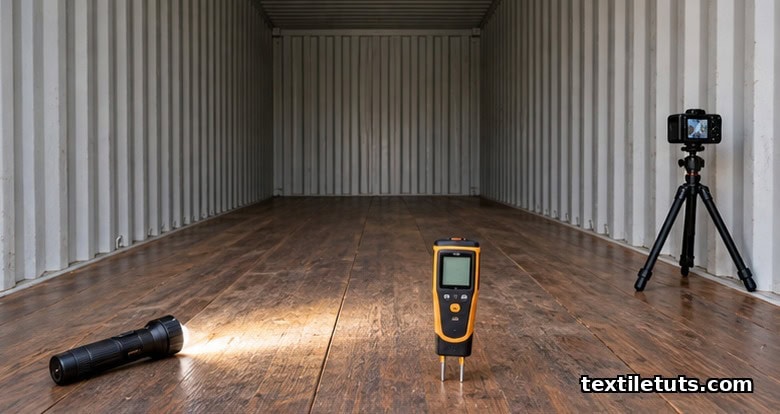
- Floor. No broken planks, no holes, no standing water, no oil stains. The wooden floor of a standard 40′ High Cube container uses 28 mm thick apitong or bamboo boards that must be dry to the touch (below 12 percent moisture as measured by a pin-type meter).
- Interior walls. No protruding nails or screws, no rust streaks, no holes. Wall panels are 1.6 to 2.0 mm corrugated steel.
- Interior ceiling and cross members. No daylight visible through the roof, no previous-cargo residue such as sugar dust, cement, or chemical powder.
- Doors and gaskets. Both doors open and close smoothly, the rubber gasket around the door frame is unbroken, hinges and locking bars are not bent, and the four corner castings are intact.
- Exterior sides and front. No major dents (typically accepted up to 25 mm deep on flat panels under TSCIR (Tropical Shipping Container Inspection Requirements) guidance), no structural cracks, no fresh welding marks that would suggest a recent repair.
- Exterior roof. No deformations deeper than 50 mm, no soft spots that would channel rainwater onto the cargo during the ocean transit.
- Undercarriage and CSC plate. The Container Safety Convention (CSC) plate is legible, the approval country mark is visible, and the next periodic examination date has not expired. Under the 2023 IMO updates to the CSC, the periodic examination interval remains 30 months from the date stamp.
Any single failed zone is enough to reject the container and request a replacement. Photographic evidence is captured at every step, normally 10 to 25 photographs covering all seven zones, and the images are filed in the loading report shared with the buyer.
Carton Sampling Using ISO 2859-1
Once the container is accepted, the inspector opens a statistically determined sample of cartons. The sample size and the acceptance number come from ISO 2859-1 (Sampling procedures for inspection by attributes), which is the standard every major apparel buyer references in its AQL clause.
For a buyer’s order of a few thousand finished garments packed in hundreds of cartons, ISO 2859-1 normal inspection level II calls for a sample of 32 to 200 units pulled from at least 25 percent of the cartons in the lot. At AQL 1.0 for major defects, the lot is accepted if the sample shows one or zero major defects; at AQL 2.5 for minor defects, the lot is accepted if the sample shows fewer than the rejection number set by the same row of the table. Exact numbers vary with lot size, so the inspector always reads the relevant row of the ISO table before walking the floor.
A typical defect classification used in CLI reports looks like this:
| Category | Examples | Typical AQL |
|---|---|---|
| Critical | Sharp needle, broken piece, live insect, biological or chemical contamination, wrong style in carton | 0 (zero acceptance) |
| Major | Open seam longer than 1 inch, stain larger than 1 cm², broken button or snap, wrong size in carton, missing care label | 1.0 or 2.5 |
| Minor | Loose thread, slight shade variation within tolerance, mildly uneven hem, small printing smudge | 2.5 or 4.0 |
What Inspectors Look For Inside Each Carton
Inside each opened carton, the inspector counts the poly bags, checks that each garment is folded to spec, and confirms the size ratio printed on the carton header matches the size ratio on the buyer’s packing list. The most frequent CLI finding in Bangladesh, Vietnam, and Indian export shipments is wrong ratio, where one size is over-packed and another is under-packed relative to the buyer’s plan.
Other common findings include mislabeled cartons, missing tissue paper, poly bags without silica gel in markets where humidity is a concern, and unit-pack weight outside the buyer’s tolerance, usually plus or minus 2 percent of the spec. Garments heavier than the spec waste freight cost (a 1 percent over-weight on a full 40′ HC container can cost USD 200 to 400 in extra ocean freight). Garments under weight raise questions about missing trims, undersized panels, or thinner fabric than the spec called for.
Poly bag thickness matters more than most checklists admit. A 0.025 mm LDPE bag will tear on a 25 mm carton corner during stacking. Most buyer standards call for 0.04 to 0.06 mm. ASTM D5430 (Standard Test Methods for Visually Inspecting and Grading Fabrics) and the related terminology standard ASTM D3990 (Standard Terminology Relating to Fabric Defects) define the language inspectors use when describing visible fabric defects, so the CLI report stays consistent with the mill’s internal grading.
Loading Pattern and Weight Distribution
A standard 40′ High Cube container has an interior volume of about 67.7 m³ and a maximum payload of roughly 26,460 kg. Mis-loading that volume is a common cause of cargo damage claims at destination. The inspector watches the loading sequence and confirms:
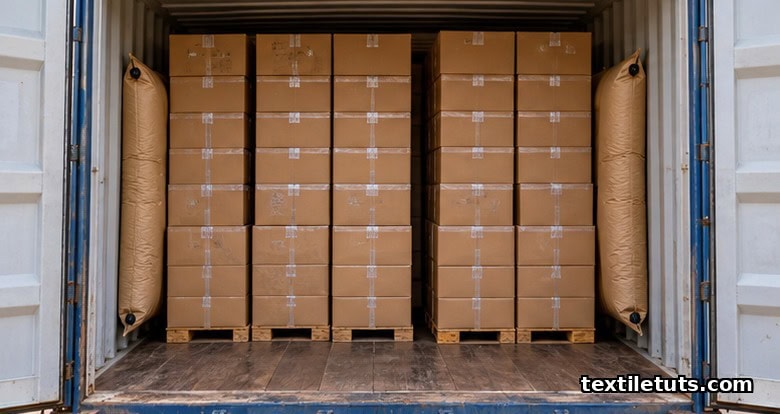
- Heavy cartons go on the bottom layer, light cartons on top.
- Cartons are stacked column-by-column, never pyramid-stacked, so the load stays stable under braking forces up to 0.5 g longitudinal and 0.25 g transverse.
- The load leaves a 50 to 100 mm gap to the inside of the container doors, allowing air circulation and preventing condensation from dripping onto the front row of cartons.
- Cartons are braced against shifting using airbags, dunnage bags, or cargo straps, especially for ocean transit that can flex the container up to 30 mm vertically in heavy seas.
- The gross weight is recorded at the weighbridge after sealing and matches the packing list within plus or minus 0.5 percent.
ISO 2234 (Packaging. Complete, filled transport packages and unit loads. Stacking tests using a static load) is the underlying standard for the stacking-strength part of this check. Related standards in the ISO 2234 to ISO 2248 family cover horizontal impact, vibration, and conditioning for the same unit loads.
Sealing, Documentation, and Photo Records
Once loading is complete and the inspector is satisfied, the doors are closed and the high-security bolt seal is fixed. The seal number is engraved on the seal body, written into the loading report, photographed, and shared with the buyer’s logistics team before the truck leaves the yard. ISO 17712 (Freight containers. Mechanical seals) classifies the seal as a high-security seal when it meets the pull-strength and shear-strength tests defined in that standard, which is why most buyers require ISO 17712-compliant seals rather than generic plastic seals.
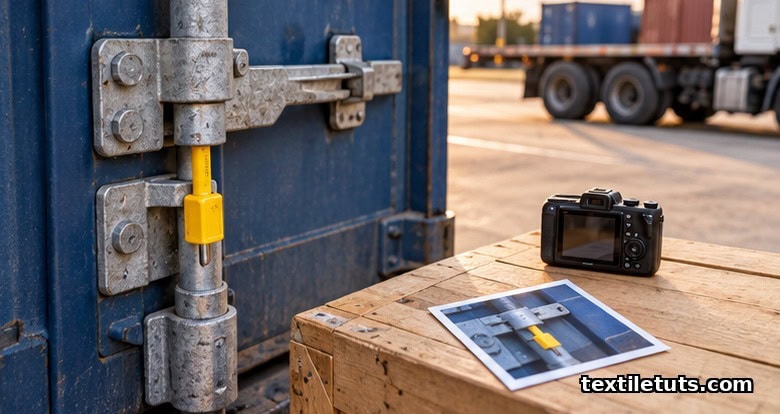
A complete CLI loading report includes:
- The 7-point container condition photos with timestamps and GPS coordinates.
- The ISO 2859-1 sample size used, the inspection level, the AQL chosen, and the count of defects found in each category.
- The seal number and a close-up photo of the seal after installation.
- The container number, truck number, and driver name.
- The packing list, commercial invoice, and bill of lading reference numbers cross-checked against the buyer’s purchase order.
- The gross weight recorded at the weighbridge after sealing.
The report is typically shared with the buyer within 24 hours of sealing. If any of the photos, seal numbers, or weights do not match, the buyer can stop the truck before the vessel sails and request a re-inspection or container replacement at the supplier’s cost.
What the Buyer Does With the Report
A clean CLI report is the buyer’s last layer of assurance before the goods leave the supplier’s control. If the report flags a critical defect (a needle left in a garment, for example), the buyer usually rejects the lot outright and the supplier reopens every carton at its own cost. If the report flags only minor defects within the AQL, the buyer accepts the shipment but may open a claim for the defect rate above the agreed tolerance.
Across the apparel export industry, third-party inspection bodies publish annual summaries of CLI defect rates. The most recent public compilations from SGS, Intertek, and QIMA consistently show that 4 to 6 percent of inspected lots in Bangladesh, Vietnam, and India fail the CLI on first inspection, most often for ratio errors, poly-bag tears, and container moisture. A factory that ships 20 containers a month and brings its CLI fail rate from 5 percent down to 1 percent saves, on average, the equivalent of one full container’s loading and demurrage cost per month.
Frequently Asked Questions
How long does a container loading inspection take?
A CLI on a 40′ High Cube container holding 8,000 to 12,000 garments typically takes 3 to 5 hours. The 7-point container condition survey takes 20 to 30 minutes, the carton sampling 1 to 2 hours, and the rest of the time is loading supervision, weighing, sealing, and documentation. Factories that pre-stage their cartons and have a clean, dry container waiting at the loading bay can finish a clean CLI in under 3 hours.
Who pays for the CLI?
Most buyers cover the inspection cost through the inspection body’s commercial invoice paid directly by the buyer. Some buyers, particularly smaller ones, charge the supplier if the first inspection fails, since the supplier caused the rework. Either way, the CLI cost is small compared with a single rejected shipment, where demurrage, re-export, and air-freight replacement can run USD 5,000 to 15,000 per rejected container.
Can a CLI fail even after the lot passed the FRI?
Yes, and this is the most common confusion for first-time exporters. The FRI looks at garment quality on the shop floor, while the CLI checks the container, the loading, and the seal. A lot can pass FRI and still fail CLI for wrong ratio in the cartons (FRI samples only a few sizes), poly bags torn during loading, container floor wetness, or seal mismatches. The two inspections complement each other, and most large buyers require both as separate steps.
What is the anxiety point for a first-time exporter?
Most first-time exporters worry about hidden cargo contamination: insects in the carton, a chemical odor from the previous cargo, or water damage from a roof leak. None of these can be caught by the FRI, and all three are common reasons a buyer files a claim even when the garments themselves are perfect. A supplier who runs the 7-point container survey before loading and photographs every step gives the buyer the evidence needed to dismiss these claims quickly and avoid a chargeback.
Can a supplier do its own CLI without a third party?
For domestic orders or small CMT runs in the local market, yes. For export orders where the buyer’s contract names a third-party inspection body (SGS, Bureau Veritas, Intertek, QIMA), no. Self-CLI is rarely accepted by large apparel buyers because independence is the whole point of the inspection, and an internal QA team cannot sign off against its own packing list. Some buyers allow a “supervised self-CLI” where the supplier runs the check and the buyer’s local merchandiser signs off, but that is a weaker form of evidence than a third-party report.
References
- International Organization for Standardization. ISO 2859-1:1999 Sampling procedures for inspection by attributes. Part 1: Sampling schemes indexed by acceptance quality limit (AQL) for lot-by-lot inspection. https://www.iso.org/standard/1141.html — defines the AQL sample size tables used in every container loading inspection.
- International Organization for Standardization. ISO 17712:2013 Freight containers. Mechanical seals. https://www.iso.org/standard/51565.html — defines high-security seals for ocean containers, including the pull-strength and shear-strength tests a CLI seal must pass.
- International Organization for Standardization. ISO 2234:2000 Packaging. Complete, filled transport packages and unit loads. Stacking tests using a static load. https://www.iso.org/standard/35124.html — covers the stacking-strength check applied to loaded cartons inside a freight container.
- ASTM International. ASTM D5430-24 Standard Test Methods for Visually Inspecting and Grading Fabrics. https://www.astm.org/d5430-24.html — provides the defect vocabulary CLI inspectors use when reporting visible fabric defects.
- ASTM International. ASTM D3990-24 Standard Terminology Relating to Fabric Defects. https://www.astm.org/d3990-24.html — defines the visual defect classes referenced during carton sampling.
- AATCC. Technical Manual of the American Association of Textile Chemists and Colorists. https://www.aatcc.org/testing/ — current edition referenced for textile inspection vocabulary and color-fastness checks during CLI.
- Kabir, S. M. R. (2012). Factors of quality management practices and organizational performance in the readymade garment industry. International Journal of Productivity and Quality Management, 10(4), 451-466. https://www.inderscienceonline.com/doi/abs/10.1504/IJPQM.2012.049155 — peer-reviewed data on quality management practices in apparel factories exporting under CLI contracts.
This article is the working reference for container loading inspection in apparel export. Editorial by Sabbir Ahmed, TextileTuts. Sources: ISO 2859-1, ISO 17712, ISO 2234, ASTM D5430, ASTM D3990, AATCC Technical Manual, and Kabir (2012) as cited.


