
Conductive Fibers and Yarns

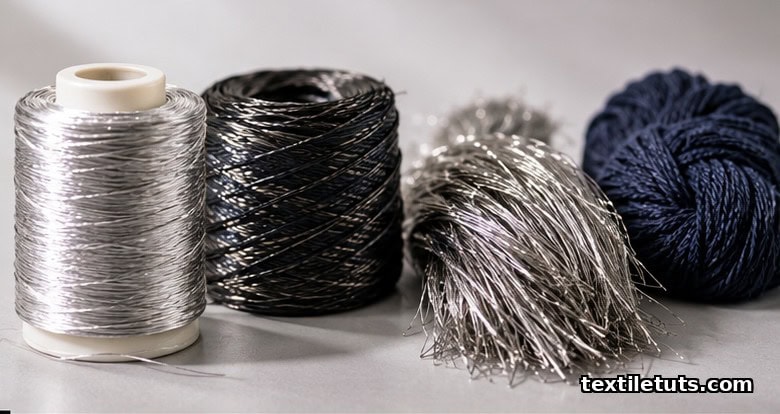
Conductive fibers and yarns are textile filaments whose electrical resistivity falls below 10³ Ω·cm, produced by incorporating metals, carbon, or inherently conductive polymers into a fiber-forming matrix through blending, coating, or extrusion. They deliver surface resistivities from 10⁰ to 10⁹ Ω/sq, support electromagnetic shielding of 60 to 90 dB, and sustain Joule heating of 30 to 200 W/m² at supply voltages between 5 and 24 V DC.
This guide explains how conductive fibers and yarns are made, which material families dominate commercial production, the electrical and mechanical properties engineers measure, and the standards (ISO 21195, ASTM D4496, AATCC TM76) that govern their testing. Engineers, sourcing managers, and textile students will find the data and citations needed to specify conductive yarns correctly for heating garments, EMI shields, wearable sensors, and antistatic workwear.
What Are Conductive Fibers and Yarns?
A conductive fiber or yarn is any continuous textile structure that exhibits electrical resistivity low enough to transport current without the resistance losses that would make the textile unusable in a circuit. The textile industry treats anything below roughly 10³ Ω·cm as “conductive” for functional use, and below 10⁹ Ω/sq as antistatic per the practical threshold set by ISO 21195:2021 and AATCC Test Method 76.
Conductive fibers differ from conductive fabrics. A conductive fabric is usually a finished textile (knit, woven, or nonwoven) that achieves conductivity through surface coatings, printed circuits, or stitching patterns. A conductive fiber or yarn is the building block: it carries current along its length and can be processed on standard textile machinery without special tooling. This is why roughly 80% of smart-textile prototypes in the peer-reviewed literature start with a conductive yarn rather than a coated fabric (Stoppa and Chiolerio, 2014).
Four Main Families of Conductive Fibers
The commercial conductive-fiber market divides into four material families, each with a distinct conductivity, processing profile, and cost band.
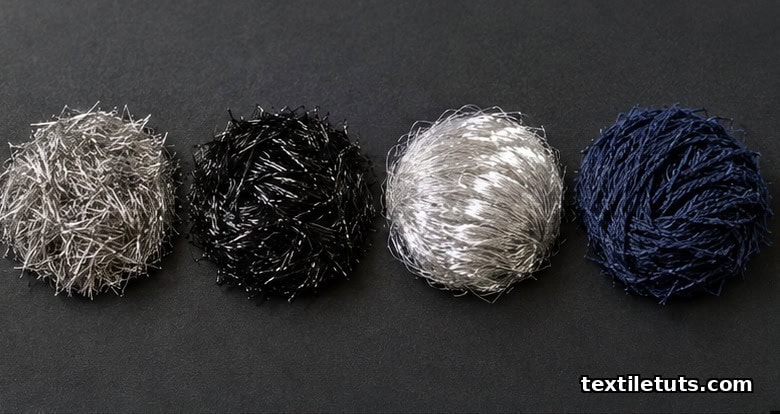
Metal fibers. Stainless steel (typically 316L or 304 grades), copper, silver, and titanium fibers are produced by bundle-drawing wire bundles to 8 to 25 µm diameters. Stainless steel fiber resistivity is roughly 6 to 8 × 10⁻⁷ Ω·m, about 40 times higher than bulk copper (1.68 × 10⁻⁸ Ω·m), but its textile processability is good. Pure metal fibers are heavy, kink-prone, and expensive, so they appear mostly in specialty filtration, antistatic brushes, and cut-resistant blends.
Carbon fibers. Polyacrylonitrile (PAN)-based or pitch-based carbon fibers deliver resistivities of 10⁻⁵ to 10⁻³ Ω·m depending on heat-treatment temperature. They are stiffer than textile fibers (tensile modulus 230 to 700 GPa versus 5 to 15 GPa for polyester), so carbon yarns are usually blended with polyester or cotton at 1 to 5% by weight to suppress static in carpets, workwear, and cleanroom garments.
Metal-coated fibers. Polyamide or polyester filaments sputter-coated or electroless-plated with silver, copper, nickel, or tin dominate the smart-textile market. Silver-coated polyamide 6,6 filament with a 0.5 to 2 µm silver layer shows linear resistance of 1 to 500 Ω/cm, depending on denier, and supports both heating and biopotential-electrode applications. Electroless plating gives a more uniform coating than sputtering but adds 3 to 8 process steps.
Inherently conductive polymers (ICPs). Polyaniline (PANI), polypyrrole (PPy), and PEDOT:PSS can be wet-spun into continuous fibers with bulk resistivities of 10⁻³ to 10⁰ Ω·cm after secondary doping. ICP fibers are light, drape like cotton, and survive 50 or more domestic wash cycles when overcoated, which is why PEDOT:PSS-coated yarns are a research focus for textile electrodes and biosignal monitoring (Lund et al., 2018).
Manufacturing Methods
Three routes account for nearly all commercial conductive-yarn production. Each route fixes the cost, the conductivity ceiling, and the wash durability in a specific way.
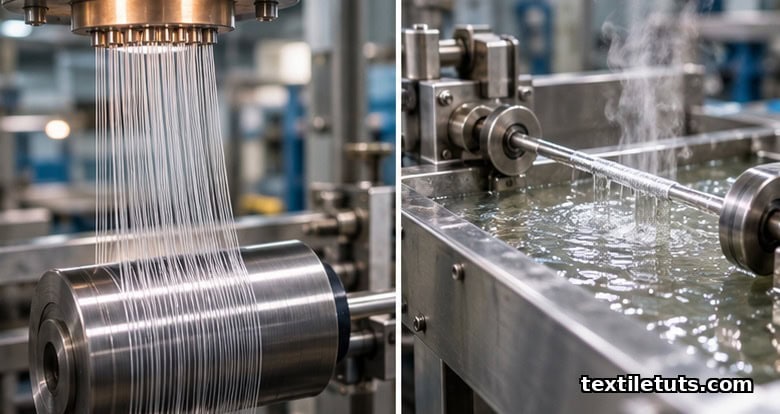
Filament spinning with conductive additives. Carbon black, carbon nanotubes, graphene, silver flakes, or stainless steel microfibers are compounded into a polymer melt or solution and extruded. The conductivity rises sharply once the additive reaches its percolation threshold, typically 3 to 15 wt% for carbon black in polyester. Spun conductive filaments can be drawn, textured, and woven on standard equipment, but conductivity is anisotropic: along the fiber, 10² to 10⁵ Ω/cm; across the fiber, 10⁶ to 10¹⁰ Ω/cm.
Metallization. Sputtering, electroless plating, and ionic-liquid deposition coat a base filament (usually polyamide 6,6 or polyester, 22 to 220 dtex) with a 0.1 to 5 µm metal layer. Silver-coated yarns lead the market because silver oxide remains conductive, while copper-coated yarns require a nickel or tin topcoat to prevent oxidation in storage.
ICP coating. Polyester or cotton yarns are dipped in PANI, PPy, or PEDOT:PSS dispersions, then dried and cured. Multiple dip cycles raise conductivity at the cost of hand-feel; a 3-dip PEDOT:PSS treatment on 30/1 cotton yarn reaches roughly 10² Ω/cm linear resistance but stiffens the yarn by 25 to 40%.
Electrical and Mechanical Properties Engineers Measure
Five properties predict whether a conductive yarn will function in a finished textile: linear resistance, surface resistivity, EMI shielding effectiveness, Joule heating response, and strain tolerance. Engineers report these values per ASTM D4496 (DC resistance), AATCC TM76 (electrical resistivity of fabrics), and ISO 21195:2021 (textile conductivity determination).
Linear resistance (Ω/cm) is the property yarn manufacturers publish most often. Silver-coated polyamide 6,6 filament (110 dtex / 34 filament) typically reads 5 to 50 Ω/cm; copper-coated polyester (150 dtex / 48 filament), 0.5 to 5 Ω/cm; PEDOT:PSS-coated cotton (30/1 Ne), 80 to 400 Ω/cm. Coated yarns hold their value longer than doped yarns: silver-coated polyamide retains over 90% of its initial conductivity after 40 ISO 6330 domestic wash cycles, while PEDOT:PSS-coated cotton loses 50 to 70% in the same test (Lund et al., 2018).
Surface resistivity (Ω/sq) describes how the yarn behaves once it is in a fabric. AATCC TM76 specifies a four-point probe measurement at 10 V on a conditioned specimen (20 °C, 65% RH). For antistatic workwear, the textile should read below 10⁹ Ω/sq; for antistatic cleanroom garments, below 10⁵ Ω/sq; for electromagnetic shielding fabrics, surface resistivity must fall below 1 Ω/sq, which typically requires a metal-foil or dense metal-knit construction rather than a yarn alone (Knittel and Schollmeyer, 2009).
Applications in Smart and Technical Textiles
Joule heating garments. Silver-coated or stainless-steel-blend yarns are knit into heating panels that reach 35 to 45 °C surface temperature at 30 to 80 W/m² power input. Battery packs at 5 to 12 V DC drive the system, with carbon-coated or steel-blend yarns used as bus bars.
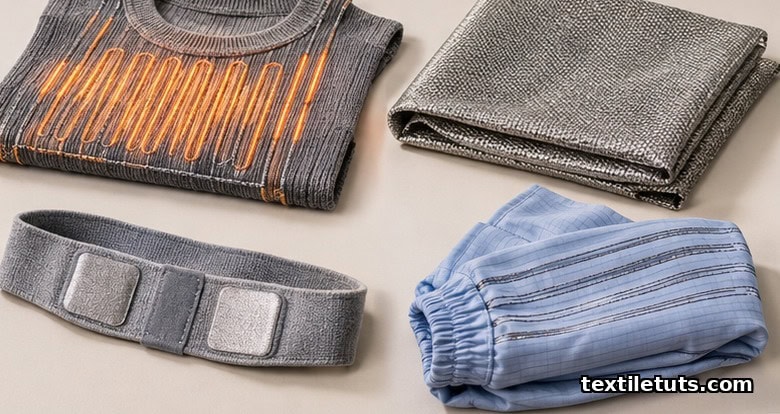
EMI shielding. A metal-knit or metal-woven fabric of 60 to 200 g/m² areal density attenuates 60 to 90 dB across the 30 MHz to 10 GHz range, meeting the EN 50147-1 attenuation target for military and aerospace enclosures. Achieving sheet resistance below 1 Ω/sq is the engineering baseline.
Biomedical electrodes. PEDOT:PSS-coated or silver-coated yarns woven into chest bands and ECG garments record biopotentials with skin-electrode impedance of 5 to 50 kΩ at 10 Hz, comparable to standard Ag/AgCl gel electrodes (Stoppa and Chiolerio, 2014).
Strain and pressure sensors. Conductive yarns whose resistance changes predictably with strain (gauge factor 1.5 to 50) form the sensing element in textile strain gauges, gait monitors, and pressure-mapping mats for seating and prosthetic sockets.
Antistatic workwear and filtration. A 1 to 3% carbon-fiber or stainless-steel-fiber blend in polyester is enough to dissipate static below the 10⁹ Ω/sq threshold, which is why fuel-handling uniforms, electronics cleanroom garments, and industrial filter bags all rely on conductive-yarn blends rather than coatings.
Standards That Govern Conductive Yarns
Three ISO and ASTM standards govern the laboratory testing of conductive fibers and yarns. ISO 21195:2021 specifies a four-point probe method for electrical conductivity on conditioned textiles. ASTM D4496-21 covers DC resistance or conductance for moderately conductive materials and is the test method most North American suppliers report against. AATCC Test Method 76 (Electrical Resistivity of Fabrics) is the long-standing North American method and the reference cited in many commercial datasheets. For specific applications, additional standards apply: EN 1149-5 for antistatic protective clothing, IEEE 299 for EMI shielding enclosures, and IEC 60601-1 for biomedical electrode safety.
Comparison Table: Common Conductive Yarn Families
| Property | Stainless steel fiber | Carbon fiber | Silver-coated polyamide | PEDOT:PSS-coated polyester |
|---|---|---|---|---|
| Bulk resistivity (Ω·m) | ~7 × 10⁻⁷ | 10⁻⁵ to 10⁻³ | n/a (coating) | n/a (coating) |
| Linear resistance (Ω/cm, 110 dtex) | 10 to 100 | 10³ to 10⁶ | 5 to 50 | 80 to 400 |
| Tensile strength (cN/tex) | 5 to 15 | 15 to 30 | 35 to 50 | 25 to 40 |
| Wash durability (cycles to 80% conductivity) | >100 | >100 | 40 to 80 | 10 to 30 |
| Typical end use | antistatic, filtration | antistatic, EMI blends | heating, electrodes | biomedical, sensing |
Frequently Asked Questions
What resistivity makes a fiber “conductive” for textile use?
Textile engineers treat anything below roughly 10³ Ω·cm as functionally conductive, and below 10⁹ Ω/sq surface resistivity as antistatic. The 10⁹ Ω/sq threshold is set by ISO 21195:2021 and AATCC Test Method 76 as the practical boundary between an insulator and a static-dissipative textile.
Can conductive yarns be processed on standard knitting or weaving machines?
Metal fibers and stainless-steel blends can be processed on standard machines when fiber length is kept above 50 mm and the metallic content is below 10% by weight. Silver-coated polyamide and PEDOT:PSS-coated yarns behave like standard filament yarns on circular knitting, flat knitting, and rapier weaving machines, with no special needles required up to 30% substitution rates.
How many wash cycles will a conductive yarn survive?
Silver-coated polyamide 6,6 typically retains more than 90% of its initial conductivity after 40 ISO 6330 domestic wash cycles at 40 °C, while electroless-plated copper coatings fail at 15 to 25 cycles unless protected by a nickel or tin topcoat. ICP-coated yarns lose 50 to 70% of conductivity after 20 to 30 cycles, which limits them to disposable or limited-reuse biomedical applications.
What voltage and power do textile heating panels use?
Wearable heating panels knit from silver-coated or stainless-steel-blend yarns typically run at 5 to 12 V DC from a lithium-ion battery pack, reaching 30 to 80 W/m² and 35 to 45 °C surface temperature. Higher-power industrial heating blankets can run at 24 to 48 V DC and 100 to 200 W/m².
Are conductive yarns safe to wear next to skin?
Yes, when the yarn is supplied by a reputable manufacturer and meets OEKO-TEX Standard 100 or REACH compliance. Silver-coated polyamide yarns have been used in ECG and TENS garments in clinical studies for more than a decade without skin sensitisation reports. Stainless-steel blends can cause minor abrasion on direct skin contact, so they are usually lined with a non-conductive inner layer in wearable applications.
References
- International Organization for Standardization. (2021). ISO 21195:2021 — Textiles — Determination of electrical conductivity. iso.org/standard/74156.html — Four-point probe method for textile conductivity on conditioned specimens.
- ASTM International. (2021). ASTM D4496-21 — Standard Test Methods for D-C Resistance or Conductance of Moderately Conductive Materials. astm.org/d4496 — DC resistance test method used by most North American conductive-yarn suppliers.
- AATCC. (2018). AATCC Test Method 76 — Electrical Resistivity of Fabrics. aatcc.org — Four-point probe method at 10 V on a 20 °C / 65% RH conditioned specimen.
- Stoppa, M., and Chiolerio, A. (2014). Wearable Electronics and Smart Textiles: A Critical Review. Sensors, 14(7), 11957–11992. mdpi.com/1424-8220/14/7/11957 — Survey of conductive-yarn construction, applications, and characterisation methods.
- Lund, A., van der Velden, N. M., Persson, N. K., Hamedi, M. M., and Müller, C. (2018). Electrically conducting fibres for e-textiles: An open playground for conductive polymers and carbon nanotubes. Materials Science and Engineering: R: Reports, 126, 1–29. sciencedirect.com/science/article/pii/S0927796X1830010X — Wash durability and conductivity data for conductive-polymer yarns.
- Knittel, D., and Schollmeyer, E. (2009). Electrically high-conductive textile yarns. Synthetic Metals, 159(14), 1433–1437. sciencedirect.com/science/article/pii/S0379677909001845 — Resistivity data for metal-coated and metal-blend filament yarns.
This article is the working reference for conductive fibers and yarns, from material families and manufacturing methods through testing standards. Editorial by Md. Asad Ullah (Meem), TextileTuts. Sources: ISO 21195:2021, ASTM D4496-21, AATCC TM76, MDPI Sensors, Materials Science and Engineering R: Reports, Synthetic Metals, as cited.


