
Common Spinning Mill Problems and Solutions

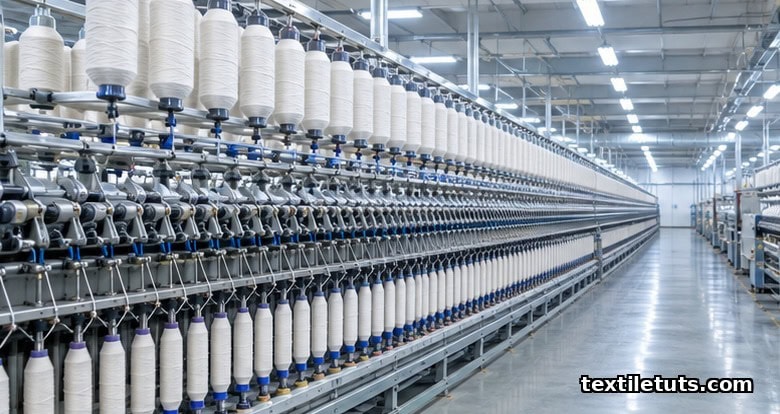
Ring spinning mills lose 8 to 12 percent of operational efficiency to recurring yarn breakage, fly generation, and count variation, with an end-breakage rate above 5 breaks per 100 spindle-hours translating into a direct revenue loss of 3 to 5 percent of total yarn output value.
The most frequent spinning mill problems fall into three groups: process defects (end breakages, fly generation, nep formation), quality deviations (count CV above 14 percent, yarn unevenness above the world-median benchmark, hairiness above H-index 6.0), and machine downtime caused by drafting-zone wear or environmental drift. Each defect has a documented root cause, a measurable fix, and a verification method backed by ISO 2061, ISO 2060, ISO 139, and ASTM D2256 test methods.
This article walks through the seven most expensive spinning mill problems, the engineering controls that solve them, and the textile standards you can cite when a customer rejects a lot.
The seven spinning mill problems that cost the most money
Spinning mill operators typically attribute unplanned downtime to four fault categories: yarn breakage, fiber fly, machine stoppages, and quality downgrades. Published spinning benchmarks show that a 30s Ne combed cotton yarn should run below 10 end breakages per 1,000 spindle-hours, below 14.5 percent CV on the evenness tester, and below 5.5 thin places per 1,000 m. Falling outside any one of these windows adds measurable cost: a 1 percent increase in end-breakage rate at a 50,000-spindle ring frame running 4.5 g per second consumes roughly 18 kg of additional roving per day and adds 0.7 percent to labor hours.
You can group the seven most common problems by where they originate in the process line: blowroom-to-carding (lap irregularity, nep seed, microdust), drawframe (sliver unevenness, drafting waves), roving (roving CV, soft packages), and ring or rotor spinning (end breakage, hairiness, fly generation).
1. End breakage in ring spinning
End breakage is the single most expensive defect because every broken end stops one spindle and consumes operator time to piece up. The acceptable end-breakage rate for combed cotton ring-spun yarn is 5 to 25 breaks per 1,000 spindle-hours, depending on count and fiber length. A break rate above 30 per 1,000 indicates a process problem, not random noise.
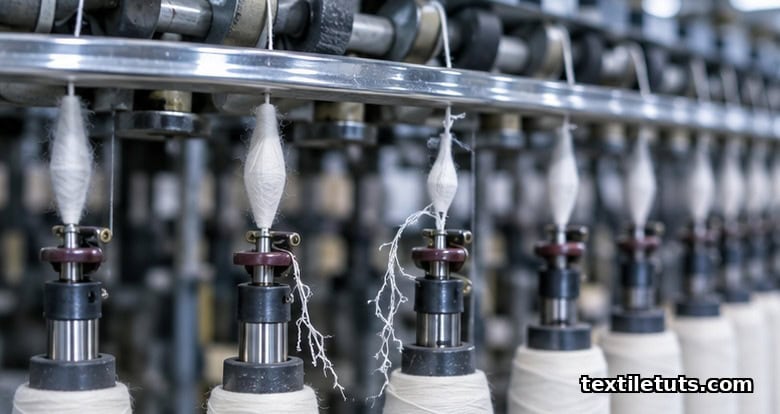
Root causes fall into four groups:
- Fiber-related: short fiber content above 16 percent by weight, immature fiber above 6 percent, micronaire below 3.0 or above 5.0.
- Process-related: incorrect roving twist multiplier, traveler weight mismatch, drafting zone settings off by more than 1 mm, top roller pressure below 16 kg per cm.
- Environmental: relative humidity outside the 55 to 65 percent window, temperature above 32 °C, electrostatic buildup on synthetic blends.
- Mechanical: worn spindle tapes, traveler burn marks, drafting elements with flats greater than 0.05 mm.
The control loop is straightforward. First, run an HVI test on the cotton lot to confirm micronaire, upper-half-mean length, and short fiber index. Second, verify traveler weight against the spindle-speed chart supplied by the traveler maker. Third, log ambient RH and temperature at the frame every two hours. Fourth, audit the drafting system: top roller loading pressure, apron spacing, and cradle gap. Each parameter is documented in the machine maker’s manual and can be corrected without major capital spend.
2. Yarn unevenness and count CV
Yarn unevenness, measured as CV percent on an evenness tester, is the most-cited rejection parameter by fabric buyers. The published world-wide median benchmark for 30s Ne combed cotton is a CV of 14.5 percent; 5 percent of mills run at 12.5 percent (best-in-class) and 25 percent of mills run above 16.0 percent (worst quartile). A mill sitting at 17 percent CV pays the price in downstream loom stops, weft bars, and dyeing shade variation.
Unevenness is created upstream and amplified downstream. Carding and drawframe contribute roughly 60 percent of total CV in a 30s Ne yarn; roving contributes 25 percent; ring spinning adds the final 15 percent. Fixing unevenness starts at the card:
- Maintain cylinder under-flatness below 0.05 mm and clothing surface in good condition (replace wire at 18 to 24 months of operation).
- Set cylinder-to-doffer speed ratio between 18:1 and 25:1 based on fiber length.
- Set the crush angle to 105 degrees and licker-in-to-cylinder setting at 0.18 to 0.23 mm.
- Aim for a card sliver CV of 3.5 percent or below and a sliver weight variation of less than 1.5 percent per 10 m.
At the drawframe, run two drawframe passages with a total draft of 8 to 12 and a break draft of 1.02 to 1.05, using crush pressure above 30 kg per cm and top roller pressure above 35 kg per cm. Modern servo-driven drawframes with autolevelers can drive sliver CV below 2.0 percent.
3. Nep formation and seed contamination
A nep is a small entangled cluster of fibers that does not disentangle in drafting. The AFIS-Nep module counts neps per gram; 30s Ne combed cotton should run below 100 neps per gram of raw stock and below 10 neps per gram of card sliver. Anything above 150 neps per gram in the yarn shows as white spots in dyed fabric.
Most neps form in the blowroom and card. The causes are mechanical, not chemical:
- Blowroom beaters running above 1,200 rpm with too aggressive a feed rate create nep seed.
- Card flat speed above 0.6 m/min relative to cylinder speed increases nep generation.
- Dull or damaged card wire hooks fibers without releasing them.
- Blending cotton with long-staple synthetic at a moisture regain below 6 percent raises static-induced nepping.
The fix is process control, not more chemicals. Run an AFIS-Nep test at the bale, after blending, after carding, and after combing. If the nep count rises by more than 30 percent across any single process, that process is generating neps and needs a wire audit or speed adjustment. Combing removes about 70 to 80 percent of card-sliver neps, but cannot fix what the card already tangled.
4. Fly generation and dust contamination
Fly, the airborne fiber and dust that escapes the drafting zone, is both a quality and a health problem. Visible fly on the machine or package face is a customer-rejection criterion; airborne dust above 5 mg/m³ exceeds the occupational exposure limit in many jurisdictions. Modern card rooms measure dust at 0.8 to 1.5 mg/m³ under good housekeeping, but a card with damaged clothing can push that above 4 mg/m³.
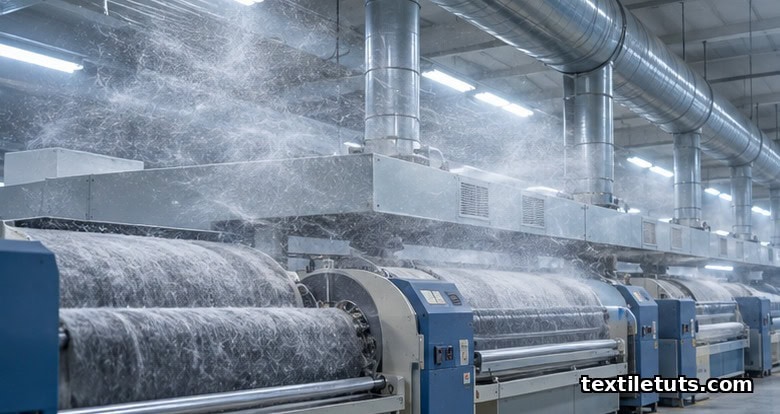
The root causes are well documented:
- Worn or improperly ground card clothing releases fiber fragments instead of holding fibers for transfer.
- Improperly set stripper and worker settings cause fiber to be thrown instead of transferred.
- Low humidity (below 50 percent RH) increases static, which releases fly into the air.
- Poorly sealed undercasings and missing suction ducts let fly escape into the room.
Solutions include installing a card-mounted suction system with 800 to 1,200 m³/h per card, maintaining relative humidity at 55 to 60 percent in the card room, and replacing card wire on a fixed schedule. ISO 139 specifies the 20 °C and 65 percent RH standard atmosphere for textile testing; production rooms should run within ±2 percent RH of this target.
5. Drafting-wave and drafting-zone defects
A drafting wave is a periodic thickness variation caused by fibers slipping in the drafting zone. It shows up on the spectrogram as a recurring wavelength between 2 cm and 8 cm. The most common causes are incorrect top roller pressure, mismatched apron gauge, and incorrect spacer width.
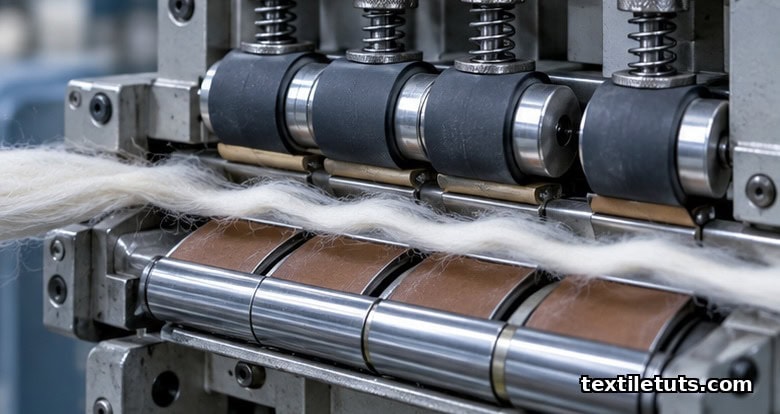
For a 30s Ne cotton yarn running on a modern ring frame with four-line drafting, the standard settings are:
- Top roller pressure: 18 to 22 kg per cm.
- Apron spacing: 38 to 42 mm for cotton, 44 to 48 mm for blends.
- Cradle gap: 3.5 to 4.5 mm.
- Top roller run-out: less than 0.03 mm.
Failure to meet any one of these introduces a visible drafting wave. The fix is a drafting audit: pull and inspect top rollers, measure cradle gap with a feeler gauge, and re-set apron spacers per the maker’s chart. Most drafting-wave problems resolve within an hour after a proper audit.
6. Hairiness and surface fiber
Yarn hairiness, measured as the H-index on a Zweigle Hairiness Tester, is a value-add parameter for weaving and knitting. For a 30s Ne combed cotton ring yarn, an H-index above 6.0 causes shedding on the loom and visible surface defects in knit fabric. Acceptable range is 4.5 to 5.5.
Hairiness is influenced by fiber length, twist, and traveler condition. A 1 mm increase in effective fiber length reduces H-index by approximately 0.3 units. A traveler burn mark can raise H-index by 0.8 units within a single doff. The fixes are mechanical: replace the traveler at the first sign of burn, verify top roller concentricity, and verify the yarn twist multiplier is at 4.0 to 4.4 (TM for cotton ring yarn).
7. Environmental drift: temperature and humidity
Spinning is humidity-sensitive. Cotton yarn moisture regain of 7 to 8.5 percent is required for stable processing; outside that window, fiber friction and yarn tension shift measurably. ISO 139 specifies 20 °C and 65 percent RH as the standard atmosphere, and production rooms should be controlled to within ±2 percent RH. Most mill buildings run between 25 and 32 °C in warm climates, which is acceptable provided humidity is stable.
Symptoms of poor environmental control include higher end breakage in the morning (low overnight RH), static shocks in synthetic processing, and inconsistent yarn count (because conditioned weight changes). Modern air-handling units with chilled-water cooling and steam humidification hold the room within ±1 percent RH year-round; the energy cost of doing so is recovered in lower end-breakage and fewer downgrades.
Yarn quality benchmarks (30s Ne combed cotton)
| Parameter | Unit | Top 5% | Median | Bottom 25% | Rejection limit |
|---|---|---|---|---|---|
| Coefficient of variation (CV) | % | 12.5 | 14.5 | 16.0 | 17.0 |
| Thin places (-50%) | per 1,000 m | 1 | 5 | 15 | 25 |
| Thick places (+50%) | per 1,000 m | 10 | 35 | 90 | 120 |
| Neps (+200%) | per 1,000 m | 40 | 110 | 280 | 400 |
| H-index (hairiness) | index | 4.0 | 5.0 | 6.0 | 6.5 |
| End-breakage rate | per 1,000 spindle-h | 5 | 15 | 30 | 40 |
Frequently asked questions
What is the acceptable end-breakage rate in a ring spinning mill?
The acceptable end-breakage rate for combed cotton ring-spun yarn is 5 to 25 breaks per 1,000 spindle-hours, depending on count. Anything above 30 per 1,000 indicates a process fault that needs a mechanical or environmental audit, not normal variation.
How do you control yarn unevenness in spinning?
Yarn unevenness is controlled at the card and drawframe: card sliver CV should sit below 3.5 percent and drawframe sliver CV below 2.0 percent. Modern autoleveler drawframes can drive sliver CV below 1.5 percent and reduce downstream yarn CV by 1 to 2 percentage points.
What causes neps in yarn and how do you remove them?
Neps form in the blowroom and card when fibers are mechanically entangled by worn wire or excessive beater speed. They are removed by combing, which eliminates 70 to 80 percent of card-sliver neps. The best fix is to stop generating them upstream by auditing card clothing and verifying cylinder speed.
Why does relative humidity matter so much in spinning?
Cotton fiber friction changes with moisture regain. Below 6 percent regain, fibers become brittle and break; above 9 percent, drafting becomes uncontrolled. ISO 139 specifies 20 °C and 65 percent RH as the standard atmosphere, and production rooms should sit within ±2 percent RH of that target.
What is the most common reason for yarn count variation?
Yarn count variation (CV of count) is most often caused by roving CV variation, not by ring spinning itself. A 1 percent roving CV translates into roughly 0.8 percent yarn count CV. The fix is a roving-frame audit: check the flyer speed, top roller pressure, and roving twist multiplier against the machine maker’s standard.
References
- ISO 2061:2015. Textiles – Determination of yarn linear density (count) by the skein method. International Organization for Standardization. Yarn count reference method.
- ISO 2060:1994. Textiles – Yarn from packages – Determination of single-end linear density. International Organization for Standardization. Single-end count test.
- ISO 139:2005. Textiles – Standard atmospheres for conditioning and testing. International Organization for Standardization. Specifies 20 °C and 65% RH test atmosphere.
- ASTM D2256 / D2256M-21. Standard Test Method for Tensile Properties of Yarns by the Single-Strand Method. ASTM International. Tensile strength and elongation reference.
- Krifa, M., & Ethridge, M. D. (2006). Compact spinning effect on cotton yarn quality: interactions with fiber characteristics. Textile Research Journal, 76(5), 388-399. Peer-reviewed study on yarn evenness drivers.
- Lawrence, C. A. (2020). Advances in Yarn Spinning Technology. Woodhead Publishing (Elsevier). Academic textbook on ring, rotor, and air-jet spinning processes.
- Barella, A., & Manich, A. M. (1989). Yarn hairiness: a further review. Textile Progress, 19(4), 1-36. Peer-reviewed review of hairiness measurement and causes.
This article is the working reference for spinning mill process control and yarn-quality benchmarking. Editorial by Iftay Khairul Alam, TextileTuts. Sources: ISO 2061, ISO 2060, ISO 139, ASTM D2256, Textile Research Journal, and Woodhead Publishing as cited.


