
10-Point Fabric Inspection System

Fabric graded under the 10-point inspection system earns First Quality status when it accumulates no more than 20 to 30 penalty points per 100 linear yards, Second Quality at 31 to 40 points, and is rejected above 40 points, with each defect class carrying a fixed deduction between 1 and 4 points based on its severity to the garment cut-and-sew operation.
This penalty-point framework, originally codified by the United States military in the 1940s as MIL-STD-105 and later adopted by textile mills worldwide, lets a buyer reject an entire shipment with a single agreed threshold rather than arguing defect-by-defect with the supplier.
This guide walks through each of the ten defect classes, the exact point values, the math behind the yardage thresholds, the inspection speed and lighting conditions specified by ISO 2859-1, and the practical decisions a quality team faces when a roll falls on the borderline.
Origin and Modern Scope of the 10-Point System
The 10-point system was formalized as the grading scheme referenced by the American Apparel Manufacturers Association (now the American Apparel & Footwear Association) and adopted in U.S. government textile purchase contracts through the mid-twentieth century. It is not an ISO, AATCC, or ASTM standard; rather, it is a commercial contract standard that two parties agree to invoke, with most mills referencing it through the four-point system at 100 points per 100 yards for stricter sampling.
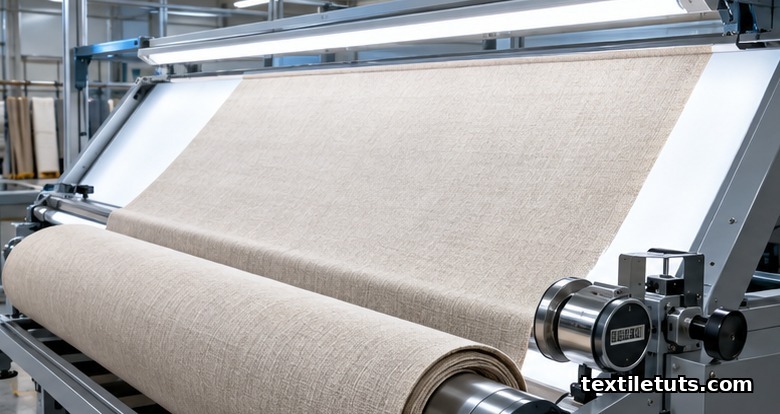
In modern apparel sourcing, the buyer specifies which scheme (10-point or 4-point) applies in the purchase order, the inspection speed (typically 15 yards per minute), and the lighting level (minimum 1000 lux at the inspection table per ISO 2859-1 sampling guidance and AATCC Evaluation Procedure 9). The fabric arrives at the inspection table on a fabric inspection machine (often called a “fabric guider” or “measuring machine”), is passed over a slanted illuminated panel, and an inspector records each defect against the ten classes below.
The Ten Defect Classes and Their Point Deductions
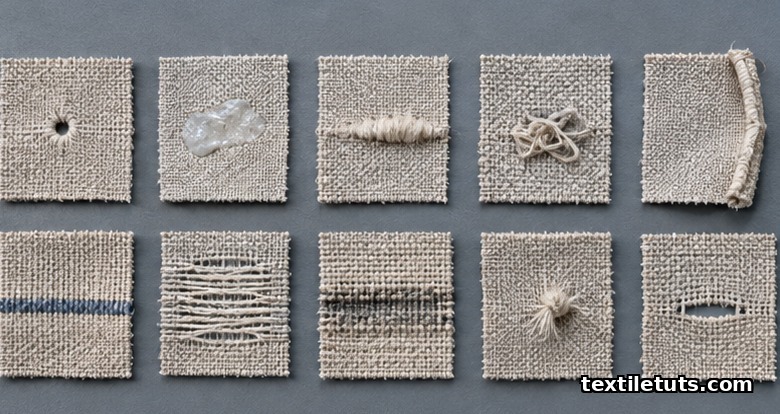
Each defect class carries a fixed point deduction per occurrence. The points are not interchangeable: a hole cannot be “split” into two smaller deductions, and a hole longer than a threshold cannot be downgraded. The table below reproduces the canonical deductions used in the U.S. textile trade and reproduced in academic textile-testing references.
| Point # | Defect Class | Description | Point Deduction per Occurrence |
|---|---|---|---|
| 1 | Holes or Tears | Open fabric damage, including needle holes larger than 1 mm and slits. | 4 points (also called a “major” or “critical” defect) |
| 2 | Coated or Encapsulated Yarn | Sticky or fused yarn sections that resist separation during sewing. | 4 points |
| 3 | Slubs, Foreign Yarn, or Nepps | Thick places in yarn or foreign matter contaminating the weave. | 3 points |
| 4 | Snarls or Mispicks | Yarn pulled out of the weave structure or interlacing errors. | 3 points |
| 5 | Bad Selvedge | Cut, curled, or improperly woven selvedge that will not feed through the cutting machine. | 3 points |
| 6 | Wrong Yarn (Color or Count) | Yarn that does not match the approved color standard or count spec. | 3 points |
| 7 | Floats | Yarn that floats over more warp or weft ends than the weave pattern allows. | 2 points |
| 8 | Barriness or Uneven Yarn | Visible horizontal or vertical bands caused by yarn count variation. | 2 points |
| 9 | Knots | Yarn knots not trimmed flush with the fabric surface. | 1 point |
| 10 | Dropped Pick or Stitch | Missing end or pick in woven fabric, or missing course in knit fabric. | 1 point |
Total points are summed across the entire inspected roll, divided by the inspected length (typically 100 yards), and compared to the agreed quality threshold.
Reading the Penalty-Point Thresholds
A roll that scores 28 points per 100 yards is First Quality. A roll that scores 38 points per 100 yards is Second Quality and typically triggers a commercial discussion: the buyer may accept with a discount, request re-rolling, or reject the lot. A roll that scores 45 points per 100 yards fails outright under most purchase contracts and is sent back at the mill’s expense.
The 4-point system at 100 points per 100 yards is the tighter cousin: only defects 1 through 10 with deductions of 4, 3, 2, and 1 are tracked, and “firsts” must score below 100 points per 100 yards (1 point per yard average). It is the standard demanded by U.S. department-store buyers and most mass-market garment programs.
Inspection Conditions: Lighting, Speed, and Bias
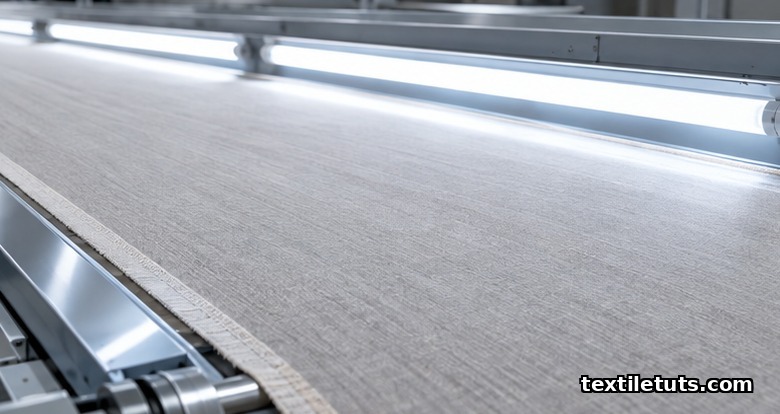
Two environmental parameters quietly change the score: the lighting level at the inspection table and the speed at which the fabric moves past the inspector. AATCC Evaluation Procedure 9 specifies that fabric inspection lighting should be a cool-white fluorescent source at 750 to 1500 lux, with the inspector’s eye perpendicular to the fabric plane to avoid shadowing defects.
Speed matters because the human eye integrates visual information over time. Inspection speeds above 20 yards per minute measurably reduce the detection rate of low-contrast defects such as barriness and minor slubs, a finding documented in peer-reviewed ergonomic studies of visual-search performance. Most commercial inspection machines run between 12 and 18 yards per minute; military contracts run slower.
Fabric bias also affects the count: a 2-degree bias in a woven fabric is recorded as one defect per affected yard and can quickly move a roll from First to Second Quality. The width roll should be flat on the inspection table, not folded, so that the inspector sees both selvedges simultaneously.
How the Inspection Is Sampled
Full-roll inspection (every yard inspected) is the default for the 10-point system, but ISO 2859-1 sampling plans are widely used for sampling inspection when full inspection is impractical. The acceptance number depends on the lot size and the chosen AQL (Acceptable Quality Level); a typical woven-fabric AQL of 2.5% under General Inspection Level II corresponds to sample sizes from 32 rolls for a 51-roll lot up to 200 rolls for lots larger than 1200 rolls.
The 10-point system does not by itself replace AQL sampling; many buyers run both: the 10-point system to score the inspected sample, and ISO 2859-1 to decide whether the score is good enough to accept the lot. This dual approach is the standard referenced by test labs such as SGS, Intertek, and Bureau Veritas in their woven-fabric inspection protocols.
The Anxiety Question: When the Roll Is on the Borderline
A roll that scores exactly 31 points per 100 yards is, by the strict definition, Second Quality, but most garment buyers will accept it if the defects cluster (so they can be cut around in the marker) rather than distribute (forcing cut waste across the marker). This clustering decision is the single most contested negotiation between buyer and supplier, and it has no fixed rule: each defect class is reviewed for whether it falls inside a marker zone or on the seam.
Practical guidance: a 31 to 35 point roll with clustered defects and no holes usually passes after the supplier offers a 2 to 5 percent discount. A 36 to 40 point roll with distributed defects is almost always rejected, especially if any 4-point hole or coated-yarn defect is present, because a single hole in a cut panel is a single garment lost.
Limitations and Modern Adaptations
The 10-point system was designed for woven fabrics and predates the rise of knit and technical-textile manufacturing. Knits are typically inspected against the same defect classes but the deduction weights are adjusted because a small hole in a knit can run easily and become catastrophic. Modern fabric inspection increasingly supplements the 10-point system with computer-vision inspection, where cameras at 0.1 mm resolution per pixel can detect sub-millimeter defects that the eye misses; the buyer still records scores under the 10-point framework, but the AI assists the human inspector rather than replacing the contractual standard.

For technical textiles (medical, geotextile, protective wear), additional defect classes such as coating pinholes, fiber orientation defects, and basis-weight variation are added to the contract, and the 10-point system becomes one of several scoring layers.
Internal Link Opportunities
Readers who arrive at this article often need follow-up support for the calculations it implies. The TextileTuts fabric consumption calculators (woven shirt and T-shirt) let a merchandiser convert penalty points into actual cut-waste percentages when defects cannot be avoided. The fabric GSM calculator pairs with the inspection table to flag rolls whose measured GSM falls outside the ±5% tolerance agreed in the spec sheet, a separate but common cause for rejection.
Frequently Asked Questions
What is the difference between the 10-point system and the 4-point system at 100 points per 100 yards?
The 10-point system deducts between 1 and 4 points per defect across ten named classes and grades First Quality at 20 to 30 points per 100 yards. The 4-point system at 100 points per 100 yards is stricter: only defects deducting 1, 2, 3, or 4 points count, and First Quality requires fewer than 100 points per 100 yards (an average of one point per yard). The 4-point system is the more common standard in U.S. mass-market apparel contracts; the 10-point system is used where looser defect definitions are acceptable.
Who decides whether a fabric passes inspection, the mill or the buyer?
The buyer does, within the contract. The mill runs the inspection on its own floor and submits an inspection report, but the buyer has the right to arrange a third-party inspection by a lab such as SGS, Intertek, QIMA, Bureau Veritas, or TESTEX. If the third-party score disagrees with the mill’s score by more than the contract’s tolerance band (often ±10 percent of points per 100 yards), the third-party score governs.
How fast should fabric move during 10-point inspection?
Commercial mills typically run 12 to 18 yards per minute (11 to 17 m/min). Slower inspection (8 to 12 yards per minute) increases defect detection but raises labor cost; faster inspection (above 20 yards per minute) reduces detection of slubs, neps, and barriness. AATCC Evaluation Procedure 9 specifies the lighting condition but does not set a fixed speed; most buyers specify 15 yards per minute in the purchase contract.
Can a roll be re-inspected if it fails the first inspection?
Yes, and this is common practice when the failing defect is a single 4-point hole. The mill may cut out the affected yard, splice the roll, and resubmit. Most contracts allow a re-inspection pass that adds no more than 20 percent new yardage; if the re-inspected roll still exceeds the threshold, it is rejected outright.
What lighting is required for 10-point fabric inspection?
Cool-white fluorescent light at 750 to 1500 lux at the fabric surface, with the inspector’s viewing angle perpendicular to the fabric plane. LED panels rated 5000 to 6500 K are an acceptable modern equivalent. Light levels below 500 lux cause inspector fatigue and reduce defect detection; light levels above 2000 lux create glare and again reduce detection. The light source should illuminate both faces of the fabric simultaneously, which is why most inspection machines use a slanted illuminated panel rather than overhead lighting alone.
References
- American Association of Textile Chemists and Colorists. Evaluation Procedure 9: Visual Assessment of Fabric Defects. AATCC, Research Triangle Park, NC. Reference standard for inspection lighting and viewing conditions.
- ASTM D5430-13. Standard Test Methods for Visually Inspecting and Grading Fabrics. ASTM International, West Conshohocken, PA. Companion standard to the 10-point system covering woven and knit fabrics.
- International Organization for Standardization. ISO 2859-1: Sampling Procedures for Inspection by Attributes. ISO, Geneva. The sampling framework used alongside the 10-point grading to decide lot acceptance.
- American Apparel & Footwear Association. 10-Point Grading System Reference Table. AAFA, Arlington, VA. Historical codification of the original defect-class deductions reproduced in the table above.
- SGS Textile Inspection Services. Woven Fabric Inspection Protocol. SGS, Geneva. Modern third-party inspection workflow used by sourcing teams.
- Intertek. Softlines Inspection Handbook: 4-Point and 10-Point Systems. Intertek, London. Operational comparison of the two dominant grading schemes.
- TESTEX. Fabric Grading Reference for Apparel Buyers. TESTEX, Zurich. European reference for the 4-point system used in EU apparel sourcing.
This article is the working reference for fabric-inspection grading under the 10-point system. Editorial by Sabbir Ahmed, TextileTuts. Sources: AATCC EP9, ASTM D5430, ISO 2859-1, AAFA, SGS, Intertek, TESTEX as cited.


