
Colorfastness to Light: ISO 105 B02

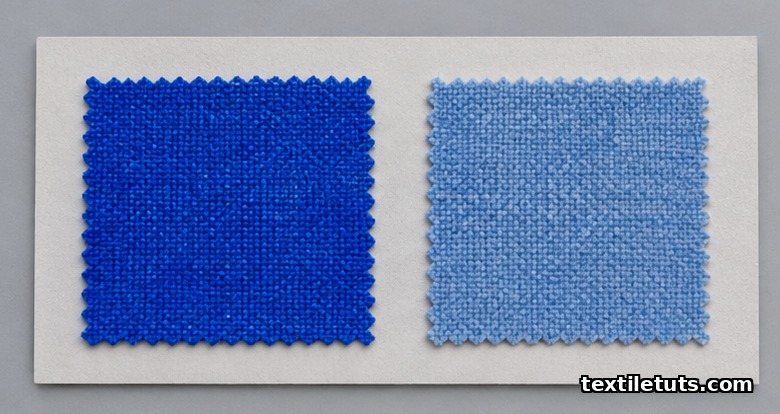
ISO 105-B02:2014 specifies a xenon arc fading lamp test for textile colorfastness to artificial light, exposing specimens under controlled conditions of 50±5% relative humidity with irradiance of 1.10±0.02 W/m² at 420 nm for durations scaled to end-use exposure.
This method simulates the D65 daylight spectrum that destroys textile dyes through photochemical reactions, ranking fabrics on an 8-step blue wool scale where grade 8 represents the most lightfast dye and grade 1 fades visibly within hours of xenon exposure.
This guide covers what ISO 105-B02 measures, how the xenon arc apparatus replicates sunlight, how to interpret blue wool ratings against gray scale change, and how the standard compares to related ISO 105-B parts and AATCC TM 16.
Why Colorfastness to Light Matters in Textile Manufacturing
Dye loss to sunlight is a photochemical problem, not a washing problem. Ultraviolet photons break the chromophore’s conjugated pi-electron system in dyes and pigments, producing colorless or yellow photoproducts. The faster the photodegradation, the faster the visible hue drifts and contrast patterns lose definition.
For an automotive seat cover, curtains, outdoor apparel, or contract upholstery, a fabric that fades after 200 hours of sun exposure is a return, not a product. ISO 105-B02 gives manufacturers, retailers, and buyers a single, repeatable test that compresses months of sunlight into days of accelerated aging.
The economic stakes are high. A 2018 study in the journal Dyes and Pigments noted that color quality complaints consistently rank among the top three returns drivers for home textile and apparel products, with lightfastness failures leading the list for outdoor and automotive end-uses. A reliable lab test that correlates with field performance saves the industry both reputation and recall costs.
What ISO 105-B02 Actually Tests
ISO 105-B02:2014 is titled “Textiles, Tests for colour fastness, Part B02: Colour fastness to artificial light: Xenon arc fading lamp test.” It is one of more than a dozen parts in the ISO 105 family, originally published in 1978 and revised through several editions to match advances in lamp and filter technology.
The test exposes a textile specimen alongside a set of blue wool reference fabrics of known lightfastness under a xenon arc lamp filtered to approximate D65 standard daylight. The exposure continues until a defined endpoint is reached, usually when the specimen shows a perceptible color change or matches a specified blue wool reference.
The scope is intentionally broad. The same method covers woven, knitted, and nonwoven fabrics, yarns, loose fibers, and even finished garments, provided a representative flat specimen can be mounted in the test chamber.
How the Xenon Arc Apparatus Replicates Sunlight
The xenon arc lamp emits a continuous spectrum from ultraviolet through visible into near-infrared. Raw xenon output is too energetic in the UV-B band to represent terrestrial sunlight, so the lamp is fitted with infrared-absorbing filters and either borosilicate or soda-lime glass filters to shape the output closer to D65 standard daylight.
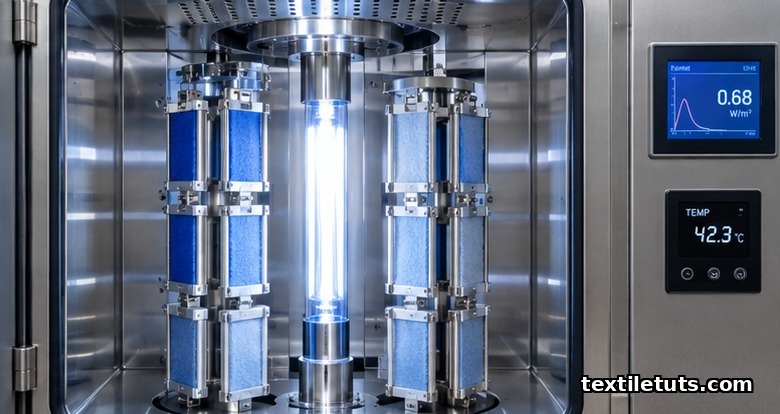
The filtered xenon beam delivers controlled irradiance inside a test chamber where temperature, relative humidity, and specimen rotation are all monitored. The 2014 edition specifies irradiance of 1.10±0.02 W/m² at 420 nm measured at the specimen plane, with chamber air temperature of approximately 25 to 35 °C and 50±5% relative humidity. A black-standard or black-panel thermometer simulates the heat absorption of a dark textile and limits test temperatures to around 50 to 65 °C depending on the chosen cycle.
Because the chamber rotates specimens around the lamp, every sample receives the same total radiant exposure regardless of position. This rotation, combined with calibrated 420 nm radiometers, is why a test run in Bangalore matches a test run in Berlin within tight tolerances.
The Blue Wool Reference Scale
ISO 105-B02’s rating scale relies on eight blue-dyed wool fabrics (designated 1 through 8) of certified, progressively higher lightfastness. Grade 1 is a fugitive dye that fades in a few hours of xenon exposure; grade 8 withstands roughly eight times longer. Each step in the scale roughly doubles resistance to light, giving the standard a near-geometric progression.
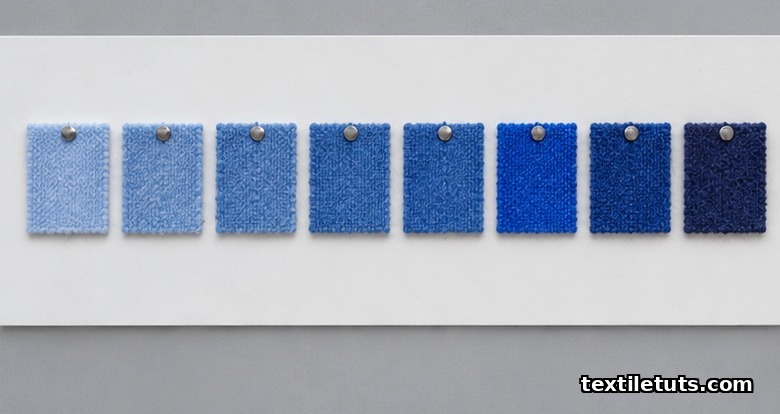
The standard requires these references to be purchased from an approved supplier because the dye recipe and application method define the rating itself. A laboratory cannot dye its own blue wool strip and assign a number to it. The references are batch-certified, and the certificate is the rating.
During the test, the specimen is mounted next to a strip of blue wool references and inspected at intervals. When the specimen shows a perceptible color change (typically gray scale grade 3, as defined in ISO 105-A02), the test operator notes which blue wool has faded to the same point. The specimen’s lightfastness is then reported as the number of the blue wool it matches or exceeds.
Test Conditions and Common Exposure Cycles
ISO 105-B02 offers several standard exposure cycles because no single set of conditions fits every end-use:
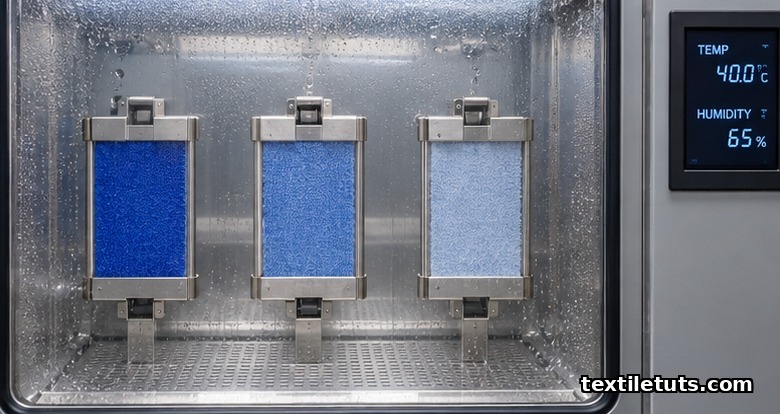
- Cycle A1 (general apparel, home textiles): moderate humidity, lower temperature, continuous light.
- Cycle A2 (automotive interior textiles): higher black-panel temperature around 89±2 °C, low humidity.
- Cycle A3 (outdoor textiles): continuous light with high humidity and elevated temperature to simulate tropical sunlight.
The 2014 revision tightened irradiance tolerances and clarified the use of narrowband 420 nm radiometers in place of older broadband meters, so that laboratories running the same test on different continents produce comparable numbers. It also added a guidance annex on correlating cycle selection with end-use exposure scenarios, which had been a frequent source of buyer-supplier dispute in earlier editions.
How Results Are Evaluated Against the Gray Scale
Color change is judged against the ISO 105-A02 gray scale, a set of nine pairs of gray chips differing in stepwise contrast. A score of 5 means no visible change; 1 means a stark contrast. The test continues until the specimen reaches gray scale 3, the midpoint at which an untrained observer can clearly see the difference under standard lighting.
For darker specimens, where a small change in lightness may hide larger chroma loss, complementary instrumental measurement using a spectrophotometer (CIELAB ΔE) is allowed. The 2014 edition permits ΔE calculation but still anchors the official rating to the gray scale, preserving traceability with the millions of historical test reports already on file in industry archives.
How ISO 105-B02 Compares to Related Standards
Three standards make up the core of textile lightfastness testing worldwide:
- ISO 105-B01 (Daylight) uses outdoor exposure racks at defined latitudes, used for long-term validation rather than routine QC.
- ISO 105-B02 (Xenon arc) is the accelerated test described here, the default in most commercial specifications.
- ISO 105-B04 (Xenon arc, alternating light and dark with humidity) adds dark cycles with high humidity to simulate day/night cycling.
In the United States, AATCC TM 16 (Colorfastness to Light) parallels ISO 105-B02 with similar xenon arc options and a slightly different framing of cycles. Many multinational buyers accept either rating, and several accredited laboratories run both side-by-side as a routine cross-check.
Practical Implications for Mills and Buyers
Specifying ISO 105-B02 in a purchase order is not enough. The cycle must be named, the blue wool rating threshold must be stated, and the test duration must be agreed. A “blue wool 5” claim from one supplier may mean 24 hours of cumulative exposure, while another supplier may have reached that rating only after 96 hours under a hotter cycle.
For outdoor fabrics such as awnings, marine canvas, or sun lounger fabric, blue wool 6 or higher is typical, often paired with ISO 105-B04 humidity cycling. For automotive interiors where glass magnifies solar load, blue wool 5 under cycle A2 (89±2 °C black panel) is the common floor. Apparel and home textiles can usually meet specifications at blue wool 4 or 5 under the milder cycle A1.
Frequently Asked Questions
What is the difference between blue wool 1 and blue wool 8?
Blue wool 1 fades after roughly 3 to 5 hours of xenon exposure under standard ISO 105-B02 conditions, while blue wool 8 withstands roughly 96 hours or more under the same conditions. Each step in the scale approximately doubles the resistance to light, giving the standard a near-geometric progression from fugitive dye to highly stable pigment.
How long does ISO 105-B02 testing take?
Most commercial laboratories report test durations of 24 to 96 hours depending on the lightfastness rating claimed and the cycle selected. Outdoor-grade specifications typically require 200 hours or more of cumulative xenon exposure before reporting, and high-stakes automotive or contract upholstery programs may run 500 to 1000 hours to validate long-term performance.
Is ISO 105-B02 the same as AATCC TM 16?
Both use a xenon arc lamp filtered to approximate daylight and rate specimens against blue wool references. ISO 105-B02 and AATCC TM 16 Option 3 align closely enough that most buying specifications accept either result, though cycle parameters, humidity targets, and the exact wording of the rating differ slightly between the two documents.
Can a fabric pass ISO 105-B02 but still fade in real sunlight?
Yes, because xenon arc exposure accelerates visible and near-UV damage but cannot replicate all wavelengths, pollutants, and seasonal humidity of real outdoor conditions. Outdoor specifications usually pair ISO 105-B02 with ISO 105-B01 outdoor exposure at a reference latitude for final validation, accepting that lab and field will correlate but never perfectly.
What blue wool rating is acceptable for curtains or outdoor cushions?
Home-textile and outdoor-fabric specifications typically require blue wool 5 or higher for moderate sunlight and blue wool 6 or higher for direct-sun applications. Upholstery and contract fabrics often need blue wool 5 to 7 depending on the buyer’s brand standard, with automotive interiors demanding blue wool 5 minimum under the harsher cycle A2 conditions.
References
- International Organization for Standardization. ISO 105-B02:2014 Textiles, Tests for colour fastness, Part B02: Colour fastness to artificial light: Xenon arc fading lamp test. iso.org, official standard text covering apparatus, cycles, and blue wool rating method.
- International Organization for Standardization. ISO 105-A02:1993 Textiles, Tests for colour fastness, Part A02: Grey scale for assessing change in colour. iso.org, gray scale rating method used to judge the color change endpoint.
- American Association of Textile Chemists and Colorists. AATCC Test Method 16: Colorfastness to Light. aatcc.org, the US counterpart method to ISO 105-B02 with comparable xenon arc options.
- International Organization for Standardization. ISO 105-B01:2014 Textiles, Tests for colour fastness, Part B01: Colour fastness to light: Daylight. iso.org, outdoor natural light exposure reference method.
- Christie, R. M. Colour Chemistry. Royal Society of Chemistry, textbook covering dye chromophore chemistry and the photodegradation pathways underlying the ISO 105-B02 test.
- Allen, N. S., Edge, M. Fundamentals of Polymer Degradation and Stabilization. Elsevier, reference on photochemical oxidation of textile polymers and stabilizer chemistry relevant to lightfastness prediction.
This article is the working reference for colorfastness to light testing under ISO 105-B02. Editorial by Iftay Khairul Alam, TextileTuts. Sources: ISO 105-B02:2014, ISO 105-A02, ISO 105-B01, AATCC TM 16, and cited textile chemistry literature as cited.


