
Cold Pad Batch Dyeing

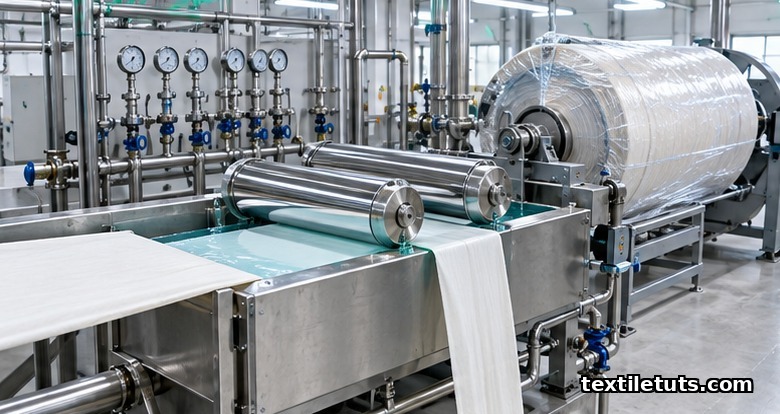
Cold pad batch dyeing (CPB) fixes 80 to 95 percent of reactive dye on cellulosic fabric at 20 to 30 °C by padding the cloth at 60 to 80 percent wet pickup, rolling it onto a batch, and letting it dwell for 8 to 24 hours before washing off hydrolysed dye.
That single temperature window is what makes CPB the lowest-energy reactive-dye route in textile wet processing: the dye reacts covalently with cotton without the salt-bath heating step used in exhaust dyeing, and the 8 to 24 hour dwell replaces the 60 to 90 second steam fixation of a continuous pad-steam line.
This guide walks through the chemistry, the padder mechanics, the recipe formulation, the process parameters you actually control on the floor, and how CPB stacks up against exhaust and pad-steam on water, salt, energy, and shade reproducibility.
What Cold Pad Batch Dyeing Is and Where It Sits in Wet Processing
Cold pad batch dyeing, abbreviated CPB or cold pad-batch, is a semicontinuous reactive-dye application method in which the dye and alkali are padded onto dry, prepared cotton (or other cellulosic) fabric, the fabric is wound onto a beam or rolled into a batch on a rotating carrier, and the batch is slowly rotated at ambient temperature for a controlled dwell time. During that dwell, the reactive dye system diffuses into the fiber and forms a covalent bond with the cellulose hydroxyl group, the same end result as exhaust or pad-steam reactive dyeing but reached without raising the bath temperature.
CPB is one of three reactive-dye routes a mill can choose: exhaust (the fabric is loaded into a machine, salt and alkali are added, the bath is heated to 60 to 80 °C), pad-steam (continuous pad followed by 100 to 105 °C steam fixation for 60 to 90 seconds), and CPB (continuous pad followed by ambient-temperature batching for 8 to 24 hours). Where CPB wins is on energy and water: cold fixation means no steam boiler load, and a single cold rinse plus a hot wash handles the unfixed-dye removal.
The trade-off is throughput. A pad-steam line running at 60 m/min processes several thousand metres per hour; a CPB line running at 30 to 80 m/min through the padder must then wait the dwell time before the same fabric can be washed. For mills with floor space and a regular product mix, that is a fair exchange.
The CPB Process, Step by Step
Every CPB line has the same five stages: pre-pad preparation, dye-liquor padding, batching and dwell, washing off, and drying. The dwell is what makes CPB a “cold” process, not the padder itself.
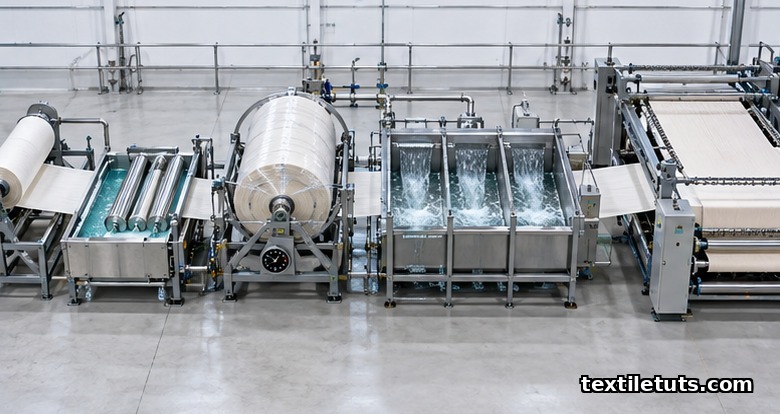
1. Pre-pad preparation
Fabric entering the CPB line must be uniformly absorbent and at a constant moisture content of about 6 to 8 percent (bone dry to air-dry range). The usual upstream steps are singeing, desizing, scouring, bleaching, and mercerising. Mercerising is not optional for deep shades: mercerised cotton takes up 20 to 30 percent more reactive dye than unmercerised cotton in CPB at equal padding conditions, because the mercerisation swells the fiber and opens the pore structure that the dye must diffuse through during the dwell.
2. Dye-liquor padding
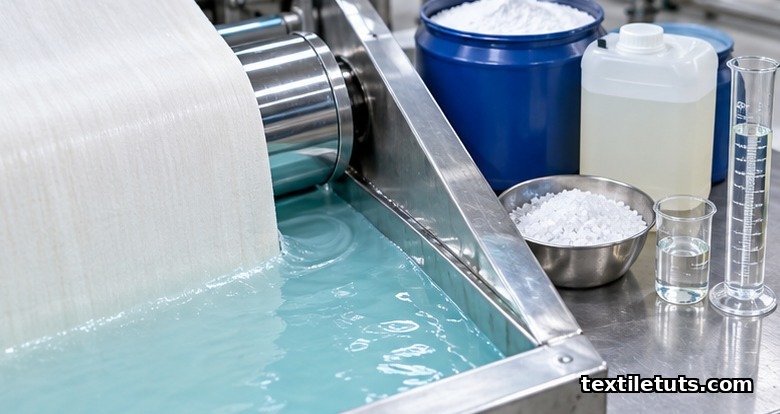
The padder applies a mixed liquor that contains the reactive dye, a wetting agent (0.5 to 1 g/L), the alkali (sodium carbonate at 5 to 20 g/L or a sodium carbonate and sodium hydroxide blend at 5 to 15 g/L total alkali), and water. Salt is sometimes added to the pad liquor to suppress dye aggregation, but at much lower concentrations than in exhaust dyeing (10 to 30 g/L in the pad versus 50 to 100 g/L in an exhaust bath) because the pad liquor contacts the fabric for less than a second and there is no long liquor to exhaust.
The fabric passes through the trough and then between two or three rollers under controlled pressure. Wet pickup, the weight of liquor retained on the fabric as a percentage of dry fabric weight, must be held inside 60 to 80 percent for cotton woven fabric. Below 60 percent the shade is uneven; above 80 percent the liquor migrates during batching and the leading and trailing edges of the roll develop shade differences. Roller pressure of 1 to 3 bar on the squeeze rollers, and padder speeds of 30 to 80 m/min, are typical.
3. Batching and dwell
Padded fabric is immediately wound onto a batch roll (or onto a beam) and wrapped in plastic film to prevent evaporation and carbon dioxide pickup from the air. The roll is placed on a rotating carrier that turns at 4 to 6 rpm for the entire dwell. Rotation prevents the liquor from draining to the bottom of the roll, which would create a shade gradient from top to bottom.
Dwell time is set by the reactivity of the dye system and the shade depth. Bifunctional reactive dyes (vinyl sulphone combined with chlorotriazine, or two vinyl sulphone groups) typically need 8 to 12 hours at 25 °C. Monofunctional vinyl sulphone dyes need 12 to 16 hours. Lower ambient temperatures stretch the dwell: at 20 °C the dwell is roughly 1.5 times the dwell at 30 °C for the same shade and the same fixation level.
4. Washing off
After the dwell, the fabric is unwound and washed in a multi-stage washer. The wash sequence is usually: cold rinse (room temperature) to remove salt and alkali, hot wash at 90 to 95 °C with nonionic surfactant to strip hydrolysed dye, a second hot wash, and a cold rinse. Total water consumption for the wash sequence runs 15 to 25 L/kg of fabric, against 80 to 150 L/kg for an exhaust reactive dyeing cycle, because the wash water in CPB only has to remove the small fraction of hydrolysed dye left after a successful fixation.
5. Drying
Hydroextracting or drying the washed fabric on a stenter completes the cycle. Shade is final at this point and can be measured spectrophotometrically against the standard.
Recipe Formulation: What Goes in the Pad Liquor
A typical CPB recipe for a medium-shade reactive dyeing on mercerised cotton woven fabric is:
| Component | Function | Range |
|---|---|---|
| Reactive dye | Color; covalent bond with cellulose | 5 to 50 g/L (shade dependent) |
| Sodium carbonate (soda ash) | Alkali; raises pH to 10.5 to 11.0 for fixation | 5 to 20 g/L |
| Sodium hydroxide (caustic) | Alkali; for deep shades and bifunctional dyes | 0 to 10 g/L (sometimes with silicate) |
| Sodium chloride or sulphate | Electrolyte; controls dye aggregation in pad liquor | 10 to 30 g/L |
| Wetting agent | Surfactant; ensures even wetting of dry fabric | 0.5 to 1 g/L |
| Sequestering agent | Chelates Ca and Mg hardness | 0.5 to 2 g/L |
The alkali is added last, just before the padder, to prevent hydrolysis of the reactive group in the pad trough. Pad liquor stability once alkali is added is short, typically 30 to 60 minutes, so the pad trough is sized to match the dwell-time-plus-padding-time cycle.
How CPB Compares With Exhaust and Pad-Steam Reactive Dyeing
Side-by-side, the three reactive-dye routes line up like this on the variables a mill actually cares about:
| Parameter | Cold Pad Batch | Pad-Steam | Exhaust |
|---|---|---|---|
| Fixation temperature | 20 to 30 °C | 100 to 105 °C | 60 to 80 °C |
| Fixation time | 8 to 24 h | 60 to 90 s | 60 to 90 min |
| Water use | 15 to 25 L/kg | 20 to 35 L/kg | 80 to 150 L/kg |
| Salt use (NaCl eq.) | 10 to 30 g/L pad | 5 to 20 g/L pad | 50 to 100 g/L bath |
| Reactive-dye fixation | 80 to 95 % | 85 to 95 % | 70 to 85 % |
| Throughput | Medium (limited by dwell) | High | Low (batch) |
| Setup capital | Low to medium | High (steam) | Medium |
| Best for | Short to medium runs, woven cotton | Long runs, woven cotton | Knits, yarn, small batches |
CPB sits in the middle on capital, the lowest on energy (no steam), and the lowest on water when the wash sequence is designed for it. Exhaust still wins for knits and yarn packages because liquor circulation is more uniform than padding on a stretchy substrate.
Process Control: The Variables That Decide Whether the Shade Passes
Four variables decide whether a CPB run passes or fails shade matching: fabric absorbency, wet pickup uniformity, dwell temperature, and dwell time.
Fabric absorbency is measured as capillary rise (AATCC 79) or sinking time; under 2 seconds is the working range for CPB. Slower wetting shows up as unlevel patches along the warp.
Wet pickup is checked by weighing the fabric before and after the padder at 10-metre intervals; the coefficient of variation across the roll should be under 3 percent. Roller pressure, trough level, and fabric tension are the three levers on pickup; trough level usually dominates.
Dwell temperature is monitored at the roll, not at the room thermostat. A 5 °C swing at the roll shifts the fixation by 5 to 10 percentage points for vinyl sulphone dyes, which is enough to push a medium-shade lot out of specification.
Dwell time is the easiest to keep constant and the easiest to get wrong. Setting 12 hours when the recipe calls for 16 hours leaves hydrolysed dye on the fiber that the wash cannot fully remove, and the result is a wash-fastness failure on the first hot wash the consumer does at home.
Common CPB Defects and Their Causes
Three defects show up often enough on CPB lines that they deserve specific mention.
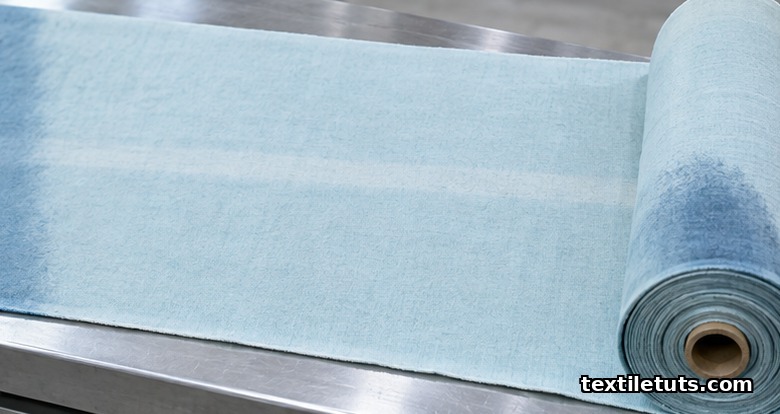
Shade variation end-to-end is usually traced to wet pickup drift caused by trough level falling as the pad liquor is consumed. Modern pad stands have automatic level control; older stands need a top-up schedule every 200 to 300 m of fabric.
Shade variation side-to-side is caused by misaligned squeeze rollers or uneven trough flow. Micrometer checks on roller parallelism every shift catch this early.
Tail-end darker shade happens because the outer wrap of the roll sees more evaporation and picks up carbon dioxide from the air; the alkali locally exhausts and fixation runs uneven. The standard fix is to use a tighter plastic wrap and to put a known bleed-off of 0.5 to 1 m of fabric at each end of the roll.
Poor wash fastness is almost always a dwell-time problem, sometimes a temperature problem. Re-wash and re-test against ISO 105-C06 or AATCC 61 will confirm.
Colorfastness Tests Run on CPB-Dyed Cotton
Shade is only part of the QC release. CPB-dyed cotton is normally tested against:
- ISO 105-C06 or C08, wash fastness at 40 °C and 60 °C
- ISO 105-X12, rubbing (crock) fastness, dry and wet
- ISO 105-B02, light fastness under xenon arc
- AATCC 8, colorfastness to crocking
- AATCC 16, colorfastness to light
- AATCC 61, accelerated laundering
CPB on properly mercerised cotton with a 12 to 16 hour dwell typically clears wash fastness grades 4 to 5, rubbing fastness 4 to 5 dry and 3 to 4 wet, and light fastness 4 to 6 depending on the chromophore.
Frequently Asked Questions
What is the difference between cold pad batch and pad-steam dyeing?
Cold pad batch dyes at 20 to 30 °C and lets the fabric dwell 8 to 24 hours before washing. Pad-steam dyes at the padder, then passes the fabric through a steamer at 100 to 105 °C for 60 to 90 seconds to fix the dye, then washes. CPB uses less energy because there is no steam; pad-steam uses less floor space because there is no dwell.
Which reactive dyes work in cold pad batch?
Bifunctional reactive dyes (combining a vinyl sulphone and a chlorotriazine group, or two vinyl sulphone groups) are the workhorses of CPB because they fix efficiently at 25 to 30 °C. Monofunctional vinyl sulphone dyes also work, but they need longer dwell times (12 to 24 hours) and are more sensitive to temperature swings. High-reactivity dyes such as dichlorotriazine types react too fast at room temperature and can hydrolyse in the pad trough before they reach the fiber.
Is mercerisation necessary for cold pad batch dyeing?
For pale shades, mercerisation can be omitted. For medium and dark shades on woven cotton, mercerisation raises dye uptake 20 to 30 percent and improves shade reproducibility run to run. Unmercerised cotton in CPB also tends to show more end-to-end and side-to-side shade variation because the less-swollen fiber takes up liquor less uniformly.
How long should a cold pad batch dwell before washing?
Dwell time is set by the dye system, the alkali strength, and the ambient temperature. As a working rule, plan 12 to 16 hours at 25 °C with a bifunctional reactive dye and 5 to 20 g/L soda ash; 18 to 24 hours for vinyl sulphone dyes at lower ambient temperature; 8 to 12 hours only for the most reactive bifunctional dyes in warm conditions. Cutting the dwell short leaves hydrolysed dye on the fiber and a wash-fastness failure.
What causes shade variation across the roll in CPB?
The three most common causes are wet pickup drift from a falling pad-trough level, misaligned squeeze rollers, and inadequate roll rotation during the dwell. A fourth, less common cause is evaporation from the outer wrap of the roll, which exhausts the alkali locally; the fix is tighter plastic wrapping plus 0.5 to 1 m of bleed-off fabric at each end of the roll.
References
- ISO. ISO 105-C06:2010, Textiles — Tests for colour fastness — Part C06: Colour fastness to domestic and commercial laundering. International Organization for Standardization. https://www.iso.org/standard/51021.html — Small-scale wash-fastness test for the QC release of reactive-dyed cellulosic fabric.
- ISO. ISO 105-X12:2016, Textiles — Tests for colour fastness — Part X12: Colour fastness to rubbing. International Organization for Standardization. https://www.iso.org/standard/65251.html — Crocking test (dry and wet) used for reactive-dyed cotton at QC release.
- AATCC. AATCC Test Method 8: Colorfastness to Crocking (Crockmeter Method). American Association of Textile Chemists and Colorists. https://www.aatcc.org/testing/methods/test-method-8/ — Standard crocking reference for wash-and-wear cotton.
- AATCC. AATCC Test Method 61: Colorfastness to Laundering, Accelerated. American Association of Textile Chemists and Colorists. https://www.aatcc.org/testing/methods/test-method-61/ — Accelerated wash-fastness method used to predict multi-cycle consumer laundering performance.
- Shore, J. (Ed.). Cellulosics Dyeing. Society of Dyers and Colourists, 1995. ISBN 978-1-85573-319-0. https://www.sciencedirect.com/book/9781855733190 — Foundational reference on reactive-dye chemistry and pad-batch application on cotton.
- Lewis, D. M. (Ed.). Handbook of Textile and Industrial Dyeing, Volume 1: Principles, Processes and Types of Dyes. Woodhead Publishing, 2011. ISBN 978-1-84569-695-5. https://www.sciencedirect.com/book/9781845696955 — Industrial reference covering pad-batch, pad-steam and exhaust reactive-dyeing process parameters on cotton.
This article is the working reference for cold pad batch (CPB) reactive dyeing on cotton and other cellulosic fabrics. Editorial by Shahrukh Islam, TextileTuts. Sources: ISO 105-C06, ISO 105-X12, AATCC 8, AATCC 61, Shore (1995), Lewis (2011) as cited.


