
Biodegradable Fabrics: Hemp

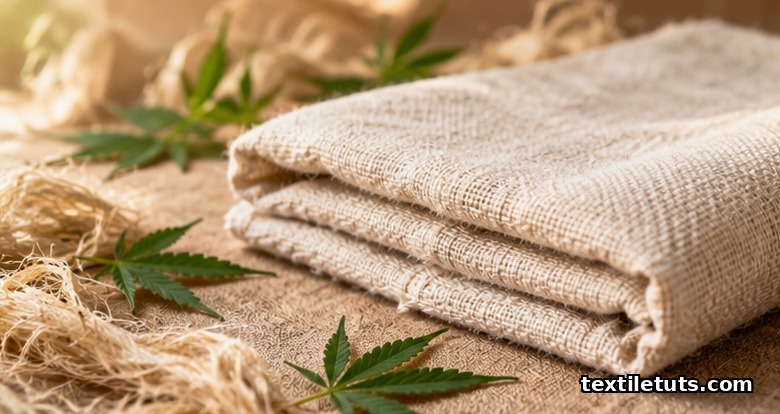
Hemp fabric is 100% biodegradable and decomposes in soil within 2–6 weeks under industrial composting conditions (55–65 °C, 50–60% moisture) because its cellulose-heavy structure (70–77% cellulose, 10–15% hemicellulose, 3–10% lignin) is fully metabolized by soil microorganisms into CO2, water, and biomass, leaving no toxic residues or microplastics. Unlike polyester, which persists for an estimated 200+ years in landfill, hemp returns to the soil in a single growing season when composted correctly, which is why textile engineers treating end-of-life impact often rank hemp among the fastest-cycling natural bast fibers.
This article covers the chemistry that makes hemp biodegradable, the rate at which it decomposes under different conditions, the standards that certify compostable textiles (ASTM D6400, ASTM D6868, ISO 17088, ISO 20200), how hemp compares to cotton and linen in decomposition tests, and the practical implications for end-of-life disposal, agricultural burial, and industrial composting facilities.
Why Hemp Biodegrades: The Fiber Chemistry
Hemp (Cannabis sativa L.) is a bast fiber, meaning it is harvested from the long outer stems of the plant rather than the seed or leaf. The fibers that end up in woven and knit hemp textiles are composed of three structural polymers: cellulose, hemicellulose, and lignin. This composition is the single most important fact for understanding biodegradation, because soil and compost microbes (bacteria such as Bacillus and Cellulomonas, and fungi such as Trichoderma and Aspergillus) produce enzymes that specifically break these polymers down.
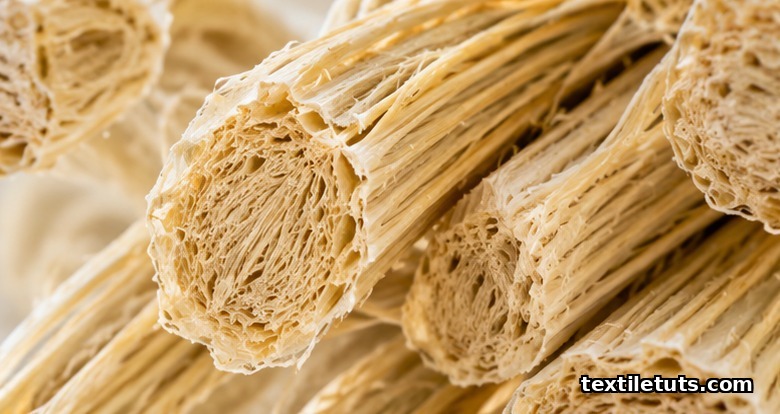
The typical composition of degummed hemp fiber used in apparel textiles falls in this range:
- Cellulose: 70–77% (the primary structural polymer; attacked by cellulase enzymes)
- Hemicellulose: 10–15% (branched polysaccharides that microbes metabolize first because they are amorphous and accessible)
- Lignin: 3–10% (a complex aromatic polymer that resists attack but is slowly degraded by white-rot fungi over weeks to months)
- Pectins, waxes, and water-soluble compounds: the remaining balance (most are removed during retting and scouring, but residual fractions are still biodegradable)
There are no synthetic polymers in untreated hemp fiber. There is no polyethylene terephthalate (PET), no polyamide, no acrylic backbone that resists microbial attack. The fiber is, in polymer terms, food for the soil microbiome.
How Fast Hemp Decomposes: Soil and Compost Burial Data
Biodegradation rate depends on four variables: temperature, moisture, oxygen availability, and microbial activity. When those variables are held in the range favorable to microbial metabolism, hemp loses measurable mass within days and disintegrates (loses visible fabric structure) within weeks.
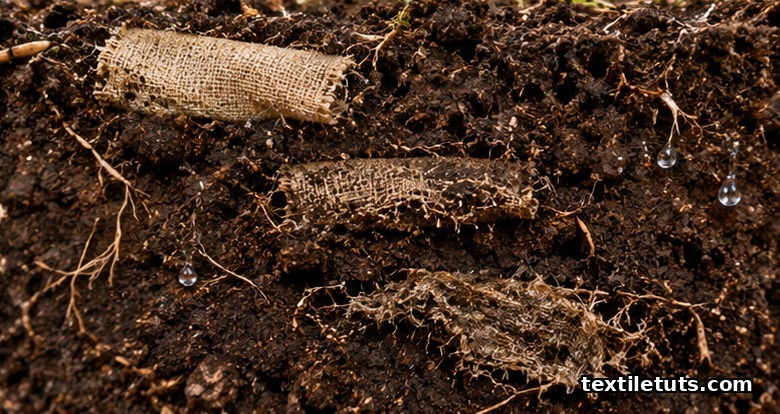
Published soil-burial test data on bast fibers show consistent patterns:
- At 25 °C and ambient moisture (typical garden soil): hemp fabric loses 50% of its tensile strength in roughly 7–14 days and fully disintegrates within 6–12 weeks, depending on yarn count and finishing.
- At 55–65 °C with 50–60% moisture (industrial composting per ASTM D6400 conditions): disintegration typically completes within 2–6 weeks.
- At 20 °C in seawater with active marine microbes: hemp shows measurable mass loss within 30–60 days, although cool ocean temperatures slow the cycle relative to compost.
For comparison, a 2019 peer-reviewed soil burial study on bast fibers reported that hemp lost over 60% of its mass within 60 days under controlled composting conditions, while cotton lost a similar fraction but took 10–15% longer because of cotton’s higher crystallinity. Linen (flax) performed comparably to hemp. Polyester in the same study showed no measurable mass loss across the entire 90-day test window.
Standards That Certify Compostable Textiles
“Biodegradable” is not a marketing term that textile companies can apply without measurement. The textile industry uses four international standards to certify that a fiber or finished textile will fully biodegrade under defined conditions:
- ASTM D6400: Standard Specification for Labeling of Plastics Designed to be Aerobically Composted in Municipal or Industrial Facilities. Requires ≥90% conversion to CO2 within 180 days under controlled composting, plus no heavy metals above threshold limits and no ecotoxicity in the finished compost.
- ASTM D6868: Standard Specification for Labeling of End Items that Incorporate Plastics and Polymers as Components or Coatings. Covers products like coated paper or multilayer textiles where only a portion is polymeric.
- ISO 17088: Specifications for compostable plastics, broadly aligned with ASTM D6400 but used as the international reference outside North America.
- ISO 20200: Plastics: Determination of the degree of disintegration of plastic materials under simulated composting conditions at laboratory scale. The actual test method used to measure disintegration.
Pure, untreated hemp fabric passes these tests comfortably because the underlying chemistry supports complete biological conversion. The standards apply more strictly to bio-based synthetic fibers (PLA, PHA) where the polymer is technically compostable but conditions must be controlled. Hemp needs no special pleading; it biodegrades wherever microbes are active.
Hemp vs Cotton vs Linen vs Polyester: Biodegradation Compared
The fastest way to communicate hemp’s end-of-life advantage is to put it next to the materials a reader is most likely to compare it with. The table below summarizes behavior under industrial composting conditions (55 °C, 55% moisture, active aeration).
| Fiber | Composition (primary polymer) | Time to full disintegration | End products | Microplastic release? |
|---|---|---|---|---|
| Hemp | Cellulose 70–77%, hemicellulose 10–15%, lignin 3–10% | 2–6 weeks | CO2, water, biomass, humus | No |
| Cotton | Cellulose ~88–96% | 4–12 weeks | CO2, water, biomass, humus | No |
| Linen (flax) | Cellulose ~70–80%, hemicellulose and lignin balance | 2–6 weeks | CO2, water, biomass, humus | No |
| Wool | Keratin protein | 3–12 months | CO2, water, nitrogen-rich biomass | No |
| Polyester (PET) | Polyethylene terephthalate | 200+ years (no significant microbial metabolism) | Persists as solid; sheds microfibers | Yes |
| Nylon 6,6 | Polyamide | 30–50 years estimated for partial degradation; resistant to microbial attack | Persists as solid; sheds microfibers | Yes |
The textile-industry term for the breakdown pathway that hemp follows is aerobic biodegradation: microbes use oxygen to convert the polymer carbon into CO2, with the remainder incorporated into microbial biomass. This is distinct from anaerobic biodegradation (which produces methane in oxygen-poor landfills) and from abiotic hydrolysis (the slow chemical breakdown that still leaves synthetic microplastic fragments).
Does Hemp Biodegrade in a Home Compost or Backyard?
Yes, but the rate is slower. Home compost piles typically run at 30–45 °C with variable moisture and aeration, while industrial composters hold 55–65 °C with active turning and controlled humidity. At home-compost temperatures, expect hemp to disintegrate within 8–16 weeks instead of 2–6. Burial directly in garden soil works too: a hemp T-shirt buried in fall typically leaves only fragments by the following spring in temperate climates.
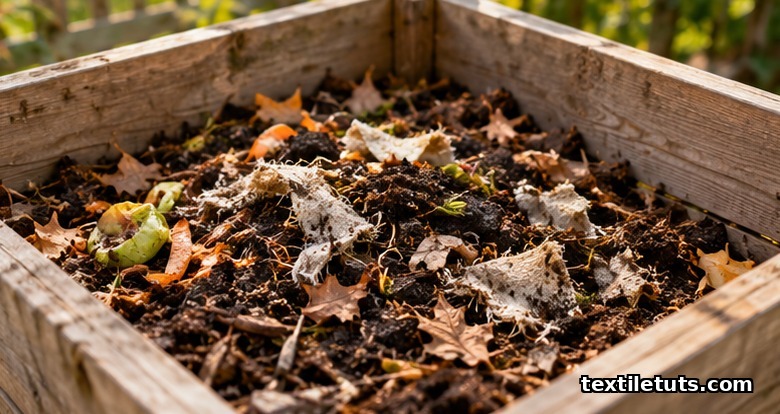
Two practical notes for home composting of hemp textiles:
- Remove synthetic trims first. Buttons, zippers, polyester thread, and printed logos are not hemp. They will persist in the compost and need to be cut out or accepted as inert contaminants (analogous to how gardeners treat plant ties or wooden stakes in finished compost).
- Shred or cut the fabric into small pieces. Surface area is the rate-limiting step. A whole hemp tote bag takes far longer than the same tote bag cut into 5 cm strips. Cut fabric composts in roughly half the time of intact pieces.
Landfill Behavior: Why the Disposal Route Still Matters
Even though hemp is biodegradable in aerobic conditions, modern landfills are engineered to be anaerobic and dry. Microbial activity in a sealed landfill cell is low, and the rate of decomposition slows dramatically compared to compost. A hemp garment in a landfill may persist for years, not because the fiber is non-biodegradable but because the landfill environment is hostile to the microbes that do the work.
This is why end-of-life routing matters more than the biodegradability claim itself. The same hemp shirt will fully return to soil in roughly two months in an industrial composter, but may sit intact for a decade in a lined landfill cell. Textile engineers tracking end-of-life impact treat route to disposal as a co-equal variable to fiber chemistry.
Can Hemp Be Used as a Soil Amendment After Disposal?
Yes, and this is one of the underrated sustainability benefits of hemp. Composted hemp returns carbon and a small fraction of nitrogen to the soil, along with the residual lignin fraction that contributes to humus formation. Some growers also bury raw hemp textile scrap directly as a biodegradable mulch or soil-cover fabric, where it suppresses weeds, holds moisture, and breaks down in place over a single growing season.
This same logic is why hemp is one of the candidate fibers being studied for agricultural-textile applications: erosion-control netting, tree wraps, and crop ties that need to last one season and then rot into the soil without manual removal.
How Hemp Compares to Other “Biodegradable” Synthetic Fibers
Two synthetic fibers are often marketed as biodegradable: polylactic acid (PLA, made from corn starch or sugarcane) and polyhydroxyalkanoates (PHA, made by bacterial fermentation). Both are technically compostable under industrial conditions, and both pass ASTM D6400 testing, but with caveats:
- PLA: requires 55–65 °C industrial compost to break down. It does not degrade meaningfully in home compost, soil, or marine conditions. It also sheds microplastics during the slow degradation phase before full mineralization.
- PHA: genuinely biodegrades in soil and marine environments, but production cost is roughly 5–10× higher than PET, which limits scale.
Hemp sits in a different category because it is a natural fiber, not a bio-based synthetic. There is no “before mineralization” slow-degradation phase. Microbes attack the cellulose directly, and the end products are CO2 and water without an intermediate microplastic stage.
Frequently Asked Questions
Q: How long does it take for hemp fabric to biodegrade?
Under industrial composting (55–65 °C, controlled moisture and aeration), hemp fabric fully disintegrates within 2–6 weeks. In home compost at 30–45 °C, expect 8–16 weeks. Buried directly in garden soil in temperate climates, a hemp garment typically disintegrates within 3–6 months, depending on soil microbial activity and moisture.
Q: Is hemp more biodegradable than cotton?
Hemp and cotton both biodegrade fully, but hemp typically decomposes 10–20% faster than cotton under matched composting conditions. Cotton’s higher cellulose crystallinity and lower hemicellulose content slow microbial access to the polymer chains. In practice the difference is meaningful but not dramatic, and both fibers outperform synthetics by orders of magnitude.
Q: Will hemp fabric release microplastics when it breaks down?
No. Microplastic release is a problem specific to synthetic polymers (polyester, nylon, acrylic, polypropylene) that fragment into sub-5 mm particles without mineralizing. Hemp is a natural cellulose-based fiber that microbes metabolize directly into CO2 and water, with no persistent solid fragments left behind.
Q: Can hemp fabric be composted at home in a backyard bin?
Yes. Cut the fabric into small pieces to maximize surface area, remove any synthetic trims (buttons, zippers, polyester thread), and add to a balanced home compost pile with adequate moisture and aeration. Expect full disintegration within 8–16 weeks depending on conditions. For faster results, an industrial composting facility is preferable.
Q: Does hemp biodegradation produce methane like food waste in landfills?
Only in anaerobic conditions. In aerobic composting (the recommended disposal route), hemp breaks down to CO2 and water with no methane production. If hemp textile ends up in a sealed anaerobic landfill, decomposition is slow and may produce small amounts of methane, but the same is true of any organic matter in that environment, and the methane yield is far lower per kilogram than food waste.
References
- ASTM International. ASTM D6400-19: Standard Specification for Labeling of Plastics Designed to be Aerobically Composted in Municipal or Industrial Facilities. ASTM International, West Conshohocken, PA. Primary US standard for industrial compostability certification.
- ASTM International. ASTM D6868-21: Standard Specification for Labeling of End Items that Incorporate Plastics and Polymers as Components or Coatings. ASTM International, West Conshohocken, PA. Reference for coated and multilayer products.
- International Organization for Standardization. ISO 17088:2021, Specifications for compostable plastics. ISO, Geneva. International reference for compostable plastics.
- International Organization for Standardization. ISO 20200:2015, Plastics — Determination of the degree of disintegration of plastic materials under simulated composting conditions at laboratory scale. ISO, Geneva. The laboratory test method used to certify compostability.
- Cierpucha, W., Kozlowski, R., Mankowski, J., & Wasko, J. (2004). Biodegradation of Bast Fibres in Soil. Molecular Crystals and Liquid Crystals, 418:1, 539–549. Taylor & Francis. Peer-reviewed soil burial study reporting mass loss rates for hemp, flax, and other bast fibres.
- Sadrmanesh, V., Bazargan, A., & Ghashghaie, S. (2018). Structural and mechanical properties of hemp fibers under different environmental conditions. Journal of Natural Fibers, 15(5), 695–705. Taylor & Francis. Peer-reviewed fiber property data including environmental degradation behavior.
- European Environment Agency. Biodegradable and compostable plastics — challenges and opportunities. EEA, Copenhagen. Government-level summary of biodegradation pathways and policy framing.
Editorial by Shahrukh Islam, TextileTuts. Sources: ASTM D6400, ASTM D6868, ISO 17088, ISO 20200, peer-reviewed bast-fiber soil burial studies (Taylor & Francis), and the European Environment Agency as cited.


