
Career Paths in US Textile: Production, QC, Merchandising, R&D

The US textile and apparel sector employed approximately 504,000 workers across 6,258 establishments (BLS NAICS 313, 314, and 315 series combined, 2022 Economic Census), with production, quality control, merchandising, and research-and-development forming four distinct career tracks offering median annual wages between $35,000 and $98,000 depending on role, credential, and region.
US textile careers split into four functional lanes. Each lane maps to a different mix of plant-floor expertise, laboratory testing, buyer-supplier coordination, and applied materials science. Knowing which lane fits your training saves years of misdirected effort.
Below is a working map of those four lanes in the United States, the standards and credentials each one leans on, and the salary brackets a textile engineer or apparel graduate should expect at each stage of the pipeline.
Production: Plant-Floor Textile Engineering
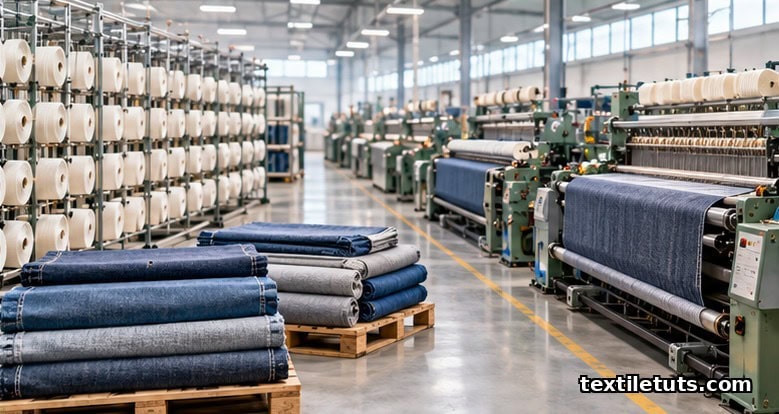
Production roles cover the people who keep yarn spinning, fabric forming, and dyeing lines running at spec. The largest US sub-segment is cut-and-sew apparel (NAICS 315), where the BLS reports 225,950 sewing machine operators nationwide as of 2023. Textile mills (NAICS 313) employ roughly 88,400 workers, and textile product mills (NAICS 314) account for another 99,300.
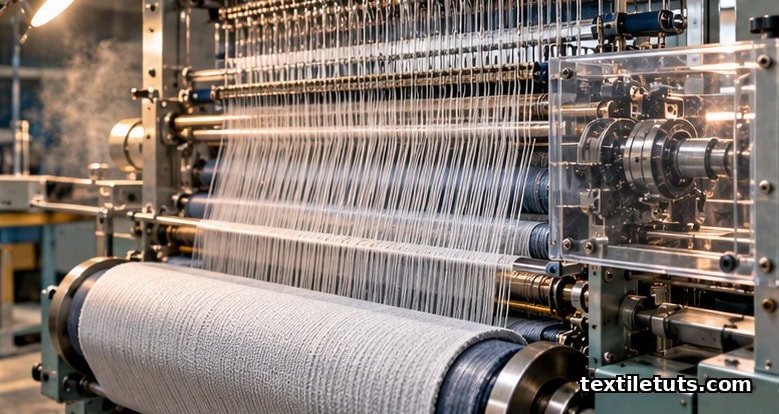
Entry-level positions include machine operator, creeler, doffer, dye-house helper, and finishing-line attendant. With 2-4 years of shift experience and a textile-engineering associate degree, operators move up to shift supervisor, then plant manager. North Carolina alone hosts 609 textile and apparel establishments (the highest state concentration), followed by California with 1,158 establishments, mostly cut-and-sew. Georgia, South Carolina, and Virginia round out the top five. Most entry-level production roles require a high-school diploma plus on-the-job training, with the median annual wage for textile machinery workers sitting at $36,170 per BLS O*NET data.
A bachelor’s in textile engineering (such as the program at NC State’s Wilson College of Textiles or Georgia Tech’s School of Materials Science and Engineering) shortens the path to process engineer, lean-manufacturing lead, or plant superintendent. Most production engineering roles command salaries between $55,000 and $85,000 after 5-7 years, with senior plant managers at large nonwovens or carpet facilities reaching six figures.
Quality Control: Testing, Compliance, and Audit Lanes
QC in US textiles centers on three reference systems: AATCC (American Association of Textile Chemists and Colorists), ASTM International (Committee E11 on textiles), and ISO/TC 38 for international buyers. A textile QC specialist runs colorfastness tests such as AATCC Test Method 61 (laundering) and AATCC 8 (crocking), tensile and tear tests per ASTM D5034 and ASTM D1424, and dimensional-change tests under AATCC 135.
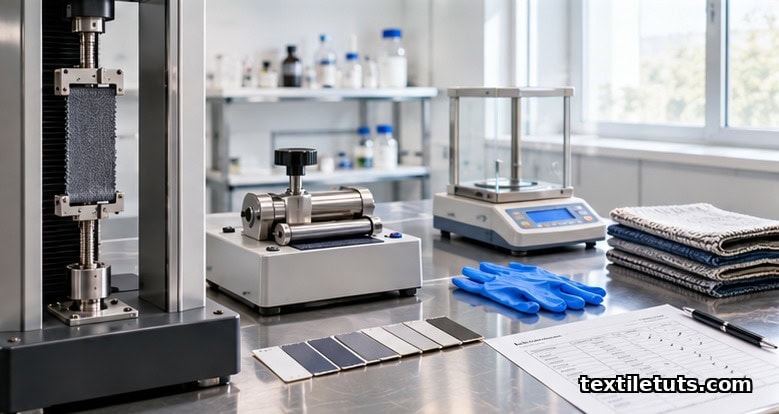
Most QA/QC roles in US apparel and textile mills sit in the 50,000-90,000 worker “inspectors, testers, sorters” BLS category (SOC 51-9061), which reports a median annual wage of $45,780. Career progression runs from QC technician to QA engineer to quality manager, with compensation rising toward $75,000-$95,000 at the QA manager level. Companies that export to the EU or to brand owners enforcing Restricted Substance Lists also hire Restricted Substance List (RSL) analysts and REACH-compliance specialists. Those roles require fluency in ISO 17025 lab accreditation and a working knowledge of OEKO-TEX Standard 100 limits, even though OEKO-TEX itself is European in origin.
Third-party testing labs (Intertek, SGS, Bureau Veritas, and QIMA) employ a substantial share of US QC textile chemists. These labs operate under ISO/IEC 17025 and serve as neutral arbiters between mills and brand buyers. Lab-based chemists typically earn $50,000-$70,000 with a bachelor’s in chemistry or textile chemistry, and senior lab managers cross $100,000 in metropolitan hubs.
Merchandising: Sourcing, Product Development, and Buyer Liason
Merchandising is the bridge between a retailer’s buyer, a brand’s design team, and the mill or cut-and-sew supplier producing the goods. US-based apparel merchandisers work for brand owners (PVH, Tapestry, Ralph Lauren), mass retailers (Target, Walmart, Gap), or sourcing agents that manage production across Asia, the Americas, and the Caribbean.
The role blends cost engineering, lead-time planning, and fabric sourcing. A merchandiser needs working literacy in woven and knit construction, GSM ranges, and the major fiber price drivers (e.g., cotton futures on ICE, polyester on China and Indian indices). Typical positions include assistant merchandiser, product developer, and account merchandiser, with median salaries in the $50,000-$70,000 range at the assistant level rising to $90,000-$130,000+ at the senior merchandiser or merchandise manager level for major US brands.
Product-development roles at technical-textile companies (Carhartt, Milliken, DuPont) often blend merchandising with technical sales. These roles require both commercial instinct and a working grasp of fabric specs, finish performance, and end-use testing. Domestic sourcing is rising again under US tariff policy, and the BLS projects 3-5% growth for wholesale and retail buyers (SOC 13-1022) through 2032, faster than the all-occupations average of 3% for the period ending 2032.
Research and Development: Technical Textiles and Applied Materials Science
R&D in US textiles lives in three settings: corporate labs (INVISTA, DuPont, 3M, Eastman Chemical), university research centers (Wilson College at NC State, the School of Polymer Science and Engineering at University of Southern Mississippi, the Department of Materials Science and Engineering at MIT and Georgia Tech), and government labs including the US Army Combat Capabilities Development Command (DEVCOM) Soldier Center in Natick, Massachusetts, which drives textile research for military applications.
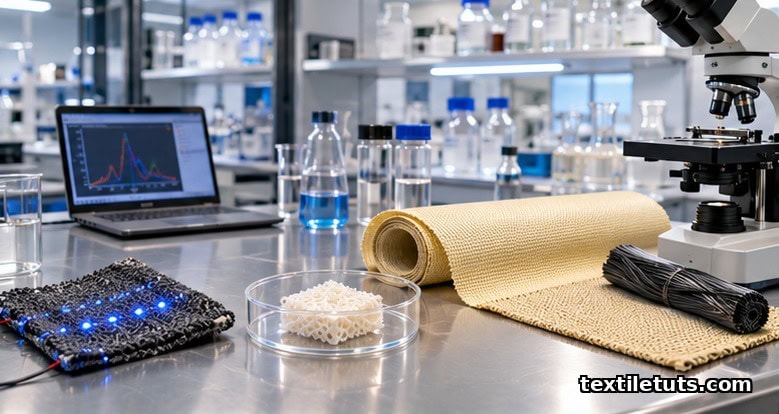
US R&D activity concentrates on technical textiles: protective fabrics (cut-, flame-, ballistic-resistance), medical textiles (wound dressings, bioresorbable scaffolds), smart textiles (conductive yarns, e-textile integration), and high-performance composites (carbon-fiber preforms, aramid laminates). Research chemists and materials engineers in these areas report median salaries of $108,000 per the BLS materials-engineers SOC 19-2032 data.
A PhD in polymer science, fiber chemistry, or textile engineering is the common credential for senior R&D roles. Master’s-level textile engineers lead pilot-line trials and product scale-up. Entry-level R&D associates with a bachelor’s start around $60,000-$75,000 at major chemical companies and rise quickly with patent authorship and product launch experience.
Credentials, Standards, and Skills Employers Screen For
Across all four lanes, the following show up most often on US textile job postings:
- A bachelor’s in textile engineering, materials science, or chemistry. NC State, Georgia Tech, University of Massachusetts-Dartmouth, Philadelphia University (now Jefferson), and Clemson run ABET-accredited textile programs with the strongest industry placement.
- Six Sigma Green or Black Belt for production and QC roles, especially in continuous-process settings (spinning, weaving, dyeing).
- AATCC and ASTM test-method literacy. Employers expect candidates to know which standard applies to a given claim (e.g., ASTM D4966 for Martindale abrasion, ASTM D737 for air permeability, AATCC 79 for absorbency).
- ISO 9001 internal-auditor training for QA and merchandising roles at export-oriented firms.
- Working knowledge of ERP systems (SAP, Oracle Apparel) for merchandising roles at large brands.
Soft skills that consistently appear: bilingual English-Spanish for California and Texas production hubs, written communication for QA documentation, and comfort with data analysis (Excel, Minitab, or Python) for R&D and process-engineering roles.
Salary Benchmarks Across the Four Lanes
| Role | Entry (0-2 yrs) | Mid (3-7 yrs) | Senior (8+ yrs) |
|---|---|---|---|
| Production (machine operator / shift lead) | $30,000-$38,000 | $45,000-$65,000 | $75,000-$110,000 (plant manager) |
| Quality Control (QC tech / QA engineer) | $40,000-$50,000 | $55,000-$80,000 | $90,000-$120,000 (QA director) |
| Merchandising (assistant / product dev) | $45,000-$60,000 | $70,000-$95,000 | $110,000-$160,000 (merchandise VP) |
| R&D (associate / senior scientist) | $60,000-$80,000 | $90,000-$130,000 | $140,000-$220,000 (R&D director, technical textile) |
Numbers are drawn from BLS Occupational Employment Statistics (May 2023), industry salary surveys, and recruiter-published ranges for US textile roles. Coastal technical-textile hubs (Boston, San Francisco, Research Triangle NC) anchor the top of each band; non-metropolitan mill towns (Gastonia NC, Spartanburg SC, Dalton GA) anchor the middle.
Frequently Asked Questions
What degree do most US textile employers want?
A bachelor’s in textile engineering, materials science, or chemistry covers the widest range of production, QC, and R&D roles. For merchandising, business or fashion-merchandising degrees are accepted but candidates with textile-specific coursework (fiber science, fabric formation, dyeing) tend to advance faster because they can read a fabric spec without a translator.
Is the US textile industry growing or shrinking?
US textile mill employment has declined since 1990, but technical-textile output has grown steadily. The BLS projects 2-4% employment growth for materials engineers and 3% for industrial production managers between 2022 and 2032, while sewing-machine operator roles continue to contract. The shift is from commodity yarn-and-fabric to engineered performance products.
Which US states hire the most textile workers?
California leads in total textile and apparel employment (cut-and-sew apparel), North Carolina leads in mill employment, Georgia and South Carolina host the largest carpet and nonwovens clusters, and Massachusetts hosts a disproportionate share of military and protective-textile R&D. New York’s fashion-merchandising labor market remains the largest for buyer-side roles.
Do I need to know AATCC and ASTM standards to get hired?
For QC and R&D roles, yes. Hiring managers expect candidates to identify AATCC 61 (laundering), AATCC 8 (crocking), ASTM D5034 (tensile), and ASTM D1424 (tongue-tear) without prompting. Production and merchandising roles are less standards-heavy but still benefit from literacy in the most-cited methods.
How do I move from production to R&D?
Most successful movers complete a master’s in textile engineering or materials science while working full-time, then transfer internally to a pilot-line or R&D associate role. Plant experience is a strong advantage: candidates who understand why a process drifts at the line level often design more robust experiments at the lab level.
References
- US Bureau of Labor Statistics. Occupational Employment and Wages, May 2023. bls.gov/oes/current/oes_nat.htm
- US Census Bureau. 2022 Economic Census: Textile Mills, Textile Product Mills, and Apparel Manufacturing. census.gov/programs-surveys/economic-census.html
- AATCC. Test Methods and Evaluation Procedures Catalog. aatcc.org/test-methods
- ASTM International. Committee E11 on Textiles and Flexibl Materials. astm.org/committees-e11
- ISO. ISO/TC 38 Textiles and ISO/IEC 17025 Testing and Calibration Laboratories. iso.org
- NC State University. Wilson College of Textiles. textiles.ncsu.edu
- US Bureau of Labor Statistics. Occupational Outlook Handbook: Materials Engineers. bls.gov/ooh/architecture-and-engineering/materials-engineers.htm
This article is the working reference for US textile career paths across production, QC, merchandising, and R&D. Editorial by Iftay Khairul Alam, TextileTuts. Sources: BLS Occupational Employment Statistics, AATCC test-method catalog, ASTM Committee E11, ISO/TC 38, NC State Wilson College of Textiles, US Census Bureau 2022 Economic Census as cited.


