
Buyer-Supplier Quality Disputes

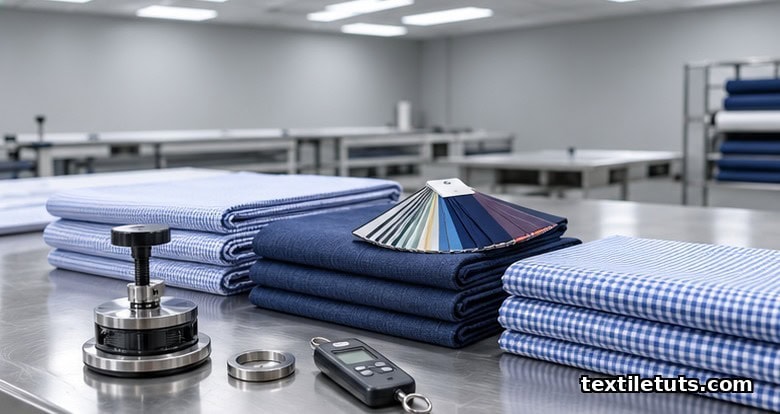
Buyer-supplier quality disputes in textile trade typically arise when a shipment’s critical-defect rate exceeds the AQL (Acceptable Quality Limit) of 2.5% under ISO 2859-1 sampling, with the four most common dispute categories being colorfastness failure under ISO 105-C06, dimensional change exceeding a ±3% tolerance in warp or weft under AATCC TM 135, fabric defects surpassing the 4-point-per-100-square-yard threshold of ASTM D5430, and GSM deviation outside a ±5% range measured by ASTM D3776.
This guide explains how buyers and suppliers can resolve quality disputes using the international standards most textile purchase orders cite, and how to document a claim so it survives commercial negotiation rather than ending in litigation or a write-off.
You will learn the inspection systems that govern textile trade, the six most frequent dispute triggers, the standard time window for raising a claim, and a step-by-step workflow that both sides can use to settle disagreements while the relationship is still intact.
Why buyer-supplier quality disputes happen in textile trade
Textile quality disputes are a structural feature of global apparel sourcing, not an exception. A typical purchase order crosses two to four borders before it reaches a buyer, and every handoff is a chance for the agreed specification to drift. A 2024 review in the Journal of Textile and Apparel, Technology and Management identified specification drift at the mill-buyer interface as the single most common trigger of claims, ahead of raw-material substitution, finishing variation, and shipping damage.
Three structural factors drive most disputes. First, textile specifications are complex: a single woven shirt order can carry 15 to 25 distinct physical, chemical, and colorfastness requirements across ISO, AATCC, and ASTM methods, and any one of them can fail. Second, most inspections rely on sampling rather than 100% inspection, so the buyer and supplier often hold genuinely different readings of the same shipment. Third, the commercial pressure to ship on time creates incentives to release lots that have not been fully tested, which moves the dispute from the lab to the receiving dock.
The economic stakes are real. A rejected shipment of 10,000 woven shirts can cost a brand $40,000 to $120,000 once air-freight replacement, sorting, chargeback penalties, and lost retail margin are counted. On the supplier side, a single major rejection can wipe out the margin on three to five preceding orders.
The inspection standards that govern textile quality disputes
Textile quality disputes are settled against a defined set of standards, not against subjective judgment. The four most commonly cited frameworks are ISO 2859-1 for sampling, ASTM D5430 for visual grading, AATCC TM 135 for dimensional change, and the 4-point system derived from AATCC TM 79 for fabric defect counting.
ISO 2859-1 is the international standard for sampling procedures for inspection by attributes. It defines the AQL (the maximum percentage of nonconforming items that can be considered acceptable as a process average), the sample size, and the accept/reject numbers for each lot size. The most common AQL for general apparel is 2.5%, with 1.0% reserved for critical defects that pose safety, legal, or functional risk, and 4.0% sometimes applied to minor defects. When a buyer and supplier disagree on whether a lot should have been rejected, ISO 2859-1 provides the statistical framework both sides refer to.
ASTM D5430 is the U.S. standard for visually inspecting and grading textiles. It specifies the lighting, viewing distance, and grading procedure used by U.S.-based third-party inspectors. The standard operates alongside the 4-point system, which assigns 1, 2, 3, or 4 points to a defect according to its length or severity, then totals points per 100 square yards of fabric.
AATCC TM 135 defines the dimensional-change test for fabrics after home laundering. It is the most cited shrinkage reference in U.S. apparel purchase orders. The companion method for non-U.S. orders is ISO 5077 with washing per ISO 6330.
AATCC TM 8 covers colorfastness to crocking (rubbing), a frequent dispute trigger for dark-dyed garments. ISO 105-X12 is the international counterpart.
The six most common categories of quality disputes
Reviewing claim files from a sample of third-party testing labs and inspection agencies, six dispute categories account for the majority of cases. Each category is tied to a specific test method, and the dispute almost always resolves around the question of whether the test was run correctly.
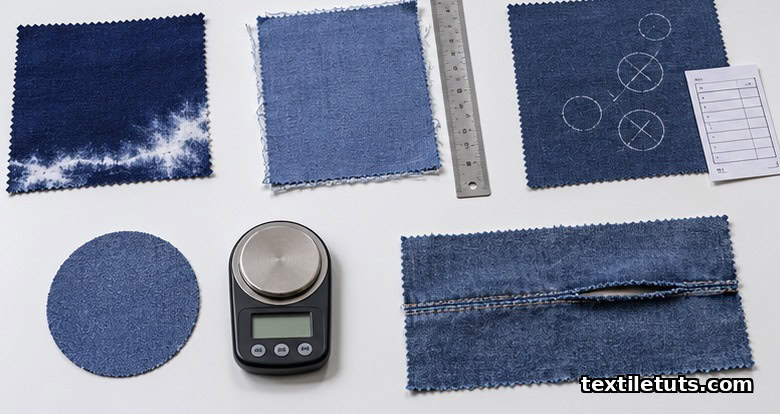
1. Colorfastness failure
Colorfastness claims typically arise from washing, crocking, light, or perspiration tests. A typical dispute: a buyer reports dye transfer onto white trim after one home wash, the supplier counters that the wash method used by the buyer differs from the one in the original specification (for example, 40 °C versus 60 °C, or with versus without optical brightener). The dispute is resolved by re-running the test at the agreed method, usually ISO 105-C06 for washing or ISO 105-X12 for crocking.
2. Dimensional change (shrinkage)
Shrinkage claims arise when the fabric or garment changes dimension outside the agreed tolerance after washing. A typical threshold is ±3% in warp and weft for woven fabrics and ±5% for knits. Disputes turn on whether the relaxation step was performed, whether the test ran for the agreed number of cycles, and whether the buyer conditioned the sample per ISO 139 (20 °C, 65% RH) before measuring.
3. Fabric defects exceeding the 4-point limit
Fabric defects (slubs, holes, yarn contamination, misweaves, dye spots) are counted using the 4-point system. Most purchase orders set a maximum of 40 points per 100 square yards for first-quality woven fabric. A dispute arises when the buyer’s inspector counts more defects than the supplier’s pre-shipment inspection did. The fix is to pull a fresh roll from both parties’ sides and re-grade under ASTM D5430 conditions.
4. GSM deviation
GSM (grams per square meter) claims arise when the actual fabric weight falls outside the agreed ±5% tolerance of the specification. GSM is measured under ASTM D3776 (small swatch method) or ISO 3801. A dispute often turns on whether the samples were conditioned per ISO 139 before weighing, since an off-condition sample can read 2 to 3% heavier than a properly conditioned one.
5. Seam slippage and seam strength
Seam performance claims arise when a sewn seam pulls apart under wear or laundering. The relevant tests are ISO 13935-2 for seam strength and ISO 13936 for seam slippage. Disputes often involve the thread type and stitch density used in the test versus those used in production.
6. Restricted substance failures
Restricted substance claims arise when the fabric exceeds regulatory limits for formaldehyde (ISO 14184-1), pH (ISO 3071), heavy metals, or banned azo dyes (EN 14362-1). These claims carry immediate regulatory consequence under EU REACH Annex XVII and U.S. CPSIA, and the dispute usually turns on the chain of custody of the sample, not on the test itself.
AQL and the 4-point system in practice
AQL and the 4-point system are not interchangeable; they measure different things. AQL is a lot-acceptance tool that asks, “Should we accept or reject this shipment based on a sample?” The 4-point system is a fabric-grading tool that asks, “How many points of defect does this fabric contain per unit area?” Most apparel purchase orders reference both: AQL 2.5 for general defects, AQL 1.0 for critical defects, and a 4-point ceiling of 40 points per 100 square yards on the fabric that goes into the order.
A practical dispute example: a buyer rejects a 5,000-piece woven shirt order at the receiving warehouse after finding 14 visible defects in a 200-piece sample. The supplier counters that 14 defects in 200 pieces (7.0%) is far above AQL 2.5 and would have been caught at pre-shipment inspection. The supplier pulls its pre-shipment record and finds an inspection report showing 4 defects in 200 pieces (2.0%), which would have passed. The discrepancy usually traces to either (a) a different sampling point along the production run, (b) damage introduced in transit, or (c) inspector inconsistency on what counts as a defect. The fix is a joint inspection at the receiving dock with both sides’ inspectors present.
Step-by-step workflow for resolving a textile quality dispute
A structured workflow keeps the dispute commercial rather than legal. The following eight steps reflect the practice of most third-party inspection agencies and textile-testing labs that handle claims.
- Issue a written claim within the agreed window. Most apparel purchase orders specify 14 to 30 days from receipt for visible defects and up to 90 days for latent defects such as colorfastness or restricted substance failures. A claim outside the window is hard to enforce.
- Quote the standard and the tolerance in the claim letter. State the standard (for example, AATCC TM 135), the agreed tolerance (±3%), and the actual result (−5.2% warp), with the test report attached.
- Preserve the disputed sample. The buyer keeps the disputed garments or fabric under standard atmosphere (20 °C, 65% RH per ISO 139) for the duration of the dispute. A retained sample that was not conditioned will be challenged by the supplier.
- Offer a joint re-inspection or joint re-test. Both sides select an independent third-party lab accredited to ISO 17025. The re-test cost is usually split or borne by the side whose result is shown to be incorrect.
- Quantify the financial claim with line items. Include the value of the rejected goods, the cost of re-inspection or re-testing, the air-freight replacement cost (if applicable), and any agreed chargeback penalty stated in the purchase order.
- Negotiate a settlement band, not a single number. Most claims settle at 30 to 70% of the original financial ask after negotiation, because partial responsibility is the norm. A claim that asks for 100% with no room to move usually ends the relationship.
- Document the settlement in writing. A short settlement letter that states the standards referenced, the agreed adjustment, the payment schedule, and the corrected actions for the next order closes the file.
- Run a root-cause review and update the specification. For recurring claims, the buyer and supplier should review the original specification, tighten ambiguous tolerances, and add a process-control step that prevents the same claim in the next order.
How to document a claim that holds up under commercial pressure
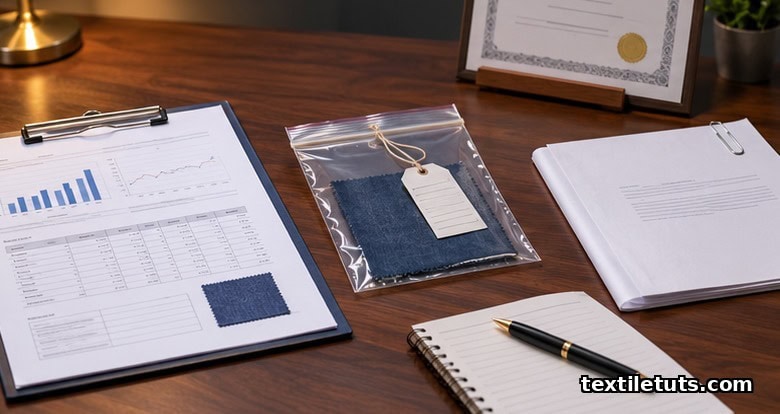
A claim that survives negotiation has five pieces of evidence attached: the agreed specification, the test method, the lab report, the sample retention record, and the chain of custody from sample to result.
The agreed specification is the purchase order or technical sheet signed by both parties before production. If the tolerance is not in this document, the supplier can argue it was never agreed. The test method is the standard cited in the specification (for example, AATCC TM 135, washing procedure (1) at 40 °C). The lab report should identify the lab, the equipment, the calibration date, the conditioning, and the individual test results. The sample retention record states where the disputed sample is held, under what conditions, and for how long. The chain of custody shows that the lab received the sample sealed, the seal number matches the buyer’s record, and the sample was not retaken or replaced.
When all five are present, the supplier’s room to dispute the result shrinks sharply. When any one is missing, the dispute usually settles in the supplier’s favor.
Frequently Asked Questions
What is the most common standard time window for raising a textile quality claim?
Most apparel purchase orders set a 14 to 30 day window from the date of receipt for visible defects (fabric defects, color matching, measurement) and a longer window of up to 90 days for latent defects (colorfastness, dimensional change after multiple washes, restricted substance failures). Some purchase orders use the Incoterms-based “date of delivery” rather than “date of receipt.” The claim letter should always quote the exact clause from the purchase order.
Who pays for the cost of a re-test during a quality dispute?
If the re-test confirms the buyer’s original result, the supplier usually pays the full re-test cost plus the original claim. If the re-test shows the buyer’s original result was incorrect, the buyer pays. In practice, most re-tests are split 50/50 before the result, and the side whose result is shown to be incorrect reimburses the other half. This split is standard for ISO 17025-accredited third-party labs that handle textile claim work.
Can a buyer reject a full shipment on a 2% defect sample rate?
Yes, if the AQL in the purchase order is set at 1.0% for critical defects. Under ISO 2859-1, the accept number for a 200-piece sample at AQL 1.0 is 5 defects. A 2% rate in 200 pieces (4 defects) is at the accept/reject threshold; a 3% rate (6 defects) is reject. The exact accept/reject numbers depend on the lot size and sample size, which are tabled in ISO 2859-1.
What is the most expensive type of textile quality dispute?
Restricted substance failures are usually the most expensive because they can trigger a product recall, a regulatory notice, and a brand-level reputational cost on top of the direct claim cost. Within the more common claim categories, colorfastness failures on dark-dyed garments and dimensional change on knits tend to be the highest-volume and highest-aggregate-cost categories per year.
Should a small brand use AQL 2.5 or a tighter AQL on first orders?
Most first orders use AQL 2.5 for general defects and AQL 1.0 for critical defects, which is the apparel-industry default. A small brand that cannot afford the cost of a claim may tighten to AQL 1.5 for general defects, but should expect the supplier to add a quality-control surcharge or to refuse the order if the run size is too small to absorb the cost of the tighter inspection.
References
- International Organization for Standardization. ISO 2859-1: Sampling procedures for inspection by attributes — Part 1: Sampling schemes indexed by acceptance quality limit (AQL) for lot-by-lot inspection. ISO, Geneva.
- ASTM International. ASTM D5430: Standard Test Methods for Visually Inspecting and Grading Textiles. ASTM, West Conshohocken, PA.
- AATCC. AATCC TM 135: Dimensional Changes of Fabrics After Home Laundering. American Association of Textile Chemists and Colorists, Research Triangle Park, NC.
- AATCC. AATCC TM 8: Colorfastness to Crocking: AATCC Crockmeter Method. American Association of Textile Chemists and Colorists, Research Triangle Park, NC.
- International Organization for Standardization. ISO 105-C06: Textiles — Tests for colour fastness — Part C06: Colour fastness to domestic and commercial laundering. ISO, Geneva.
- ASTM International. ASTM D3776: Standard Test Methods for Mass Per Unit Area (Weight) of Fabric. ASTM, West Conshohocken, PA.
- International Organization for Standardization. ISO 139: Textiles — Standard atmospheres for conditioning and testing. ISO, Geneva.
- International Organization for Standardization. ISO 3071: Textiles — Determination of pH of aqueous extract. ISO, Geneva.
- International Organization for Standardization. ISO 14184-1: Textiles — Determination of formaldehyde — Part 1: Free and hydrolyzed formaldehyde (water extraction method). ISO, Geneva.
- EN 14362-1:2012. Textiles — Methods for determination of certain aromatic amines derived from azo colorants — Part 1: Detection of the use of certain azo colorants accessible with and without extracting the fibres. European Committee for Standardization, Brussels.
This article is the working reference for buyer-supplier quality dispute resolution in textile trade. Editorial by Sabbir Ahmed, TextileTuts. Sources: ISO 2859-1, ASTM D5430, AATCC TM 135, AATCC TM 8, ISO 105-C06, ASTM D3776, ISO 139, ISO 3071, ISO 14184-1, and EN 14362-1 as cited.


