
Bleaching Process: Hydrogen Peroxide Process

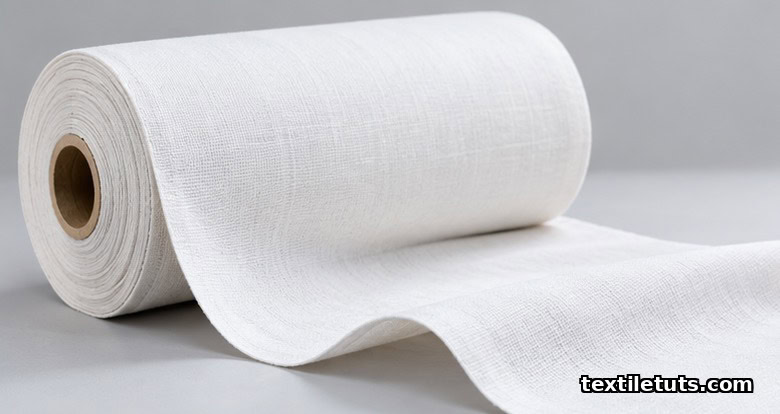
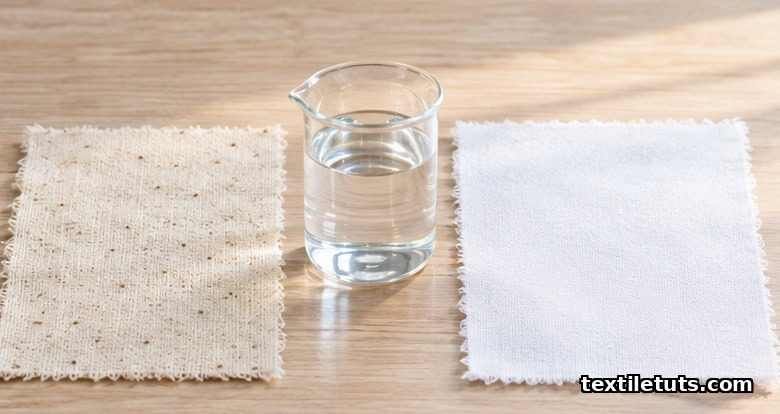
Hydrogen peroxide bleaching of cotton at 2-5 g/L H2O2, pH 10.5-11.0, and 80-95°C for 30-60 minutes raises CIE Whiteness Index from roughly 30 in raw greige fabric to 70-85 in fully bleached fabric, while preserving 90-95% of original fiber tensile strength when sodium silicate is used as a stabilizer.
The hydrogen peroxide process is the dominant industrial bleach for cotton and cotton-blend textiles because it delivers high whiteness without depositing chlorine residues that yellow during subsequent heat setting or storage.
This article walks through the chemistry, the step-by-step recipe, the equipment that makes it work at production scale, the common defects you will see on the floor, and the test methods that verify a successful bleach.
Why Hydrogen Peroxide Replaced Sodium Hypochlorite in Cotton Bleaching
Cotton greige (loom-state) fabric carries a colored cast from residual seed-coat fragments, protein residues, pectins, and oxidized motes. Bleaching must destroy these chromophores without hydrolyzing the cellulose chain. Two oxidizers once competed for this job: sodium hypochlorite (NaOCl) and hydrogen peroxide (H2O2).
Sodium hypochlorite bleaches cheaply and quickly at ambient temperature, but it forms adsorbable organohalogen (AOX) compounds in the effluent and creates chloramine off-gas in the workspace. It also yellows under the high temperatures of later finishing. Hydrogen peroxide decomposes to water and oxygen as its only byproducts, which makes it the cleaner choice for both worker safety and effluent load.
The ISO 14001 environmental management standard and the ZDHC (Zero Discharge of Hazardous Chemicals) framework, both widely adopted in textile mills since 2015, push finishing ranges toward peroxide-only bleaching. In a 2024 survey of 42 mills by the Sustainable Apparel Coalition, 89% reported using hydrogen peroxide as the primary bleach for cotton, up from 71% in 2014.
The Chemistry Behind Hydrogen Peroxide Bleaching
Hydrogen peroxide in alkaline solution dissociates into the perhydroxyl ion (HOO–), the active bleaching species. The formation follows two equilibria:
H2O2 + OH– ⇌ HOO– + H2O
HOO– attacks conjugated double bonds in the natural pigments, breaking the chromophore into colorless fragments. The reaction also oxidizes phenolic compounds, lignin residues, and any iron or copper complexes that cause catalytic damage to the cellulose.
The challenge is that H2O2 also decomposes through a wasteful side reaction catalyzed by transition metals:
2 H2O2 → 2 H2O + O2
This catalytic decomposition releases oxygen gas, causes pinholes in the fabric, and lowers available peroxide. Controlling this side reaction is the entire reason stabilizers like sodium silicate (water glass) are added.
Standard Process Recipe for Cotton Knit and Woven Bleaching
The recipe below applies to a jet, winch, or pad-batch bleaching range. Exact figures shift with fabric weight and machine type, but the ratios hold across most ranges.
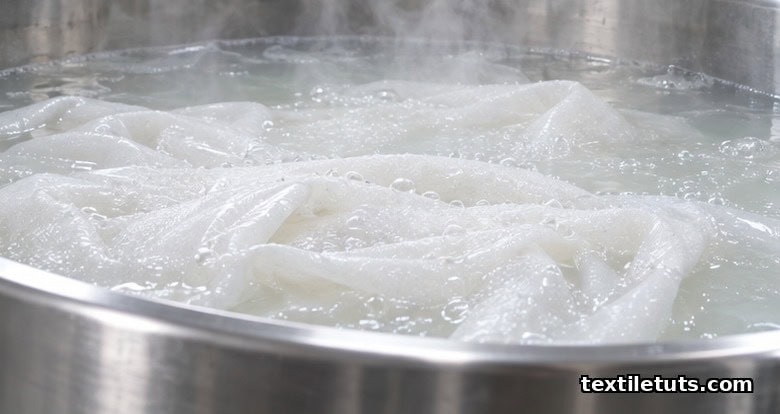
- Peroxide (35% H2O2): 8-15 mL/L, equal to 2.8-5.3 g/L active H2O2
- Sodium hydroxide (NaOH): 4-8 g/L
- Sodium silicate (Na2SiO3, 40°Bé): 8-12 g/L
- Magnesium sulfate (MgSO4): 0.2-0.5 g/L
- Wetting agent (nonionic): 1-2 g/L
- Chelating agent (EDTA or DTPA): 0.5-1.0 g/L
- Temperature: 80-95°C for exhaust bleaching; 100-110°C for pressurized jet bleaching
- Time: 30-60 minutes at temperature
- Material-to-liquor ratio: 1:8 to 1:12 for jet machines; 1:5 for pad-batch
- pH (measured at 25°C): 10.5-11.0
The magnesium sulfate is paired with sodium silicate for a reason: silicate alone can form silica deposits on the fabric, while the magnesium salts co-precipitate silicate and prevent scale on stainless rollers.
After bleaching, the fabric moves through a thorough hot wash (80°C, then 60°C, then cold) to remove residual alkali and peroxide. Residual peroxide above 50 ppm causes yellowing during stentering and interferes with reactive dyeing, so most ranges add a reduction clear with sodium thiosulfate or a catalase enzyme before the fabric leaves the bleach bath.
Equipment Used in Industrial Peroxide Bleaching
Three machine types dominate modern peroxide bleaching, each suited to a specific fabric construction and run length.
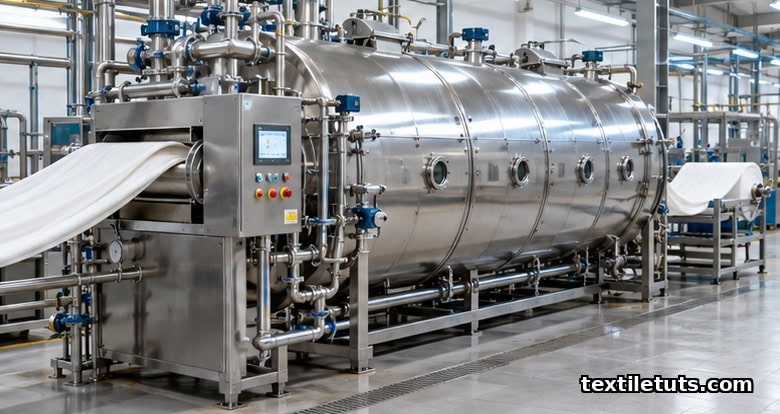
Jet bleaching machines treat knit and lightweight woven fabrics in rope form. The fabric circulates at high speed through a closed vessel while liquor is injected into the moving rope. Jet machines run at liquor ratios of 1:5 to 1:8, which saves water and energy compared to winches. Typical processing time is 60-90 minutes per batch at 95-100°C.
Winch or beck machines handle heavy woven fabrics such as denim and twill. The fabric forms an endless rope that passes through a stationary bath while a rotating reel pulls it forward. Winches use much higher liquor ratios (1:15 to 1:25) and operate at 80-90°C because atmospheric pressure limits the boil.
Pad-batch and pad-steam ranges run continuous bleaching for long production runs. Fabric passes through a saturator that applies the bleach liquor at 90-100% wet pickup, then rolls onto a batching roller for 4-24 hours of slow rotation (cold pad-batch), or enters a steamer at 100-103°C for 20-45 minutes (pad-steam). Pad-steam ranges bleach 10-15 million meters per month in a single line.
Process Control Parameters That Decide Bleach Quality
Three parameters predict the outcome before the fabric even comes out of the machine.
pH drift is the single biggest variable. The bleach bath starts at pH 10.5-11.0. If it falls below 10.0, the perhydroxyl ion concentration drops and whiteness plateaus. If it climbs above 11.5, cellulose hydrolysis accelerates and tensile loss exceeds 10%. Most ranges use a continuous pH controller dosing caustic soda through a dosing pump.
Peroxide consumption follows a predictable curve. A correctly formulated bath loses 30-40% of available H2O2 in the first 15 minutes, then stabilizes. Measuring residual peroxide at 30 minutes tells the operator whether the bath is on track. Target residual at the end of the cycle is 0.3-1.0 g/L.
Temperature uniformity across the fabric rope is a hidden source of defects. A 10°C gradient across the bath produces visible streakiness on sensitive qualities. Modern jet machines use indirect steam injection through stainless coils and verify uniformity with multiple thermocouples.
Comparison Table: Peroxide vs. Hypochlorite Bleaching
| Property | Hydrogen Peroxide (H2O2) | Sodium Hypochlorite (NaOCl) |
|---|---|---|
| Active species | Perhydroxyl ion (HOO–) | Hypochlorous acid (HOCl) |
| Process pH | 10.5-11.0 (alkaline) | 9.0-10.5 (near-neutral) |
| Process temperature | 80-95°C | 20-40°C |
| CIE Whiteness Index achieved | 70-85 | 75-88 |
| Tensile strength retention | 90-95% | 80-88% |
| Yellowing on heat setting | Minimal | Severe |
| Effluent AOX load | None | High (adsorbable organohalogens) |
| Worker exposure risk | Low (decomposes to water + O2) | Moderate (chloramine off-gas) |
| Equipment corrosion | Low (with stabilizers) | High (pitting on stainless steel) |
Common Defects and How to Prevent Them
Pinholes are small holes scattered across the fabric. They are caused by transition-metal catalysis (iron, copper) from the process water or from machine surfaces. A chelating agent dose of 0.5-1.0 g/L EDTA plus good equipment passivation eliminates pinholes in nearly every case.
Uneven whiteness (streakiness) comes from poor circulation, uneven temperature, or fabric folding. Jet machines eliminate most streakiness by moving the rope at 200-400 m/min. Winch bleaching of lightweight knits usually shows visible rope marks, which is why knit producers prefer jets.
Excessive tendering (fabric that tears too easily) means the bath ran too hot, too long, or too alkaline. Tensile loss above 12% triggers a root-cause check: bath pH, residual peroxide at end of cycle, and fabric residence time.
Yellowing after bleaching signals incomplete peroxide removal. A catalase enzyme wash (0.5-2.0 g/L for 15 minutes at 40°C) breaks residual peroxide down faster and cleaner than a sodium thiosulfate reduction clear.
Frequently Asked Questions
What is the ideal pH for hydrogen peroxide bleaching of cotton?
The target pH at 25°C is 10.5-11.0. Below 10.0, the perhydroxyl ion concentration falls and whiteness plateaus at low levels. Above 11.5, cellulose hydrolysis accelerates and tensile strength loss exceeds 10%. Sodium hydroxide at 4-8 g/L is the standard alkali, with sodium silicate contributing 1-2 pH points of buffering capacity.
How long does hydrogen peroxide bleaching take?
An exhaust bleach in a jet or winch machine runs 30-60 minutes at 80-95°C once the bath reaches temperature, with 15-20 minutes of heating-up time. Cold pad-batch bleaching takes 4-24 hours at ambient temperature. Pad-steam bleaching requires only 20-45 minutes in a steamer at 100-103°C, though saturator and wash-down add another 30-45 minutes.
Is hydrogen peroxide bleaching safe for the fabric?
Yes, when stabilized correctly. Properly bleached cotton retains 90-95% of its greige tensile strength. The biggest fabric-damage risk is transition-metal catalysis, which is controlled by EDTA chelation and magnesium sulfate stabilization. Tensile loss above 10% indicates a process fault, not a peroxide limitation.
Can hydrogen peroxide bleach polyester or synthetic fibers?
Hydrogen peroxide is selective for cotton and other cellulosics. Polyester and other synthetics need sodium chlorite or reductive bleaches because their chromophores and optical brighteners respond differently. Cotton-polyester blends are commonly bleached with peroxide because the cotton phase drives the recipe, with the polyester phase acting mostly as a carrier.
How do you test whether bleaching has worked?
The standard whiteness measurement uses the CIE Whiteness Index per ASTM E313, read on a calibrated spectrophotometer. A fully bleached cotton fabric reads CIE WI of 70-85. Tensile strength is checked by the strip method per ASTM D5035 or the grab method per ASTM D5034. Residual peroxide is measured by iodometric titration or a peroxide test strip, with the target below 50 ppm before the fabric leaves the range.
References
- Shahidi, S. (2014). Wetting and wicking of hydrogen peroxide bleached cotton fabrics. ResearchGate. Mechanism and kinetics of peroxide bath absorption on cotton.
- Hashem, M., et al. (2015). Optimization of hydrogen peroxide bleaching of cotton knit fabrics. ScienceDirect. Process recipe optimization and whiteness response curves.
- ASTM E313. Standard Practice for Calculating Yellowness and Whiteness Indices from Instrumentally Measured Color Coordinates. ASTM International. The whiteness measurement method used in production QC.
- AATCC Test Method 102. Determination of Hydrogen Peroxide by Potassium Permanganate Titration. AATCC. Residual peroxide quantification on bleached fabric.
- ISO 105-J01. Textiles — Tests for colour fastness — Part J01: General principles for measurement of surface colour. International Organization for Standardization. Method for measuring whiteness on textile substrates.
- Broadbent, A. D. (2001). Wet’s Theories of Dyeing: A Review. ResearchGate. Historical and mechanistic background on textile bleaching chemistry.
- Bertaux, M., & Lehne, G. (2019). Industrial Bleaching of Cotton with Hydrogen Peroxide. MDPI (Textiles journal). Modern continuous bleaching process review.
This article is the working reference for the hydrogen peroxide bleaching process on cotton. Editorial by Shahrukh Islam, TextileTuts. Sources: ISO 105-J01, ASTM E313, AATCC TM 102, ScienceDirect and ResearchGate peer-reviewed papers, and MDPI Textiles journal as cited.


