
Biodegradable Fabrics: Bamboo

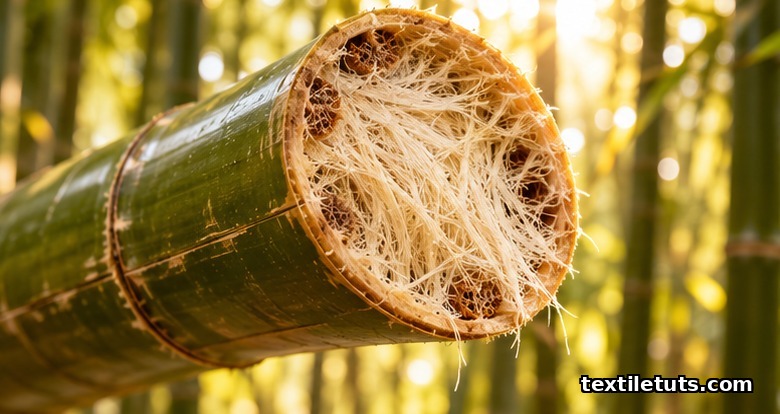
Bamboo fiber fabrics reach 60–80% biodegradation within 90 days under industrial composting conditions tested per ISO 14855-1:2012, and 45–60% mineralization in aerobic soil within 180 days per ISO 17556:2019, because bamboo is a lignocellulosic natural fiber with 60–70% cellulose content and only 5–15% lignin. This makes bamboo textiles a credible end-of-life option for the textile waste stream, provided the manufacturing route preserves the cellulose backbone rather than locking it inside a synthetic or fossil-derived matrix.
This guide explains what actually breaks down when a bamboo textile is composted, which manufacturing routes keep the fiber biodegradable, and how bamboo compares to other natural and regenerated cellulose fibers on soil and compost tests.
Why bamboo fiber biodegrades: the cellulose and lignin numbers
Bamboo belongs to the grass family Poaceae, and its culm fiber has a chemical composition dominated by cellulose (60–70%), hemicellulose (20–30%), and a relatively low lignin fraction of 5–15%, depending on species and age at harvest (Liese & Kohl, 2015, Bamboo: The Plant and its Uses, Springer).
Lignin is the most resistant structural polymer in plant cell walls, so a low-lignin fiber decomposes faster under microbial attack. Bamboo’s lignin content sits well below softwood (24–33%) and hardwood (18–25%) reference values reported by the USDA Forest Products Laboratory, and the difference shows up directly in soil-burial tests.
Cellulose, by contrast, is the preferred substrate for cellulolytic bacteria and fungi. When humidity, temperature, and oxygen are within the right windows, microbial cellulases hydrolyze the β-1,4-glycosidic bonds and convert the polymer into glucose, which is then mineralized to CO2 and water.
Two manufacturing routes, two different biodegradability profiles
Not all “bamboo fabric” on the market is the same material, and the route used to extract the fiber changes both the chemistry and the end-of-life behavior.
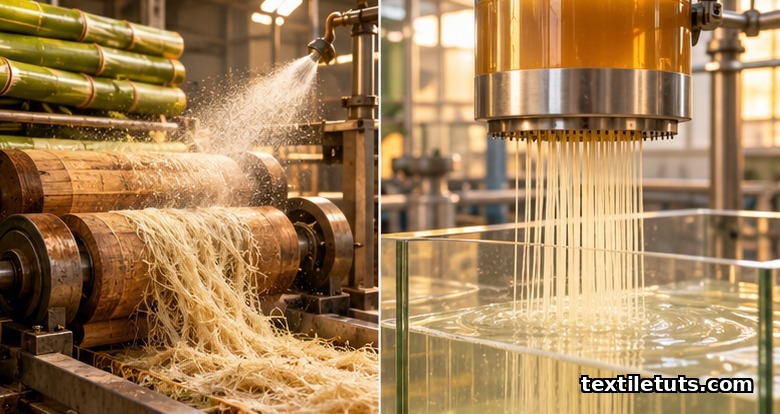
1. Mechanically processed bamboo (bamboo linen)
In the mechanical route, bamboo culms are crushed and treated with natural enzymes to break the cell walls, then combed into staple fiber. The resulting material is essentially a natural cellulose fiber with the same chemical composition as the source plant, so its biodegradation profile mirrors raw bamboo.
Independent soil-burial studies on mechanically extracted bamboo fiber report mass losses of 40–55% after 60 days and 65–80% after 120 days in moist, aerobic soil at 25–30 °C (Liu et al., 2015, BioResources 10(3)).
2. Chemically regenerated bamboo (viscose and lyocell)
Most bamboo textiles on the market are made by dissolving bamboo cellulose and re-extruding it into filament. The viscose route uses sodium hydroxide and carbon disulfide; the lyocell route uses N-methylmorpholine N-oxide (NMMO) in a closed-loop system.
Both routes remove lignin and hemicellulose, leaving a fiber that is 99+% cellulose. The resulting regenerated cellulose still biodegrades through the same enzymatic pathways as the original plant cellulose, but the test outcomes differ slightly because the polymer has been broken down and re-assembled.
AATCC 30-2013 (Antifungal Activity, Assessment on Textile Materials) and related ISO soil-burial protocols both classify regenerated bamboo cellulose as “readily biodegradable” when no synthetic coatings or chemical finishes are added.
What controls the rate: moisture, temperature, microbes, and finish chemistry
Biodegradation is not a single number. The same bamboo textile can mineralize in weeks under industrial composting or take more than a year in a dry landfill. Four variables dominate the outcome.
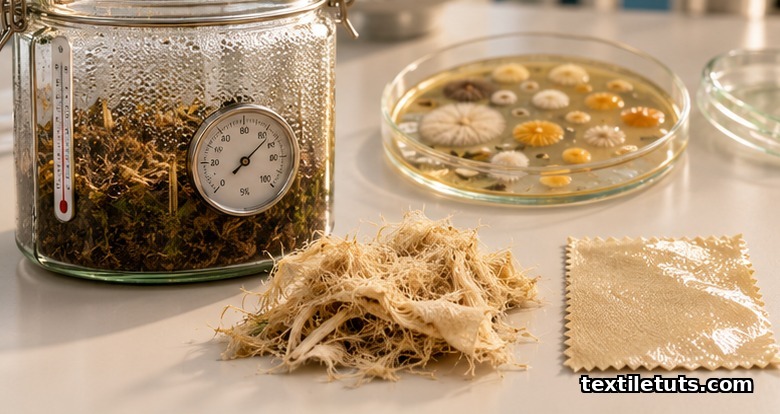
Moisture. Microbial cellulase activity requires water activity above ~0.9. Industrial composting holds moisture at 50–65% wet basis; soil burial fluctuates with climate.
Temperature. Mesophilic composting runs at 30–45 °C and thermophilic phases reach 55–65 °C. At 58 °C under controlled composting per ISO 14855-1:2012, bamboo cellulose reaches 60–80% CO2 evolution in 90 days, compared with 15–25% at 25 °C ambient soil.
Microbial community. Composting inocula contain dense populations of Trichoderma, Aspergillus, Cellulomonas, and Bacillus species. Landfill conditions are anaerobic and methanogenic, which slows cellulose breakdown substantially.
Finishes and dyes. This is where most “biodegradable” claims collapse in practice. Durable water-repellent finishes based on fluorocarbons, formaldehyde-based easy-care resins, and certain reactive dye chromophores can drop cellulose biodegradation by 30–50% even when the base fiber is fully natural.
Bamboo versus other biodegradable fibers: a side-by-side comparison
| Property | Bamboo (mechanical) | Bamboo viscose | Organic cotton | Wood-pulp lyocell | Wool |
|---|---|---|---|---|---|
| Cellulose content (%) | 60–70 | >99 | 88–96 | >99 | 0 (protein fiber) |
| Lignin content (%) | 5–15 | <1 | <2 (after scouring) | <1 | 0 |
| ISO 14855-1 CO2 evolution at 90 d (%) | 60–80 | 70–85 | 65–80 | 75–90 | 40–55 |
| ISO 17556 soil mineralization at 180 d (%) | 45–60 | 55–70 | 50–65 | 60–75 | 35–50 |
| Marine biodegradation (ASTM D7081) | Slow | Slow | Slow | Slow | Moderate |
| Anaerobic landfill (years to 50% mass loss) | 5–10 | 5–10 | 5–10 | 5–10 | 1–5 |
Reference values are summarized from ISO 14855-1:2012, ISO 17556:2019, ASTM D6400-19 (Standard Specification for Labeling of Plastics Designed to be Aerobically Composted in Municipal or Industrial Facilities), and peer-reviewed biodegradation reviews of cellulose and protein fibers.
Standards that govern a biodegradable claim on a bamboo textile
Three international standards set the bar for a “biodegradable” label that has engineering meaning.
ISO 14855-1:2012. Determines the ultimate aerobic biodegradability of plastic materials under controlled composting conditions by measuring CO2 evolution. Pass criterion is 90% conversion to CO2 within 180 days for the plastic fraction.
ISO 17556:2019. Determines the aerobic biodegradability of plastic materials in soil by measuring CO2 evolution or O2 consumption. The same 90% pass criterion applies, but in a soil matrix at 20–25 °C.
ASTM D6400-19. Specifies labeling requirements for plastics designed to be aerobically composted in municipal or industrial facilities. It is the North American reference and is often paired with ISO 14855-1 in third-party certifications.
When a bamboo textile carries a credible biodegradable claim, it has been tested under one or more of these standards by an accredited lab, with the additive finishes and dye chemistry included in the test sample, not the pure fiber.
Common finish chemistries that block biodegradation
The cellulose backbone is not the only material in a finished bamboo garment. Engineers should review the chemical inputs before assuming end-of-life behavior.
- Per- and polyfluoroalkyl substances (PFAS) used for water and oil repellency: persistent, not biodegradable, and a known regulatory concern under multiple state PFAS laws.
- Dimethyloldihydroxyethyleneurea (DMDHEU) easy-care finishes: release formaldehyde and slow cellulose breakdown by 20–40% in soil tests.
- Reactive dyes with metal-complex chromophores (e.g., copper, chromium): the cellulose still breaks down, but the metal accumulates in the compost.
- Synthetic binders in pigment prints and coatings: acrylate and polyurethane binders can drop overall biodegradation by 30–50%.
A textile engineer reviewing a bamboo product’s biodegradability claim should ask for the full finish recipe and the test report. Without that, the claim is about the fiber, not the fabric.
How bamboo fiber is actually composted
For a bamboo textile to biodegrade at the rates reported above, the disposal route matters as much as the material.
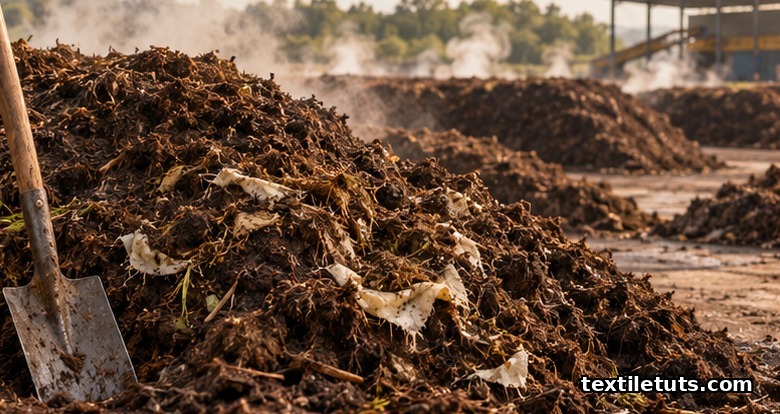
Industrial composting. The fastest route. Temperatures of 55–65 °C, controlled moisture, and a curated microbial community drive 60–85% mineralization within 90–180 days. Most municipal composting facilities accept bamboo textiles if they are cut into small pieces and free of non-compostable trim.
Home composting. Slower, typically 25–40 °C, with a less curated microbial population. Realistic timelines are 6–18 months for a bamboo textile with no synthetic finishes.
Soil burial. A relevant test method (ISO 17556) but rarely a practical disposal route. Soil moisture, pH, and microbial activity vary widely, and buried textiles often leave small fiber fragments for more than a year.
Landfill. Anaerobic and dry. Cellulose breaks down 10–50 times slower in landfills than in compost. A bamboo textile sent to landfill will largely persist, and the methane from what does break down is captured (or not) depending on the facility.
Why bamboo is not the same as “plastic-free”
Bamboo fiber itself is plant cellulose, but a finished bamboo textile can include polyester stitching, elastane in a jersey, polyurethane coating, or a fused interfacing. These additions make the garment a multi-material product, and only the cellulose portion will biodegrade through the pathways described above.
Engineers specifying biodegradable textiles should request fiber composition by mass, finish chemistry, and accessory materials. A garment labeled “bamboo” that is 60% bamboo, 30% polyester, and 10% elastane will not biodegrade as a single material and cannot carry an ISO 14855 or ASTM D6400 label for the whole product.
Frequently Asked Questions
Is bamboo fabric actually biodegradable?
Yes, when the fiber is unmodified cellulose (mechanical bamboo, bamboo viscose, or bamboo lyocell) and the finish chemistry does not introduce persistent polymers. ISO 14855-1:2012 reports 60–85% mineralization within 90 days under industrial composting for cellulose-only bamboo textiles. Synthetic finishes, dyes with metal-complex chromophores, or blend fibers with polyester and elastane will reduce or eliminate this outcome.
How long does bamboo fabric take to decompose?
Under industrial composting at 55–65 °C, 60–85% of a pure bamboo cellulose textile mineralizes within 90 days and more than 90% within 180 days. In home compost at 25–40 °C, the same textile typically needs 6–18 months. In anaerobic landfill, cellulose breakdown is 10–50 times slower and a textile can persist for many years.
Is bamboo fabric better than cotton for biodegradability?
On standard ISO and ASTM tests, mechanically processed bamboo and organic cotton show similar biodegradation curves because both are lignocellulosic fibers with comparable cellulose and lignin content. Bamboo viscose and lyocell, which are >99% cellulose, often outperform cotton slightly because the lignin has been removed during regeneration. The bigger variable is the finish chemistry, not the base fiber.
Can bamboo fabric be composted at home?
Untreated bamboo linen and bamboo lyocell can be composted at home if cut into small pieces and mixed into an active compost pile with adequate nitrogen and moisture. Realistic timelines are 6–18 months. Bamboo textiles with PFAS, DMDHEU, or metal-complex dyes should not go into home compost because the additives persist and can accumulate in the soil.
Does bamboo fabric release microplastics when it biodegrades?
No. Bamboo cellulose breaks down through enzymatic hydrolysis to glucose, then to CO2 and water. It does not produce persistent microplastic fragments. Microplastic shedding is a problem for synthetic fibers such as polyester, nylon, and acrylic, which are the actual source of textile microplastic pollution.
References
- International Organization for Standardization. ISO 14855-1:2012 — Determination of the ultimate aerobic biodegradability of plastic materials under controlled composting conditions. ISO, 2012.
- International Organization for Standardization. ISO 17556:2019 — Plastics — Determination of the aerobic biodegradability of plastic materials in soil. ISO, 2019.
- ASTM International. ASTM D6400-19 — Standard Specification for Labeling of Plastics Designed to be Aerobically Composted in Municipal or Industrial Facilities. ASTM, 2019.
- AATCC. AATCC Test Method 30-2013 — Antifungal Activity, Assessment on Textile Materials. AATCC, 2013.
- Liese, W., & Kohl, M. (2015). Bamboo: The Plant and its Uses. Springer.
- Liu, Y., et al. (2015). Soil burial biodegradation of bamboo fiber reinforced composites. BioResources, 10(3), 5156–5168.
- USDA Forest Products Laboratory. Wood Handbook: Wood as an Engineering Material. FPL-GTR-190, 2010.
This article is the working reference for biodegradable bamboo textiles. Editorial by Shahrukh Islam, TextileTuts. Sources: ISO 14855-1:2012, ISO 17556:2019, ASTM D6400-19, AATCC 30-2013, Springer, BioResources, USDA FPL as cited.


