
Biodegradable Fabrics: PLA

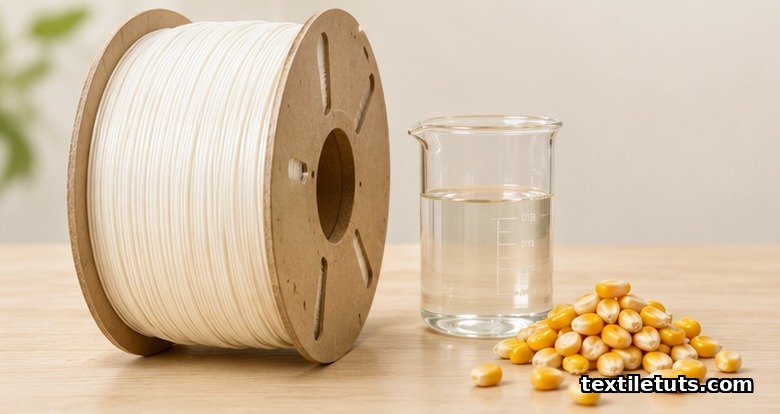
Polylactic acid (PLA) fiber is a biodegradable aliphatic polyester derived from renewable biomass that mineralizes above 90% within 84 days only in industrial composting facilities operating at 58 °C and 50–60% relative humidity, per ASTM D6400 and ISO 17088.
Outside those controlled conditions, in soil, freshwater, or marine water, PLA loses less than 10% mass in a year, which is why regulators and the textile industry classify it as industrially compostable rather than biodegradable in the everyday sense.
What follows covers what PLA actually is at the polymer level, how it is spun into fiber, the conditions that trigger its breakdown, the textile properties it delivers, and how it compares to common alternatives such as PET polyester, cotton, and other bio-based fibers.
What PLA Is and Where It Comes From
PLA is a linear aliphatic polyester built from lactic acid (2-hydroxypropanoic acid) monomers. Lactic acid is produced by fermenting a carbohydrate feedstock, typically dextrose from corn starch, sucrose from sugarcane, or starch from cassava or sugar beet, using Lactobacillus species. The lactic acid is then dimerized to lactide and ring-opened polymerized, which gives a high molecular weight polymer (commonly 100,000 to 300,000 g/mol) with controlled stereochemistry.
The ratio of L-lactide to D-lactide controls the final properties. Pure poly(L-lactic acid) (PLLA) is semicrystalline with a melting point near 170 °C, while higher D-isomer content (above about 7%) yields amorphous PDLLA that softens without a sharp melt. Commercial textile-grade PLA, marketed as Ingeo by NatureWorks, is mostly PLLA with small amounts of D-LA to tune processability.
Because the feedstock is plant sugar, the polymer fixes atmospheric carbon during the growing season. Lifecycle assessments from NatureWorks and from peer-reviewed reviews in the journal Polymer Degradation and Stability report cradle-to-factory-gate greenhouse gas emissions of roughly 1.6–2.0 kg CO2-equivalent per kg of PLA fiber, compared with about 3.0–3.4 kg CO2-equivalent per kg of PET fiber, a reduction of around 40%.
How PLA Fiber Is Spun
Textile-grade PLA is melt-spun. The polymer chips are dried to below 50 ppm moisture to prevent hydrolytic degradation in the extruder, then extruded through a spinneret at 210–240 °C. Filaments are cooled, drawn at 80–110 °C to a draw ratio of 3:1 to 6:1, and wound. The drawn PLA filament has a tensile strength of 35–65 MPa and an elongation at break of 20–35%, depending on draw ratio and stereochemistry.
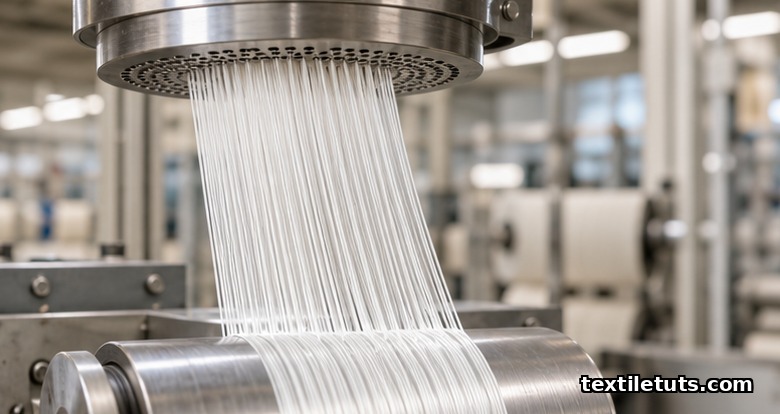
Staple fiber is produced by collecting many filaments into a tow, crimping, and cutting to 38 mm or 51 mm lengths. Filament yarns in the 75 denier to 300 denier range are common for woven fabrics and nonwovens; finer counts down to 1.5 denier are used for spunlace wipes and filtration media.
PLA can also be processed into spunbond nonwovens at line speeds comparable to polypropylene, with the advantage that the resulting fabric is compostable under industrial conditions. A peer-reviewed study in Fibers and Polymers (Springer) reported that PLA spunbond fabrics with a basis weight of 40–80 g/m² retained tensile strength similar to PP spunbond at equal weight, while scoring above 90% mineralization in controlled composting trials that followed ASTM D5338.
Industrial Composting Conditions Required for Breakdown
PLA breaks down through hydrolytic chain scission followed by microbial assimilation of the resulting lactic acid oligomers. Hydrolysis is fast at high temperature and humidity: in water at 58 °C, the polymer loses most of its molecular weight within 8–10 weeks. Below about 40 °C, hydrolysis is slow, and at ambient soil temperatures (15–25 °C) the same polymer shows minimal mass loss over multi-year trials.
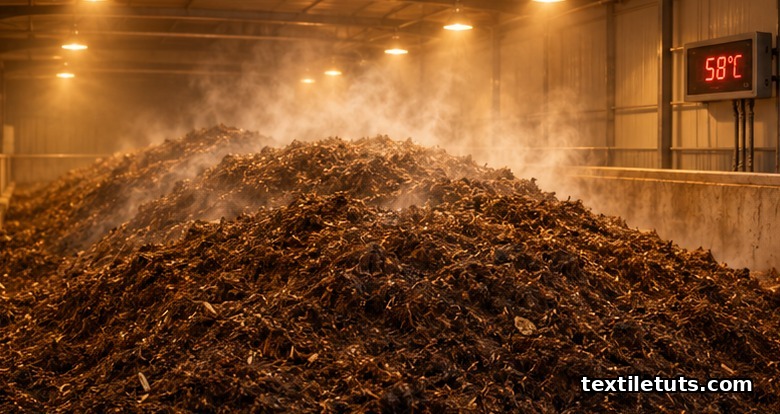
This is the basis of the regulatory threshold. ISO 17088:2021 specifies that a material labeled compostable in industrial facilities must meet three criteria: (1) mineralization of at least 90% of organic carbon to CO2 within 180 days under controlled composting, (2) no adverse effects on compost quality (heavy metals, ecotoxicity), and (3) disintegration of more than 90% of fragments to below 2 mm within 12 weeks.
ASTM D6400 mirrors ISO 17088 in the United States and requires the same aerobic composting protocol, ASTM D5338, in which the material is buried in a mature compost blend at 58 ± 2 °C with periodic aeration and moisture control. Under that protocol, PLA fiber typically shows 90% mineralization in 60–84 days. EN 13432 is the equivalent European norm and adds the ecotoxicity and heavy-metal criteria of OECD test guidelines.
Home composting is a separate category. Most PLA grades do not pass the home-compost threshold of OK Compost HOME (NF T 51-800), which requires degradation at 20–30 °C. Only a few specialty PLA formulations with higher D-isomer content and added pro-oxidants have been certified for home compost, and these are not yet mainstream in textiles.
Mechanical and Thermal Properties
PLA fiber sits between natural fibers like cotton and petrochemical fibers like PET in many of its mechanical properties, but it has one distinctive weakness: a low glass transition temperature near 55–60 °C. That means a PLA garment left on a hot car dashboard can soften and deform, while an iron set above 150 °C will glaze the fabric surface.
| Property | PLA fiber (PLLA) | PET fiber | Cotton |
|---|---|---|---|
| Tenacity (cN/tex) | 25–45 | 35–60 | 25–35 |
| Elongation at break (%) | 20–35 | 15–30 | 6–9 |
| Glass transition Tg (°C) | 55–62 | 70–80 | n/a |
| Melting point (°C) | 150–170 | 255–265 | n/a |
| Moisture regain (%) | 0.4–0.6 | 0.3–0.4 | 7.0–8.5 |
| Density (g/cm³) | 1.24 | 1.38 | 1.50 |
| UV resistance | Moderate (degrades faster than PET) | Good | Fair |
| Industrial compost mineralization (84 d, 58 °C) | ≥90% | <5% | Not applicable (natural) |
Moisture regain is much lower than cotton or wool, so PLA feels dry to the touch and wicks poorly. Dyeing requires disperse dyes at 110–130 °C under pressure, similar to PET, but with a narrower processing window because of the lower Tg.
PLA Compared With Other Biodegradable Fibers
| Fiber | Source | Industrial compost (ISO 17088) | Home compost | Marine biodegradation |
|---|---|---|---|---|
| PLA (PLLA) | Corn / sugarcane starch | Pass (60–90 days) | Limited (most grades fail) | Negligible |
| PHBV (PHB) | Bacterial fermentation | Pass | Pass in some grades | Slow |
| Lyocell (TENCEL) | Wood pulp (closed-loop solvent) | Pass (cellulose-based) | Pass | Slow |
| Cotton | Cotton plant cellulose | Composts naturally | Composts naturally | Composts naturally |
| PET | Petrochemical | Fail | Fail | Fail |
Against PET, PLA offers real compostability and a lower production carbon footprint. Against natural cellulose fibers like cotton and lyocell, PLA loses on moisture comfort, end-of-life pathway simplicity, and marine biodegradation. The honest framing is that PLA is a compostable alternative to PET in applications that demand the look and durability of a synthetic, not a replacement for natural fibers.
Where PLA Fiber Is Used Today
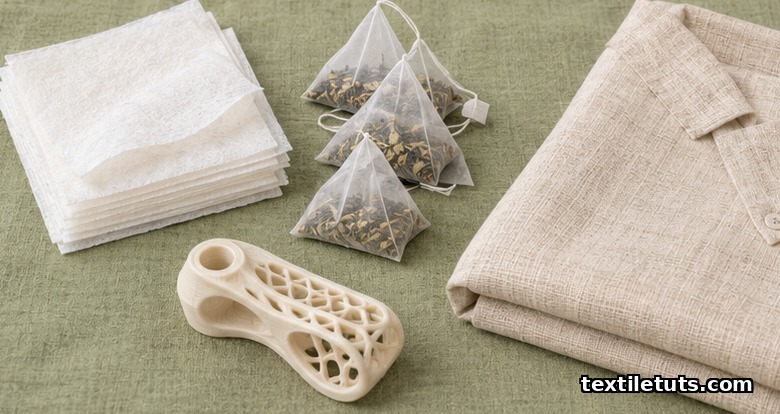
The biggest single end-use for PLA fiber is nonwovens: baby wipes, cosmetic wipes, and industrial wet wipes, where flushability claims need a backing certification. PLA’s ability to pass EN 13432 and ASTM D6400 at relatively low basis weight (30–80 g/m²) makes it attractive for single-use disposables that go to municipal composting rather than landfill.
Other established uses include:
- Filtration media for tea bags, coffee pods, and dry filtration, replacing PET where compostability is a regulatory or marketing requirement.
- Agriculture and horticulture: mulch films, plant ties, and seedling pots that are tilled into the soil at end of season, provided the local waste system supports industrial composting.
- Spunbond coverstock for compostable hygiene products, often laminated to a PLA film.
- Apparel: PLA filament yarns are used in shirtings, knitwear, and blends with cotton or wool, though the low Tg limits ironing and hot-wash care labels.
- 3D printing filament (outside the textile industry, but the same polymer) for prototype parts and short-run molds.
Apparel volumes are still small compared to PET because of the temperature ceiling in finishing and the fact that most consumer-facing composting programs do not accept garments. AATCC 135 and AATCC 150 dimensional-change tests for PLA fabrics show shrinkage of 3–5% after five home-laundry cycles at 40 °C, which is acceptable but not best-in-class.
Limitations and Real-World End of Life
Three honest limitations matter for anyone specifying PLA textiles.
First, PLA does not biodegrade in a home compost bin, in soil, or in the ocean at meaningful rates. A multi-year marine biodegradation study summarized by the European Bioeconomy Strategy reported PLA mass loss under 5% after 12 months in seawater at 25 °C. Marketing claims of “biodegradable” without the “industrial composting” qualifier are common in apparel and are not technically correct for PLA.
Second, the low Tg means PLA fabrics cannot tolerate hot washes, hot tumble drying, or high-temperature ironing without permanent deformation. Care labels must call out wash temperatures of 30–40 °C and cool iron only.
Third, PLA and PET are difficult to separate in mechanical recycling streams. A piece of PLA contamination in a PET bottle bale will degrade the recycled PET. Textile recycling lines are mostly fiber-based, so this is less of an issue than in bottle recycling, but it still matters for any mixed-fiber end-of-life scheme.
Frequently Asked Questions
Is PLA plastic biodegradable in soil or at home?
No. Standard PLA requires industrial composting at 58 °C with controlled humidity to break down in 60–90 days. At room temperature in soil, marine water, or a home compost pile, PLA loses less than 10% of its mass in a year and behaves much like PET over short timeframes. Look for explicit ISO 17088, ASTM D6400, or EN 13432 certification before treating a product as compostable.
How long does PLA take to decompose in an industrial compost facility?
Under ASTM D5338 controlled composting at 58 °C with mature compost, PLA fiber reaches above 90% mineralization in 60–84 days. The 12-week threshold in ISO 17088 is a regulatory ceiling; real facilities running thermophilic composting typically clear PLA fabric in under three months. The catch is that the fabric must reach the facility, and most curbside collection programs still do not accept PLA textiles.
Can PLA fabrics be machine washed?
Yes, but only on cool or warm cycles. PLA softens above its glass transition near 58 °C, so washing at 30–40 °C and air drying or low-heat tumble drying preserves hand and dimensional stability. Hot ironing above 150 °C will glaze or melt the fiber surface, which is why care labels on PLA-rich garments call for cool iron only.
Is PLA more sustainable than cotton or polyester?
Compared with PET polyester, PLA wins on production greenhouse gas (about 40% lower per kg of fiber) and end-of-life compostability. Compared with cotton, PLA loses on water use, soil impact, microplastic shedding at sea, and overall biodegradation. The fairer comparison is application-specific: PLA replaces PET where compostability matters, not cotton where natural fiber comfort and full biodegradation matter.
Does PLA release microplastics when washed?
Yes, at rates that are typically lower than PET but not zero. A 2021 study in Environmental Science & Technology (Springer Nature) reported that PLA fabrics shed about 50–70% of the microfibers that PET sheds under the same washing conditions. Industrial composting at end of life mineralizes the remaining fiber, which is the central sustainability argument for PLA over PET in disposable nonwoven applications.
References
- International Organization for Standardization. ISO 17088:2021, Specifications for compostable plastics. iso.org — defines compostability criteria for plastics in industrial facilities.
- ASTM International. ASTM D6400-19, Standard Specification for Labeling of Plastics Designed to be Aerobically Composted in Municipal or Industrial Facilities. astm.org — North American labeling standard linked to ASTM D5338 testing.
- ASTM International. ASTM D5338-15, Standard Test Method for Determining Aerobic Biodegradation of Plastic Materials Under Controlled Composting Conditions. astm.org — the laboratory protocol behind D6400 certification.
- European Committee for Standardization. EN 13432:2000, Packaging — Requirements for packaging recoverable through composting and biodegradation. cen.eu — European compostability criteria with ecotoxicity add-ons.
- NatureWorks LLC. Ingeo PLA Fiber Technical Data Sheet. natureworksllc.com — polymer properties and processing windows for textile-grade PLA.
- Farah, S. et al. Physical and mechanical characterization of PLA fibers. Wiley Online Library — peer-reviewed data on PLA fiber tensile, thermal, and aging behavior.
- Emadian, S. M. et al. Biodegradation of PLA under various environmental conditions. Springer / Journal of Polymer and the Environment — comparison of PLA degradation rates across soil, compost, marine, and freshwater.
- American Association of Textile Chemists and Colorists. AATCC Test Method 135 and 150, Dimensional Changes in Home Laundering. aatcc.org — standard care and shrinkage test referenced for PLA fabric stability.
This article is the working reference for PLA biodegradable fiber. Editorial by Shahrukh Islam, TextileTuts. Sources: ISO 17088, ASTM D6400 / D5338, EN 13432, NatureWorks technical data, Wiley / Springer peer-reviewed reviews, AATCC 135 / 150, as cited.


