
Anti-Slip Finishes

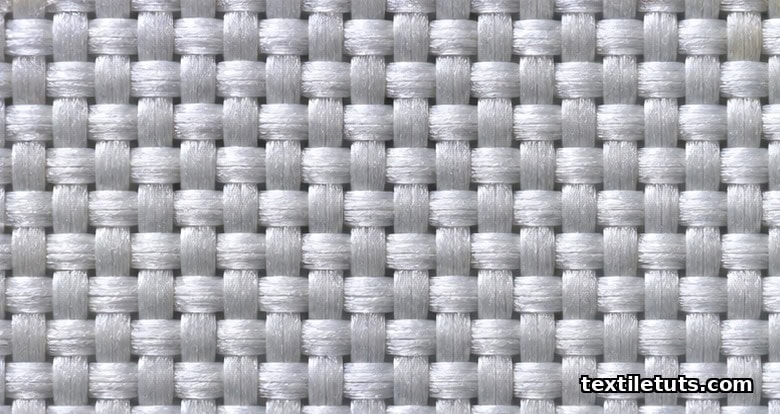
Anti-slip finishes are chemical coatings applied to yarns or finished fabrics that raise the yarn-on-yarn coefficient of friction by a factor of 2 to 3 (from about 0.18 on untreated polyester filament up to 0.45 to 0.55 after finishing), preventing the seam slippage that ruins woven linings, lingerie, hosiery, and trouser pockets.
They are also called anti-slip, slip-resistant, or anti-shift finishes, and the performance is verified under ISO 13936, ASTM D1683 (which replaced the older ASTM D434 in 2009), and AATCC Test Method 119 in the mill laboratory.
This article covers the chemistry behind the friction boost, the four chemistry classes mills actually use, the three common application routes, the test methods that confirm the effect is real, and the failure modes QA teams look for after 20 to 50 home launderings.
What Are Anti-Slip Finishes?
Anti-slip finishes are surface treatments that increase the friction between neighboring yarns in a woven fabric so that the construction stops sliding apart at stress points. On tightly woven filament garments like polyester linings, brassiere cups, shirt plackets, and sheer hosiery, smooth filament yarns can pull out of the weave under seam stress. The result is small holes or visible “runs” that appear after only a few wear cycles, even on carefully constructed garments.
The idea is older than most textile chemistry: starch-based anti-slip treatments were applied to rayon linings in the 1930s to control seam slippage in men’s suits. Modern finishes use synthetic polymers and silicones that survive 30 to 50 home launderings rather than the 5 to 10 wash cycles a starch size survives.
How Anti-Slip Finishes Work
Two mechanisms work together to raise friction at the yarn crossover points:
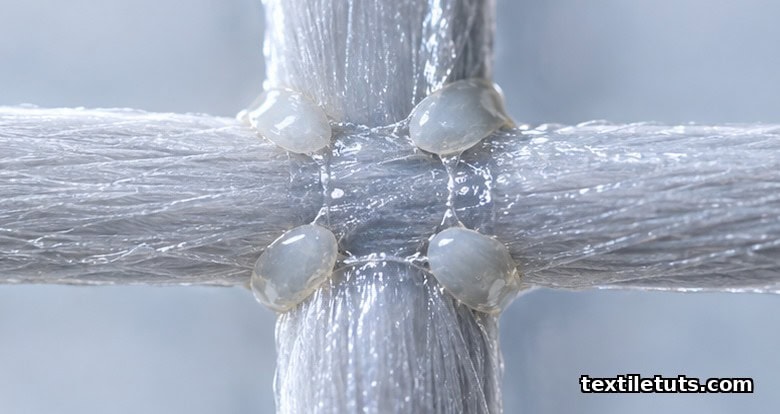
- Mechanical anchoring: cured polymer particles bond yarns at each crossing point, forming “spot welds” that resist shear.
- Surface roughening: a thin film of cured polymer creates microscopic surface roughness, raising the coefficient of friction from a typical 0.18 on untreated polyester filament to 0.45 to 0.55 after finishing.
Both depend on three process variables: cure temperature, pad pressure, and the glass-transition temperature (Tg) of the polymer. If the Tg is too high, the cured film stays rigid at room temperature, the fabric feels boardy, and drape suffers. If Tg is too low, the film softens under ironing heat and the finish migrates. Most anti-slip polymers are formulated with a Tg between -20°C and +40°C to balance hand against durability.
The polymer film thickness in a typical anti-slip finish is only 1 to 10 microns on the yarn surface. The finish adds 1 to 8% on weight of fabric (owf). Beyond about 8% owf, the polymer starts to dominate the fabric hand and drape, and most mills stop there.
The Four Chemistry Classes Used in Industry
Four chemistry families dominate the global anti-slip finish market. They differ in cost, durability, and hand feel, so mills select chemistry based on the end fabric rather than a generic best-in-class choice.
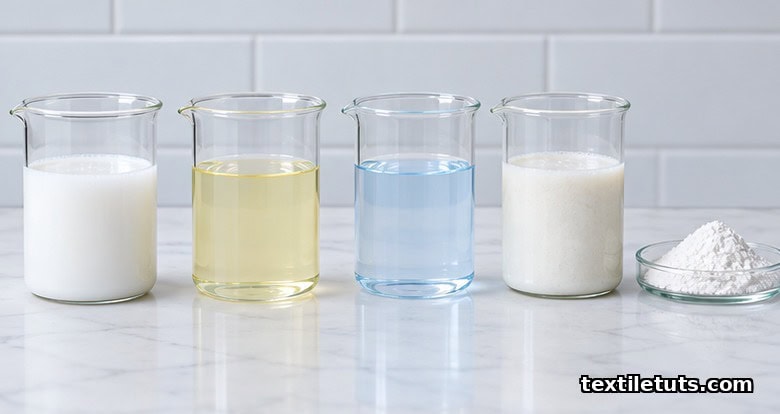
Acrylic resin dispersions
Pure acrylic and styrene-acrylic latices are the most widely used anti-slip chemistry in woven cotton and polyester/cotton blends. They form a clear, flexible film around yarn crossovers and withstand 30 to 50 home washes. Pickup is usually 3 to 8% owf, depending on the level of grip the customer specifies. Cost is the baseline against which other chemistries are priced.
Polyurethane dispersions (PUD)
Polyurethane dispersions are the premium choice for delicate linings, lingerie, and hosiery because the cured film is softer and stretchier than acrylic, and the finish remains invisible even on sheer fabrics. Pickup is typically 1.5 to 4% owf. PUD costs roughly 2 to 3 times the acrylic resin per kilogram, so mills reserve them for premium products where softness and invisibility matter.
Silicone-based finishes
Silicone emulsions and silane coupling agents can raise yarn friction to very high values, but they pose a downstream problem: silicone contamination ruins flame-retardant finishes, water-repellent finishes, and dye uptake on over-dyeing. Mills that run silicone anti-slip finishes operate them on dedicated lines and isolate silicone from the rest of the finishing range. Outside of those dedicated lines, silicone anti-slip is rare.
Starch and starch-derivative finishes
Starch, modified starch, and carboxymethyl cellulose (CMC) are the oldest chemistry and are still in use for low-cost viscose rayon linings. Durability is poor (5 to 10 washes) but cost is the lowest in the industry. Starch finishes are technically “sizing” rather than “finishing” because they are applied at the weaving stage and partially removed before the fabric ships, but the friction benefit during construction is the same.
Application Methods
Mills apply anti-slip finishes three different ways, depending on whether the substrate is woven fabric, knit garment, or trim component.
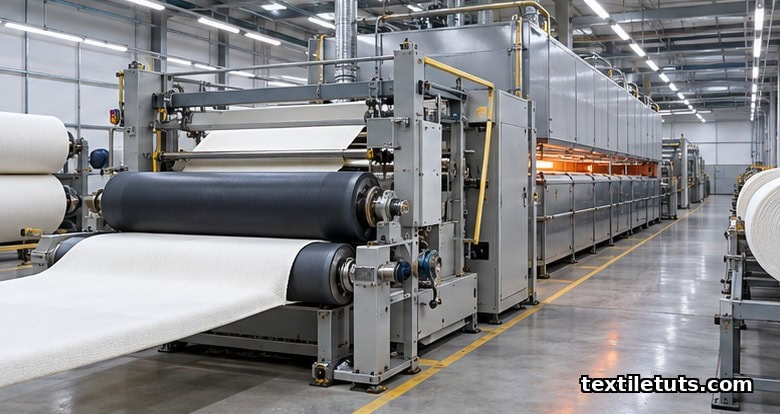
Padding (most common for woven fabric): the fabric passes through a pad mangle with the finish bath (typically 5 to 15% solids), then through a stenter at 150 to 180°C for 60 to 120 seconds. Wet pickup is 70 to 90%. Pad application is fast, reproducible, and works at production speeds up to 80 meters per minute.
Exhaust (for hosiery and seamless knits): garments are tumbled in a rotary machine at 30 to 40°C with 2 to 4% finish on weight of garment for 15 to 25 minutes, then hydroextracted and dried at 110 to 130°C for 15 to 25 minutes. Exhaust gives uniform pickup on shaped garments that cannot be run through a stenter.
Spray (for trim components and spot application): atomized spray at 2 to 4 bar pressure delivers 0.5 to 1.5% pickup to a specific zone, such as a facing or a pocket facing, without affecting the rest of the garment.
Testing Standards Mills Use
Three international standards dominate the mill laboratory. Knowing which standard applies is the first step in interpreting test reports.
- ISO 13936-1 and ISO 13936-2: fix the seam slippage test method. Part 1 uses fixed seam opening; Part 2 uses fixed load. They replace the older ISO 13936 pulls and apply to most woven apparel fabrics.
- ASTM D1683: superseded ASTM D434 in 2009 and sets the seam strength requirement for sewn seams of woven apparel. ASTM D434 is still cited in older specifications, but D1683 is the current standard.
- AATCC Test Method 119: defines slippage of yarns in woven fabrics under repeated creasing rather than seam stress, and is the most common screening test for linings.
Most mills set an internal acceptance threshold of 0.5 to 0.7 mm slippage at a 90 N seam load for polyester linings. Above 1.0 mm slippage, the lining is rejected for production.
Comparison of Anti-Slip Chemistry
| Property | Acrylic Resin | Polyurethane | Silicone | Starch |
|---|---|---|---|---|
| Wash durability | 30 to 50 washes | 30 to 50 washes | 20 to 40 washes | 5 to 10 washes |
| Hand feel | Slightly firm | Soft, elastic | Smooth, slick | Stiff |
| Cost (relative) | 1× baseline | 2 to 3× | 2 to 3× | 0.3 to 0.5× |
| Pickup range (% owf) | 3 to 8% | 1.5 to 4% | 1 to 3% | 5 to 15% |
| Best fit | Cotton, poly-cotton linings | Lingerie, hosiery | Dedicated lines only | Low-cost rayon linings |
| Combiability with other finishes | Good | Good | Poor | Limited |
Common Failure Modes in Production
Three failure modes recur in mill QA labs. Yellowing after curing above 170°C in resin-based finishes is the most common: cellulose and polyamide fibers yellow under heat, and the resin accelerates the color shift. Mills prevent it by either reducing stenter temperature below 165°C or switching catalysts.
The second failure mode is hand stiffening: when pad pickup exceeds 8 to 10% owf, the resin film starts to dominate the textile hand. Drape and softness drop quickly, and the fabric reads as “stiff” to consumers even though the technical slippage test passes. The fix is to lower the bath solids or reduce the pad pressure to bring pickup into the target range.
The third failure mode is sewing-needle fouling. Incompletely cured anti-slip finishes transfer polymer to the sewing needle, gumming the needle eye, and the sewing machine skips stitches. The cure profile on the stenter must reach the polymer’s full cure temperature; partial cure leaves a tacky film. Mills that switch from starch to resin need to recalibrate the stenter temperature profile because the migration temperature can differ by as much as 25°C.
Frequently Asked Questions
Are anti-slip finishes safe to wear against the skin?
Yes. Once cured, the polymer film is inert and locked onto the fiber surface. Anti-slip finishes certified to OEKO-TEX Standard 100 are screened for over 100 harmful substances and are approved for next-to-skin use, including baby garments. The cured film releases essentially nothing during wear.
Do anti-slip finishes change the color of the fabric?
Slight yellowing can happen with acrylic resin cures above 170°C, especially on white fabrics. Mills prevent this by dropping the cure temperature to 150 to 160°C, switching catalysts, or moving to polyurethane dispersions that cure below 130°C. On dyed fabrics, the color shift is usually invisible to the eye and within commercial tolerance.
How many washes does an anti-slip finish last?
Durability depends on chemistry and on wash conditions. Acrylic and polyurethane finishes survive 30 to 50 home washes at 40°C. Silicone finishes last 20 to 40 washes. Starch-based finishes break down faster, typically after 5 to 10 washes, which is why they are chosen for low-cost linings rather than long-life garments.
Can anti-slip finishes be combined with other finishes?
Yes for water-repellent finishes, softeners, and resin finishes. No for silicone-based anti-slip combined with reactive water-repellents, fluorocarbon finishes, or flame retardants: silicone contamination ruins the next bath and must be cleaned out between runs. Most mills split anti-slip and water-repellent onto different production lines to avoid cross-contamination.
Are anti-slip finishes the same as anti-skid coatings?
No. Anti-skid coatings are applied to the back of rugs, matting, and carpet tiles to keep them from sliding on smooth floors. They use heavy fillers, foamed PVC, latex backings, or hot-melt adhesive layers at much higher add-on levels. Anti-slip finishes are an order of magnitude thinner (1 to 10 microns of dry polymer) and are designed to prevent yarn slippage inside a fabric, not fabric slippage on a floor.
References
- ISO. ISO 13936-1:2004, “Textiles – Determination of the slippage resistance of yarns at the seam in woven fabrics – Part 1: Fixed seam opening method.” iso.org. Test method for measuring seam slippage under fixed displacement.
- ASTM International. ASTM D1683/D1683M-22, “Standard Test Method for Failure in Sewn Seams of Woven Apparel Fabrics.” astm.org. Current seam strength standard; superseded ASTM D434 in 2009.
- AATCC. AATCC Test Method 119, “Slippage of Yarns in Woven Fabrics (Creasing Method).” aatcc.org. Screening test under repeated creasing, widely used for linings.
- ResearchGate. “Effect of anti-slip finishes on the seam performance of woven fabrics.” researchgate.net. Peer-reviewed comparison of acrylic resin and polyurethane dispersion chemistry on cotton and polyester blends.
- ScienceDirect. “Tactile and mechanical characterization of anti-slip textile finishes.” sciencedirect.com. Includes coefficient of friction measurements and durability data.
- Cotton Incorporated. “Slippage and seam performance in cotton-rich woven fabrics.” cottoninc.com. Industry reference for anti-slip treatments on cotton-rich substrates.
This article is the working reference for anti-slip finishes in textile finishing. Editorial by Shahrukh Islam, TextileTuts. Sources: ISO 13936-1, ASTM D1683, AATCC 119, ResearchGate, ScienceDirect, Cotton Incorporated as cited.


