
What Yarn Twist Is and Why It Matters

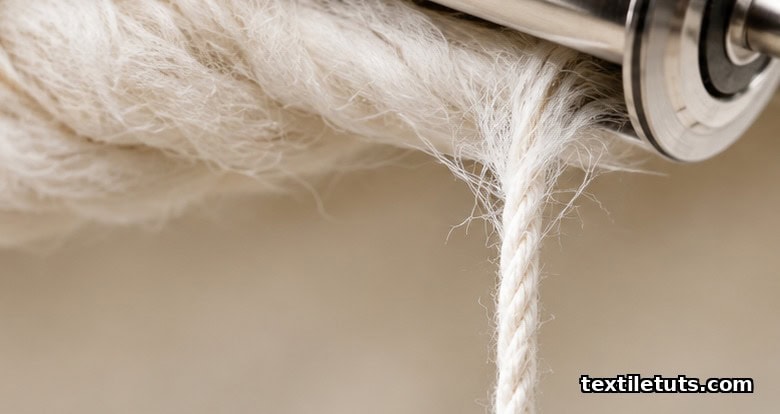
Twist is the single most fundamental structural parameter of a spun yarn. It is what holds the fibers together, gives the yarn its strength, governs its handle, and determines how it will behave in weaving, knitting, and finishing. The direction of twist, whether the fibers spiral around the yarn axis in a clockwise or counterclockwise helix, is not a stylistic choice. It is a specification that interacts with spinning equipment, fabric construction, and even the way the finished garment drapes. This article covers how twist is defined, how direction is named, and how both quantity and direction affect the yarn and the resulting textile.
What Yarn Twist Is and Why It Matters
Twist is the number of turns about its axis per unit length of yarn. In SI units it is expressed as turns per meter (tpm); in U.S. cotton-system yarn it is often expressed as turns per inch (tpi). Twist binds the individual fibers into a cohesive strand through lateral pressure and fiber-to-fiber friction. Without sufficient twist, a yarn simply falls apart.
Twist does several things at once: it gives the yarn tensile strength by ensuring fibers load-share under tension; it gives the yarn lateral stiffness and resistance to bending; it creates torque (the yarn wants to unwind), which affects downstream processing; and it locks in the surface appearance, hairiness, and abrasion resistance. Too little twist gives a weak, hairy yarn. Too much twist gives a hard, lively, snarly yarn that feels rough and may even form self-locked noose structures called snarls.
The test method for twist is standardized. ISO 2061 (Textiles, Determination of twist in yarns, Untwist/retwist method) describes the most common procedure, in which a known length of yarn is untwisted and the number of turns removed is counted, with a correction for the contraction that occurs during untwisting. ASTM D1422 provides an equivalent U.S. method for twist direction in single yarns.
How Twist Direction Is Named: Z-Twist and S-Twist
Twist direction is named by analogy to the letters S and Z. Hold a short length of yarn vertically and look at the angle of the surface fibers. If the fibers spiral around the axis in the same direction as the diagonal of the letter Z, the yarn is a Z-twist (also called right-hand twist, or “twist on”). If the fibers spiral in the same direction as the diagonal of the letter S, the yarn is an S-twist (also called left-hand twist, or “twist off”).
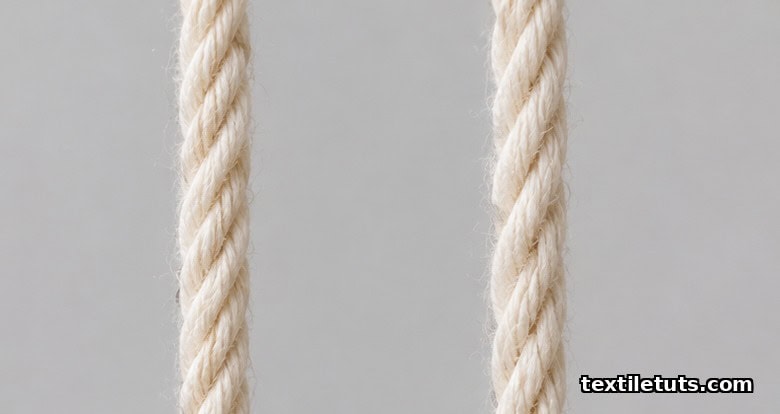
The convention is defined in ISO 2061 and ASTM D1422 (Standard Test Method for Twist in Single Yarns by the Untwist-Retwist Method). It is the same convention used in the U.S., Europe, and Asia, so a “Z-twist” yarn is recognizable in any mill specification worldwide.
The vast majority of single-spun yarns worldwide are produced as Z-twist, because most ring frames and rotors are built to insert Z-twist by default. S-twist yarn is a specialty product, used where the fabric design or the downstream plied-yarn construction requires it.
Effect of Twist Direction on Single Yarn Properties
In a single, unplied yarn, the choice between S and Z direction has very little effect on most measured yarn properties. Tenacity, elongation, evenness, and hairiness are essentially the same for S and Z versions of the same yarn, provided the twist level is identical. The body of experimental literature on this point is consistent: a 20 tex Z-twist cotton yarn and a 20 tex S-twist cotton yarn, spun on the same frame with the same settings (but with the frame reconfigured for the opposite direction), have statistically indistinguishable tensile and evenness properties.
What changes is the torque. The yarn’s residual torque after relaxation, the tendency of the yarn to untwist when held in a loop, is mirror-symmetric in S vs Z. A Z-twist yarn tries to rotate counterclockwise to relieve its torque; an S-twist yarn rotates clockwise. This matters in plied yarns and in knitted or woven fabrics where balanced construction depends on canceling the torque of component yarns.
Effect of Twist Direction on Plied and Cabled Yarns
Twist direction becomes critical when single yarns are plied together. A plied yarn is made by twisting two or more single yarns together in the opposite direction to the singles: Z singles are plied with S twist to form a balanced yarn, and S singles are plied with Z twist. This opposite-ply direction cancels the residual torque of the singles and produces a stable, non-lively yarn.
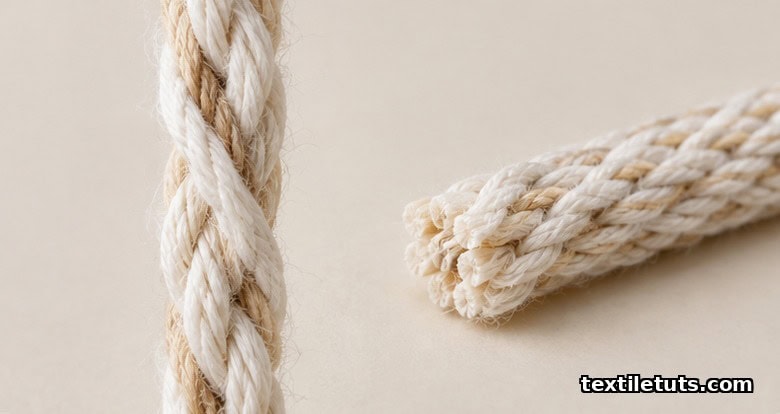
The naming of plied yarn direction is the same convention: a “ZS” yarn has Z singles and S plying direction. A “ZZ” yarn, Z singles plied with Z twist, would be unbalanced and would snarl aggressively because both the singles and the ply insert torque in the same helical sense. Unbalanced plied yarn is rarely useful and is generally considered a manufacturing defect.
For three-ply yarn (e.g., sewing thread), the convention is balanced: ZZZ singles with S final plying direction, written as ZZS, or SZZ with Z plying direction. Cabled yarns (yarns plied of plied yarns) alternate direction at each stage. ISO 2061 and the equivalent textile handbooks specify these constructions.
Effect of Twist Direction on Fabric Appearance and Behavior
Twist direction affects fabric appearance most strongly in woven twills and in knit fabrics where the surface loop direction is visible. In a 2/1 twill weave, for example, the diagonal of the wales runs in a direction determined by the twist of the weft yarn combined with the weave structure. Mills specify Z or S weft to control whether the twill diagonal runs from lower-left to upper-right or from upper-left to lower-right.
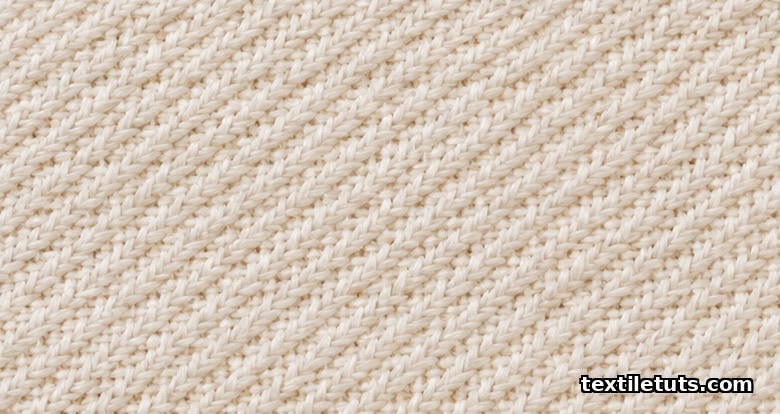
In knit fabrics, the loop direction (the way the knit loop crosses over itself) interacts with the yarn torque to set the fabric’s dimensional stability and skew. Twistless or low-twist knit yarns of one direction can produce highly skewed fabrics if the gauge and stitch length are not adjusted. This is why knit fabric specifications always call out yarn twist direction alongside count.
Sewing thread is the most familiar consumer example. Most sewing thread is a ZSZ construction: Z singles, plied with S twist, then cabled with Z twist. The final Z direction allows the thread to be released from a standard sewing-machine bobbin without untwisting during stitch formation. S-twist sewing thread exists for special applications but is far less common.
Choosing Twist Direction for a Given Application
The choice of twist direction is largely determined by the conventions of the downstream process:
- Woven warp: Z-twist singles are standard. The warp is sized and stretched under high tension, so the residual torque is locked in and does not affect the fabric.
- Woven weft for balanced fabric: Z singles plied with S twist for a balanced, low-snarled yarn that lies flat in the shed.
- Single-jersey knit: Z-twist singles are standard. The knit loop direction interacts with Z torque to set the fabric’s wale direction and skew behavior.
- Sewing thread: ZSZ (Z singles, S ply, Z cable) is the dominant construction. The Z final direction is required for proper stitch formation.
- Specialty and decorative yarns: S-twist singles are used where the surface appearance or fabric design calls for it, such as some crepe yarns and certain decorative knit constructions.
The mills that produce these yarns choose their twist direction deliberately. The most common mistake in fabric development is mixing Z and S singles in the same fabric construction without realizing it, the resulting imbalance shows up as visible skew, poor dimensional stability, or unusual drape.
Testing Twist and Twist Direction
Twist testing is described in ISO 2061 and ASTM D1422/D1423. The untwist-retwist method is the most common: a measured length of yarn is held under a small tension, untwisted until the fibers become parallel, and the number of turns removed is counted. The method includes a correction for yarn contraction during untwisting. Twist direction is observed visually by holding the yarn vertically and matching the fiber helix to the letter S or Z.
For plied and cabled yarns, the test is performed layer by layer. The single yarns are removed from the ply by reverse-unwisting, then tested individually for direction and turns per unit length. This allows the construction of a complex yarn to be verified against specification.
Frequently Asked Questions
What is the difference between Z-twist and S-twist?
Z-twist yarn has fibers spiraling around the yarn axis in the same direction as the diagonal stroke of the letter Z (right-hand twist). S-twist yarn has fibers spiraling in the same direction as the diagonal of the letter S (left-hand twist). The convention is defined in ISO 2061 and ASTM D1422.
Why is most single yarn Z-twist?
Ring spinning frames and rotor spinning machines are most commonly built to insert Z-twist because the traveler or rotor geometry defaults to that direction. S-twist singles are a specialty product made on frames configured for the opposite direction.
Does twist direction affect yarn strength?
For single yarns of the same fiber, count, and twist level, there is no measurable difference in tenacity or evenness between S and Z twist. The differences appear in plied yarn balance, fabric skew, and sewing-thread behavior, not in the singles themselves.
What does ZS mean in yarn nomenclature?
ZS refers to a plied yarn: Z singles plied with S direction. The opposite plying direction cancels the torque of the singles, producing a balanced, low-liveliness yarn. Sewing thread is typically a ZSZ or ZZS construction.
How is twist tested?
Twist is measured by the untwist-retwist method described in ISO 2061 and ASTM D1422. A known length of yarn is untwisted until fibers become parallel, the number of turns is counted, and a correction is applied for yarn contraction. Twist direction is observed visually and matched to the S or Z convention.
References
- ISO 2061:2015. Textiles, Determination of twist in yarns, Untwist/retwist method. International Organization for Standardization, Geneva.
- ASTM D1422 / D1422M-20. Standard Test Method for Twist in Single Spun Yarns by the Untwist-Retwist Method. ASTM International, West Conshohocken, PA.
- ASTM D1423 / D1423M-16. Standard Test Method for Twist in Yarns by Direct-Counting. ASTM International, West Conshohocken, PA.
- ISO 2:1973. Textiles, Designation of the direction of twist in yarns and related products. International Organization for Standardization, Geneva.
- Lawrence, C.A. (2003). Fundamentals of Spun Yarn Technology. CRC Press, Boca Raton. ISBN 978-1566768138.
- Morton, W.E., and Hearle, J.W.S. (2008). Physical Properties of Textile Fibres, 4th Edition. Woodhead Publishing, Cambridge. ISBN 978-1845692209.
- Textile Institute (2009). Textile Terms and Definitions, 11th Edition. The Textile Institute, Manchester.
Editorial by Iftay Khairul Alam, TextileTuts


