
From Air-Jet to Vortex: Why the Nozzle Changed

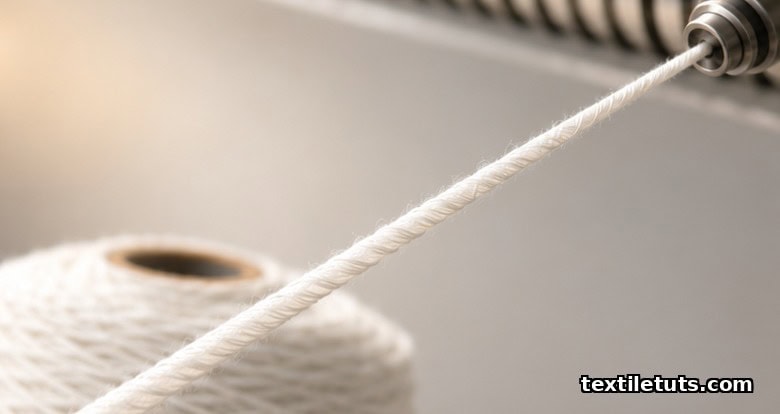
Vortex spinning is a refinement of the air-jet spinning concept, developed by Murata Machinery and introduced commercially in 1997 as the Murata Vortex Spinner (MVS). Where original air-jet (MJS) frames used two tandem nozzles to wrap a parallel fiber core, the MVS uses a single nozzle with an internal stationary needle that creates a stable air vortex and produces a tightly wrapped yarn at very high delivery speeds. Vortex spinning has become the dominant high-speed wrapped-yarn system for woven and knit apparel, and it remains the yardstick against which other wrapped-yarn technologies are measured.
From Air-Jet to Vortex: Why the Nozzle Changed
Early air-jet spinning machines suffered from a tension problem. The wrapped yarn structure gave smooth surface and low hairiness but produced a yarn that was lively, with high residual torque and low package density. The Murata Vortex system addressed this with a redesigned single-nozzle arrangement that includes a stationary needle (or “spindle needle”) along the nozzle axis. The needle stabilizes the air flow inside the nozzle, lets the wrapper fibers bind more tightly, and dramatically reduces yarn liveliness. The result is a yarn with significantly higher tenacity than MJS yarn of the same fiber and count, while retaining the productivity advantage of air-jet spinning.
This single change, a stationary needle inside the swirling air column, has had outsized effects on yarn structure and downstream fabric behavior, and it is the defining feature of all vortex spinning machines in commercial use today.
The Vortex Spinning Process Step by Step
Vortex spinning begins with a combed sliver fed through a four-roller drafting system, very similar to a ring frame. The drafted fiber ribbon enters the vortex nozzle at the front drafting rollers. Inside the nozzle, six tangential air jets (in the MVS design) create a swirling flow pattern. The needle along the nozzle centerline divides the air stream and provides a stable surface for the forming yarn.
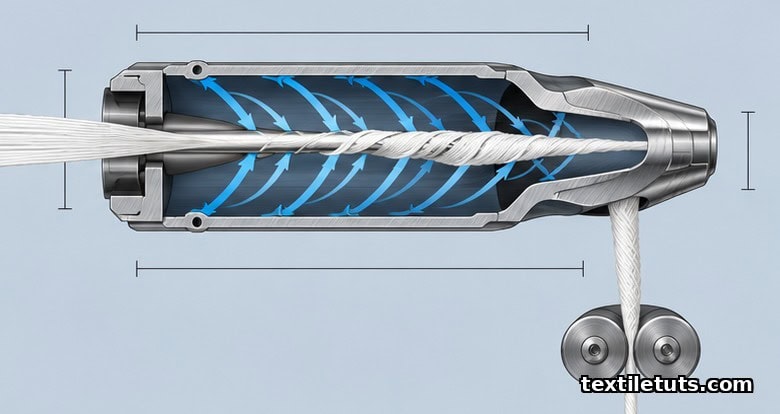
Fibers entering the nozzle are separated into two zones. The leading fiber ends are drawn down the needle and form the parallel core of the yarn. The trailing fiber ends are caught by the swirling air and wrapped helically around the core, binding it together. The formed yarn exits the bottom of the nozzle and is wound onto a package at delivery speeds of 350 to 500 m/min, with newer MVS designs running above 500 m/min.
The take-up rollers also provide back-pressure to the nozzle, controlling the wrapper helix angle and the package density. Adjusting the back-pressure and nozzle pressure is the primary process control for vortex yarn quality.
Yarn Structure: True Wrapper Yarn
Vortex-spun yarn has a distinctive structure that has been studied extensively using tracer fiber and cross-section microscopy. The yarn consists of a parallel untwisted fiber core surrounded by wrapper fibers wound at very high helix angles, sometimes close to 70 to 80 degrees from the yarn axis. The wrapper fibers are tightly packed along the yarn length, and the wrapper zone accounts for a substantial fraction of the yarn cross-section.
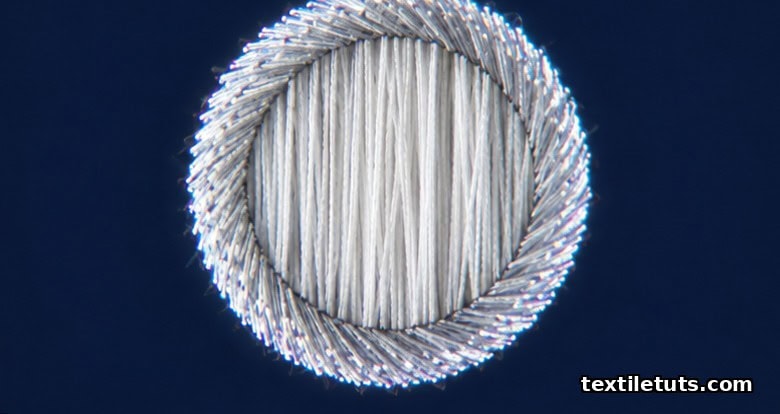
This structure is fundamentally different from ring yarn (helically twisted core) and different from rotor yarn (random core with limited wrapper). It explains the property profile: very low hairiness, smooth surface, lower tenacity than ring, lower elongation than rotor in some constructions, and high abrasion resistance.
Tracer fiber studies have shown that the boundary between core and wrapper zones in vortex yarn is sharper than in MJS yarn, which is the structural reason vortex yarn is more stable and stronger than its predecessor.
Properties Compared to Ring and Rotor Yarn
Tensile strength
Ring yarn is still stronger than vortex yarn of the same fiber and count. ISO 2062 single-end breaking force measurements typically show vortex tenacity 10 to 20 percent below ring yarn but 10 to 15 percent above MJS air-jet yarn of the same specifications. The wrapper helix is too high to develop the full core-twist contribution to tenacity, but it is sufficient to lock the fibers in place under most fabric-load conditions.
Evenness and imperfections
Vortex yarn has excellent evenness, generally comparable to ring or rotor yarn when measured on an Uster Evenness Tester per ISO 16549. Imperfection counts are typically lower than ring yarn because short fibers and trash are extracted by the suction channel below the nozzle. This is a significant advantage in knitting, where thick places cause needle damage.
Hairiness
ISO 7211-5 hairiness measurements show vortex yarn with hairiness counts 70 to 90 percent lower than ring yarn of the same count. The wrapper fibers are tightly bound, and there are almost no protruding fiber ends on the yarn surface. This is the single biggest reason vortex yarn is preferred for sheeting and for printed fabrics that require a clean surface.
Abrasion and pilling
Vortex yarn has excellent abrasion resistance, generally exceeding ring yarn on a yarn-to-yarn abrasion test and substantially exceeding rotor yarn. Fabrics made from vortex yarn pill less than ring equivalents and show better wear durability in repeated laundering. This is the reason vortex yarn has become standard in school uniforms, workwear, and hotel sheetings.
Liveliness and torque
Compared to MJS air-jet yarn, vortex yarn has very low liveliness. The stationary needle inside the nozzle produces a more balanced wrapper helix, with alternating S and Z wrapper segments, which cancels out residual torque in the running yarn. This makes vortex yarn easier to weave and knit without the ballooning problems that plagued early air-jet yarn.
Count Range, Speed, and Productivity
Vortex spinning is most economical in the medium count range, roughly 10 to 30 tex (Ne 20 to Ne 60) for cotton and cotton blends, though modern MVS machines are extending into both finer and coarser ranges. Delivery speeds are the highest in short-staple yarn production, with 450 m/min common and newer machines running above 500 m/min. Multi-position frames can spin in excess of 200 kg of yarn per spindle position per year, well above the comparable rate for ring or rotor spinning.
The energy cost per kilogram of vortex yarn is generally lower than ring or rotor because there is no ring/traveler friction and no rotor bearing drag at high speed. Maintenance cost is also lower: no traveler replacement, no rotor cleaning, and no oil contamination of the spinning zone.
Applications and End Uses
Vortex yarn is used in woven sheeting, pillowcases, quilt covers, dress shirtings, workwear, school uniforms, knit polo bodies, and printed apparel. The smooth surface and low hairiness make it ideal for high-quality printing and for fabrics that must withstand repeated industrial laundering. It is less common where maximum tenacity or fineness is required, such as combed shirting, sewing thread, or fine-count knitwear, these remain ring-yarn applications.
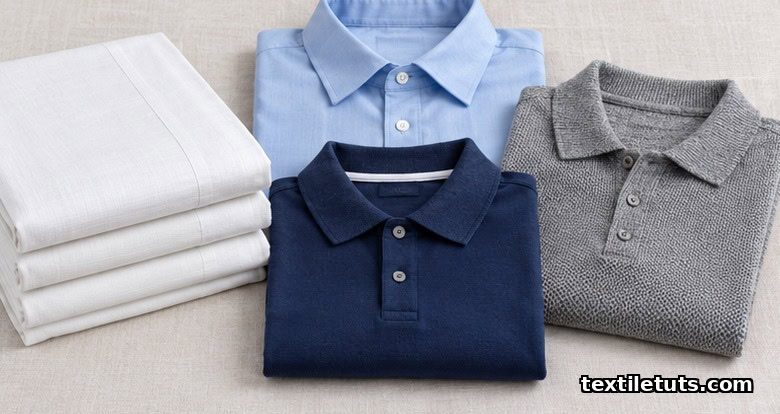
Recent developments include vortex spinning of finer counts, vortex-carded sliver with recycled cotton content, and vortex spinning of synthetic blends for technical textiles. The Vortex platform has continued to expand its market share at the expense of ring spinning in the medium-count woven market.
Competitive Technologies and the Wider Wrapped-Yarn Field
Several manufacturers offer competitive wrapped-yarn systems. Suessen’s Air-Com-Tex uses a similar needle-and-nozzle concept with proprietary air-flow geometry. Rieter’s ComforSpin and various Chinese-developed single-nozzle frames have entered the market. All of them rely on the same fundamental mechanism: a swirling air column that wraps trailing fibers around a parallel core, with mechanical refinements (needle design, jet angle, suction control) tailored to the specific fiber blend.
The Murata Vortex platform remains the dominant design globally, with the largest installed base and the most extensive academic and industrial literature. For yarn buyers and fabric engineers, the practical takeaway is that all wrapped-yarn systems share the same property profile, low hairiness, smooth surface, high abrasion resistance, and lower tenacity than ring yarn of equivalent construction.
Frequently Asked Questions
How is vortex spinning different from air-jet spinning?
Vortex spinning uses a single nozzle with a stationary needle along the centerline, while traditional air-jet (MJS) spinning uses two tandem nozzles without a needle. The needle stabilizes the swirling air flow, allowing tighter wrapper formation and lower yarn liveliness. Vortex yarn is typically 10 to 15 percent stronger than MJS yarn of the same fiber and count.
Is vortex yarn stronger than ring yarn?
No. Ring-spun yarn has higher tenacity than vortex-spun yarn of the same fiber, count, and twist multiplier when measured by ISO 2062. Vortex yarn is generally 10 to 20 percent weaker than ring yarn but 10 to 15 percent stronger than MJS air-jet yarn. The trade-off is high productivity and lower hairiness versus maximum tenacity.
Why is vortex yarn less hairy than ring yarn?
The wrapper fibers in vortex yarn bind the trailing fiber ends tightly around the core, leaving almost no protruding fiber ends. Hairiness counts per ISO 7211-5 are typically 70 to 90 percent lower than ring yarn of the same count. The result is a smooth, clean surface ideal for printing and high-speed weaving.
What counts can vortex spinning produce?
Vortex spinning is most economical from about 10 to 30 tex (Ne 20 to Ne 60) for cotton and cotton-rich blends. Modern MVS designs extend the range in both directions, but vortex yarn is rarely cost-competitive with ring or compact ring systems for very fine counts (above Ne 60) or very coarse counts (below Ne 10).
What standards apply to vortex yarn testing?
Key standards include ISO 2061 (yarn twist), ISO 2060 (linear density), ISO 2062 (single-end tensile strength), ISO 16549 (yarn evenness), and ISO 7211-5 (hairiness). These same standards are used for ring and rotor yarn, allowing direct property comparison across systems.
References
- ISO 2061:2015. Textiles, Determination of twist in yarns, Untwist/retwist method. International Organization for Standardization, Geneva.
- ISO 2062:2009. Textiles, Yarns from packages, Determination of single-end breaking force and elongation at break using constant rate of extension (CRE) tester. International Organization for Standardization, Geneva.
- ISO 2060:1994. Textiles, Yarn from packages, Determination of linear density by the skein method. International Organization for Standardization, Geneva.
- ISO 16549:2004. Textiles, Determination of yarn evenness and approximation of yarn fineness by capacitance method. International Organization for Standardization, Geneva.
- ISO 7211-5:2020. Textiles, Methods for analysis of woven fabrics, Part 5: Determination of number of hairs per unit length. International Organization for Standardization, Geneva.
- Lawrence, C.A. (2003). Fundamentals of Spun Yarn Technology. CRC Press, Boca Raton. ISBN 978-1566768138.
- Murata Machinery, Ltd. (2007). Vortex Spinner, Technical Documentation. Murata Machinery Technical Bulletin, Kyoto.
Editorial by Iftay Khairul Alam, TextileTuts


