
The Air-Jet Spinning Principle

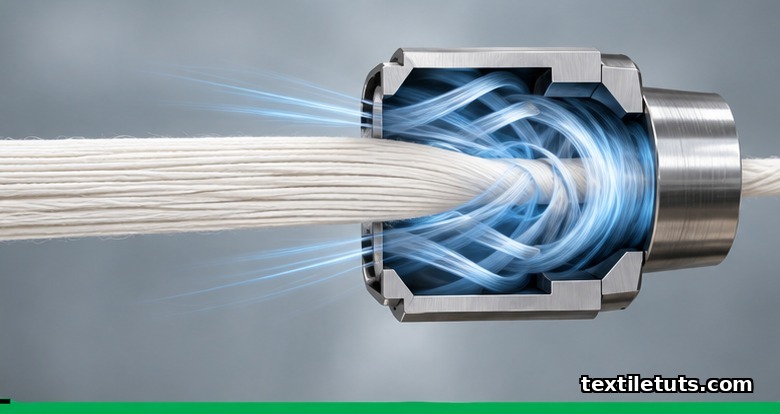
Air-jet spinning is the youngest of the major short-staple spinning systems in commercial use, developed in Japan and introduced commercially by Murata Machinery in the early 1980s as the Murata Jet Spinner (MJS). It inserts twist using vortex air flows rather than mechanical components, which gives it the highest delivery speeds in short-staple yarn production and a distinctive yarn structure that fits specific end uses very well. For mills weighing air-jet against ring or rotor, the comparison comes down to two questions: what does air-jet yarn do that other systems cannot, and what does it give up in the trade.
The Air-Jet Spinning Principle
Air-jet spinning replaces the mechanical twist-insertion zone of a ring or rotor machine with one or more air nozzles. A drafted fiber stream exiting the front drafting rollers is passed through a nozzle where tangential air jets create a swirling flow. The jets twist the trailing fibers around the leading fiber bundle, producing a wrapped core structure. The yarn is then wound onto a package at very high delivery speeds, typically 200 to 450 meters per minute depending on count and machine model.
Because there is no ring, traveler, or rotor in motion, air-jet frames can run at speeds unattainable for ring or rotor frames without the mechanical stress on those components. This is the productivity advantage that drove the early adoption of air-jet technology, especially in coarse-count weaving markets.
Nozzle Design and the Role of the Spinning Nozzle
Modern air-jet machines use one or two nozzles. In the original Murata MJS design, two tandem nozzles were used. The first nozzle (the “twisting nozzle”) rotates the trailing fibers around the leading fibers; the second nozzle stabilizes the yarn structure by re-twisting and setting the wrapper zone. In the Murata Vortex Spinner (MVS), a single nozzle with an inner needle produces the wrapper structure and the yarn is wound directly. Other manufacturers (Suessen, Rieter, Truetzschler) have their own single- and twin-nozzle variants, but the physics is similar.
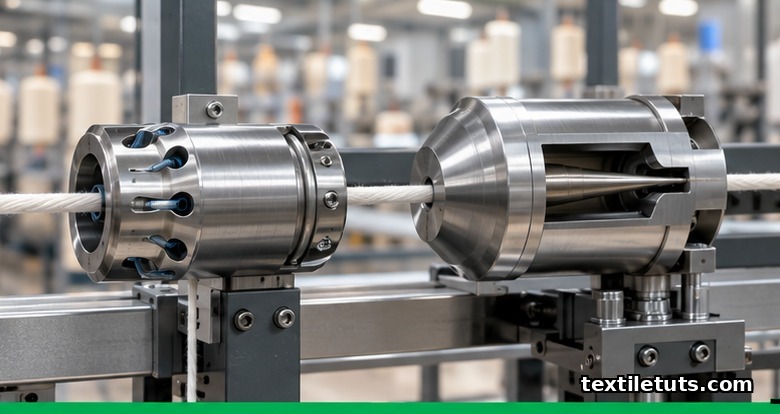
Nozzle geometry controls the rate of twist insertion and the level of wrapper-fiber formation. Higher nozzle pressure increases the proportion of wrapper fibers and tightens the helix, but there is a plateau: above a certain pressure, the trailing fiber ends break rather than wrapping cleanly, which degrades yarn strength. This trade-off is documented in the academic literature on nozzle parameters and yarn quality.
Fiber Drafting and Sliver Preparation
Air-jet spinning is unusual among modern systems in that sliver quality is the most critical upstream variable. The drafting system is a conventional three- or four-roller apron drafting arrangement similar to ring spinning, but the fiber separation achieved at the front rollers is more demanding. Because the wrapper structure depends on having enough trailing fiber ends to wrap the core, longer fibers and well-prepared sliver consistently outperform short-fiber or poorly carded stock on air-jet machines.
Most air-jet mills comb the sliver before spinning and many use additional compacting or humidification to maximize fiber control at the nip. The practical consequence: air-jet yarn quality is highly sensitive to fiber length, length uniformity, and trash content, far more so than rotor spinning, which can blend or partially compensate for variation through the opening roller.
Yarn Structure: The Wrapped Core
Air-jet yarn has a distinctive two-zone structure similar in spirit to rotor yarn but formed by entirely different mechanics. The yarn consists of a parallel core of straight, untwisted fibers held together by wrapper fibers wound helically around the core. The wrappers are short trailing ends of fibers that were caught by the air vortex and wrapped around the core bundle. The wrapper helix angle is very high, wrapper fibers typically lie nearly perpendicular to the yarn axis in coarse-count air-jet yarn.
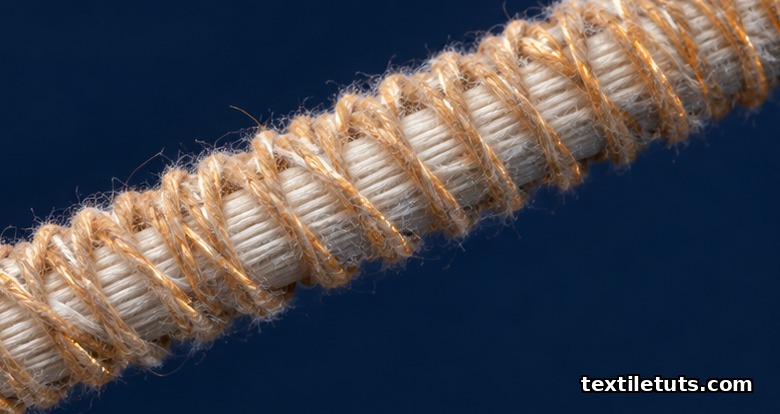
This structure is documented in the literature using tracer fiber techniques and cross-section microscopy. The high wrapper helix is what gives air-jet yarn its characteristic smooth surface, low hairiness, and high abrasion resistance, and it is also the reason air-jet yarn has lower tenacity than ring yarn of the same fiber and count: the core fibers lie parallel rather than helically twisted, so they slip past each other more easily under tensile load.
Properties Compared to Ring and Rotor Yarn
Tenacity and elongation
Ring yarn has the highest tenacity of the three systems. Air-jet yarn is typically 15 to 30 percent weaker in tenacity than ring yarn of the same fiber, count, and twist multiplier, when measured per ISO 2062 (single-end breaking force and elongation at break using constant rate of extension). However, air-jet yarn shows higher elongation at break than rotor yarn, especially in fine counts.
Evenness and imperfections
Air-jet yarn has excellent evenness, typically approaching or matching ring yarn, when tested per ISO 16549 on a capacitance evenness tester. Imperfection counts (thick places, thin places, neps) are usually lower than ring and competitive with rotor yarn, because the air vortex sheds short fibers and trash into the suction channel.
Hairiness
Air-jet yarn is among the least hairy short-staple yarns produced. The wrapper zone tucks in any stray fiber ends, and ISO 7211-5 hairiness measurements routinely show air-jet yarn with 70 to 90 percent lower hairiness counts than ring yarn of the same count. This makes it attractive for woven warp sizing efficiency and for smooth printing surfaces.
Abrasion and pilling
The tight wrapper gives air-jet yarn excellent abrasion resistance, and fabrics made from it pill less than ring-spun equivalents. This is the reason air-jet yarn became the standard for sheeting, workwear, and printed apparel.
Count Range, Speeds, and Productivity
Air-jet yarn is most economical in the coarse to medium count range, typically 10 to 30 tex (Ne 20 to Ne 60) for cotton and cotton-rich blends, though modern machines can run finer. Delivery speeds of 300 to 450 m/min per delivery are standard, and the absence of mechanical wear parts in the twist zone means higher uptime and lower maintenance than ring frames.
For mills with high labor or energy costs, the productivity advantage is significant. Air-jet machines are also cleaner: no oil from ring lubrication and no fly from the rotor groove, which improves the working environment in humidified spinning rooms.
Applications and End Uses
Air-jet yarn is widely used in woven shirting, sheetings, workwear, printed fabrics, quilt covers, and dress goods where surface smoothness, low pilling, and high abrasion resistance matter more than maximum tenacity. It is also the system of choice for fine-count polyester-cotton blends used in medical and hygiene nonwoven precursors where uniformity is paramount.
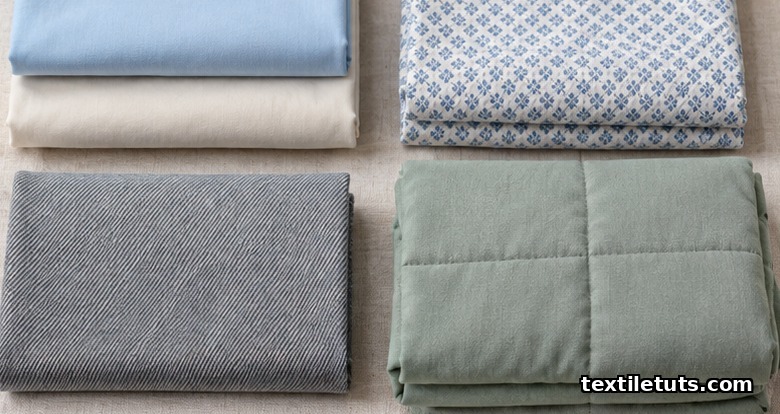
Air-jet yarn is generally not used where ring-yarn tenacity is essential, such as sewing thread, fine combed yarn, or warp yarns that must withstand high loom tensions. It is, however, a strong match for fabrics where surface and aesthetics, not raw strength, are the qualifying specification.
Frequently Asked Questions
How does air-jet spinning insert twist without a mechanical component?
Air-jet spinning inserts twist using high-velocity tangential air jets inside one or more nozzles. The swirling air flow rotates the trailing ends of fibers around the leading fiber core, creating a wrapped yarn structure without any ring, traveler, or rotor. Delivery speeds of 300 to 450 m/min are typical.
Is air-jet yarn stronger than ring yarn?
No. Ring-spun yarn is generally stronger than air-jet yarn of the same fiber, count, and twist multiplier, typically by 15 to 30 percent when measured by ISO 2062 single-end tensile testing. Air-jet yarn trades some tenacity for higher productivity, smoother surface, and lower hairiness.
Why is air-jet yarn less hairy than ring yarn?
The high-velocity air vortex wraps the trailing fiber ends tightly around the yarn core, leaving few free fiber ends on the surface. Hairiness counts per ISO 7211-5 are typically 70 to 90 percent lower for air-jet yarn compared to ring yarn of the same count.
What counts can air-jet spinning produce?
Air-jet spinning is most economical in the coarse to medium range, around 10 to 30 tex (Ne 20 to Ne 60) for cotton and cotton blends. Modern twin-nozzle designs can spin finer counts but at reduced speeds. Fine-count air-jet yarn is rarely cost-competitive with ring or compact ring systems.
What standards apply to air-jet yarn testing?
Key standards include ISO 2061 (yarn twist), ISO 2060 (yarn linear density), ISO 2062 (single-end tensile properties), ISO 16549 (yarn evenness), and ISO 7211-5 (hairiness). Together they provide the comparable property set used to qualify air-jet yarn against ring and rotor alternatives.
References
- ISO 2061:2015. Textiles, Determination of twist in yarns, Untwist/retwist method. International Organization for Standardization, Geneva.
- ISO 2062:2009. Textiles, Yarns from packages, Determination of single-end breaking force and elongation at break using constant rate of extension (CRE) tester. International Organization for Standardization, Geneva.
- ISO 2060:1994. Textiles, Yarn from packages, Determination of linear density by the skein method. International Organization for Standardization, Geneva.
- ISO 16549:2004. Textiles, Determination of yarn evenness and approximation of yarn fineness by capacitance method. International Organization for Standardization, Geneva.
- ISO 7211-5:2020. Textiles, Methods for analysis of woven fabrics, Part 5: Determination of number of hairs per unit length. International Organization for Standardization, Geneva.
- Lawrence, C.A. (2003). Fundamentals of Spun Yarn Technology. CRC Press, Boca Raton. ISBN 978-1566768138.
- Cheng, K.P.S., and Yu, C. (2001). “Relationship between Air-Jet Spun Yarn Properties and Nozzle Pressure,” Textile Research Journal, 71(4), 301-307. DOI: 10.1177/004051750107100405.
Editorial by Iftay Khairul Alam, TextileTuts


